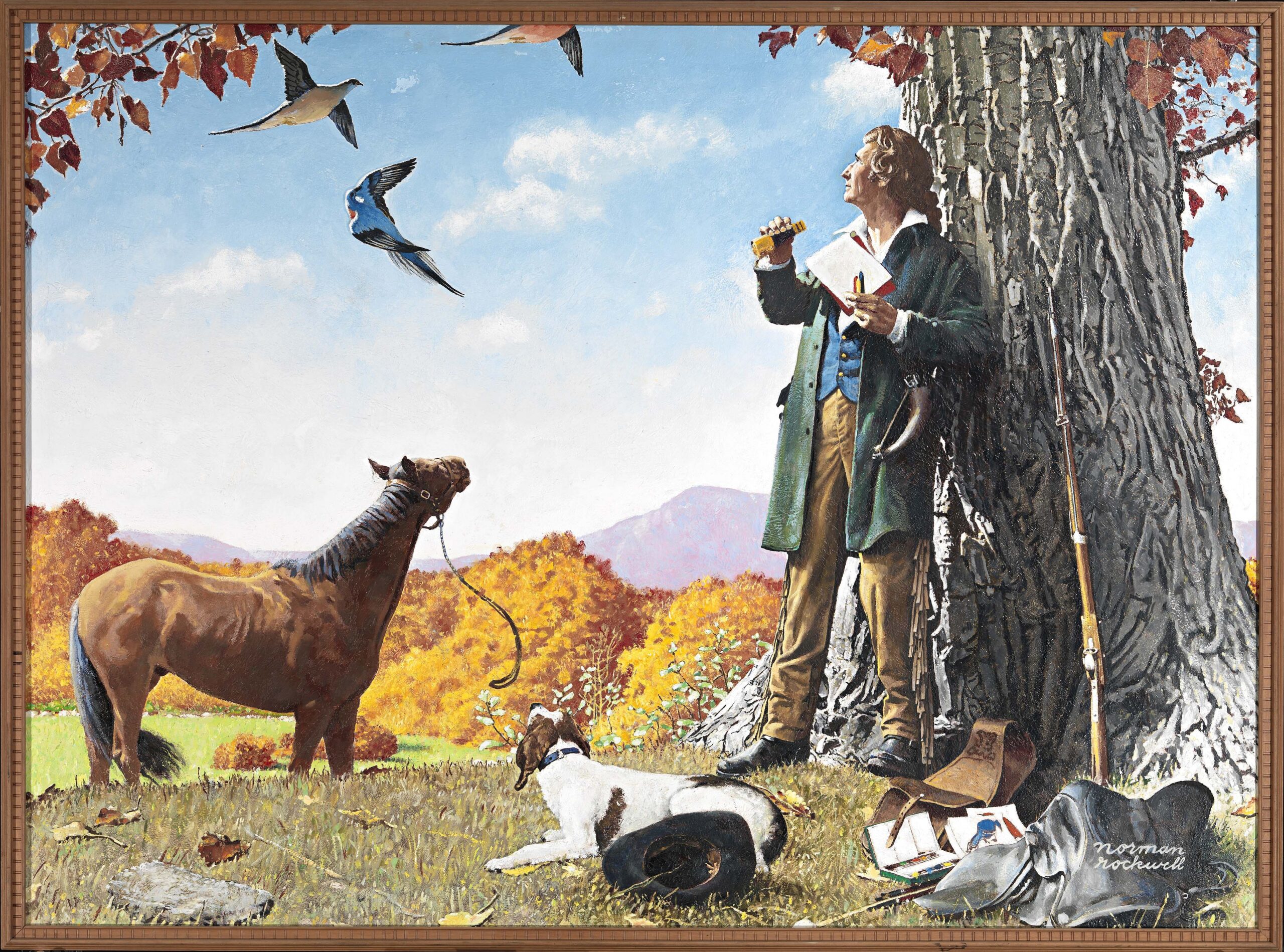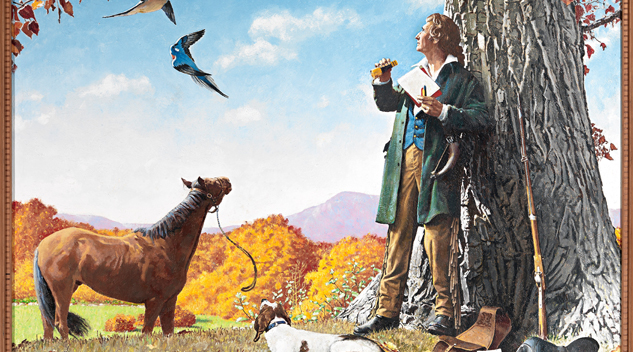
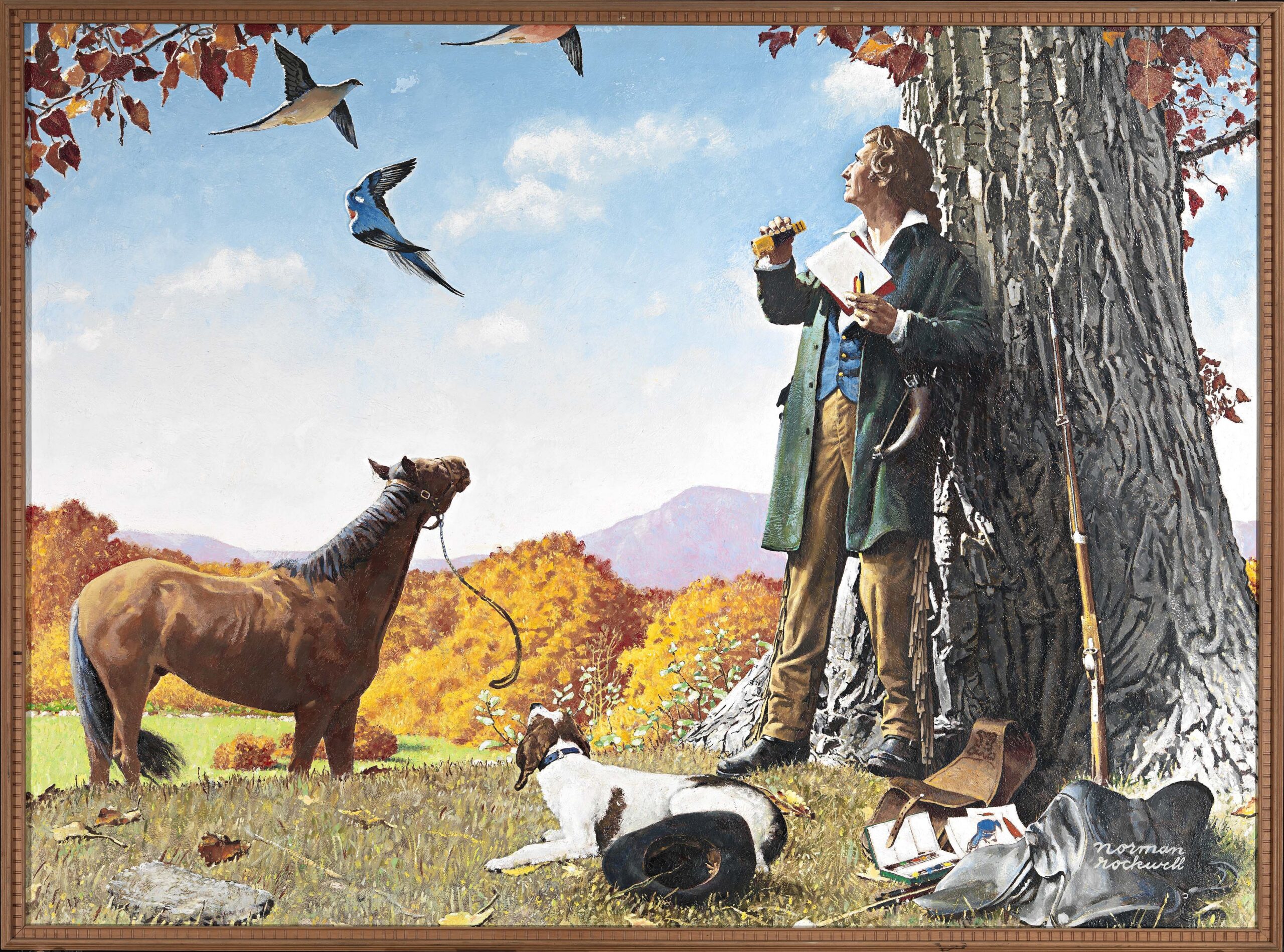
“Audubon Observing the Passenger Pigeon” by Norman Rockwell (1894-1978), 1971, oil on canvas, story illustration for “Audubon Observing the Passenger Pigeon” by Jack Shepherd, Look, October 19, 1971. The National Museum of Natural History, Smithsonian Institution, Washington, DC. Licensed by Norman Rockwell Family Agency. All rights reserved.
By Liz Goldner
STOCKBRIDGE, MASS. — A dramatic painting in “American Stories: From Rockwell to Revolution” is “The Great Falls” (2013) by Stephen Hannock. The 20-foot-wide cinematic-styled landscape evokes the Nineteenth Century Hudson River School of painting. Through many layers of paint, meticulously applied to the canvas, the work expresses the vistas, gushing water and luminous atmosphere of Niagara Falls in the late afternoon. As a significant artwork in this semiquincentennial exhibition, it is one of 250 items on view at the Norman Rockwell Museum through October 26. Included are textiles, ceramics, paintings, prints, drawings, books and digital media.
The art and artifacts displayed explore the history, sweep and scope of Americana while illuminating “a bold vision to create a nation governed of, by and for the people, seeking human rights and freedom for all,” said Laurie Norton Moffatt, Norman Rockwell Museum director and CEO. The curators explain that the exhibition focuses on “the power of the image to express our aspirations, argue for social change, educate and entertain the populace and bring light to dark moments.” The artworks are from the museum’s extensive holdings of Rockwell paintings and other fine art pieces and objects, along with loans from major institutions and private collections nationwide.
“American Stories” fills up the museum’s entire main floor, affording visitors the opportunity to view its legendary art as soon as they enter the front doors. Its nine galleries, also referred to as chapters, address our country’s history, challenges and victories. They inform us of how imagery has been used to assert identity, deal with power and call attention to marginalized people. The historic and contemporary works reflect the curators’ convictions that familiar symbols such as our flag, the bald eagle and the Statue of Liberty convey our country’s ideals of freedom, unity and democracy. Archival objects on the museum’s lower level include Rockwell’s sketches of presidents, documents lauding his work and his 1977 Presidential Medal of Freedom. “This is the first time in quite a while that we’ve had an exhibition take up the entire museum,” explained Russell Lord, the museum’s chief of curatorial affairs, who curated the show.
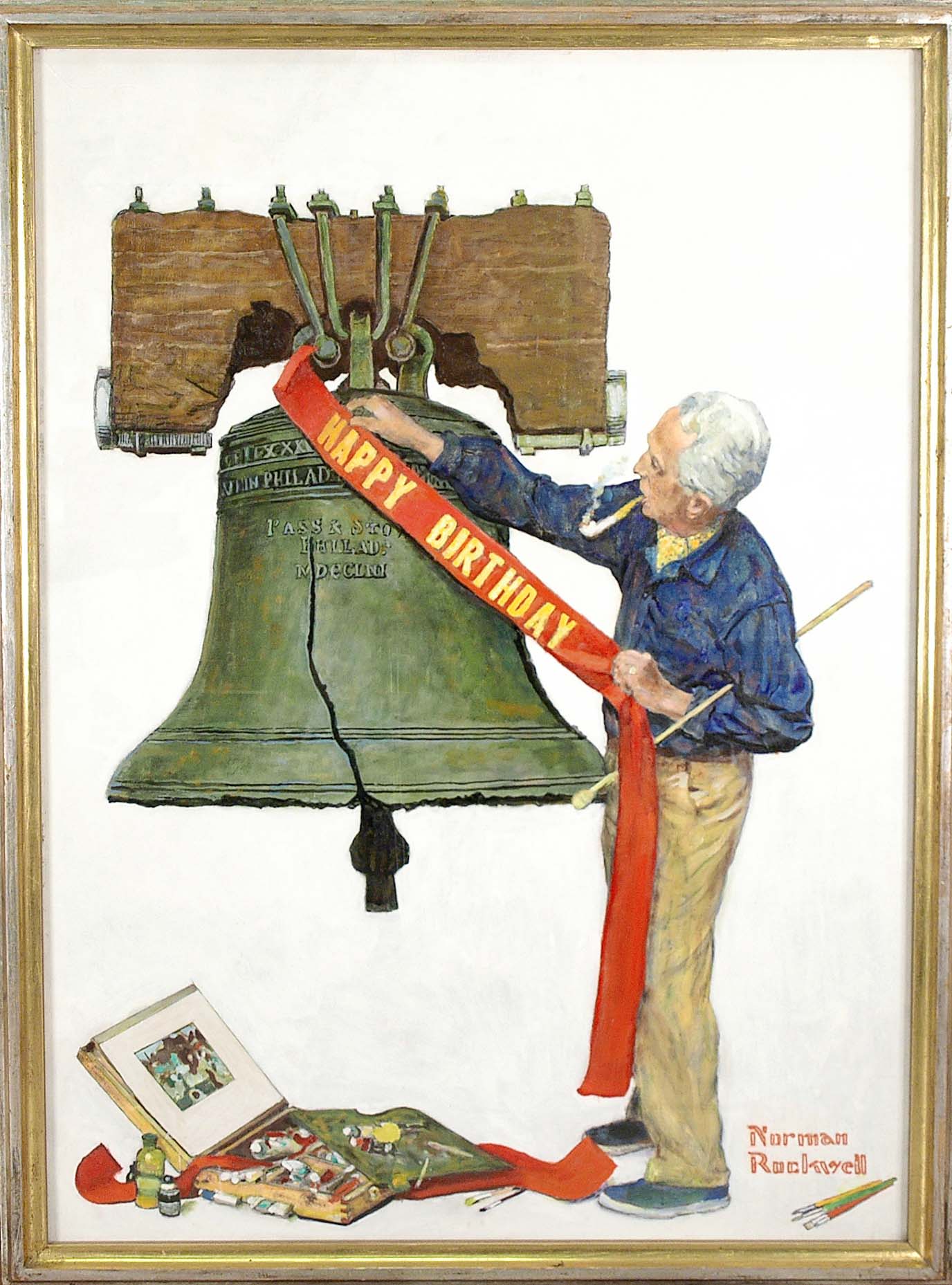
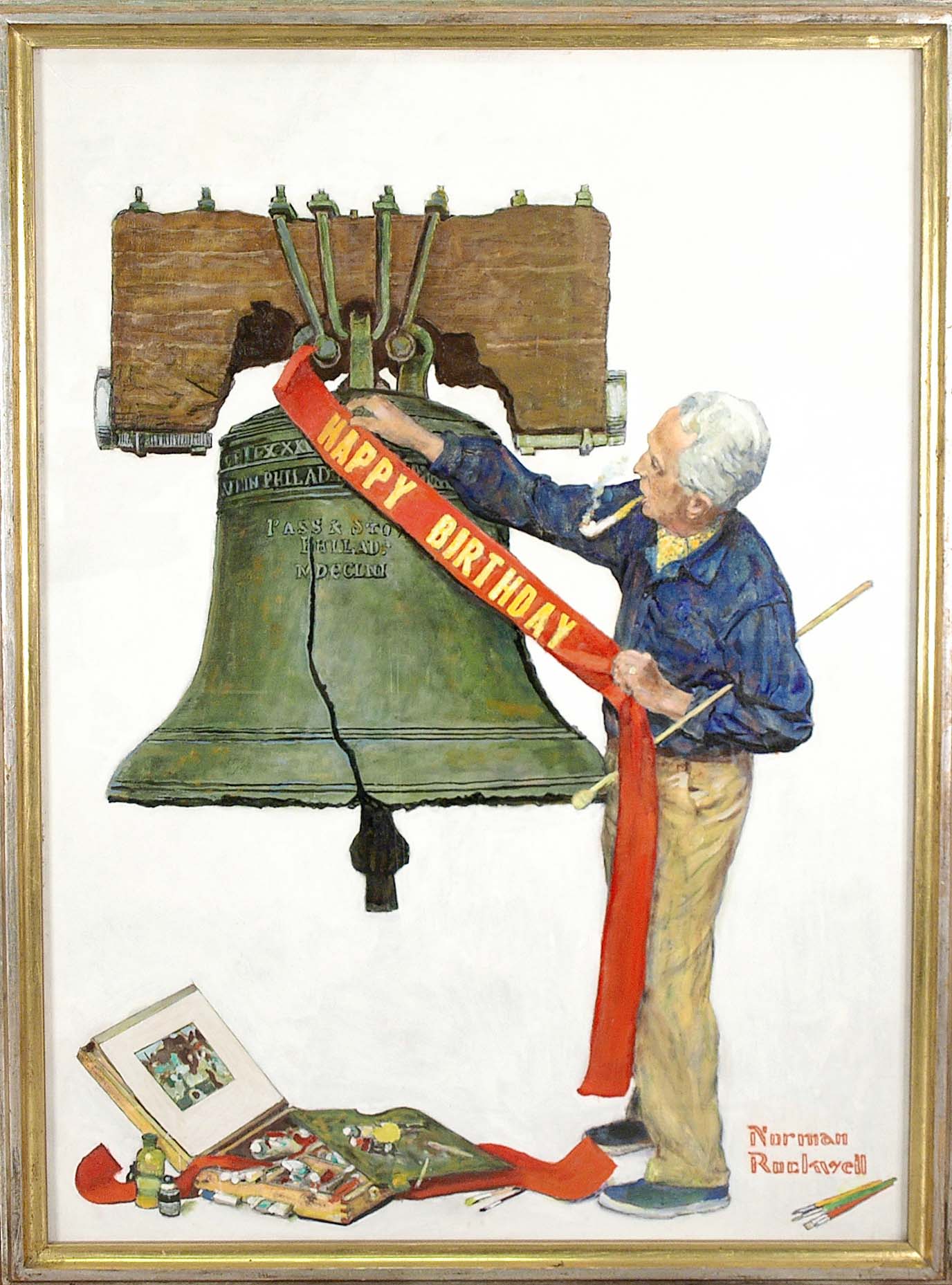
“Liberty Bell (Celebration)” by Norman Rockwell (1894-1978), 1976, oil on canvas, cover illustration for American Artist. Norman Rockwell Museum Collection, NRM.1988.01. Licensed by the Norman Rockwell Family Agency. All Rights Reserved.
He added that while art over the centuries contains political social and racial perspectives, “American Stories” explores how artists have been relating the evolving story of our country for more than 200 years.
The exhibition details major themes in our diversified nation. One gallery explores our country’s origins. Another highlights collective memories of places we have lived in and visited. Other sections look at immigration, industry and innovation, our relationship with the environment, social justice and equal rights. A popular gallery displays wartime posters. The show’s overall outlook is based on the spirit of Rockwell’s renowned 1943 “The Four Freedoms” series: Freedom of Speech, of Worship, from Want and from Fear, Lord explained.
The “Representing Origins” gallery, displaying artwork created during the American Revolution, includes detailed engravings of Colonial scenes. An example is “The Boston Massacre, 1770, (or, The Bloody Massacre perpetrated in King Street, Boston, on March 5, 1770 by a party of the 29th Regiment)” by Paul Revere. Another is “A view of the town of Concord” (1775) by Amos Doolittle.
The gallery also presents a variety of Statue of Liberty images. “By altering her posture, expression or surroundings, artists recast her as weary, defiant or contemplative, reflecting public sentiment in moments of crisis and change,” the labels explain. “Her raised torch symbolizes both enlightenment and a standard by which justice is measured.”
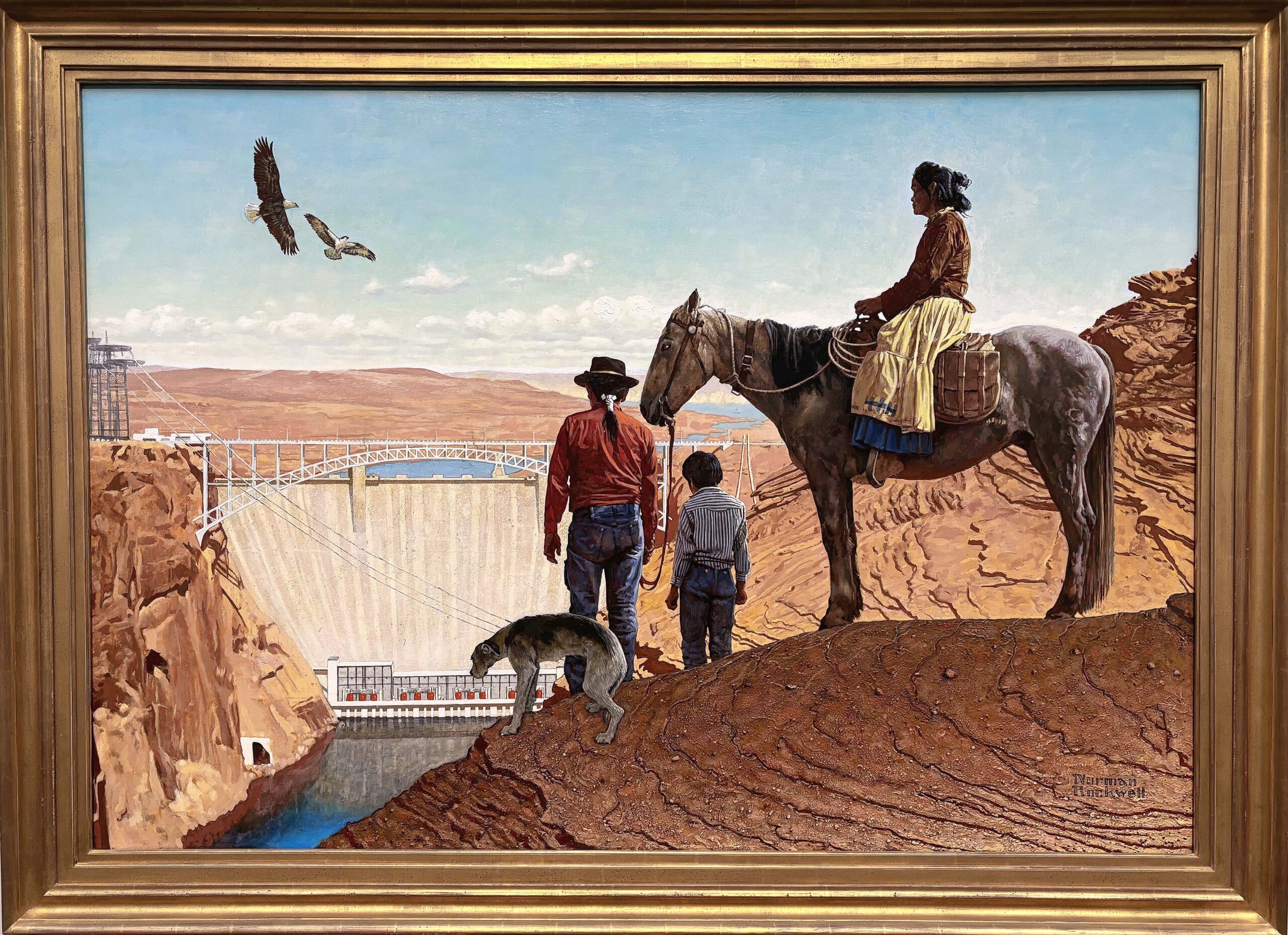
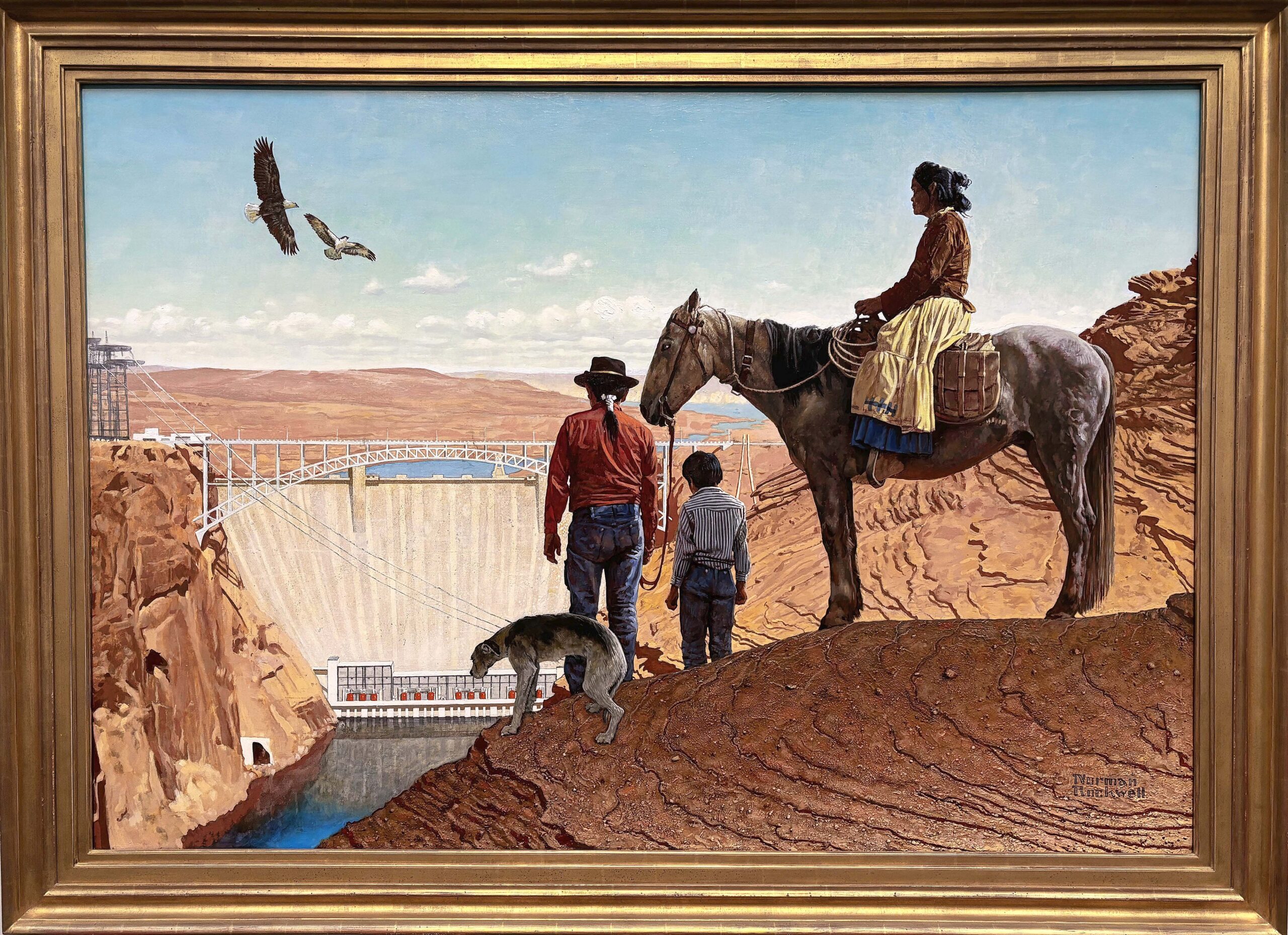
“Glen Canyon Dam” by Norman Rockwell (1894-1978), 1969, oil on canvas. Commission and © U.S. Department of the Interior, Bureau of Reclamation Collection.
William Steig’s 1978 “Lady Liberty,” a compelling New Yorker drawing, observes Independence Day with a woman dressed as Liberty, holding an American flag, surrounded by a barn and grazing cows. Tim O’Brien’s contrasting “Go Back Where You Came From” (2019) illustrates the statue from the rear, her flowing robes in the New York Harbor, waving goodbye to immigrants. With Liberty separated from her Island and from Emma Lazarus’ 1883 poem “The New Colossus,” which is engraved on her pedestal, offering refuge to the “huddled masses,” she is a symbol of our country during difficult times.
“Liberty Bell” (1976), a self-portrait by Rockwell, pictures the artist placing a “Happy Birthday” banner onto the bell, honoring our country’s bicentennial. He created the painting to commemorate the birthday of the country he had drawn and painted throughout his life.
The “Sense of Place” gallery contains several works paying tribute to Niagara Falls. These include early illustrations of its Indigenous ownership, those celebrating its natural grandeur and the Falls as a source of hydroelectric power. Stephen Hannock’s “The Great Falls,” described above, captures its spirit while extolling our majestic American landscape.
The “Coming to America” didactics explain that our country “has been shaped by successive and overlapping waves of migration: European settlement in the Seventeenth and Eighteenth Centuries; the forced migration and enslavement of Africans through the transatlantic slave trade; and later arrivals from Ireland, Germany and Southern and Eastern Europe.”
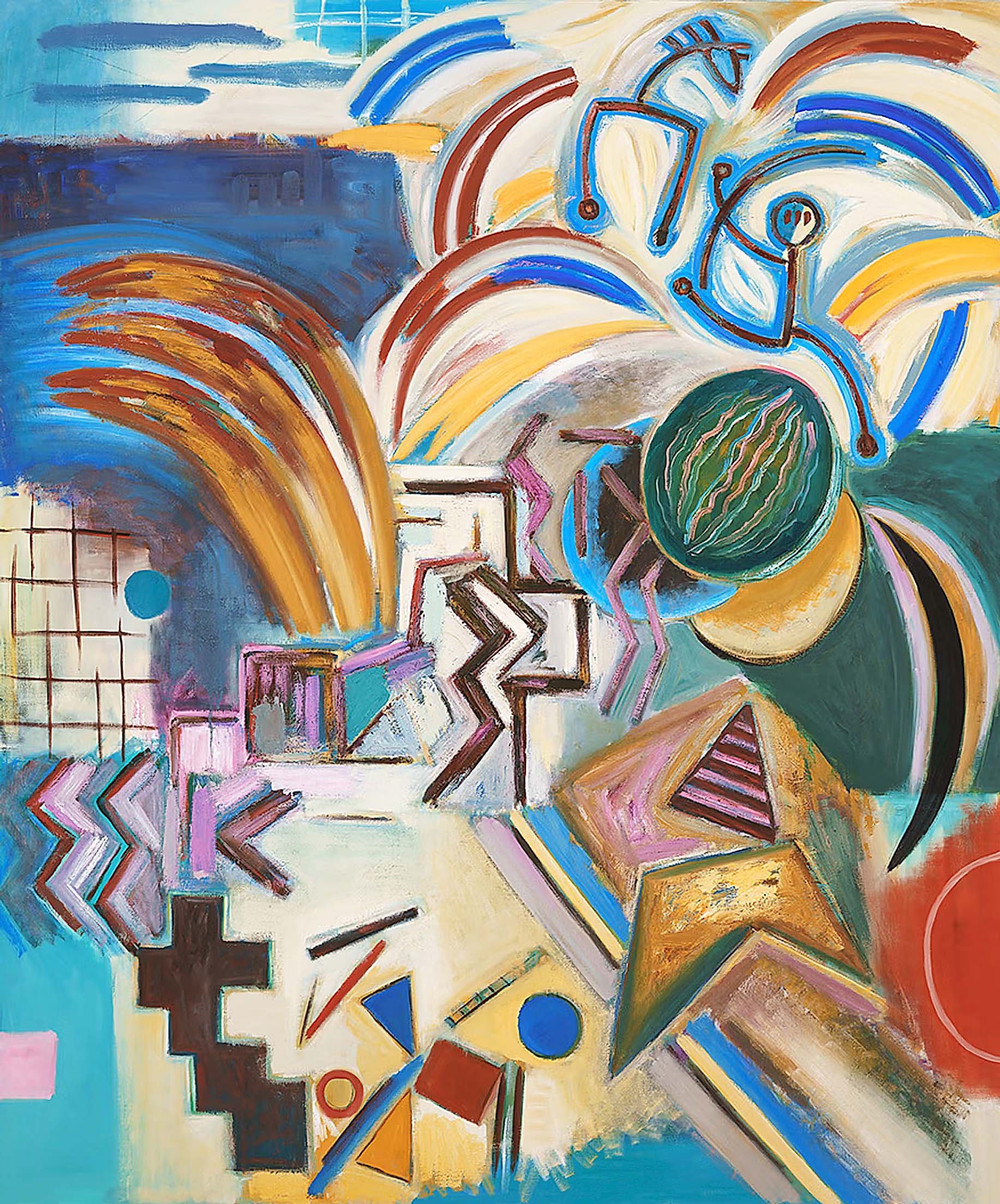
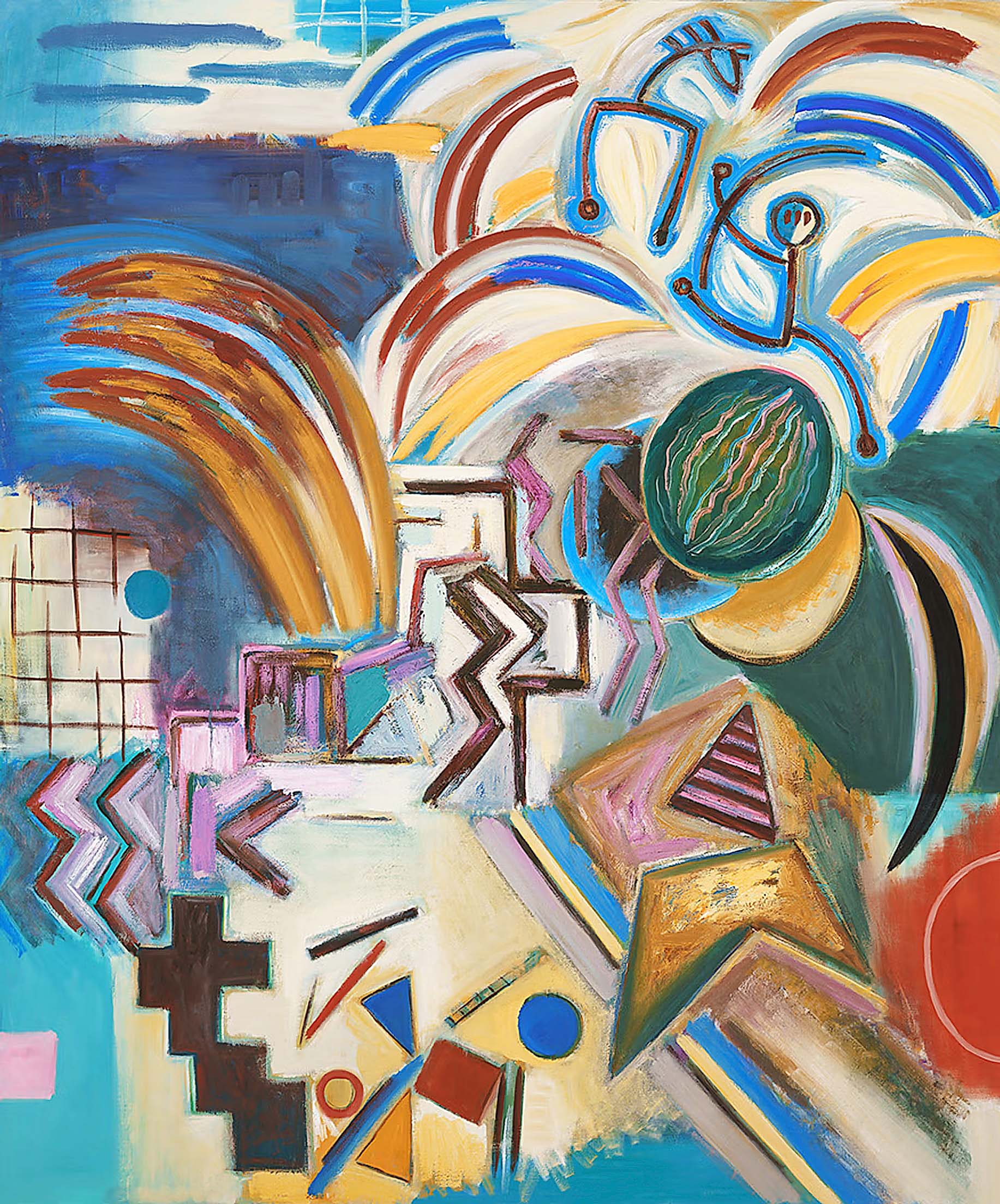
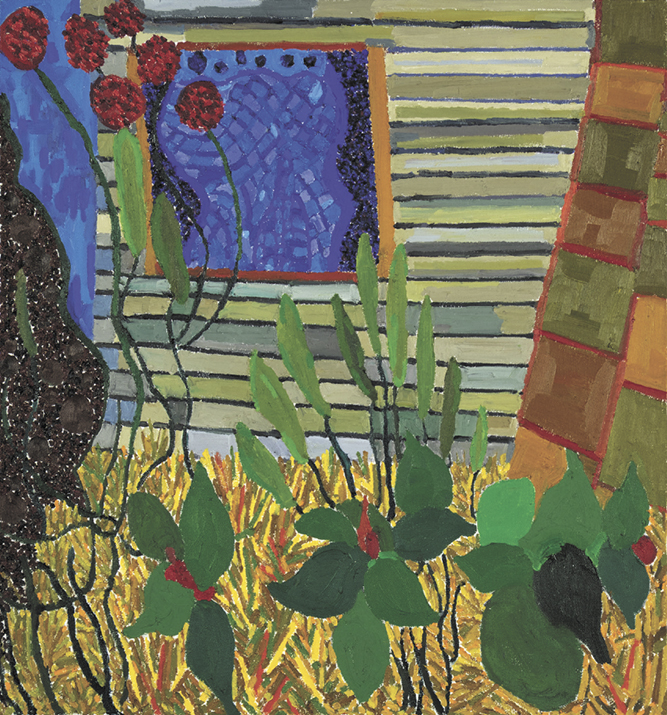
“Playground” by Jaune Quick-to-See Smith (American, 1940-2025), 1987, oil on canvas. Art Bridges, © Jaune Quick-to-See Smith.
A dramatic painting in the “Social Justice and Equal Rights” gallery is Rockwell’s “Golden Rule” (1961). Featuring a tightly knit group of people representing different religions, races and ethnicities standing harmoniously together, it contains the words, “Do unto others as you would have them do unto you.”
A different perspective is conveyed in Jerry Pinkney’s “Again, She Lit Another” (1999), an illustration for The Little Match Girl by Hans Christian Anderson. The original story is set in Europe, yet this painting — about a homeless girl who dies during a freezing night — occurs in the slums of New York. The heart-rending artwork reveals how desperate lives can be when social justice is ignored.
The “Service and Sacrifice” section includes several wartime posters. James Montgomery Flagg’s “I Want You for U.S. Army” (1917), featuring Uncle Sam pointing his finger at us, was reproduced more than four million times during World War I.
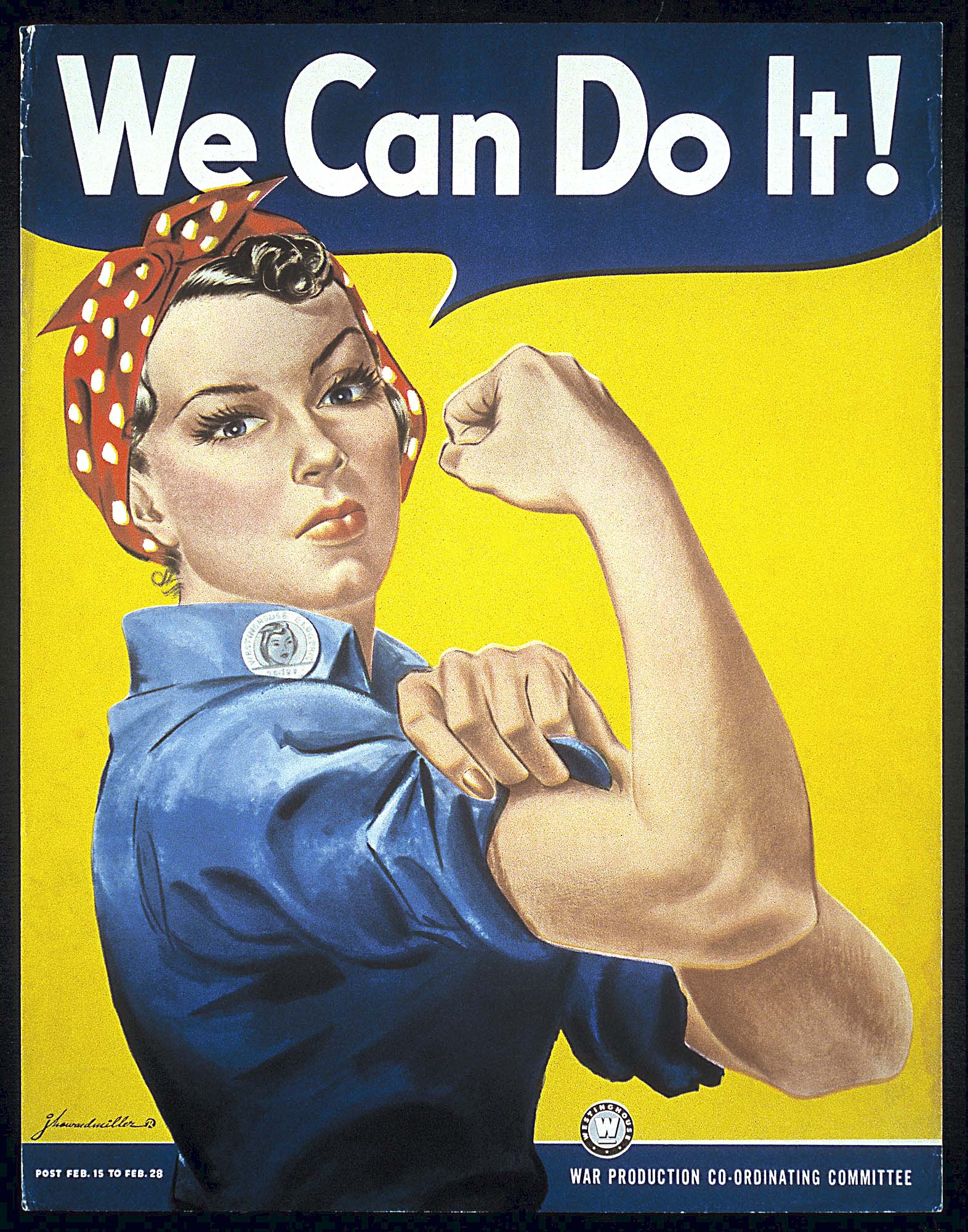
J. Howard Miller’s 1942 poster “We Can Do It!,” of a determined woman flexing her muscles, was originally created for Westinghouse Electric Company to inspire female workers during World War II. The image became well-known during the 1980s when it was appropriated by feminist movements, as it conveys the empowerment of women in the workforce and beyond.
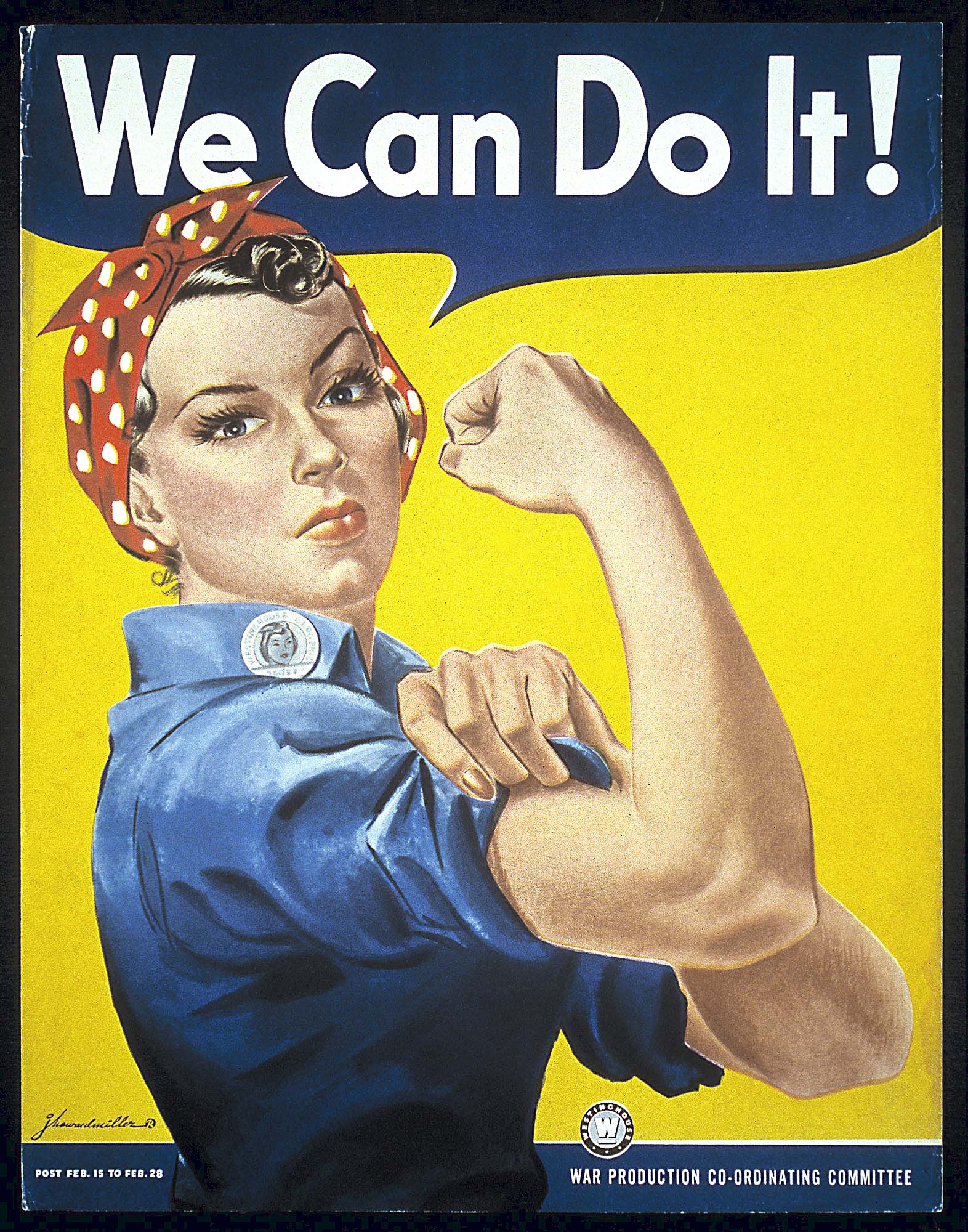
“We Can Do It!” by J. Howard Miller, 1942, photo lithograph on paper, illustration for Westinghouse Electric & Manufacturing Company.
Several other works by Rockwell in his finely wrought realistic style express his compassion and reverence for democracy, service and integrity. His Saturday Evening Post cover “Thanksgiving” (1943) features a young homeless woman wearing an Army coat in war-torn Italy, warming up food in the chilly outdoors, as she folds her hands in thanks over her meager meal. The drawing expresses the angst created by poverty.
In the “Down to Earth” gallery, Rockwell’s 1969 “Glen Canyon Dam” illustrates the Arizona dam that damaged the Colorado River’s ecosystem, altering the Navajo landscape as well as its farming and herding capabilities. In this Western-style painting, the artist included an Indigenous family observing the project’s deleterious impact on their people.
In the “American Myths, The Image as Story” section, Rockwell’s illustrations of “Tom Sawyer” (1936), for the book of the same name, and “Ichabod Crane” (1937), for Washington Irving’s 1820 classic, The Legend of Sleepy Hollow, are included. Graphics by Munroe Leaf, Rockwell Kent and other artists are also included in this section.
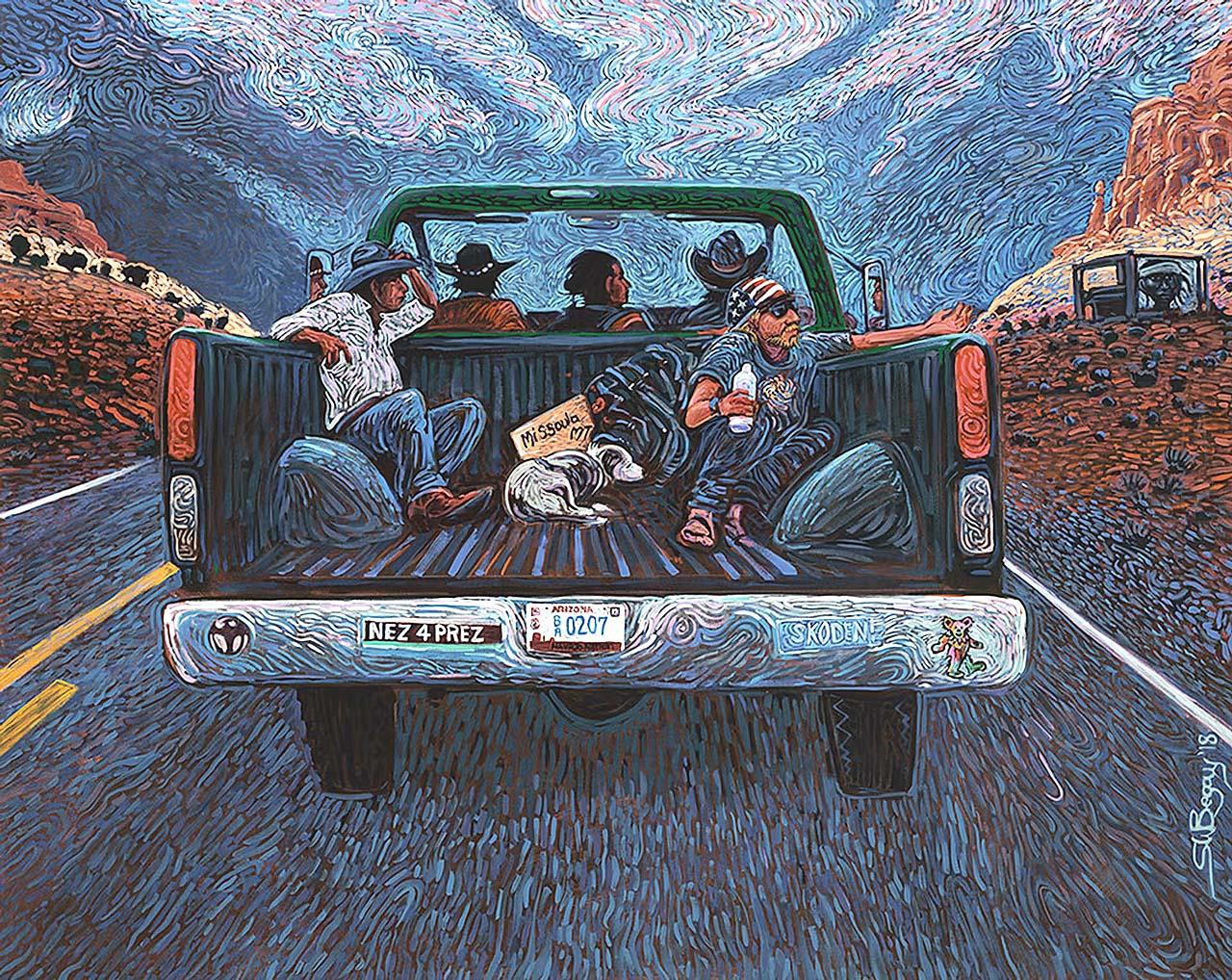
Other artworks in this exhibition deserve special mention. Shonto Begay’s “Navajo Blue Highway” (2018) focuses on a pickup truck carrying five Native American men and a dog, likely commuting from fields that could be in Gallup, Phoenix or Albuquerque, N.M., back to their homes after a long day of working on the land. The painting’s thick impasto brushwork, evoking the look of Vincent van Gogh’s nighttime paintings, conveys the intensity and determination of the Navajo people to survive and thrive.
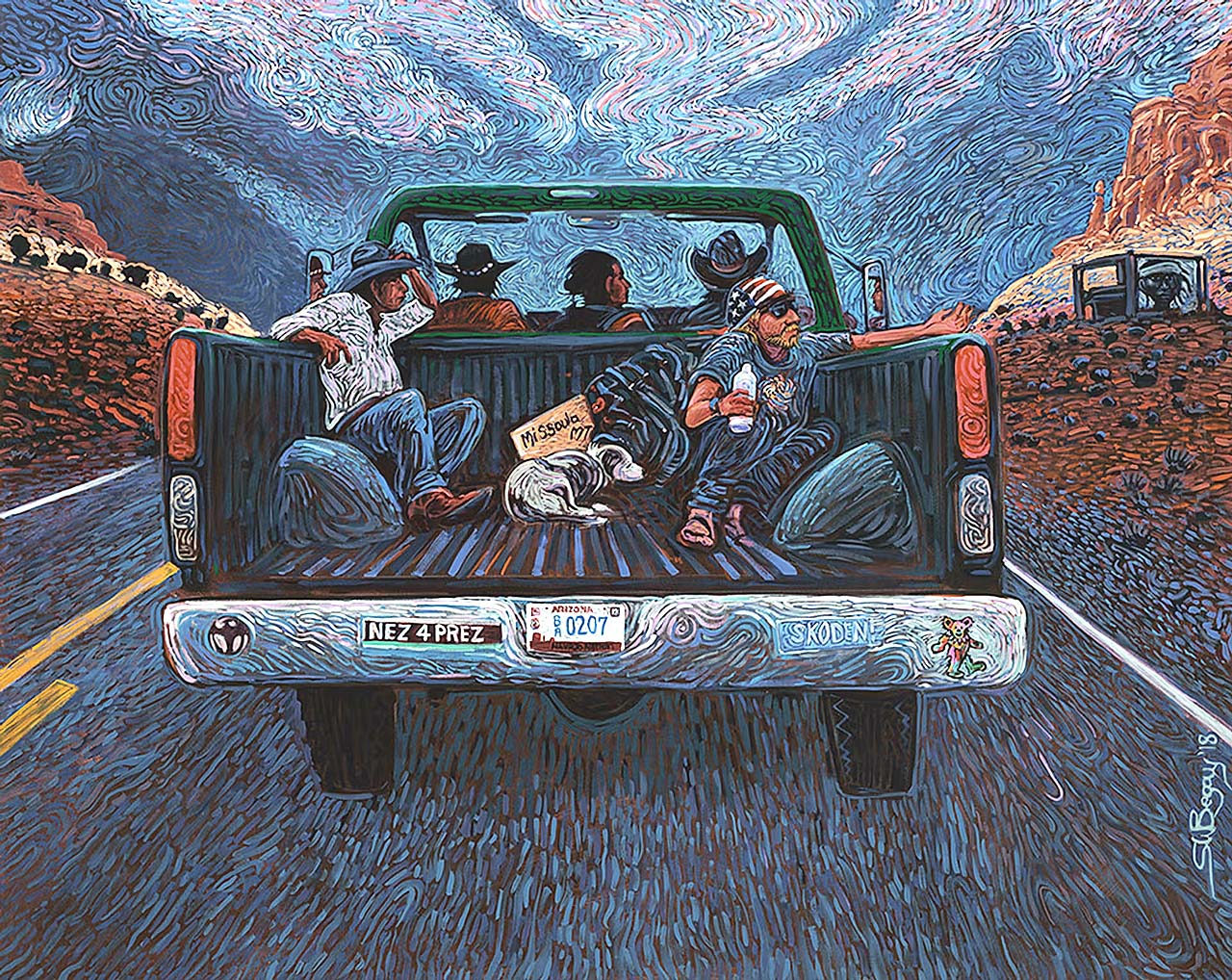
“Navajo Blue Highway” by Shonto Begay (American, b 1954), 2018, acrylic on canvas, Art Bridges. © Shonto Begay.
Navajo artist Susan Hudson’s semi-abstract quilt titled, “The Tree of Many Colors” (2020) expresses the diversity of her Native ancestors and contemporaries. The award-winning artist learned quilting from her mother, who was forcibly taught the craft in a government-funded Indian boarding school in the early Twentieth Century. Hudson symbolically sews into the quilt the hardships and strengths of her ancestors.
As we approach our nation’s 250th birthday, “American Stories” presents an expansive, thought-provoking perspective on the American experience and our democracy, with works selected to stimulate, educate and inspire us.
The Norman Rockwell Museum is at 9 Glendale Road. For information, www.nrm.org or 413-298-4100.