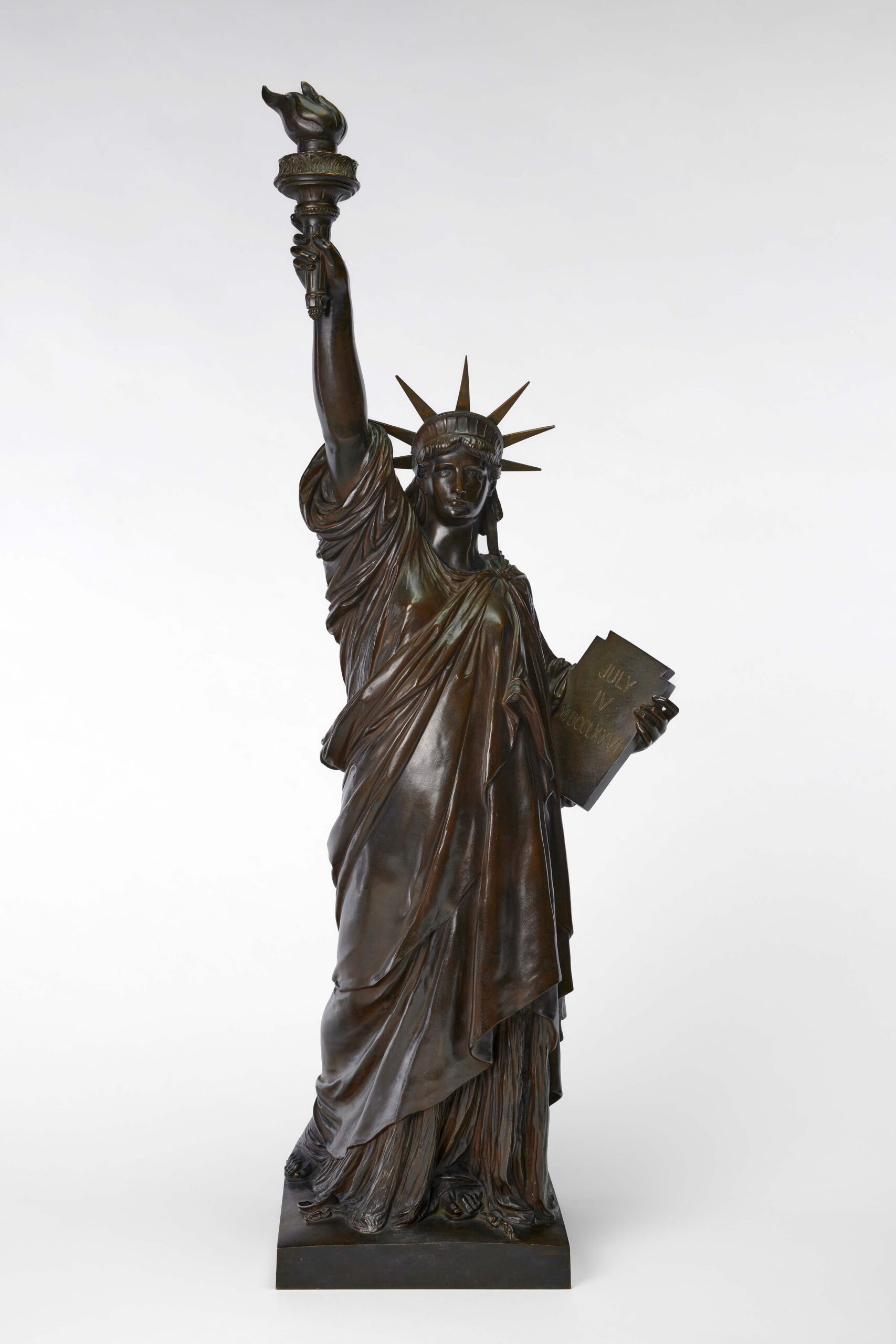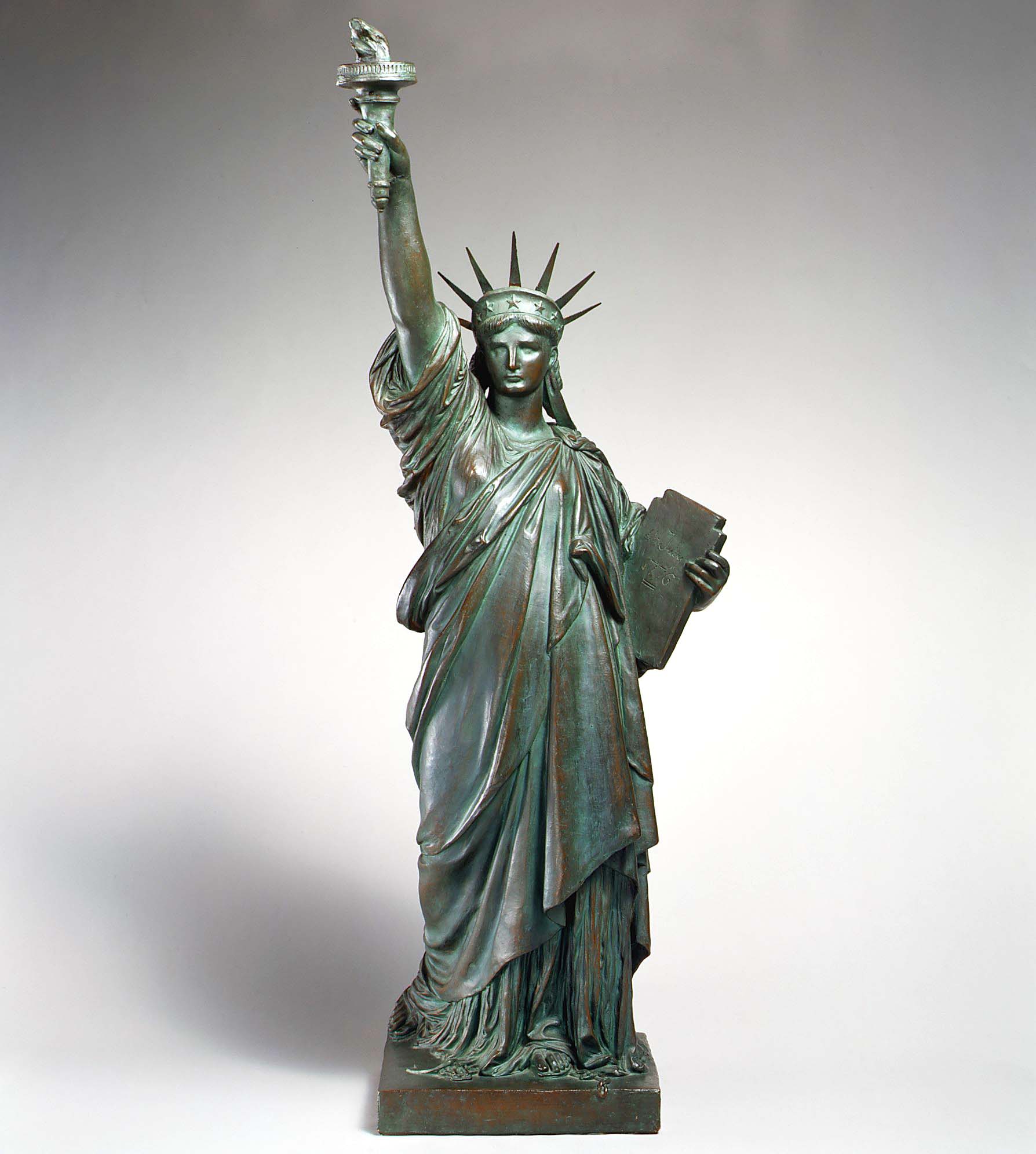
“Liberty” by Frédéric Auguste Bartholdi (1834-1904) 1875, bronzed terracotta. The Metropolitan Museum of Art, gift of Julia Neville Adams Aubry (Mrs Charles Georges Aubry), in memory of Jules Weber and his grandson, Charles George Aubry, 1999.
By Kay Koeninger
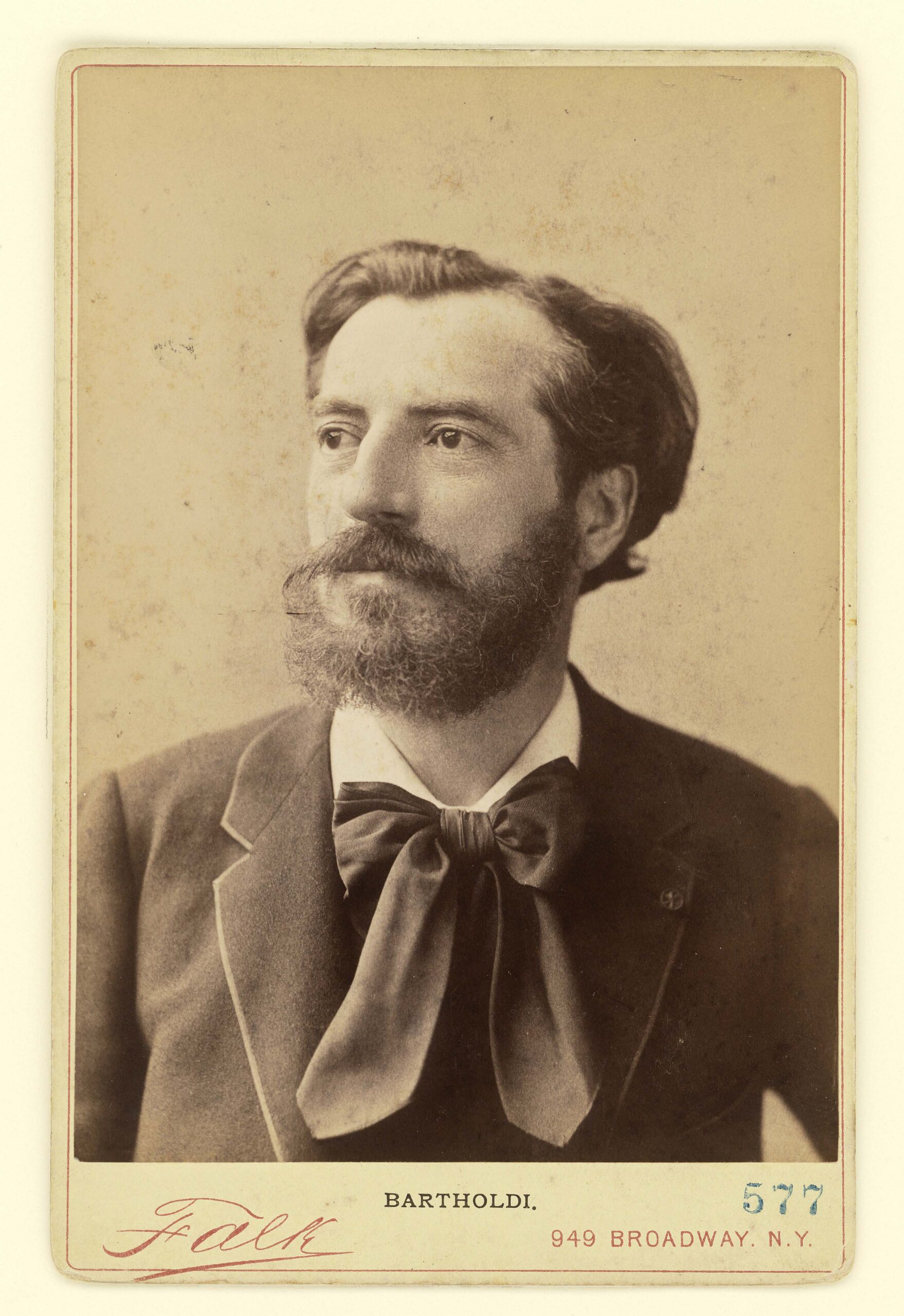
FORT WORTH, TEXAS — It is safe to say that French artist Frédéric Auguste Bartholdi ’s Statue of Liberty, dedicated in 1886, is the most recognizable sculpture in American art. And, fittingly in a year celebrating the 250th birthday of the United States, it is the subject of a new exhibition, “The Statue of Liberty from Bartholdi to Warhol,” on view at the Amon Carter Museum of American Art from August 15 to January 3.
The exhibition not only shows preparatory art for the sculpture but how it has inspired numerous other works of art from the time of its unveiling to the present. It includes notable works from the Amon Carter collection in addition to loans from across the United States. Though he is now deputy director and head of art and exhibitions at Maine’s Portland Museum of Art, Andrew Eschelbacher, who organized the exhibition while an Amon Carter curator, said “the concept for the exhibition followed shortly after the Carter’s acquisition of an important cast of the Statue of Liberty. In the process of adding that work to our collection, we thought a lot about the position of the monument as something that functions as a type of avatar of the United States, and as a statue that is so familiar its history has actually become obscured by its role in popular culture.”
“Lady Liberty” she may be, but the exhibition demonstrates that “Lady Shape Shifter” is also an appropriate moniker for this monumental sculpture. Depending on the artist and the historical context, works with a Statue of Liberty focus express a wide range of views not only about the sculpture as a work of art but also about fundamental definitions of the United States and liberty itself.
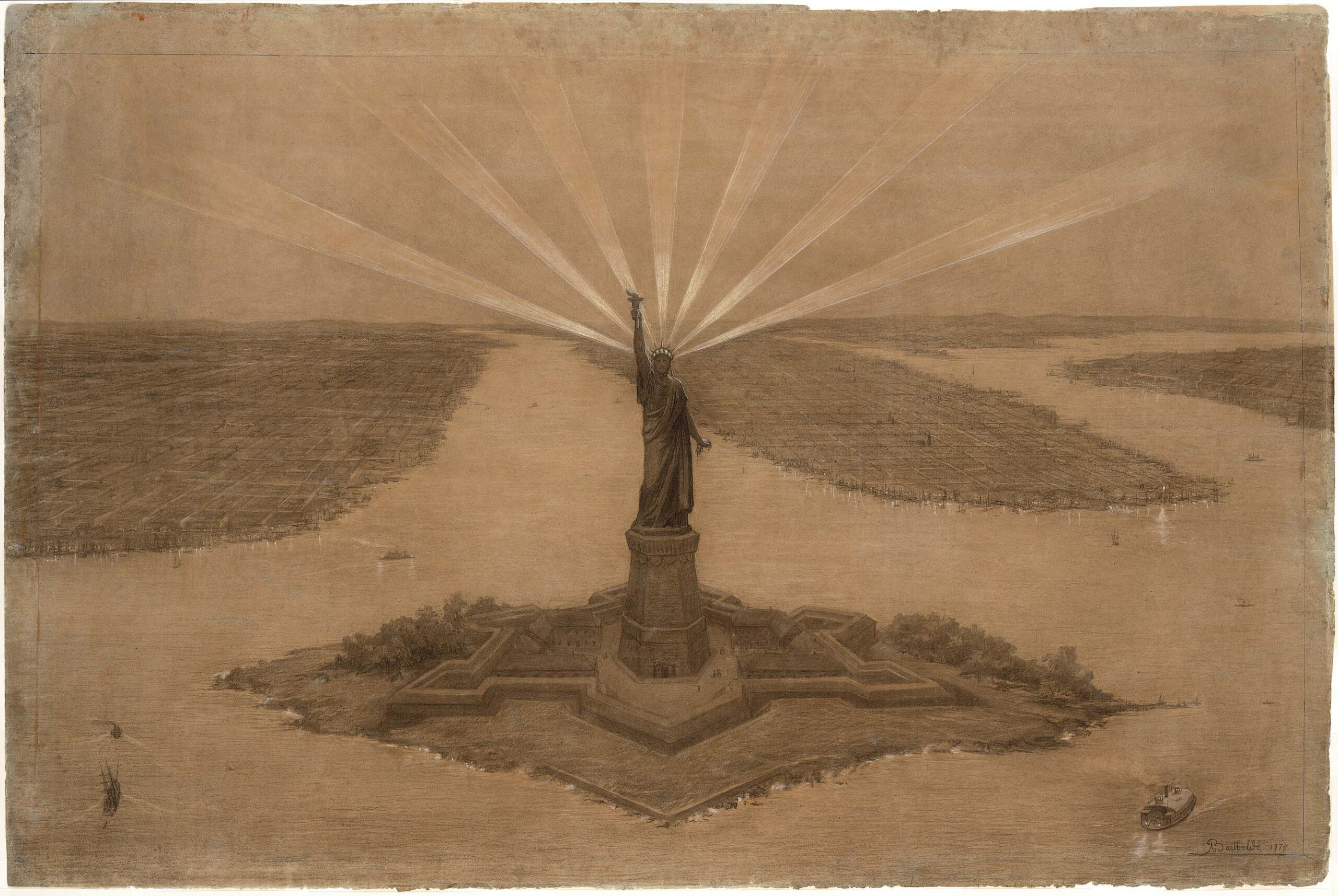
Presentation drawing of “The Statue of Liberty Illuminating the World” by Frédéric Auguste Bartholdi (1834-1904), 1875, charcoal, heightened with white chalk. The Metropolitan Museum of Art, Harry G. Sperling Fund, 2014.
Scholars have pointed out that the original impetus for the sculpture was Bartholdi’s design for a lighthouse on the Suez Canal celebrating French imperialism in Egypt. The large scale was probably inspired by ancient Egyptian art. When this project fell through, the concept was repurposed as a gift from the French government to the United States in celebration of the two countries’ close ties forged by the Revolutionary War and the Declaration of Independence. French architectural notables Eugène-Emmanuel Viollet-le-Duc (1814-1879) and Gustave Eiffel (1832-1923) also worked on the project helping design the interior supports.
The design of the sculpture can be seen as conservative in tone when compared to earlier, more revolutionary depictions of liberty in French art. For example, Eugène Delacroix’s painting “Liberty Leading the People” (1830) depicts Liberty as a striding Greek goddess, brandishing the French tricolor flag and a gun in the midst of a revolutionary uprising. In contrast, the Statue of Liberty showcases a monumental static figure, rigidly standing in a barely contrapposto stance. She is not in action, but stands as a guardian of order, echoing Bartholdi’s earlier lighthouse project.
A nod to more revolutionary depictions of Liberty in French art is shown in the exhibition by the anonymous sculpture of “Sketch of an Allegory of the Abolition of Slavery” (circa 1848), which shows a female figure representing Liberty wearing a revolutionary cap and supporting a freed enslaved person. In comparison to the stoic nature of the Statue of Liberty, this sculpture is characterized by empathetic emotion.
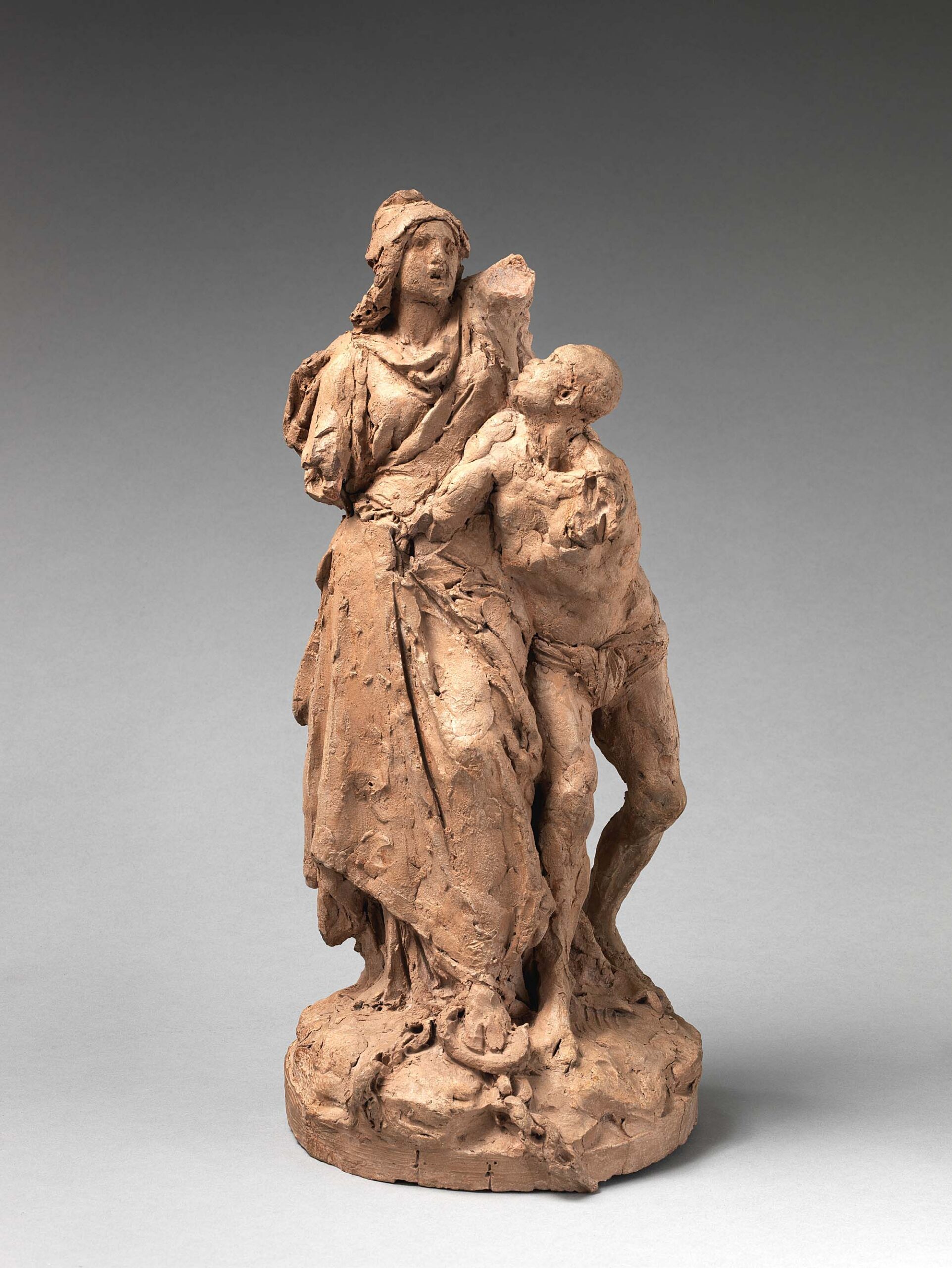
“Sketch of an Allegory of the Abolition of Slavery,” unknown maker, circa 1848, terracotta. The Metropolitan Museum of Art, purchase, Friends of European Sculpture and Decorative Arts Gifts, 2021.
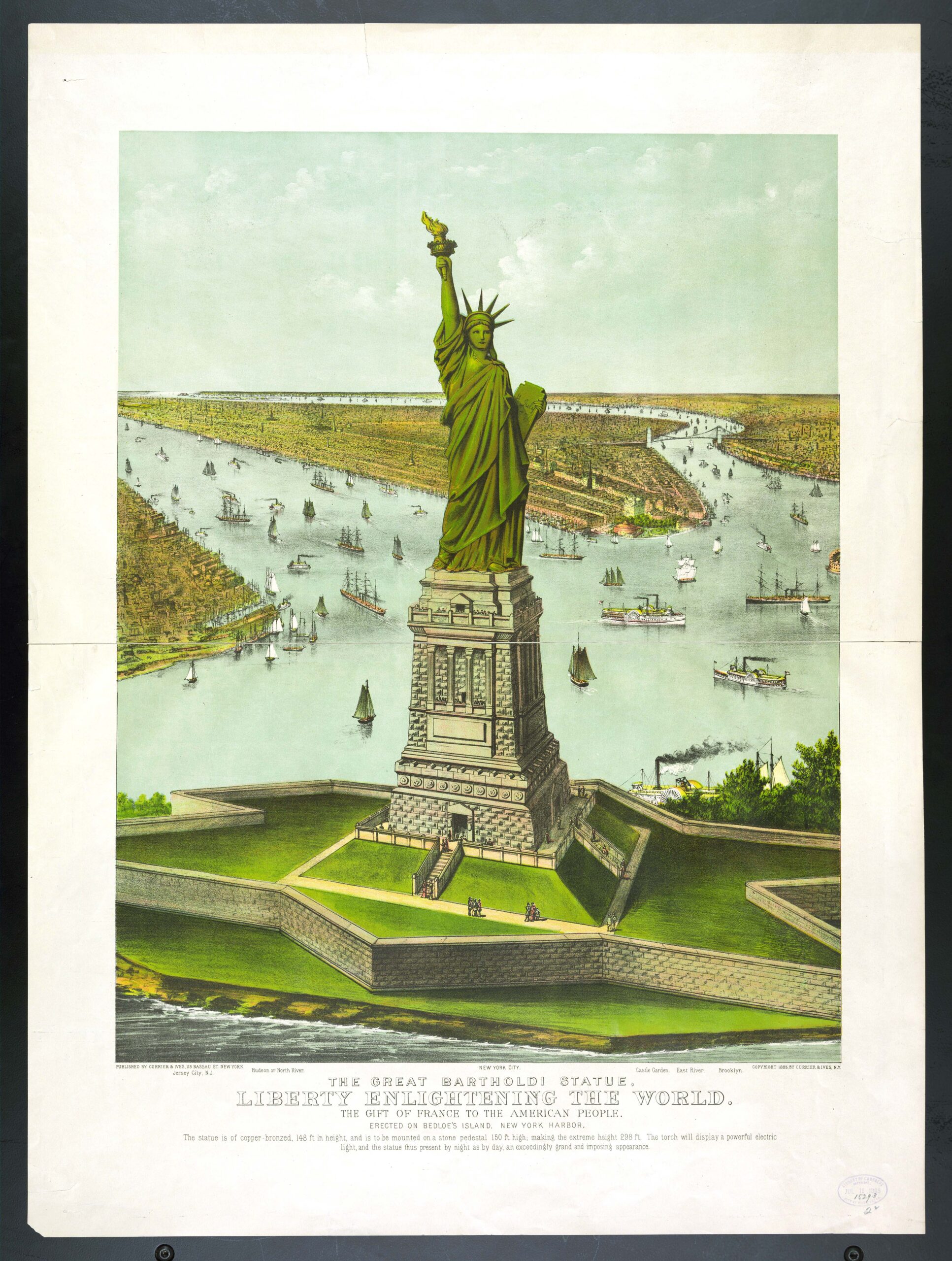
It is safe to say that the Statue of Liberty became the leading symbol of the United States in the late Nineteenth Century, in part because Bartholdi produced numerous miniature cast models of the sculpture, several examples of which are shown in the exhibition. Cheaper, more ubiquitous versions of the Statue of Liberty were the two-dimensional chromolithograph prints produced by Currier and Ives. “The Great Bartholdi Statue — Liberty Enlightening the World: the gift of France to the American people” (circa 1885) is a straight-forward presentation of the sculpture, but with a disconcerting flat landscape background that appears to stretch into infinity. In another print, “The Port of New York: birds eye view from the battery looking South” (circa 1892), the statue is lost amid a plethora of steam and sailing ships in the busy harbor.
In addition to its artistic accomplishment, the Statue of Liberty, due to its immense size, was also an engineering marvel. Assembled in France from copper sheets over an Eiffel-designed frame, it was disassembled into hundreds of parts that were shipped to the United States and re-assembled on Richard Morris Hunt’s massive pedestal. This aspect of the statue is represented by a fascinating albumen silver print by Pierre Petit (1832-1909), “[Construction of the skeleton and plaster surface of the left arm and hand of the Statue of Liberty, at the Gaget, Gauthier & Co. workshop in Paris, 1881-1883]” (1883). The photograph prefigures early Twentieth Century industrial photography and presents the scale of the statue more effectively than any other documentation.
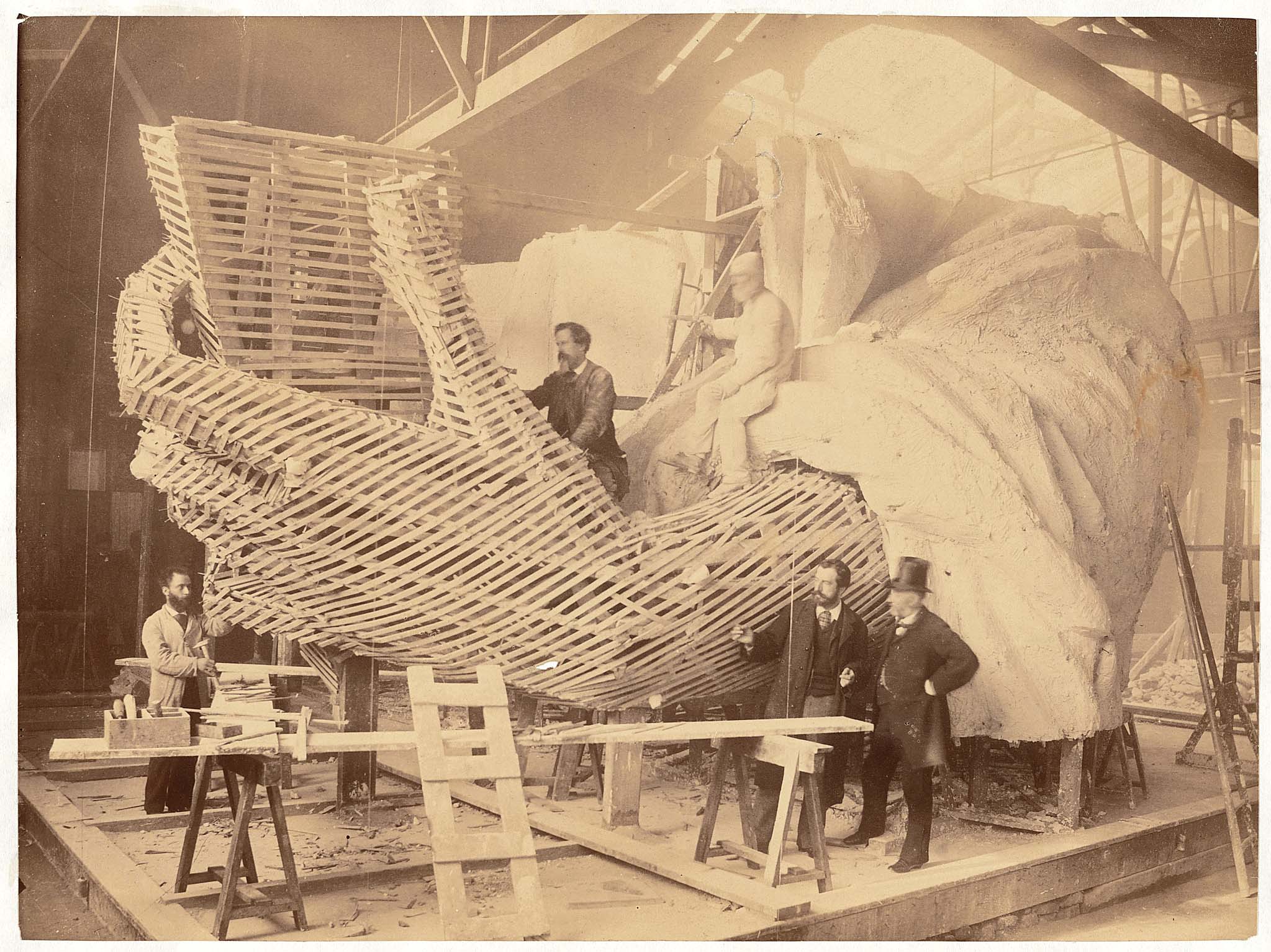
“[Construction of the skeleton and plaster surface of the left arm and hand of the Statue of Liberty, at the Gaget, Gauthier & Co. workshop in Paris, 1881-83]” by Pierre Petit (1832-1909), 1883, albumen print. Library of Congress Prints and Photographs Division Washington, DC.
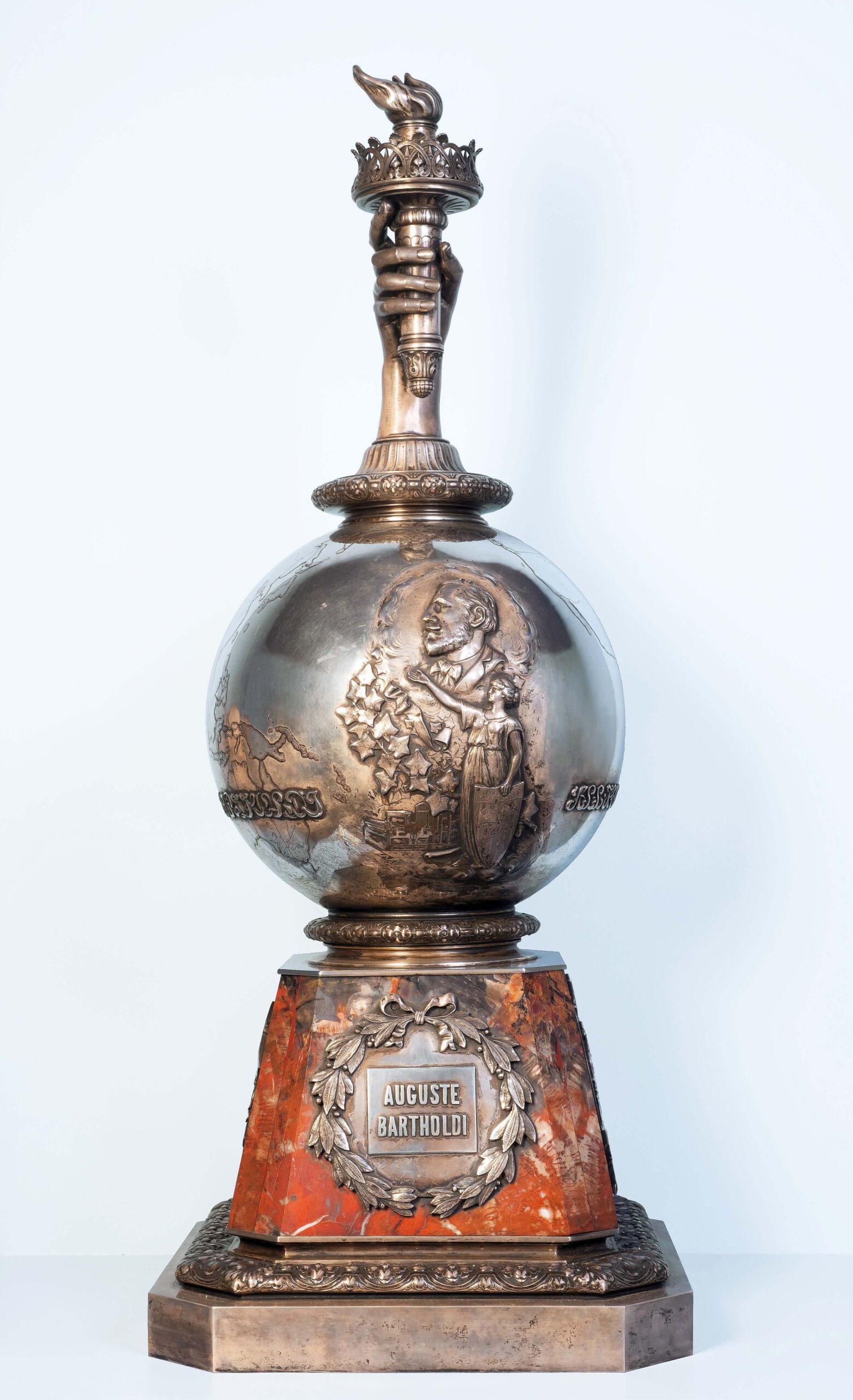
It seems that the Statue of Liberty has always been famous even before it was installed in 1886 overlooking New York Harbor. Tiffany and Company awarded Bartholdi the Tiffany Trophy for excellence in design in 1885. In contrast to the severe classicism of Bartholdi’s statue, the trophy is dripping with Gilded Age excess, including silver, gold and petrified wood, and features both three-dimensional (the Liberty torch is on the top) and relief sculpture.
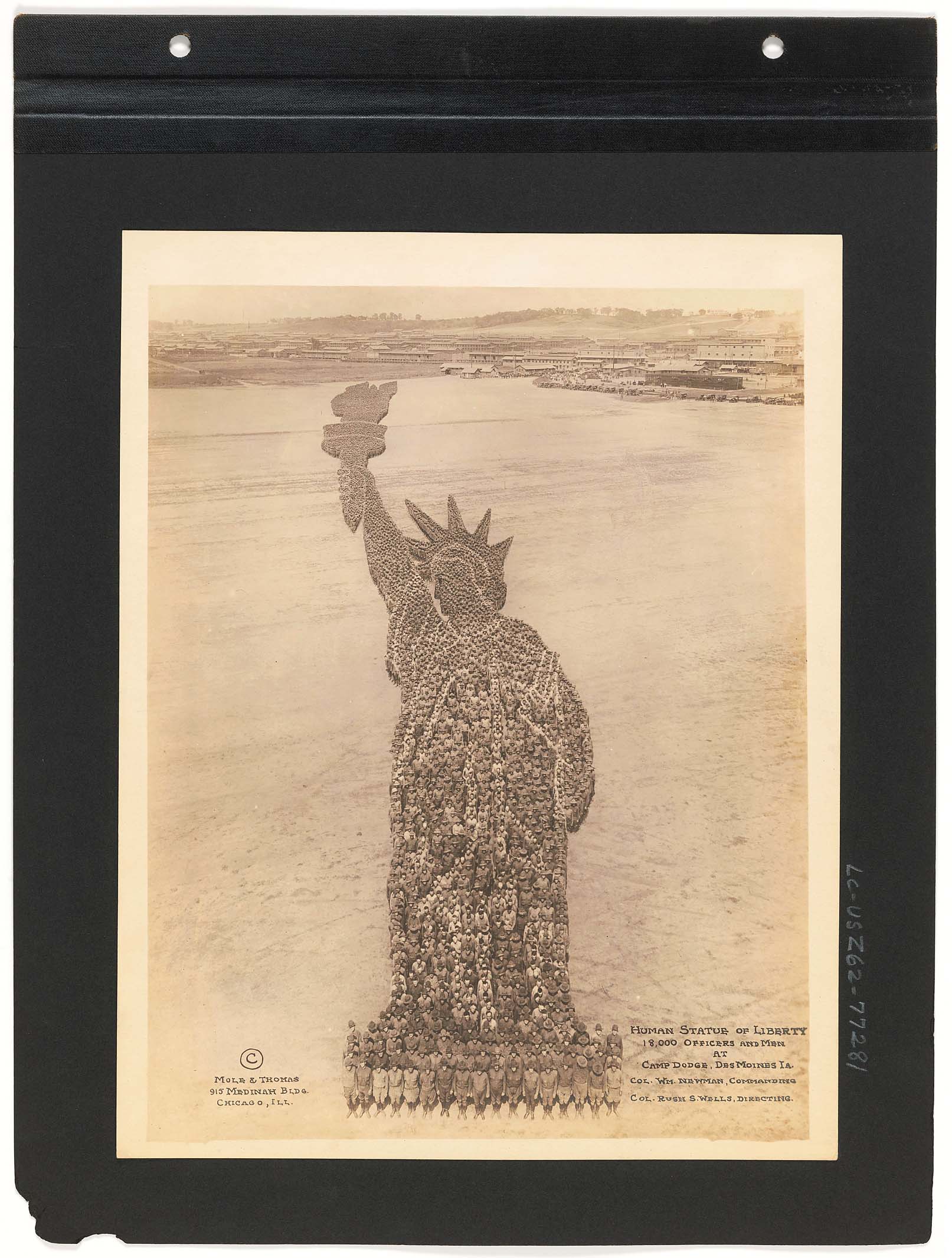
American fascination with the Statue of Liberty continued into the Twentieth Century and to the present day, and the exhibition contains notable examples from both “low” and “high” art. Patriotic fervor during World War I inspired thousands of US Army soldiers to create a “living” Statue of Liberty on a parade field as seen in Mole & Thomas’ “Human Statue of Liberty; 18,000 officers and men at Camp Dodge, Des Moines, Ia…:” (1918). This gelatin silver print documents that moment using photography from an aerial viewpoint — and all this before the age of drones!
The Statue of Liberty came to be identified with the celebration of an idealistic and inclusive view of immigration (“Give me your tired, your poor…” as in Emma Lazarus’ “The New Colossus” poem of 1883). However, immigration to the United States has often been tempered by restrictions. During periods in the late Nineteenth and Twentieth Century, immigrants from China, Japan and other parts of Asia were barred from entering the country. The effect of this history is shown in an untitled 1965 painting, (Stop Picture Bride), by Henry Sugimoto (1900-1990). The composition shows Uncle Sam gesturing “No” in front of the Statue of Liberty to a young man awaiting the arrival of his future spouse from Japan.
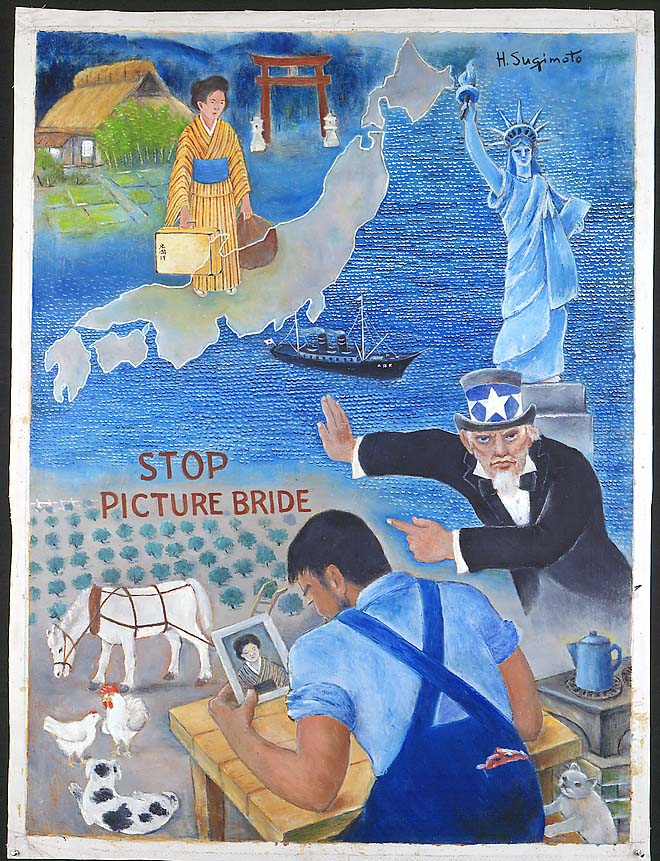
Untitled (Stop Picture Bride) by Henry Sugimoto (1900-1990), 1965, oil on canvas. Japanese American National Museum, gift of Madeleine Sugimoto and Naomi Tagawa.
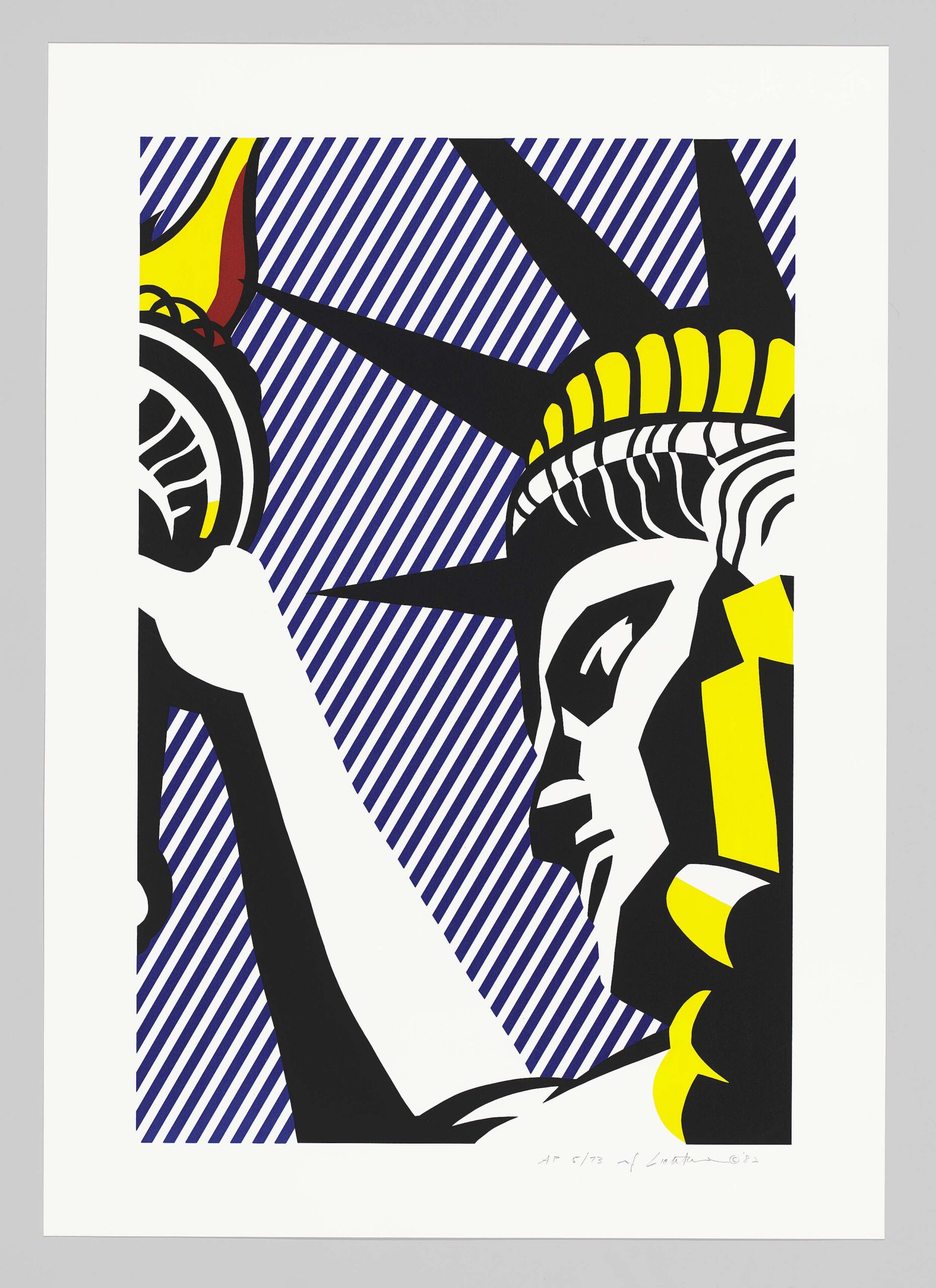
The sculpture was a perfect subject for the Pop art movement of the 1960s, with its irreverent depiction of national icons and sense of irony. Roy Lichtenstein’s (1923-1997) “I Love Liberty” print of 1982 applies the conventions of comic book art and mass-production printing to the Statue of Liberty. No full details are shown, and even the famous torch is severely cropped. Is the artist saying that the statue is so famous that it only needs to be suggested? The point of view is also unique in that the viewer is looking over the statue’s shoulder, taking away some of its power as a frontal image.
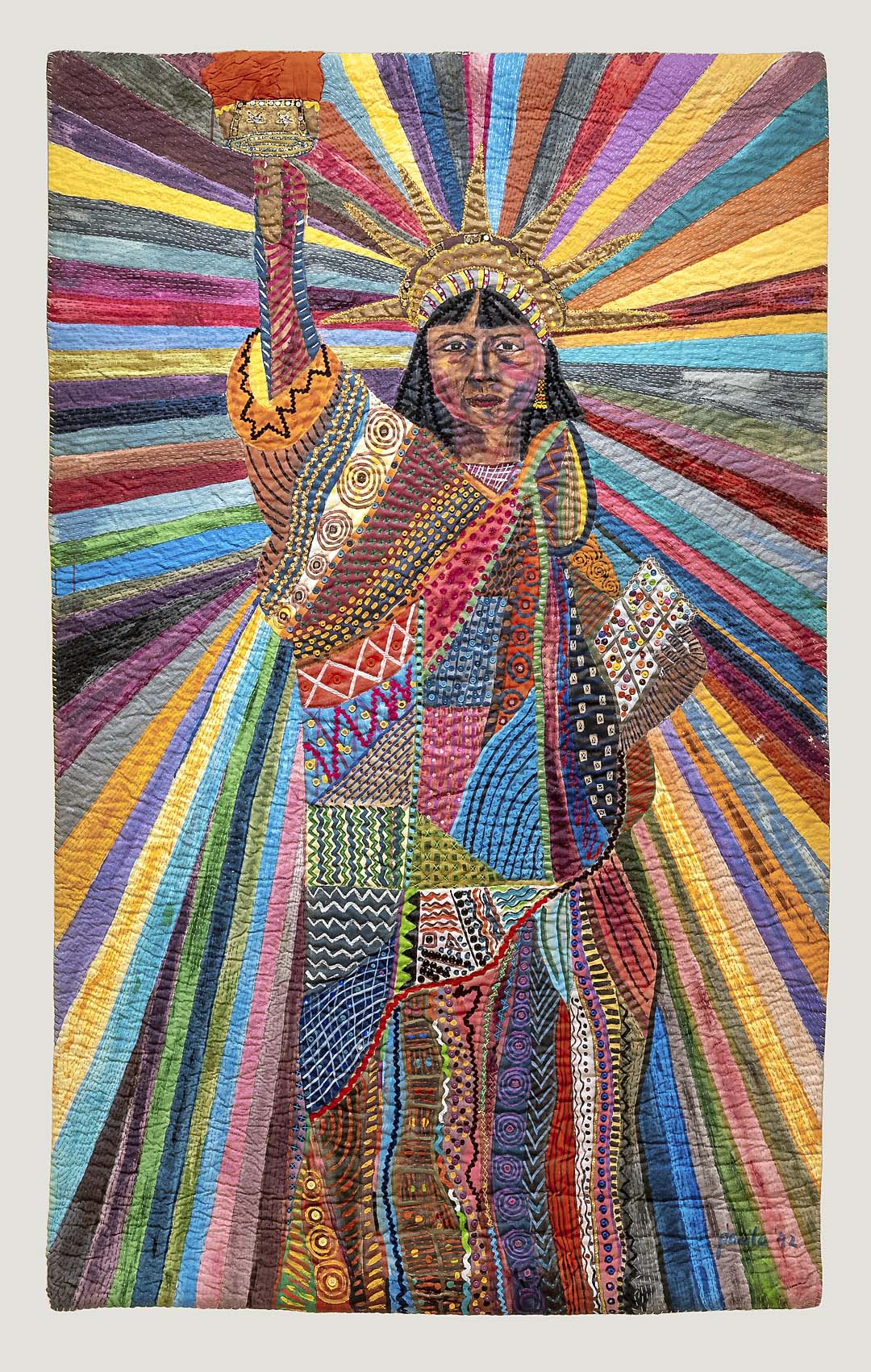
Pacita Abad’s (1946-2004) powerful “L.A. Liberty” (1992) recasts the Statue of Liberty as a woman of color. Abad, who was Filipino-American, also uses a variety of fiber media and textile techniques to produce an important alternative vision of liberty, with “L.A.” referring to both Los Angeles and to Latino-American. The colorful diagonals of the background refer to the lighting that is emitted from the statue’s crown and references the original title of the sculpture, “Liberty Enlightening the World.”
The Statue of Liberty, due to its location and date, has often been associated with European immigrants arriving in New York during the late Nineteenth and early Twentieth Century at nearby Ellis Island. Abad’s work pays homage to immigrants from other parts of the world, whose points of entry were the West Coast and the Southern Border of the United States. Her use of materials is also nontraditional, as she merges the idea of “craft” with “fine art.”
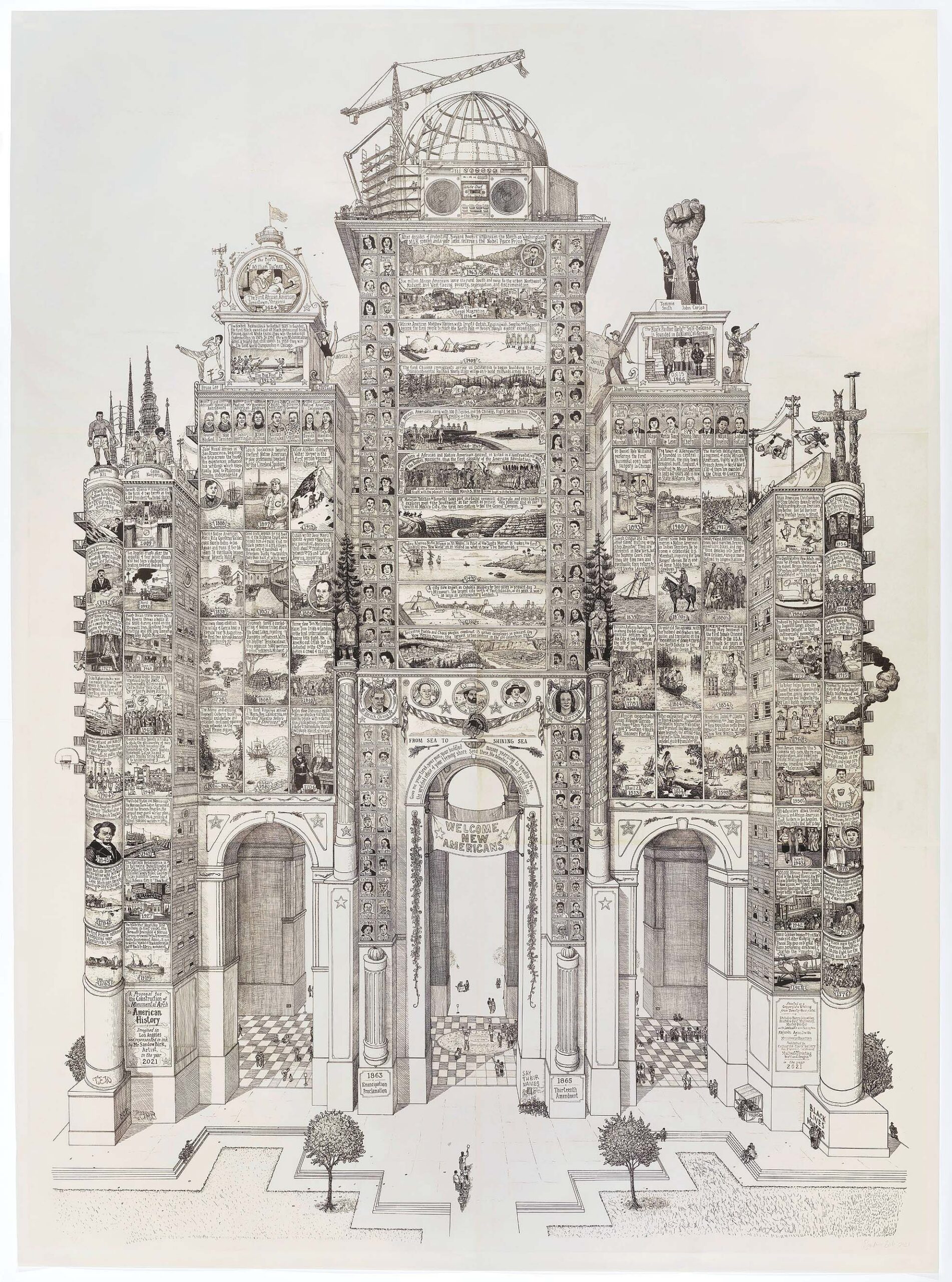
“White Out: A Monumental Arch to American History” by Sandow Birk (b 1962), 2021, direct gravure etching. Amon Carter Museum of American Art, Fort Worth, Texas, 2025.2, © Sandow Birk. Courtesy of the artist, Catharine Clark Gallery and Mullowney Printing.
Alternative views of American history are also shown in Sandow Birk’s (b 1962) “White Out: A Monumental Arch to American History” (2021). The print details the history of Black, Indigenous and people of color in the United States, using detailed line drawings of historical incidents, portraits, text and architectural features. The arch is decorated with a banner that reads, “Welcome New Americans.” Both the scale of the monument and the size of the print, like the scale and size of the Statue of Liberty, are large, and also incorporate classical features.
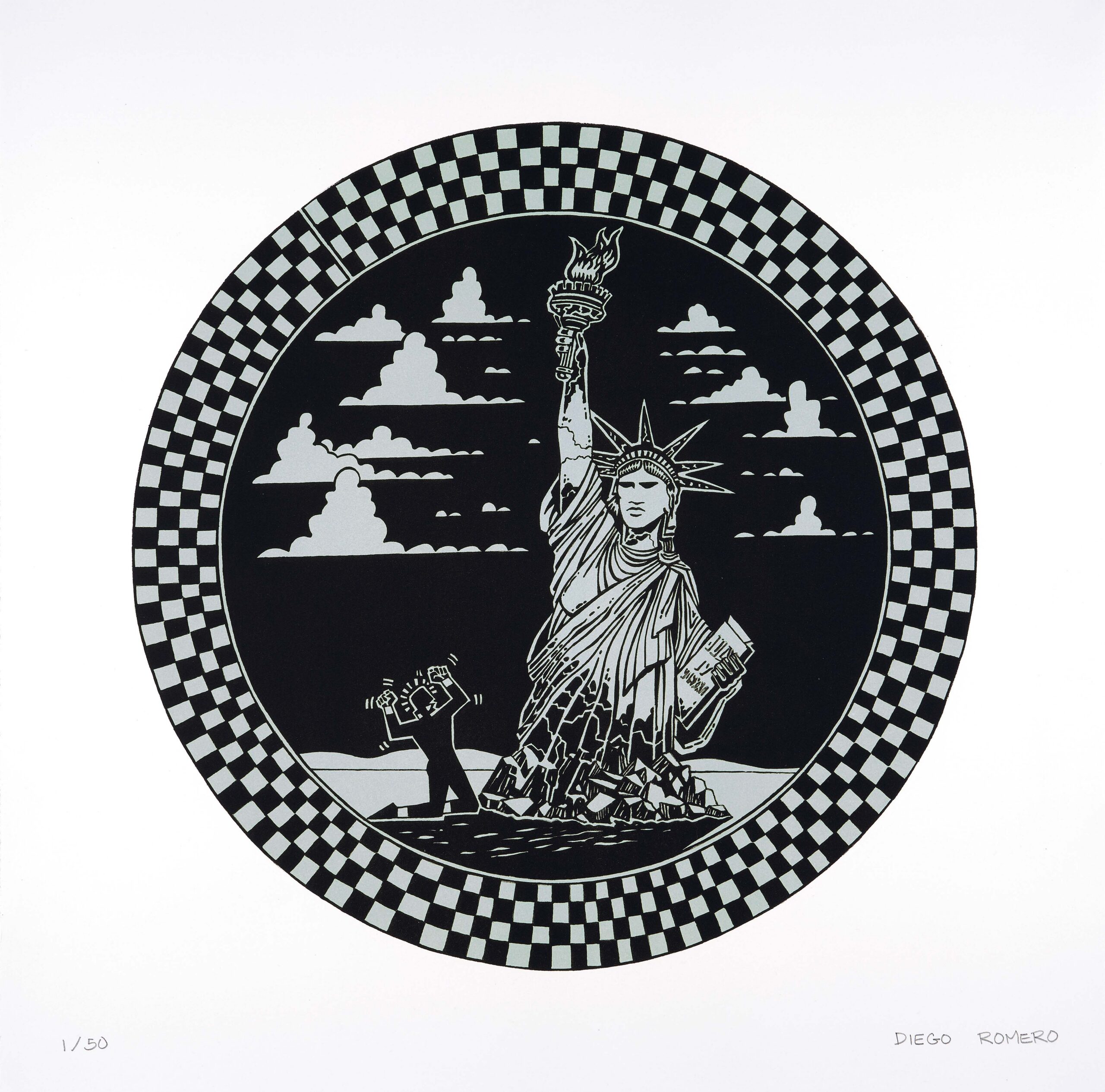
“Apocalypto” (2011), a lithograph by Diego Romero (Cochiti Pueblo, b 1964), reimagines the Statue of Liberty from a Native American perspective. The statue is broken, set at an angle and possibly drenched in blood. A Native American figure, inspired by ancient Native American painting, lifts their hands in protest. Romero often refers to the Pueblo Revolt of 1683 in his work, when Native Americans in the Southwest rebelled against European colonization.
For Eschelbacher, the Statue of Liberty continues to be an artistic lodestar in the future: “I believe it will continue to resonate with artists. History is our best guide here, as the monument has been a touchstone for artists continually since the Nineteenth Century. Since the monument’s inception, artists have mined its iconic form and powerful symbolism to explore the promise of America and to pose important but often difficult questions about how liberty is experienced in the United States.”
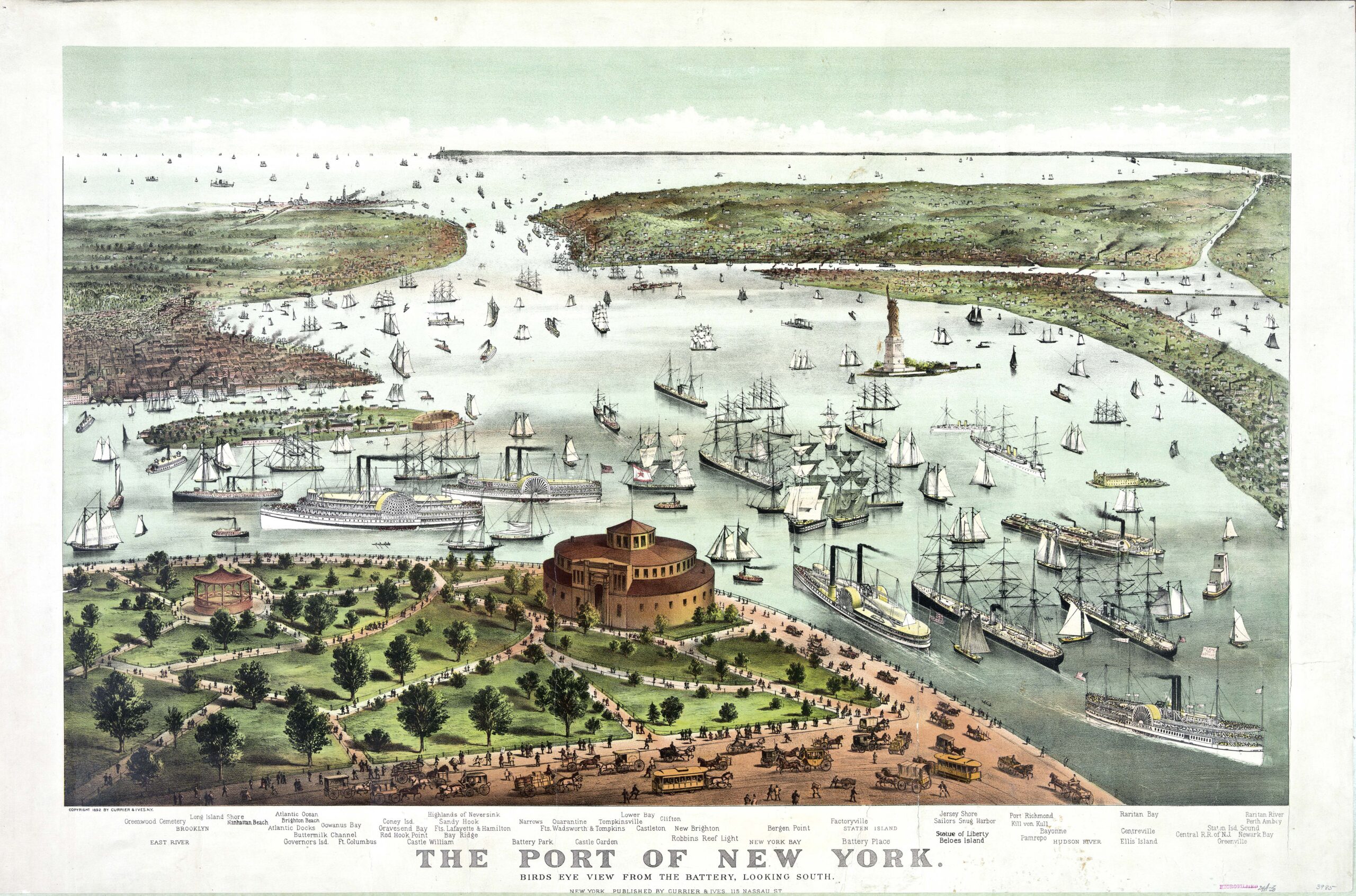
“The Port of New York: birds eye view from the battery, looking South” by Currier & Ives, circa 1892, color lithograph. Library of Congress Prints and Photographs Division Washington, DC.
Today our nation, once again, is caught in an historical moment of questioning fundamental American values. What is an American? Who can be an immigrant? Who can stay and who must go? And, most fundamentally, what is “liberty” and who defines it? This powerful and timely exhibition, using the Statue of Liberty as a focal point, shows how these questions are not new and have reverberated throughout American art and history. The question is whether the Statue of Liberty remains a visual beacon of hope, or a silent guardian in front of a closed gate that once was open.
After “The Statue of Liberty from Bartholdi to Warhol” closes at the Carter, it will travel to the Denver Art Museum (March 28-July 4) and the Munson Museum of Art in Utica, N.Y. (August 5-December 5).
The Amon Carter Museum of American Art is at 3501 Camp Bowie Boulevard. For information, www.cartermuseum.org or 817-738-1933.