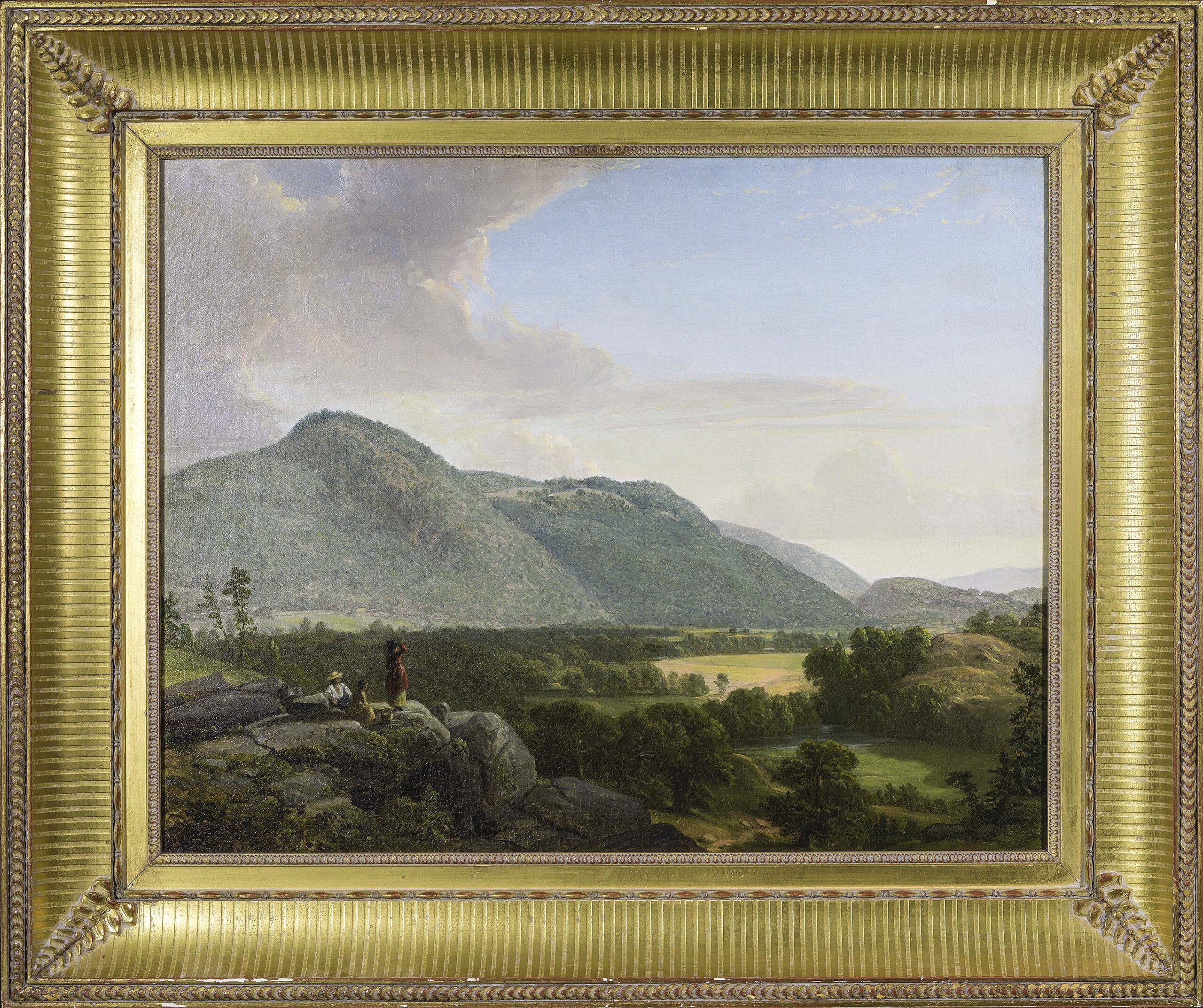
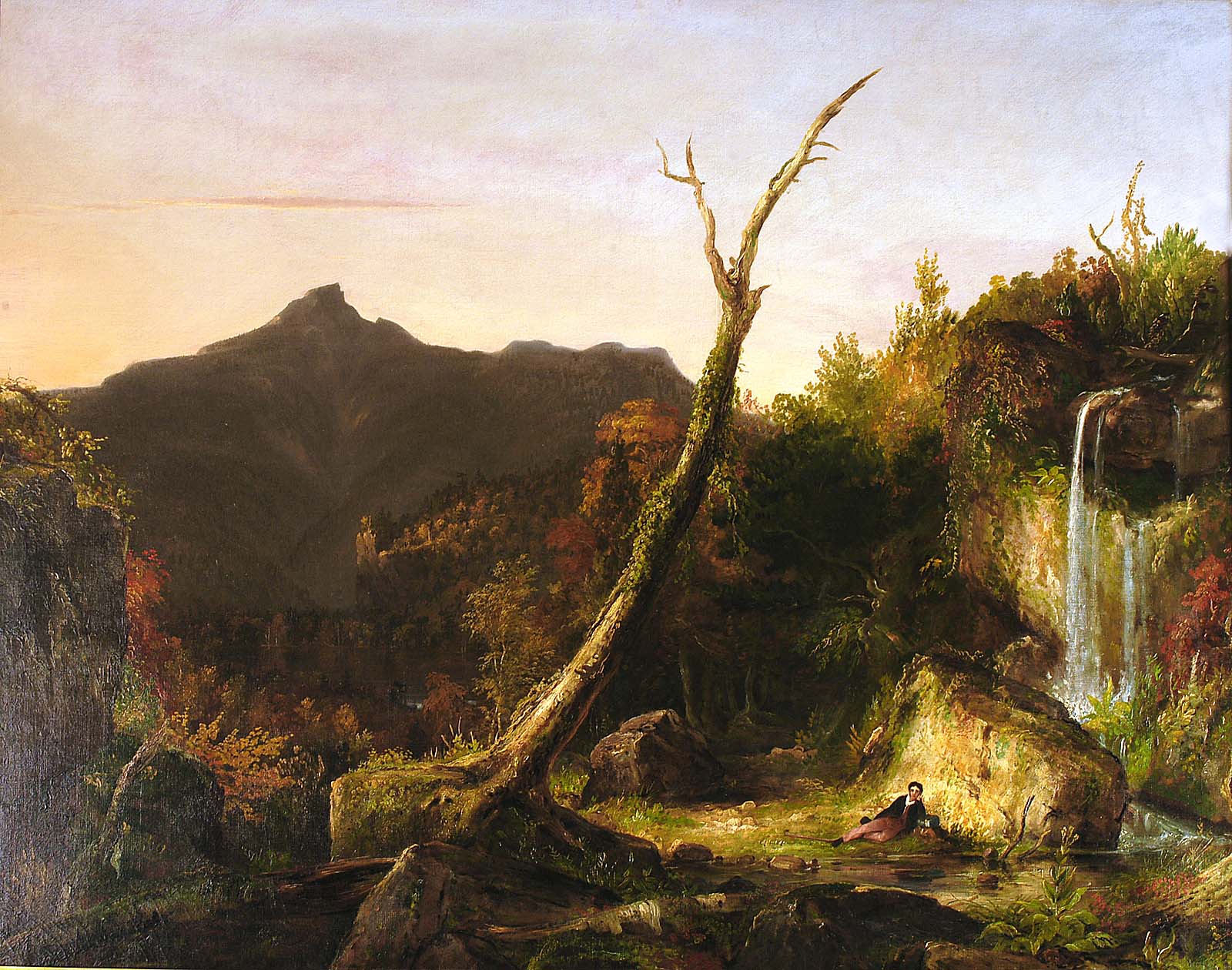
“Autumn Landscape (View of Mount Chocorua)” by Thomas Cole (1801-1848), 1827, oil on canvas, 38 by 48 inches. Warner Foundation Collection.
By James D. Balestrieri
CATSKILL, N.Y. — One of the most famous Japanese haiku translates roughly as: “An ancient pond / A frog jumps in / The sound of water.” The core image at the heart of “Circles of Influence: Thomas Cole and the American Landscape Movement,” a new exhibition at the Thomas Cole National Historic Site on view through December, calls this simple poem to mind.
By analogy, the American continent is the ancient pond; Thomas Cole is the frog who jumps in. The ripples he made, and the sound those ripples made — and still make to this day — signify the enduring impact of his art and thought, not only on the ways in which artists depict the American landscape, but in the ways in which all Americans perceive the landscape of this land, and, extending the metaphor, how the American landscape is broadcast to the rest of the world.
In many ways, at least the ways that count, Thomas Cole (1801-1848) is the first true non-Indigenous American artist. He is the first to see American landscape as distinct from Europe, and his two trips to Europe only seemed to deepen his conviction of America’s distinctness — and its distinction. Further, the movement Cole is credited with founding — though he did not live to see it coined as the Hudson River School — is the first (again, non-Indigenous) American art movement.
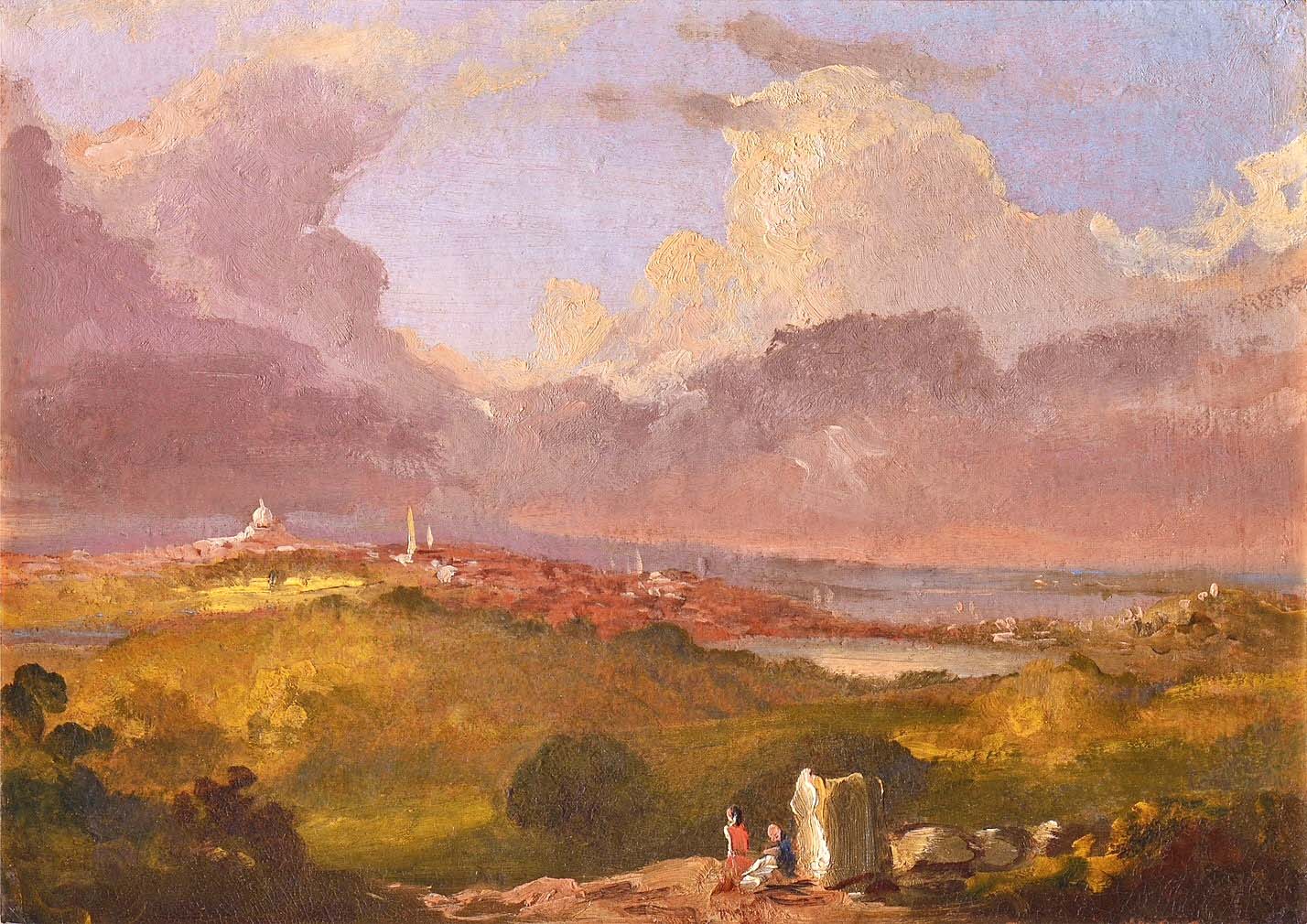
“Distant View of Boston” by Thomas Cole (1801-1848), circa 1838-39, oil on canvas, 8⅝ by 11⅞ inches. Collection of J. Jeffrey and Ann Marie Fox.
Cole was born in Bolton, a town of weavers in the north of England that swiftly became a center of the new, highly industrialized textile industry. The fires of the factories burned day and night, and the old hand weavers — including Cole’s parents — rose up in rebellion at their displacement. Contemporaries described the scene in infernal terms. It is perhaps no wonder that Cole turned away from man and looked to nature for solace and inspiration. Cole’s parents felt compelled to emigrate and brought their family to the United States, settling in Philadelphia. Cole’s own talents ran to drawing and painting and he made his way to New York, then the center of the young American art world.
Encouraged to visit the Catskill Mountains, Cole discovered what Amanda Malmstrom, associate curator at the Thomas Cole Historic Site, describes as a “kind of untouched pristine landscape with rugged rocks and blasted trees. He was doing something that other artists hadn’t really done, taking the Western landscape painting tradition and imbuing it with this very American wilderness.”
Cole’s paintings were a sensation in the city, and he would split his time thereafter between the Catskills — where his eventual home would become the Thomas Cole Historic Site — and two lengthy sojourns in Europe, where he would study, draw and paint. But he also bore witness to the rapid economic growth of the Catskills. Great forests were razed to fuel industry and were cleared for farms. Tourism, perhaps inspired by his own art, became an industry in itself. Malmstrom observes, “After having grown up in an industrial part of England, what Cole witnessed on his later trips to Europe allowed him to look at the course of empire, and to feel some fear and anxiety about rapid industrialization. Looking at Roman ruins, seeing with his own eyes the rise and fall of this great civilization, he was wondering, very, very early on — is that going to happen in the United States?”
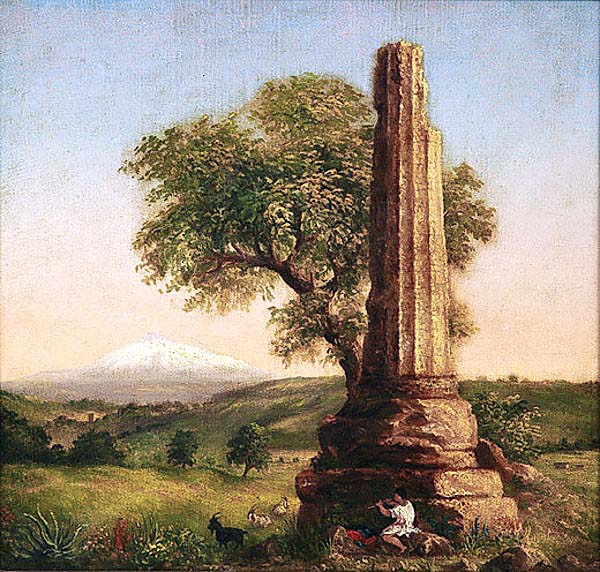
“Ancient Column Near Syracuse” by Sarah Cole (1805-1857), circa 1848, oil on canvas, 11⅞ by 11⅞ inches. Thomas Cole National Historic Site, gift of Susan Clark Livingston, TC.2024.1.
Cole’s famous “Lecture on American Scenery,” as Malmstrom emphasizes, “demonstrates his depth as a person. He was a painter, but also an intellectual who was thinking really deeply about the natural world and how he saw industrialization and development and the railway changing that. He pursued what he called a higher style of landscape… exploring environmental, literary and spiritual themes.”
Cole’s importance and influence rests on the breadth of his interests: the natural (and supernatural); the real and the ideal; the biblical and the cyclical; the primordial and the historical; the realistic and the oneiric; the emotional and the intellectual. His major works, like the four-painting sequence, “The Course of Empire,” embody all of these dialectical, philosophical pairs. Artists who follow him pick up on one or more of these strands and run with them.
What it all boils down to is time and our various concepts of time. The Christian model of time is straight. It’s an arrow that begins in the Old Testament, starts a new epoch with the birth of Christ, and proceeds until the proposed end of days and salvation. But Cole grafts the ancient Greek and Roman cycle onto this, superimposing the cycles of empire onto the cycles of the seasons and applying his revised paradigm to the “New Eden” idea. In Thomas Cole’s thoughts and art, Eden itself is a vulnerable empire — the empire of capital-N “Nature” — and is highly susceptible to humanity’s flaws, especially those that see trees as masts or fuel or obstacles.
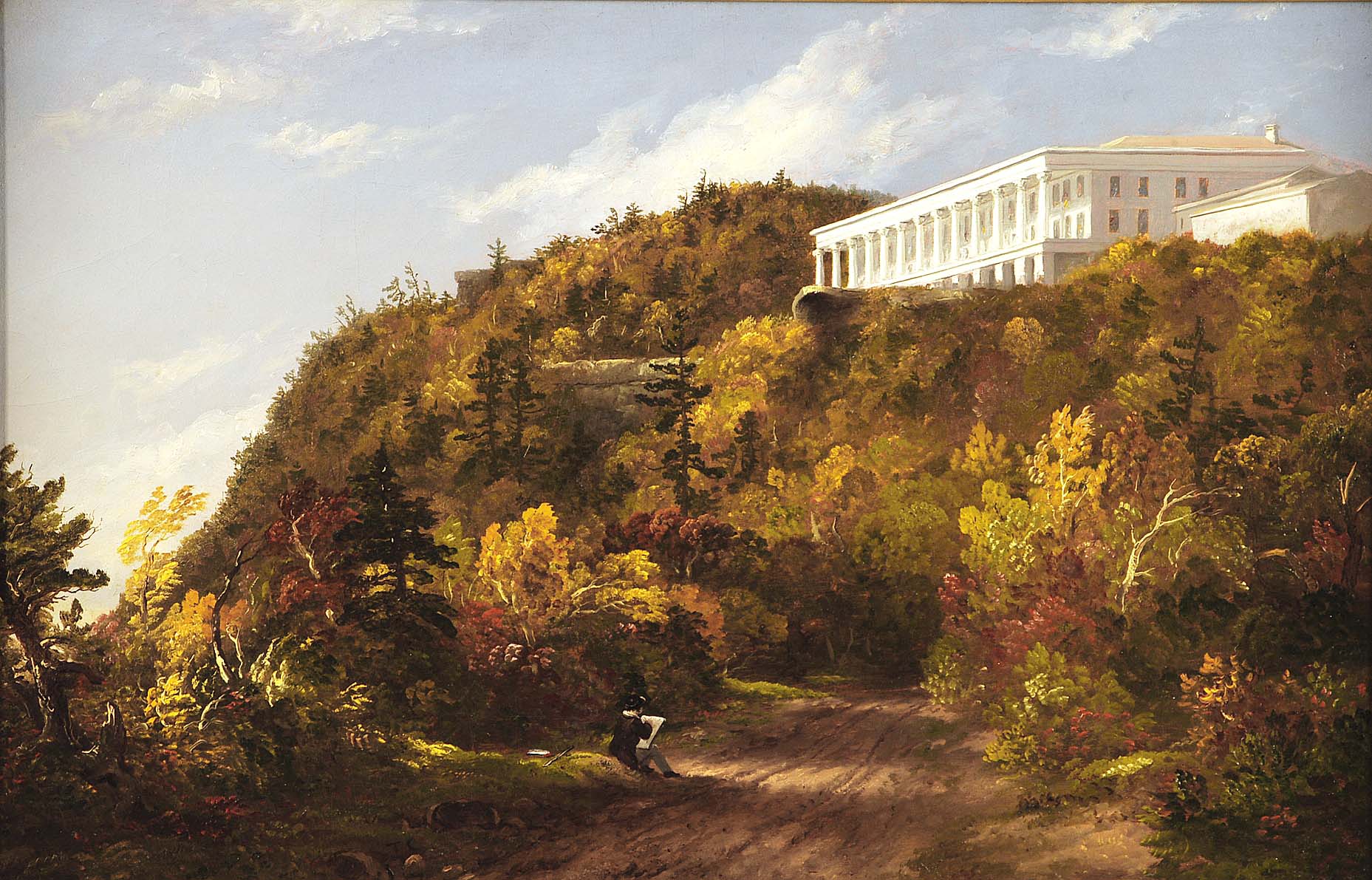
“Catskill Mountain House” by Thomas Cole (1801-1848), 1846, oil on canvas, 15 by 23¼ inches. Warner Foundation Collection.
Cole’s metaphorical association between the ruins in Europe and what he was beginning to see as the ruined landscape of the United States is a subtle key to all American art. Though he was interested in the Native names of places and in the residual Native culture of the Catskills and New England, Cole’s one misstep is his total assumption of the notion of America as a pristine Eden because it all but erases the Indigenous presence from the landscape. Yet this, too, becomes part of his legacy and the legacy of the Hudson River School.
A quick look at one Cole painting, “Autumn Landscape (View of Mount Chocorua),” painted in 1827, offers insight into the artist’s facture. The tree is singular and individual, natural and realistic, but dying or even dead, while the waterfall seems ideal, even idyllic. The scene is Edenic, primordial and dreamlike (oneiric) but cyclical; seasonal time is turning. The figure (often thought to be Cole himself) is in a rapture, a reverie, but the light, already fading, sets a metronome against the moment.
Now consider some of the other artists whose works are featured in the exhibition.
In his sister Sarah Cole’s painting, “Ancient Column Near Syracuse,” circa 1848, which looks as though it was painted on site, she foregrounds the ruined column so that it, and the tree behind it, dwarf the mountain in the distance. Perhaps the landscape was painted en plein air, but the arcadian shepherd playing his panpipe while his goats graze makes the scene seem ancient. This, in turn, makes the column even more mysterious and somewhat supernatural. Frederic Church (Cole’s sole pupil) paints an enormous storm cloud behind the Prophet in “Moses Viewing the Promised Land,” 1846, as if the cycle of creation and destruction never rests in nature or for humankind.
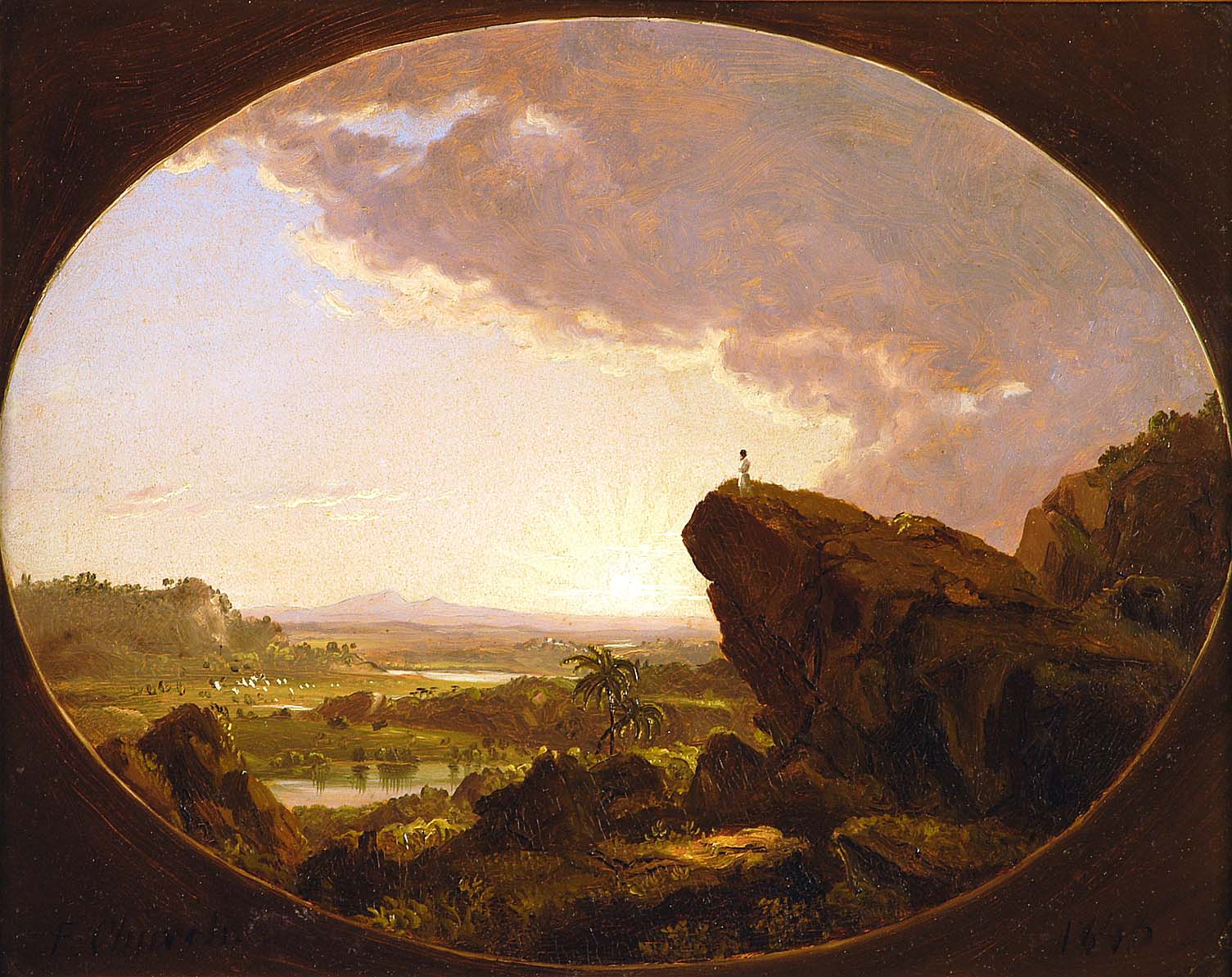
“Moses Viewing the Promised Land” by Frederic Edwin Church (1826-1900), 1846, oil on board, 9⅝ by 12½ inches. Collection of Susan Austin Warner.
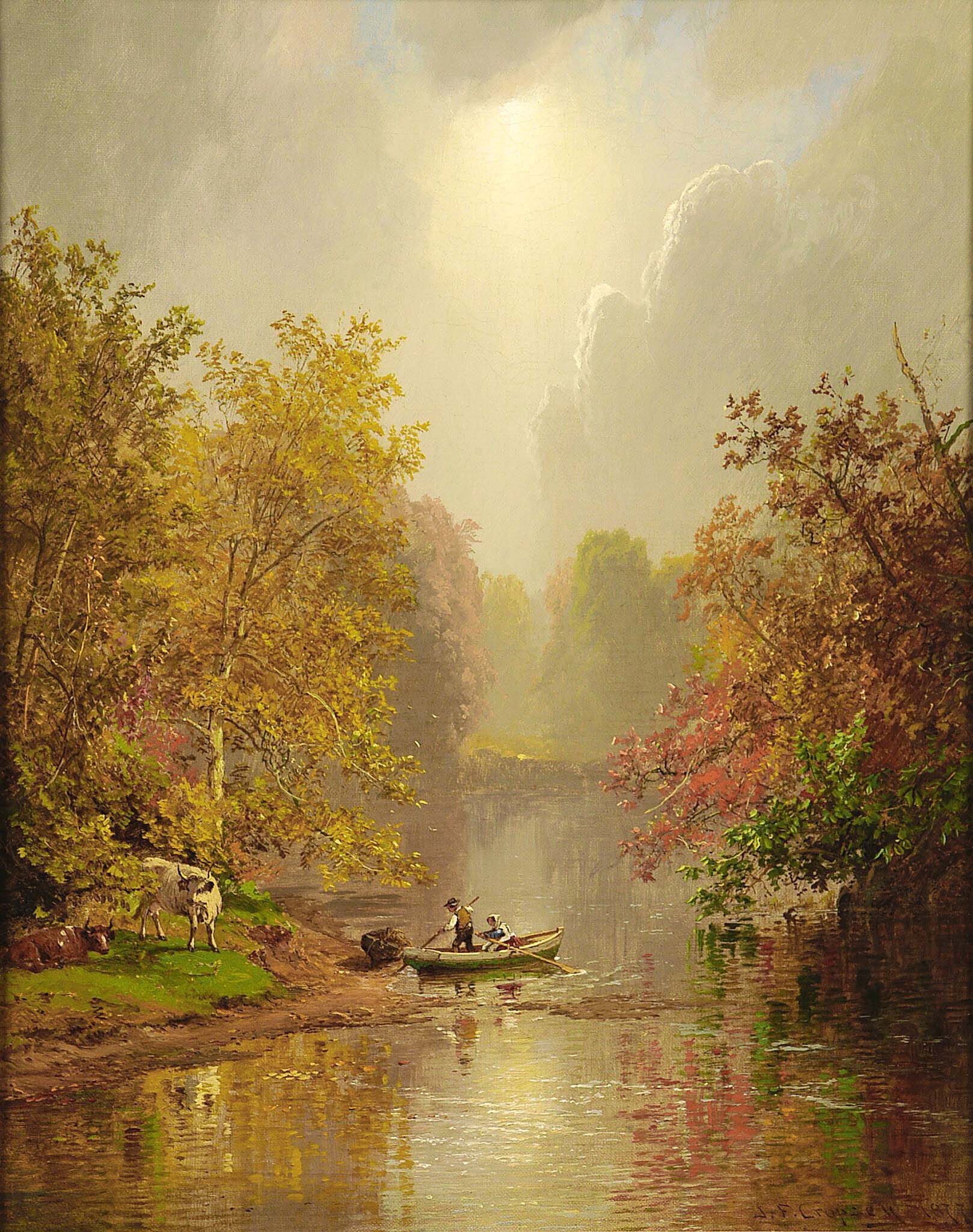
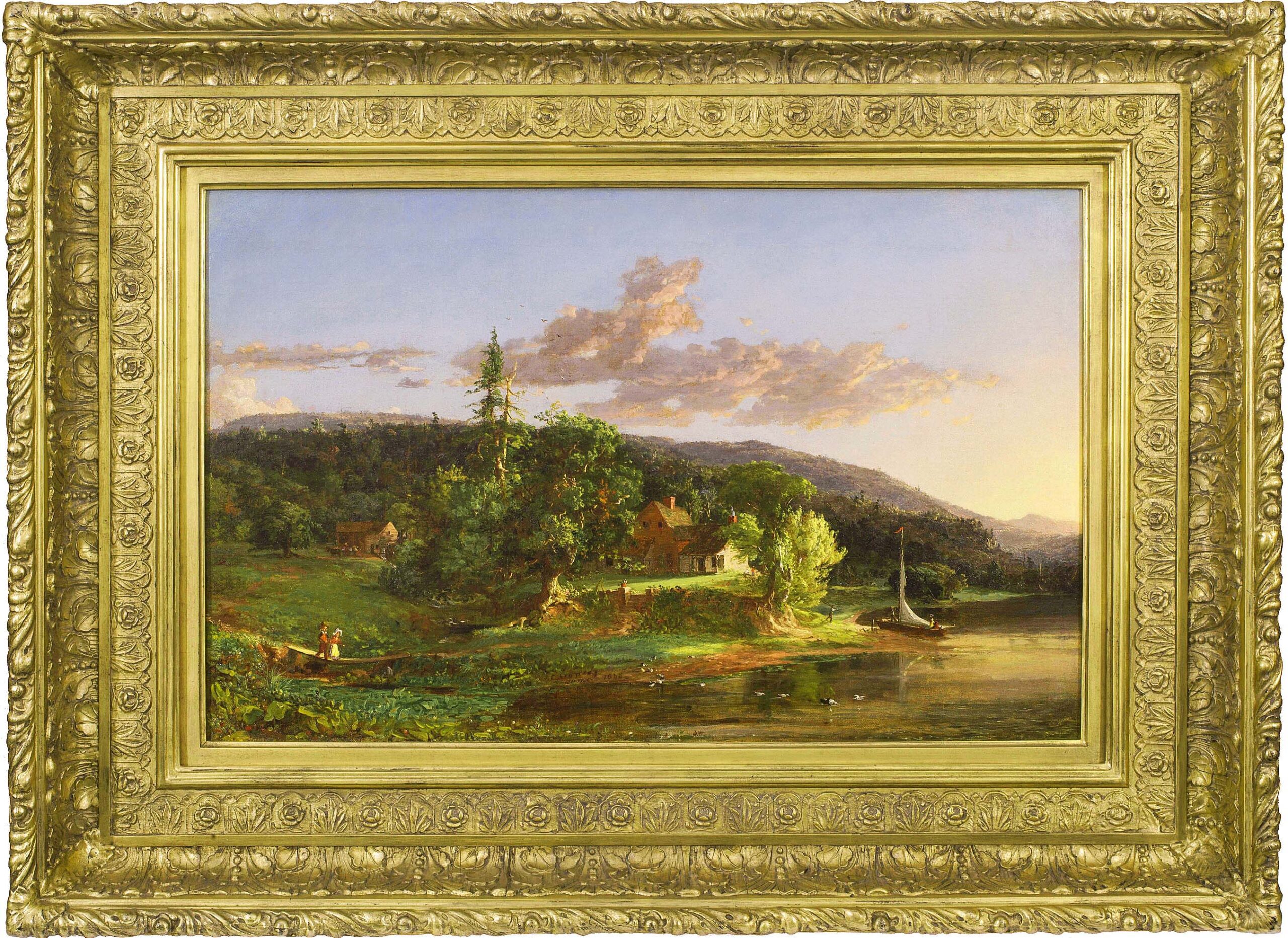
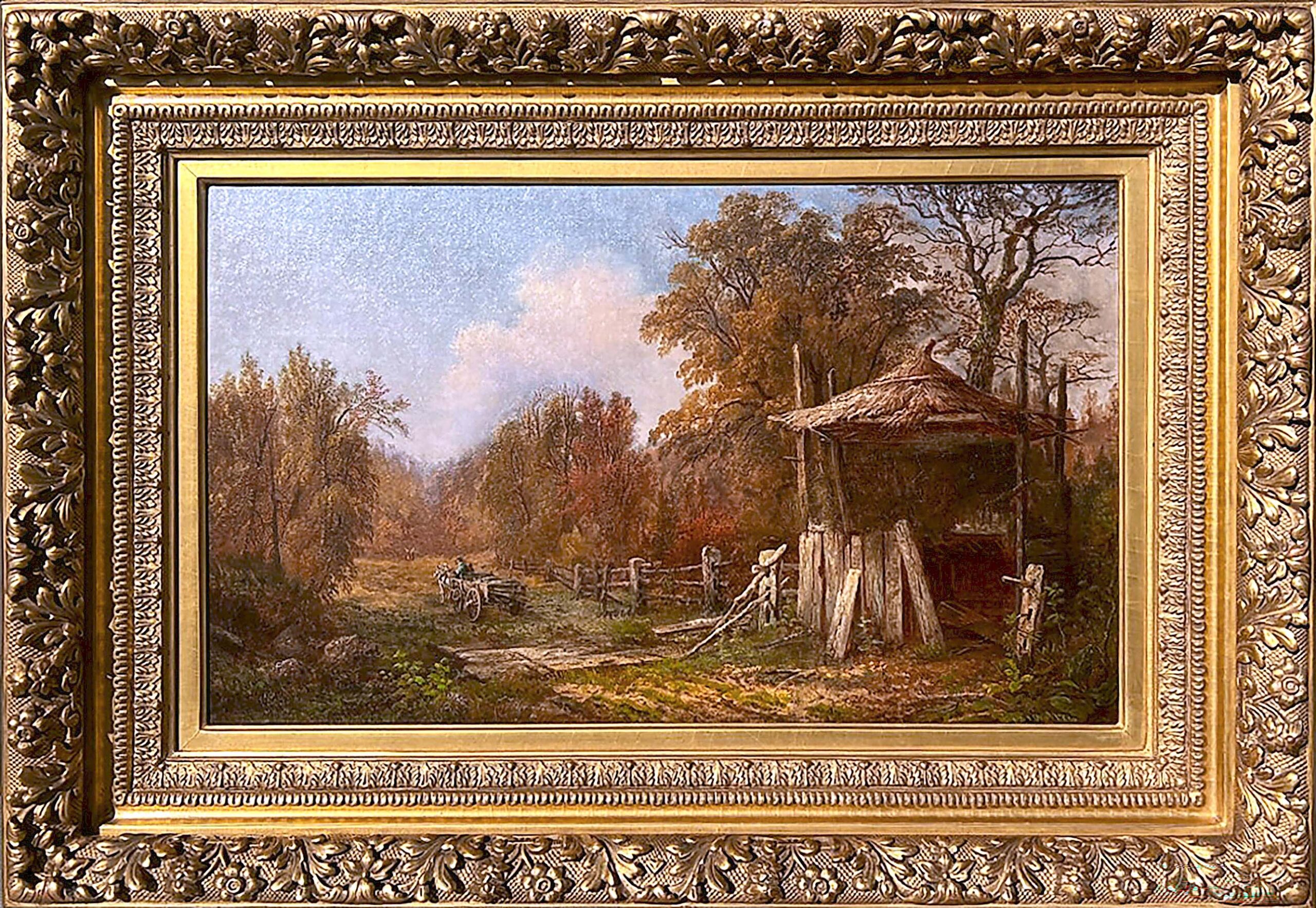
In the featured works by Jasper Cropsey, Asher Durand and Thomas Worthington Whittredge, we see artists whose education was clearly more academic, more closely related to the Eighteenth Century European tradition. Nature is more idealized, picturesque, bucolic and sweeter. The scenes balance the human and non-human worlds and make the non-human more inviting and purely Edenic.
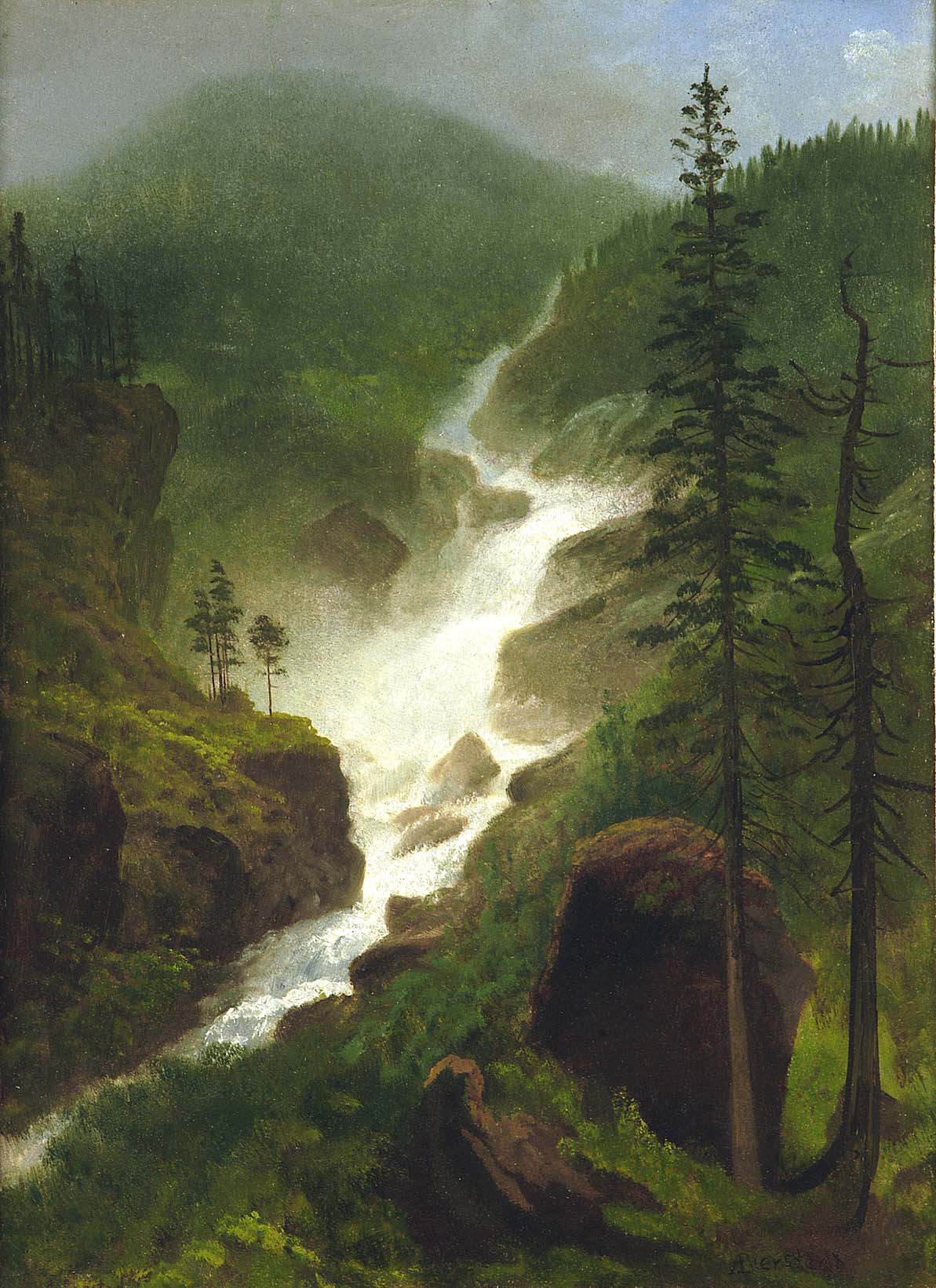
Because Albert Bierstadt went West, his work captures what Cole captured in the Northeast, what Edmund Burke termed “the sublime.” In Bierstadt as in Cole, the sublime refers to the vertigo that their landscapes inspire, an almost supernatural feeling of giving yourself over and falling into a vastness. For Bierstadt, the sublime grafts his studies in Düsseldorf under the influence of German Romantic painters such as Caspar David Friedrich with Cole’s visual grammar, as evidenced in paintings like “Colorado Waterfalls,” circa 1890, where the power of the river mist obscures the looming peak and the cataract plunges between craggy banks flanked by dark forests.
In “Flatlands,” circa 1860, John Frederick Kensett reimagines the Hudson River School in a style that anticipates American Impressionism. Here, it’s the moment, expressed in the totality of his treatment of the subject, that embraces the real and the ideal, the momentary and the eternal, and, indeed, all the dialectical pairs that emerge from Cole’s art.
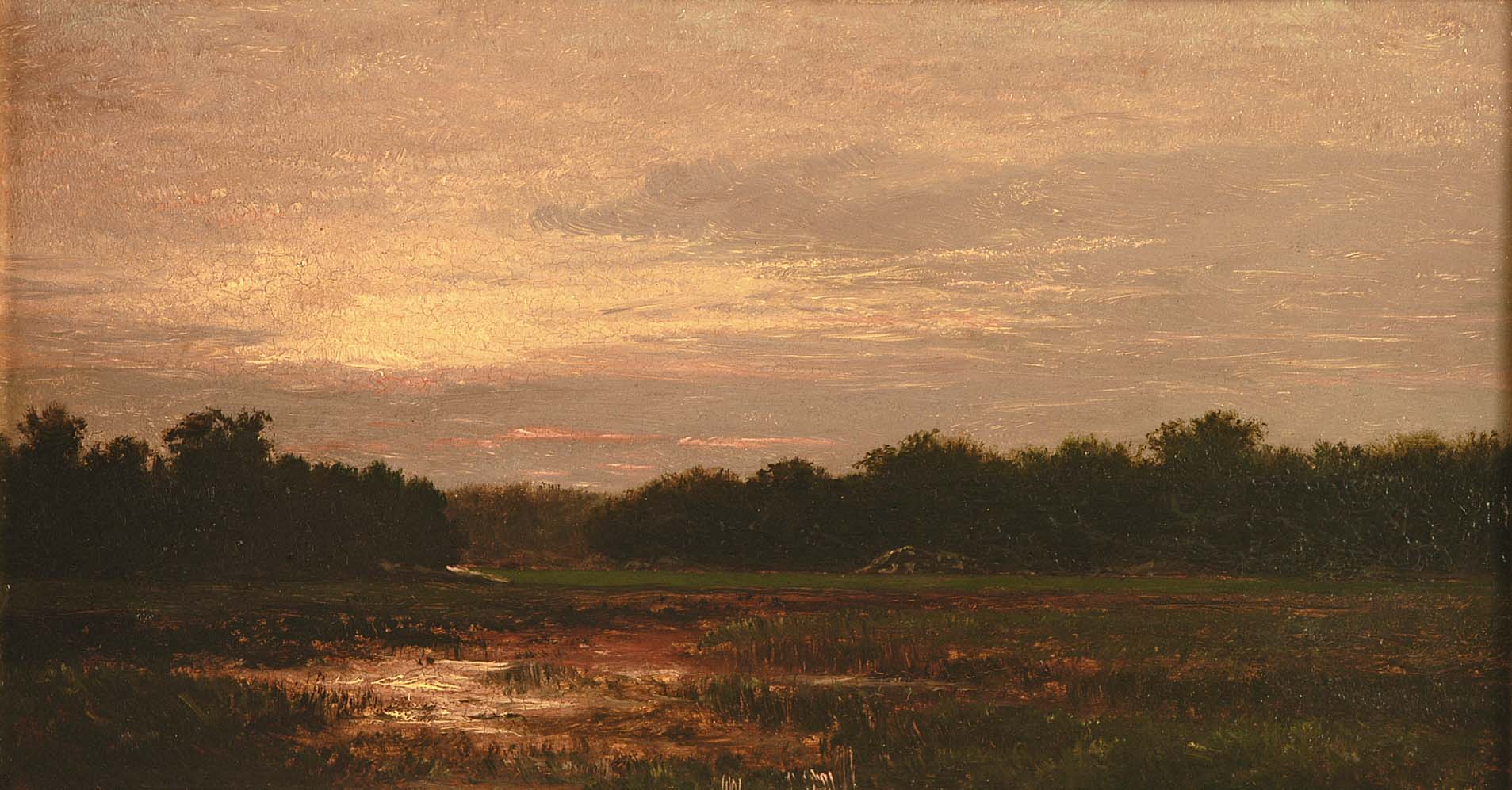
“Flatlands” by John Frederick Kensett (1818-1872), circa 1860, oil on board, 15 by 20½ inches framed. Warner Foundation Collection.
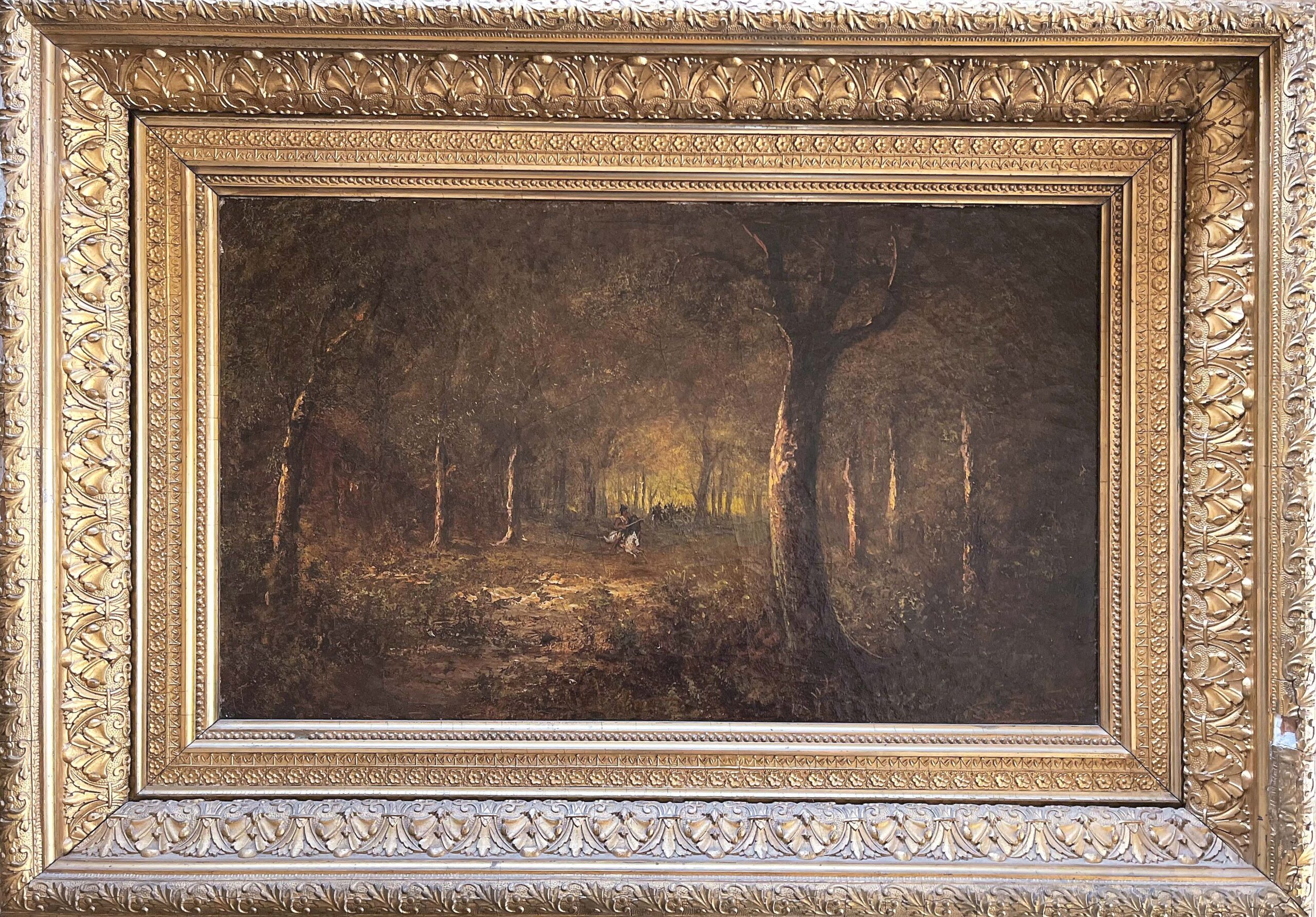
Lastly, in an untitled work by Ralph Albert Blakelock, circa 1869-71, we see a switch to mood, to an internalizing of landscape, one that is also notable in Cole when you look back at his work from the vantage of his successors. It’s a personal, mystical psychology of the American landscape in which Cole went so far as to pay tribute to individual trees and assign them personalities. What is interesting in Blakelock, particularly this Blakelock, is the restoration of what seem to be mounted Natives to this gloom-hung forest, a group following (or pursuing) a single rider on a white horse (Death?) in the foreground. As in the works of Thomas Moran, another descendant of Cole, Indigenous peoples haunt the land, ghosts reflecting an Edenic past that shifts the American landscape to the realm of the tragic and mythical, by which I mean that our art, consciously and unconsciously, has served larger purposes, purposes dark as well as bright.
In his 1836 “Essay on American Scenery,” Cole wrote, “We are still in Eden.” It’s the word “still,” in all its connotations, that ought to haunt us.
The Thomas Cole Historic Site is at 218 Spring Street. For information, www.thomascole.org or 518-943-7465.