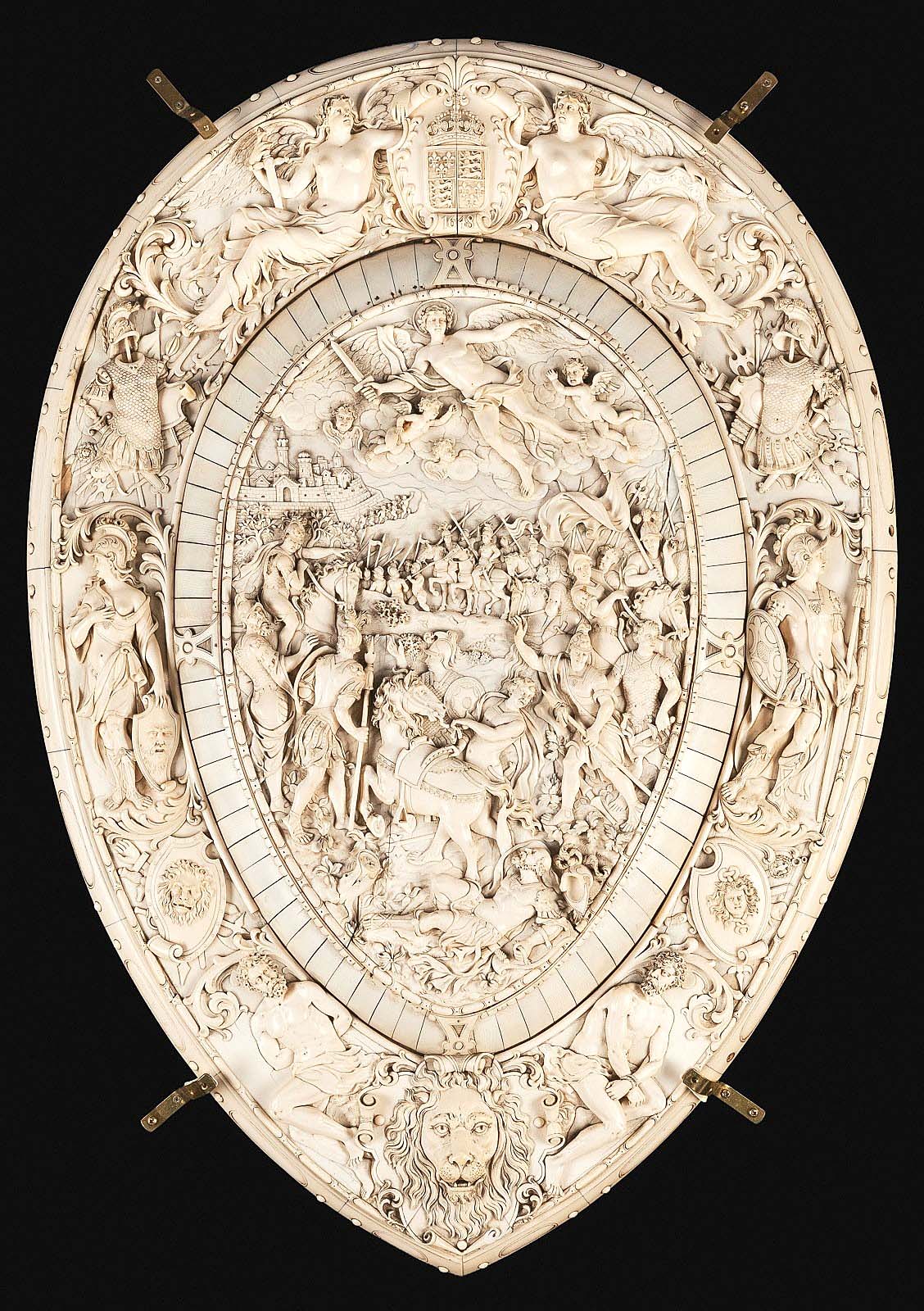
Bidder battled for this carved ivory ceremonial parade shield, German, second half Nineteenth Century, approximately 35⅞ by 33½ inches, which was the auction’s top lot overall at $118,396 (€100/200,000).
Review by Carly Timpson
DÜSSELDORF, GERMANY — Hargesheimer Kunstauktionen’s Auction 160 was conducted September 9-12 and featured four sessions: Jewelry & Watches; European Works of Art; Nineteenth Century Paintings & Musical Instruments; and Sculptures & Old Master Paintings. In total, the marathon event presented 3,255 lots in a plethora of collecting categories.
The four-day auction was led by an ivory ceremonial parade shield that marched across the block for $118,396. The German shield had high-relief carving depicting a chaotic battle scene at its center. It outer border featured a coat of arms crest marked with the date “1648,” which was flanked by allegorical winged women, at its top, and there was a lion mask at the bottom. The ivory shield, likely made in the second half of the Nineteenth Century but commemorating the end of the Thirty Years’ War and the Peache of Westphalia, was mounted to black velvet and framed. A buyer from the Netherlands, bidding online, became the object’s new owner.
Another highlight was “Der Soldat von Marathon (The Soldier of Marathon)” by Alexandre-Hippolyte Charles, which sold in the third session. The oil on canvas painting, 52¼ by 65¾ inches framed, was accompanied by a 9¾-by-12½-inch oil study and was marked with the artist’s stamp to the reverse. The work was completed for the Prix de Rome competition — the highest award for young artists at the Paris École des Beaux-Arts. The virtuoso painting, strengthened by its storied provenance, departed from a private collection in Düsseldorf, selling to a phone bidder in Greece for $53,567, just shy of doubling its high estimate.
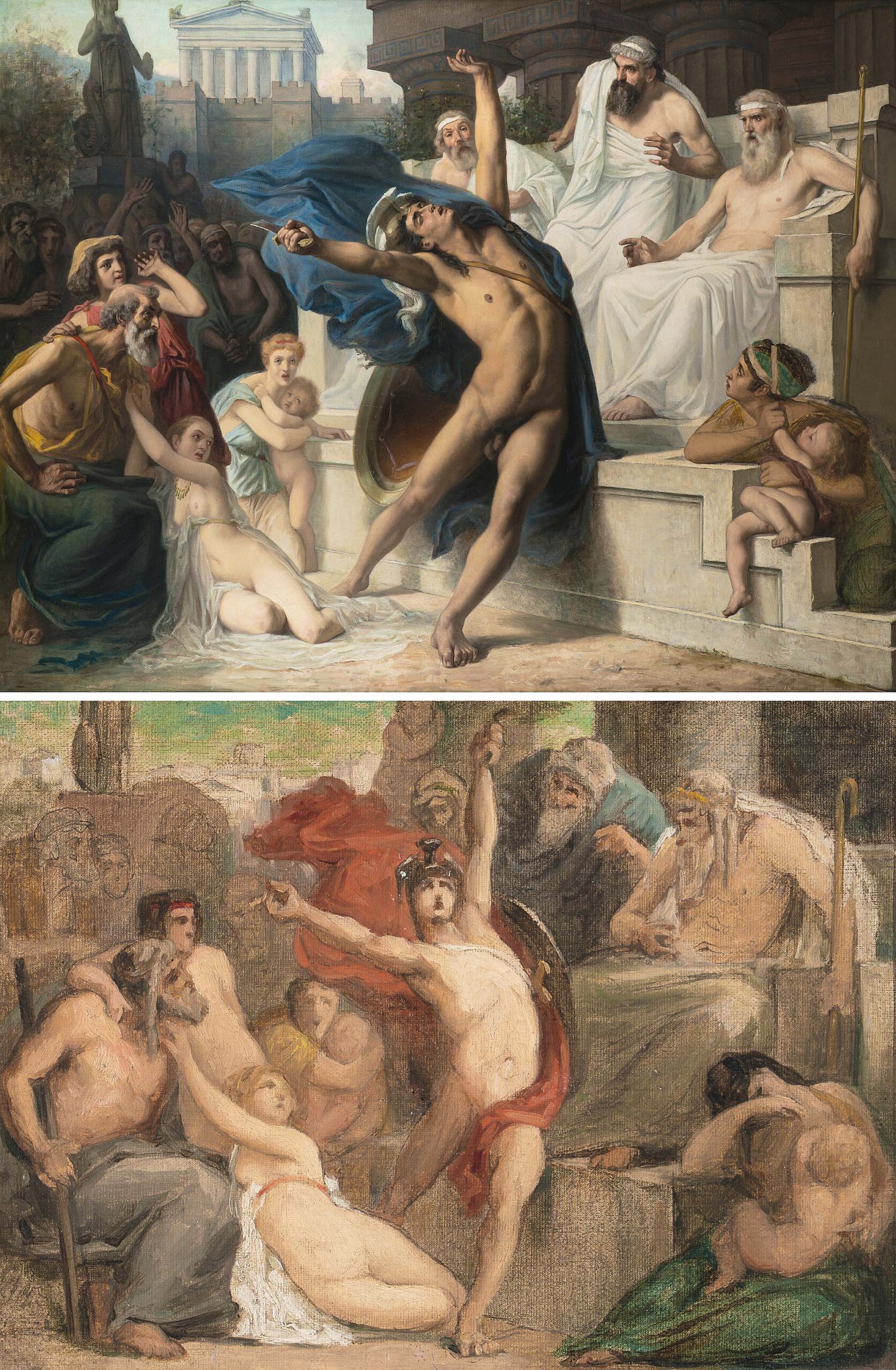
“The Soldier of Marathon” by Alexandre-Hippolyte Charles (French, 1845-1918), oil on canvas, 52¼ by 65¾ inches framed, sold with its a 9¾-by-12½-inch oil study (lower) for $53,567 (€10/20,000).
Other paintings to easily rise above estimates included an oil on panel portrait of a young man that was cataloged as “probably workshop or school” of Rembrandt Harmensz. van Rijn. However, bidders took a chance on the cautious €150/300 (about $172/344) estimate, pushing the possible self-portrait of Rembrandt to $32,554. The framed panel had provenance to a private collection in Rhineland-Palatinate collection in the southwest of Germany. In addition to an old paper label that read “Manshuvud / Tyskt 1700-tal” or “Male head, German, Eighteenth Century,” the reverse of the work had several unidentifiable markings. It sold to a buyer in Spain via the internet.
Also heading to Spain with an online buyer was Alfred Dehodencq’s portrait of a young Spanish woman with a guitar. The signed painting came from a local private collection in Düsseldorf and topped off at $17,761, tripling its €4,000 high estimate.
Religious themes continue to draw interest, and several allegorical paintings brought strong prices. Ascending far beyond its €300 high estimate and heading to Italy for $18,501 was an arched oil on canvas painting of “The Assumption of the Virgin” by a member of the school/circle of Guillaume Courtois. It had provenance to a collection in the central German state of Hesse and sold to a phone bidder.
“Our Lady of the Seven Sorrows” after Adriaen Isenbrandt (Netherlandish, circa 1485-1551), Nineteenth/Twentieth Century, oil on panel, 54 by 54¾ inches, rose to $20,720 (€8,5/17,000).
An old, typed paper note on the rear of an oil on panel rendition of “Our Lady of the Seven Sorrows” indicated it was painted by Lionel Poupaert (Bruges, Belgium) for a Mr Henrico Maes with the consent of the Reverend Mr Deschepper (likely René De Schepper [1875-1963]), both representing the Church of the Blessed Virgin Mary in Bruges. Poupaert “executed this most faithful copy of the original painting of the Virgin of Sorrows by the eminent painter Adriaen Ysenbrandt (1530),” as the note read. This copy after Ysenbrandt/Isenbrant was last held in a South German private collection and sold to an online buyer in the Netherlands for $20,720.
In the decorative arts category, a gilded wall mirror designed by Dagobert Peche for Wiener Werkstätte that Hargesheimer cataloged as “hochbedeutender” or highly important, sold to an internet bidder in Switzerland for $40,149. The limewood mirror, with label for Max Welz, an Austrian gilder who was responsible for executing works designed by Wiener Werkstätte members. The mirror combined a basic rectangular frame with ornamental flourishes on the top and bottom, including stylized dolphin motifs, ribbons and volutes.
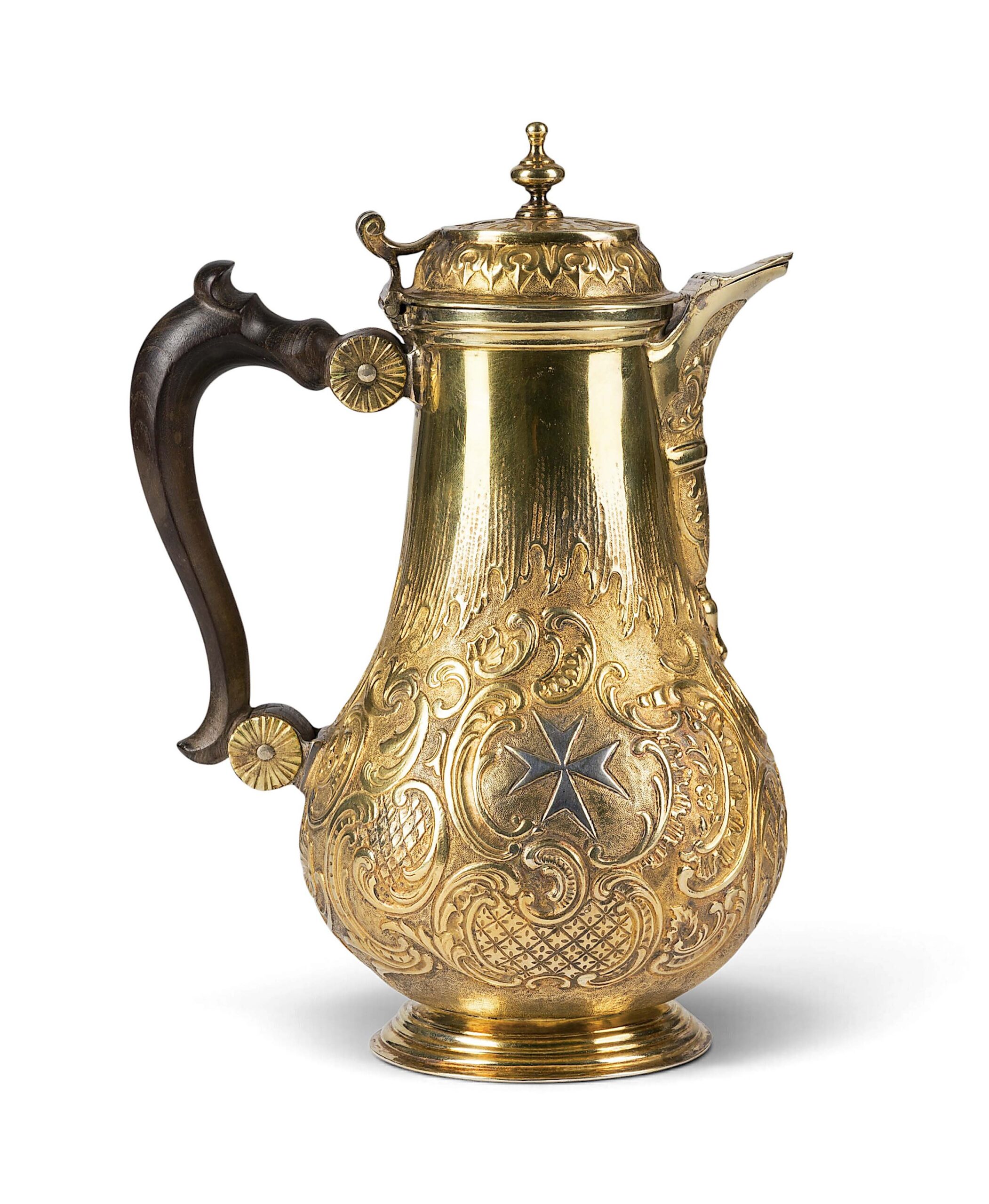
Another standout example of craftsmanship was a Maltese mocha pot bearing the coat of arms of António Manoel de Vilhena, Grand Master of the Order of Malta, on the front beneath the spout, and a Maltese cross on either side. The intricately chased vessel had a hinged lid and a wooden handle and was marked “MB,” possibly for silversmith Matteo Borg, to its underside. Made circa 1623-36, the pot was featured in The Silver of Malta by Alaine Apap Bologna, published for Fondazzjoni Patrimonju Malti (the Maltese Heritage Foundation) in 1995. The historic piece sold to an online bidder for $29,600.
Prices quoted include the buyer’s premium as reported by the auction house and have been converted into USD from euros based on the exchange rate on the day of the auction. For information, www.kunstauktionen-duesseldorf.de/en.