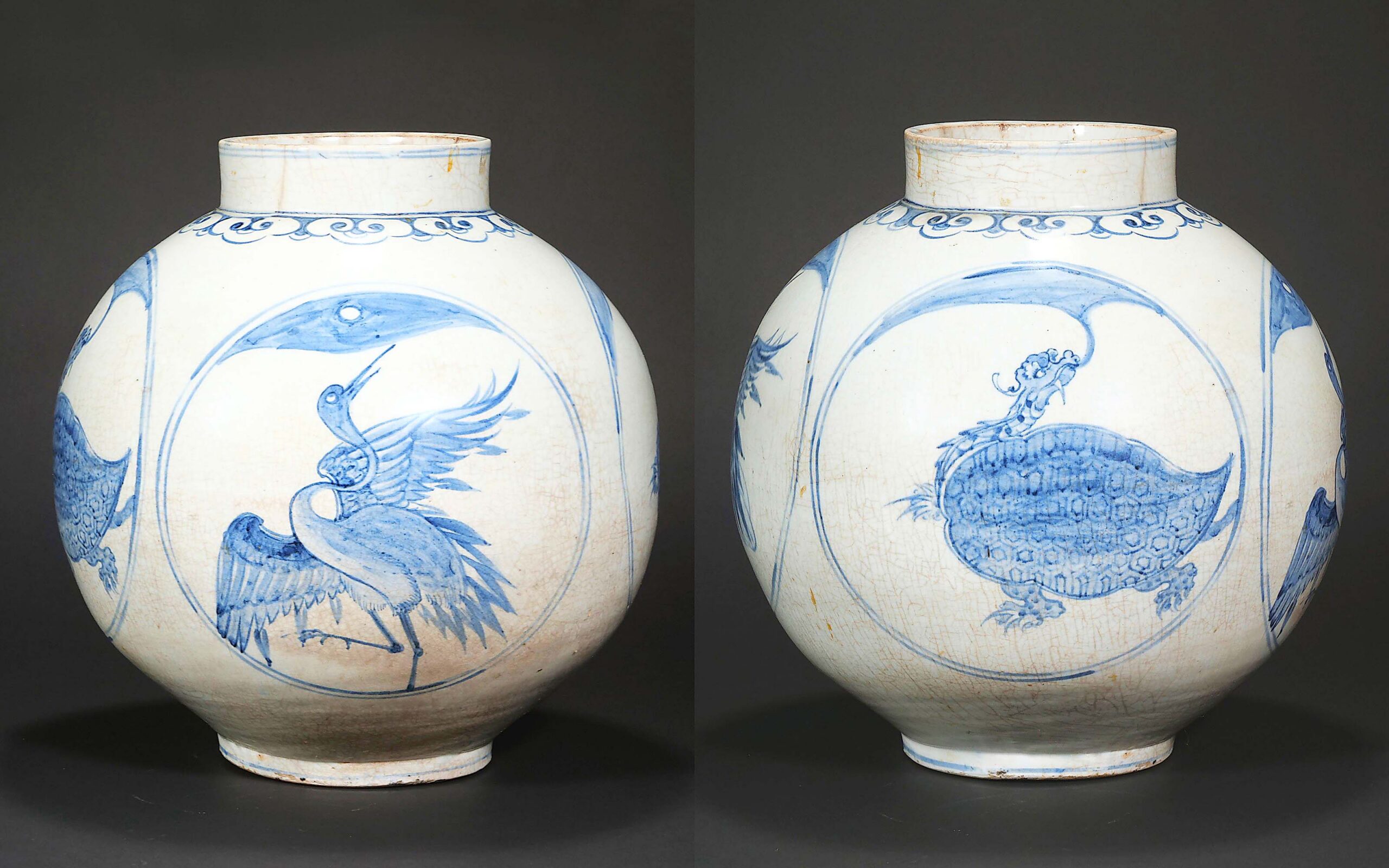
Making an impressive $344,400 to lead the auction was this important Eighteenth Century blue-and-white ovoid jar with crane and tortoise motifs, Joseon dynasty, Korea, 13½ inches tall and diameter ($5/10,000).
Review by Carly Timpson
STAMFORD, CONN. — “We are very pleased, and obviously there were several headline lots,” said ACES Gallery founder Alex Fonarow, jumping into conversation about the firm’s Fall Estates Auction on October 18. Comprising 450 lots, the sale was “overall very strong,” he said.
While lower-priced objects are still struggling at auctions due to fulfillment costs and other economic challenges, he explained, the same cannot be said for those at the top. “The high-end bidders were eager, excited and positive going into the auction,” Fonarow added. “Our staff said they have never seen so many happy buyers.”
The biggest story to come out of the gallery was the $344,400 result for an Eighteenth Century Korean blue-and-white jar that held an estimate of just $5/10,000. Made during the Joseon dynasty, a time during which sipjangsaeng motifs, representing the Ten Symbols of Longevity, became widely popularized, the ovoid jar was detailed with symbolic images of cranes and tortoises within circular medallions and had a ruyi-style cloud band around the neck.
“I had my suspicions about the jar when I found it sitting on the living room floor of an unassuming Bedford, N.Y., home with a potted plant inside,” said Fonarow. “Diligent research, several trips to the library and a strong marketing plan drew the gaze of eager bidders, and they all agreed it was the real McCoy.”
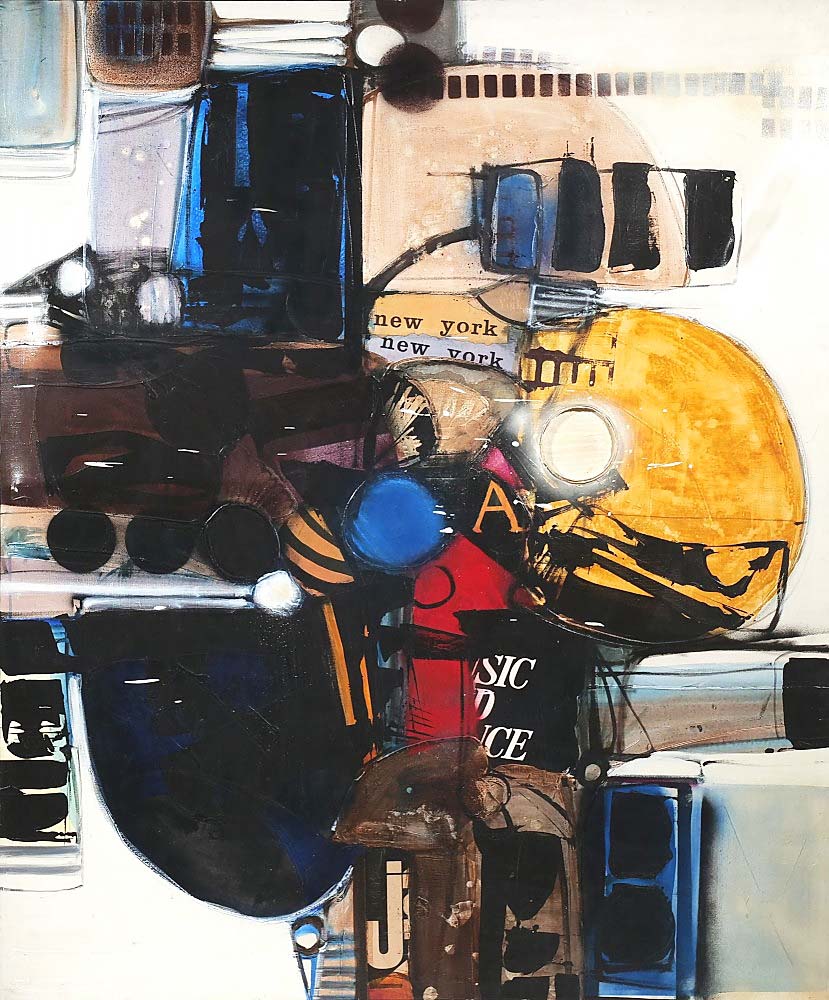
“New York II” by Kazuya Sakai (Japanese/Argentine, 1927-2001), 1964, mixed media and collage on canvas, 60¼ by 50¼ inches framed, was pushed to $86,100 ($5/10,000).
As for why this particular jar did so well, Fonarow explained that Korean ceramics that came to the US in the Twentieth Century were not well-tracked and a lot of the provenance was lost, but the history of this example, as it was collected and then given as a gift, was preserved. He added that, “it was great and had all of the qualities that give it value: form — the silhouette was just incredible — iron on the foot, craquelure…”
“The jar is going back to Korea. We had lots of bidders from Korea, China, Japan and some in the US, but it was mostly Asian buyers on the phones carrying the bidding.”
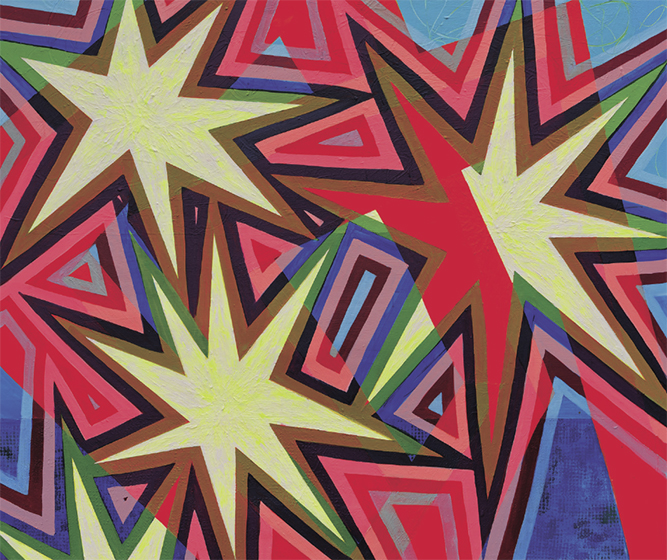
Asian representation continued, as did exceptional results, with a large mixed media and collage on canvas by Japanese Argentine artist Kazuya Sakai easily besting its $10,000 high estimate and selling for $86,100. The work, titled “New York II,” was an abstract composition primarily featuring paint and typographic clippings. As the catalog notes, “This 1964 work represents his ‘New York’ period, characterized by the integration of Pop art influences and urban collage elements into his abstract style.”
Though it was a large work from a desirable, short-lived period, “The Sakai really shocked everyone,” Fonarow shared. “It came from the private collection of a woman in Ardsley (N.Y.). She lived in New York City and purchased it from a gallery there in the 70s. She didn’t pay much for it, and when she moved into her apartment in Ardsley, it didn’t fit. So, it’s been in storage for almost 20 years.”
“Remnants of Order” by Paul Horiuchi (Japanese/American, 1906-1999), 1966, mixed media collage with washi paper on canvas, housed in a 66½-inch-by-79-inch frame, sold to a phone buyer on the West Coast for $67,650 ($5/10,000).
Paul Horiuchi, who was part of the Northwest School of artists in the Pacific Northwest, was another Midcentury artist working with abstractions. His “Remnants of Order,” a mixed media collage with washi paper on canvas, “came from a custom-built home in Larchmont, N.Y., that was like a time capsule. It was built in the 60s and decorated with all period furniture and art and was never touched again — it still had gray shag carpet in the bathroom! This was hanging over the fireplace.”
In great condition minus some small dents, “Remnants of Order” was signed and dated to the lower right corner, adding to the work’s draw. The date, “66,” places this collage in the artist’s highly sought-after mid-career period. Additionally, the work was created at a scale much larger than his typical collages, measuring 66½ by 79 inches framed; comparable large pieces are held in major institutional collections. Fonarow noted that some “important bidders” came to the gallery to view the work, as its size and condition captured attention. Despite receiving institutional interest, it ultimately sold on the phone to a private West Coast bidder for $67,650, and another private client was the underbidder.
A Korean School four-panel screen decorated in the popular style of chaekgeori (books and things) impressed bidders as well. The Nineteenth or Twentieth Century screen was made of ink and color on paper mounted to panels, each depicting a traditional still-life scene with books, flowers, ceramics, fruits, birds and other symbolic images. Though the screen’s high estimate was just $1,200, it went out to an Invaluable bidder at $10,455.

This Nineteenth or Twentieth Century Korean School four-panel screen, ink and color on paper mounted to panels, 32¼ by 64½ inches overall, had chaekgeori motifs and sold to an Invaluable bidder for $10,455 ($800-$1,200).
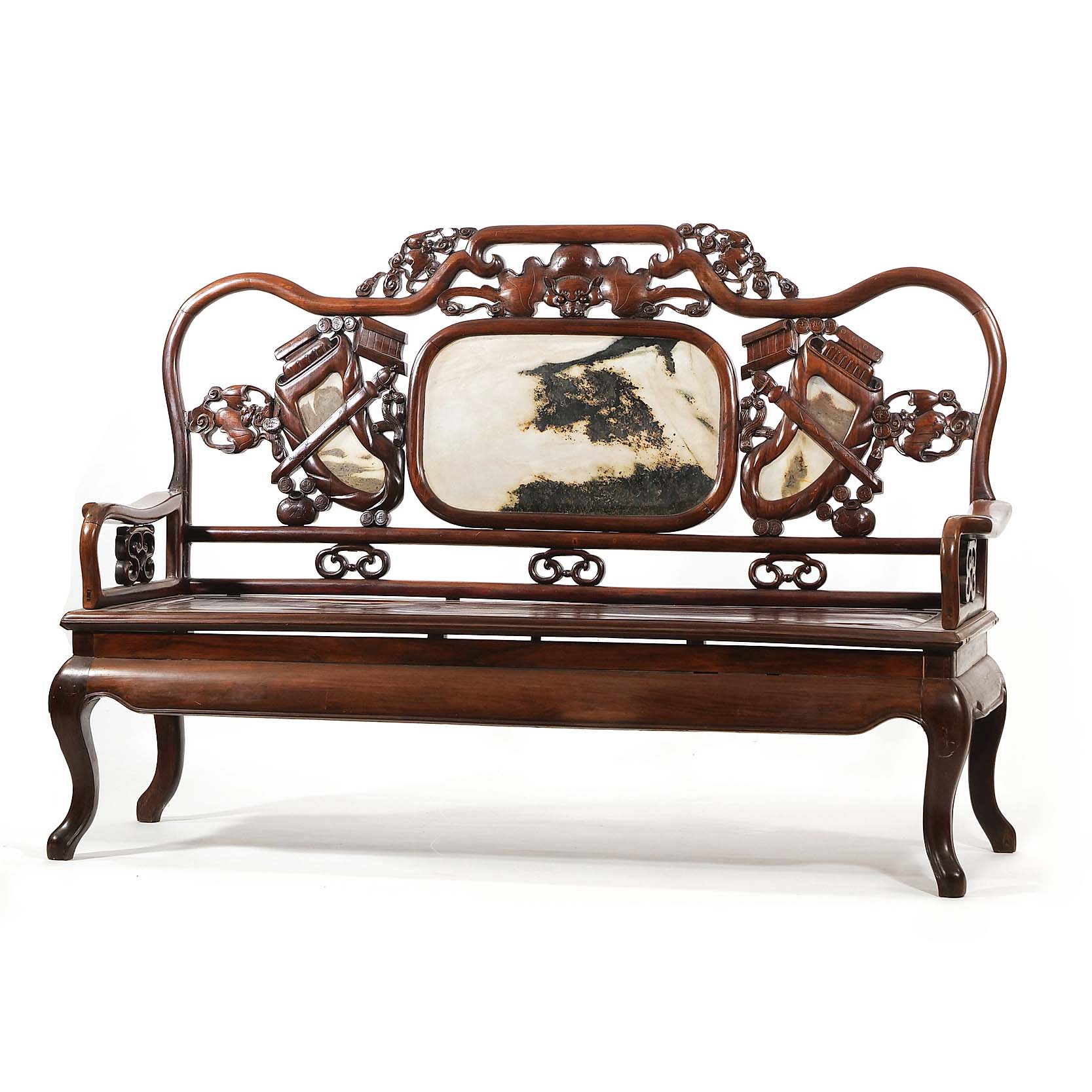
Asian furniture was led by a Chinese carved settee. The circa late Nineteenth or early Twentieth Century seat, either Qing dynasty or Republic period, was made of dark hongmu wood and had a triple-panel Dali marble-inset backrest. “The hongmu settee took off. It was consigned from a collection in Stamford. It was really heavy with its stone-inset back, the carving was really great, but the back story was even better,” Fonarow explained. “It was purchased by the consignor’s father, a businessman in Hong Kong. He bought it for his office in the 1920s.”
Prices quoted include the buyer’s premium as reported by the auction house. For information, www.aces.net or 914-222-8686.