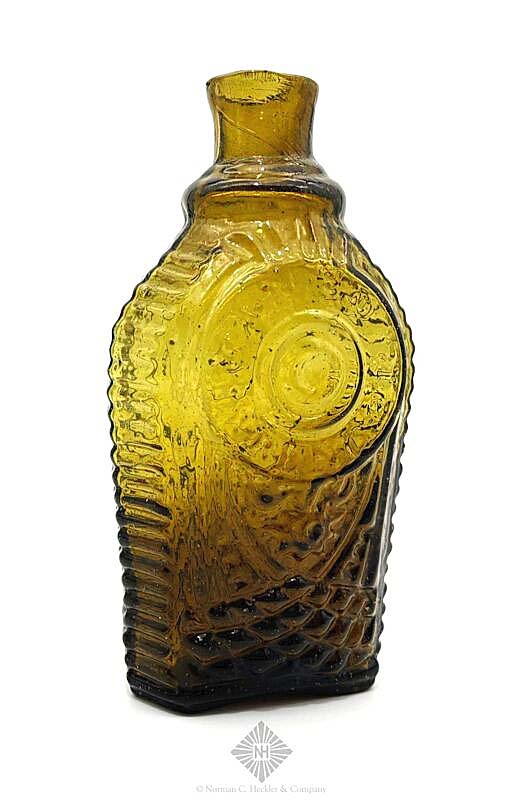
Bringing the auction’s highest price of $24,570 was this light olive-yellow “Jared Spencer” flask, Pitkin Glass Works, Manchester, Conn., 1815-30 ($20/30,000).
Review by Carly Timpson
WOODSTOCK, CONN. — Norman C. Heckler & Company, known for its auctions of antique bottles and early American glass, conducted a 105-lot auction of glass, flasks, bottles, pottery and curiosities from the collections of Dr Gary & Arlette Johnson, Chuck Bukin, Jay & Maxine Jacobs, Robert Luthi and Ray Trottier, as well as property deaccessioned from the Suffield (Conn.) Historical Society to benefit its collection fund and new discoveries.
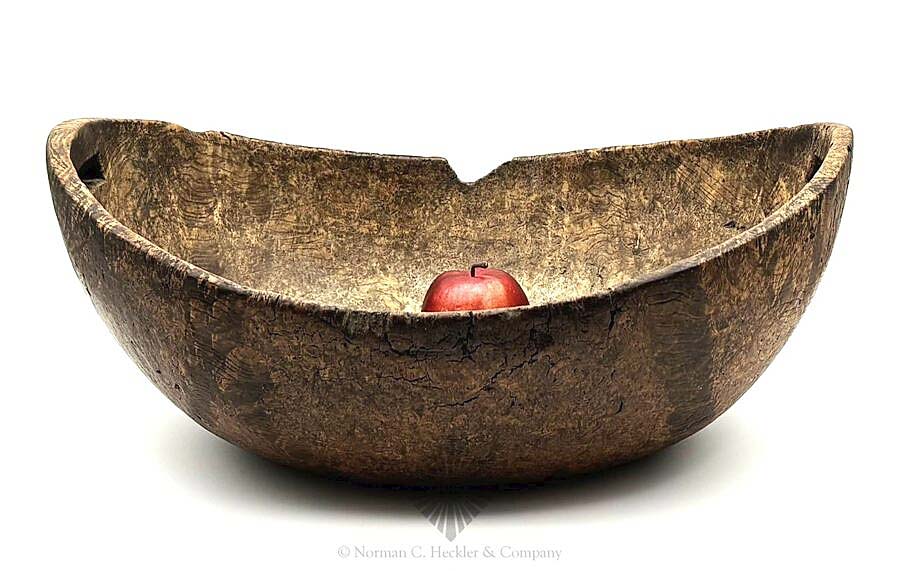
Owner and auctioneer Norman Heckler shared, “We had fun putting together this variety of material for the auction. We went out to see a glass collection and the people asked if we could sell the rest of it, so we did!” One of those lots that are outside the firm’s norm was a large wooden bowl that was probably made by a Native American in the Eighteenth Century. The burl bowl, which was bid well beyond its $800 high estimate to achieve $7,605, retained its original grainy, richly textured surface and had rectangular cut-out handles. “It was a very desirable form, with the cut-out handles,” Heckler explained. “They usually do command that kind of money, far and above the regular wooden bowls.”
Of course, bringing in diverse lots can bring in new collectors, or encourage regular bidders to take a chance on something they may not have sought out otherwise. “I got a lot of calls from regular collectors of glass asking, ‘What is this mocha ware? It’s really cool; I don’t remember seeing this form’ and things like that,” Heckler said. “Mocha ware pottery is always popular.” The leading price of the selection was achieved by two mugs with geometric patterns ($527), though other forms included a lot of three salt cellars with seaweed patterns in blue, chocolate and red ($497) and three individual salt cellars, in cat’s-eye, seaweed and earthworm patterns, each selling for $468.
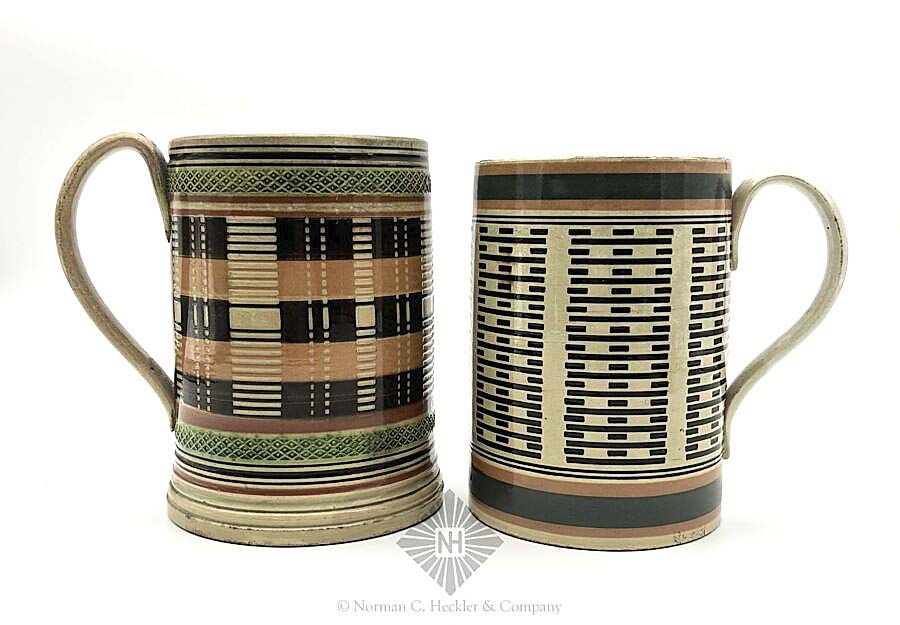
These two mugs, 6 inches (tallest), led mocha ware pottery offerings at $527 ($600/800).
However, the auction’s top price — back to regularly scheduled programming — was a Jared Spencer flask from the Jay and Maxine Jacobs collection. Considered one of the most sought-after flasks in the Jared Spencer group, this McKearin GX-24 example was impressed with “Jared / Spencer” in a medallion above diamond diapering, with the reverse having the same pattern, though the medallion read “Manchester / Con.,” where it was made circa 1815-30 by Pitkin Glass Works. “That flask has been sought-after since the beginning of collecting — 1900s, 1920s — and it’s still very rare; not many have come to light in over 100 years,” Heckler noted. In a light yellow-olive glass, this example brought $24,570.
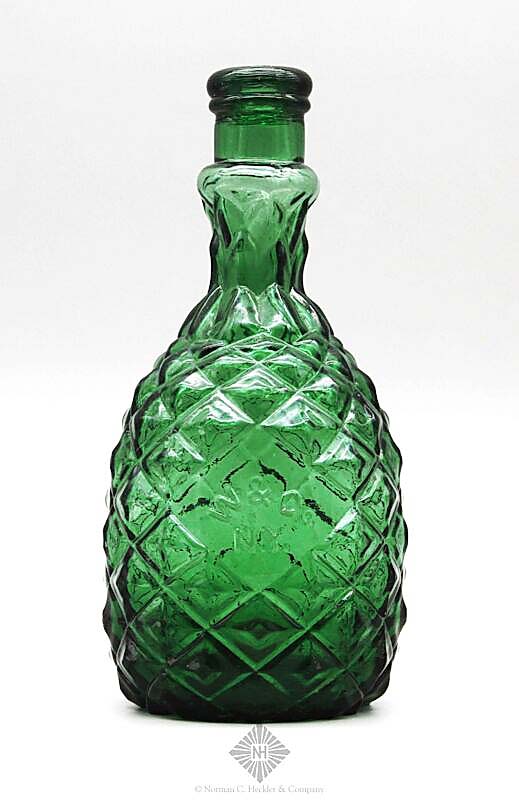
While a pineapple figural whiskey bottle is already a “very good form,” according to Heckler, the brilliant green color he offered in this auction was exceptional. “They make like $500 in amber, and this one in green got $11,700, so color definitely makes a lot of a difference in early glass and bottles,” he explained. The American bottle dated to 1845-60 and was marked at the center of its body for “W & Co / N.Y.” With an applied double collared mouth and an iron pontil scar, the bottle was in wonderful condition, coming from the collection of John Rieben.
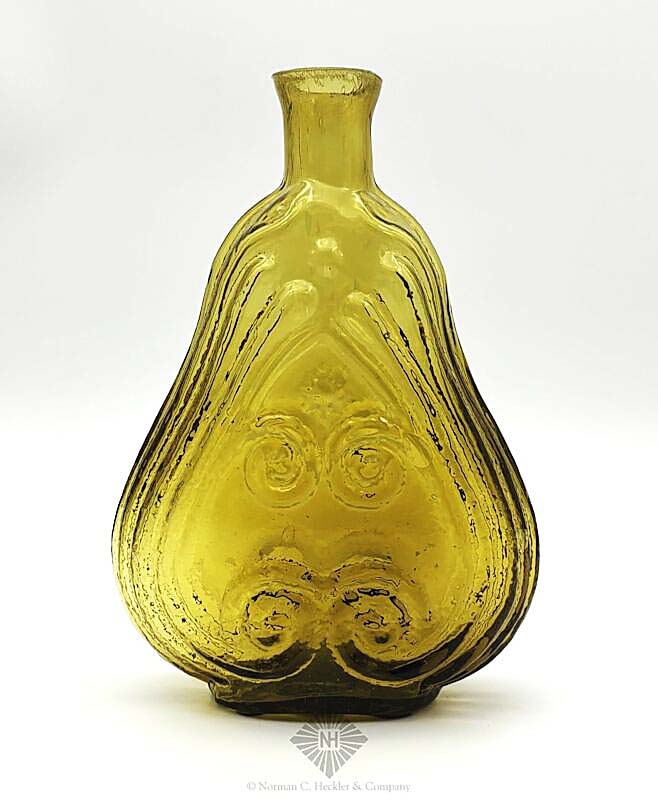
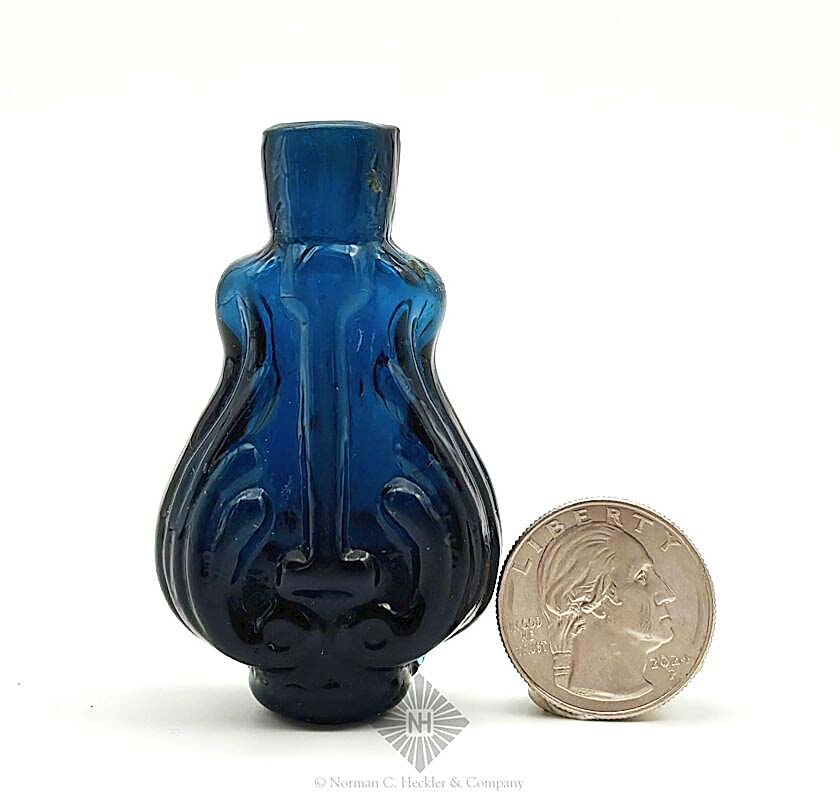
A circa 1845-60 mold-blown scroll flask in a lemon yellow with a hint of topaz that had provenance to the John Apple collection more than doubled its high estimate to bring $9,360. Though it was identified as McKearin GIX-11, a fairly common historical flask, this nearly pure yellow coloration was considered rare. A significantly smaller scroll flask, this one in a rich peacock blue and measuring just 2⅝ inches tall, realized $4,388. From the Jacobs collection, this McKearin GIX-40 example was dated to 1840-60 and had a ⅛-inch potstone with a flash of iridescence in its shoulder.
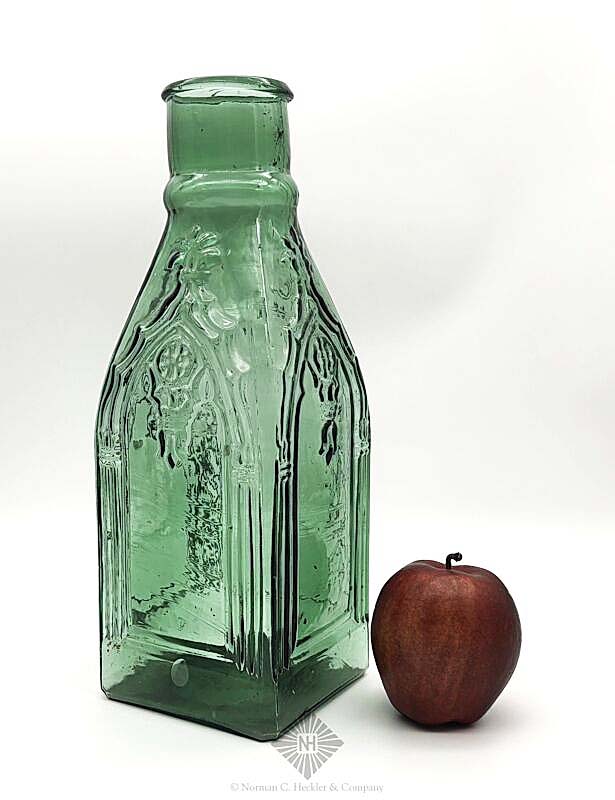
At 14 inches tall, this Willington (Conn.) Glass Works cathedral pickle jar, 1845-60, was claimed for $4,973 ($3/4,000).
With fancy cathedral arches and a tooled round collared mouth, a Willington Glass Works pickle jar in green also bested estimates to bring $4,973. Though the jar had a ¼-inch stretch mark on one of its beveled corners, it was no harm to the jar’s overall condition.
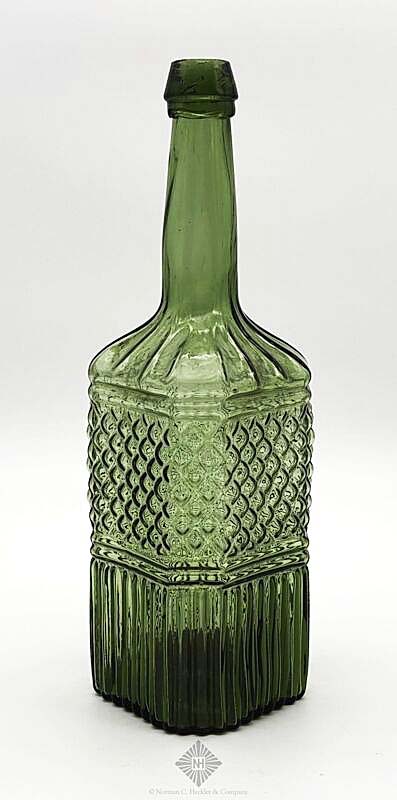
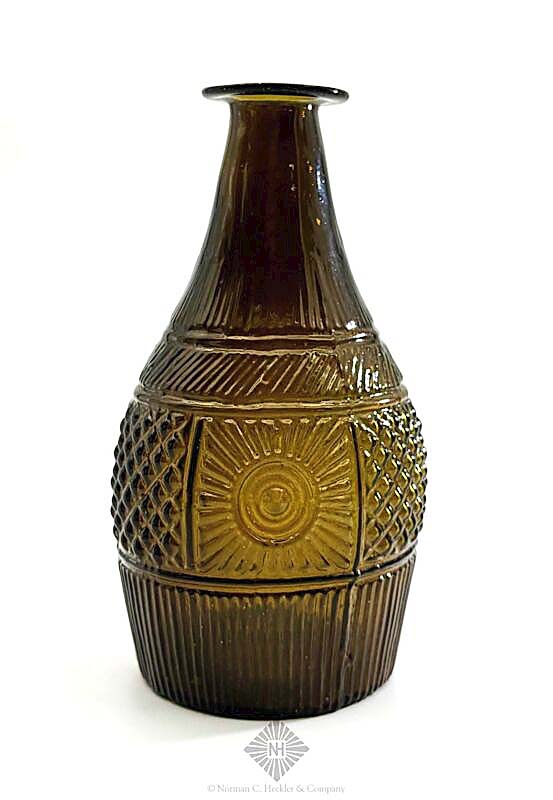
From the Keene Marlboro Street Glassworks further north in New England came two blown three mold decanters. These New Hampshire-made bottles were both made between 1820 and 1840, though they differed in several ways. Bringing $4,680 was a brilliant green bar bottle with a rectangular body having geometric and ribbed patterns and a long neck, identified as McKearin GII-28 and with provenance to the Barry Hogan collection. The other was an olive-green example with a flared mouth, cataloged as GIII-16. The bulbous body was patterned with alternating panels of sunburst and geometric patterns above a ribbed bottom. Heckler noted that this example, which brought $4,095, was “extremely rare with the flared mouth treatment.”
Perhaps also from behind the bar was an American barrel-form bitters bottle in lemon yellow. Made circa 1860-80 for Old Sachem Bitters and Wigwam Tonic, this bottle, with an applied square collared mouth and smooth base, had concentric rings above and beneath its smooth, marked center. Heckler identified the example as having “fantastic color,” and it was a good buy at $4,095.
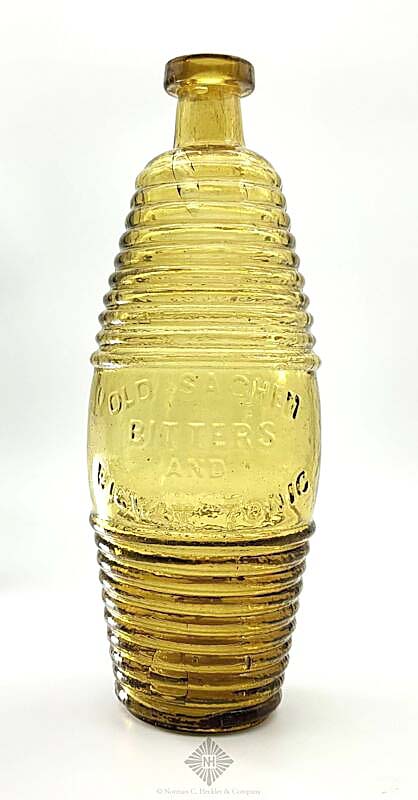
This barrel-form figural bitters bottle for “Old Sachem / Bitters / And / Wigwam Tonic,” American, 1860-80, 9¾ inches tall, finished for $4,095 ($6/8,000).
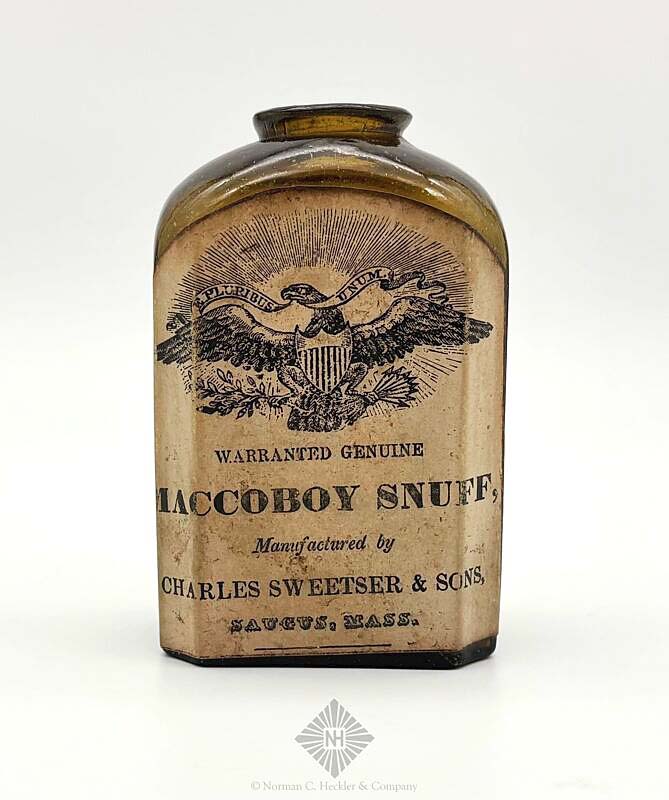
Satisfying another vice was a labeled snuff bottle in olive green that rose far beyond its $500 high estimate to achieve $3,803. Beneath an illustration of an American eagle, the still-intact paper label read, “Warranted Genuine / Maccoboy Snuff / Manufactured by / Charles Sweetser & Sons / Saugus, Mass.” With a short tooled flared mouth, the bottle, which came from the Trottier collection, featured a pontil scar and bold letter “F” stamped to the base.
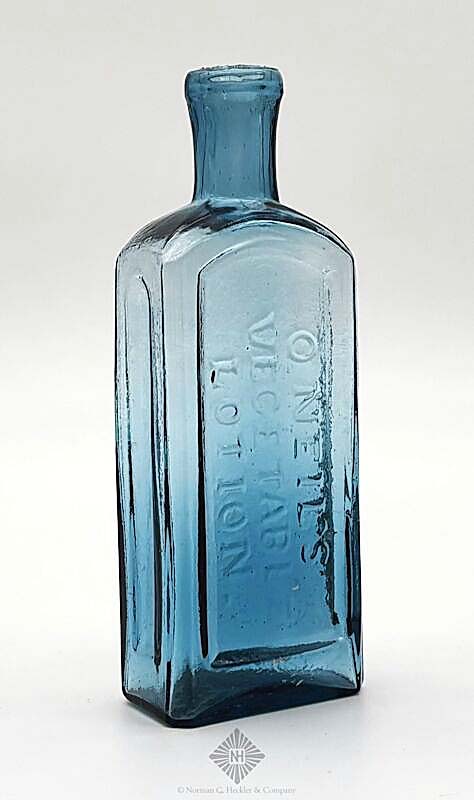
With provenance to the collections of Sam Greer and James Chebalo, an O’Neil’s Vegetable Lotion medicine bottle was taken to $3,803. The rectangular American bottle dated to 1845-55 and was in a cornflower-blue color. Cataloged as a “Unique example” and “A beautiful colored pontiled medicine,” the 5-inch-tall bottle had beveled corners and a rough sheared mouth.
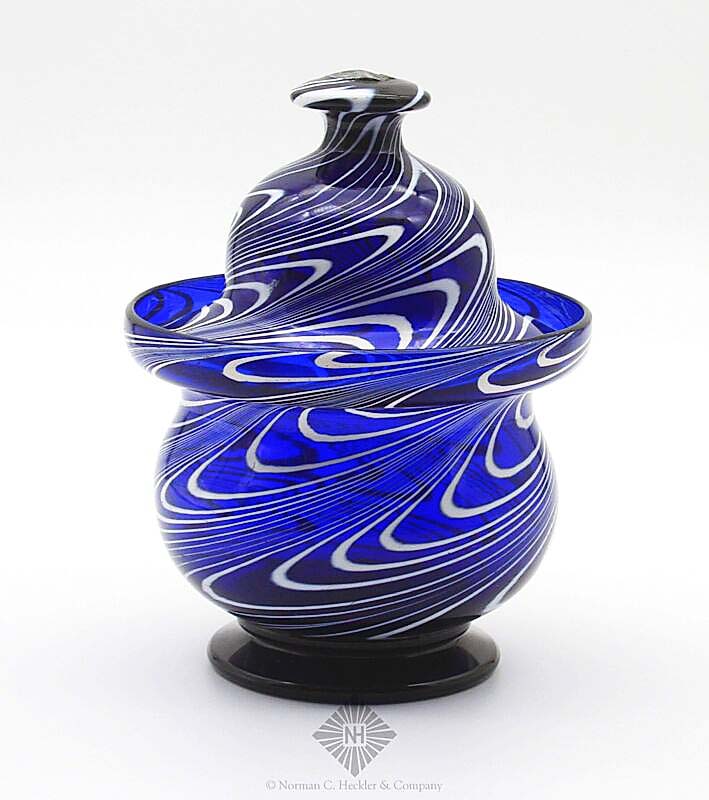
Aside from bottles and flasks, glass tableware was also a hit. A free-blown covered sugar bowl from Pittsburgh circa 1830-50 found a new home for $3,510. Of bulbous form with an applied circular foot and a domed cover, both with pontil scars, the bowl was a brilliant sapphire blue with milk glass loopings. A similar form was illustrated in Pittsburgh Glass 1797-1891: A History and Guide for Collectors by Lowell Innes (1976).
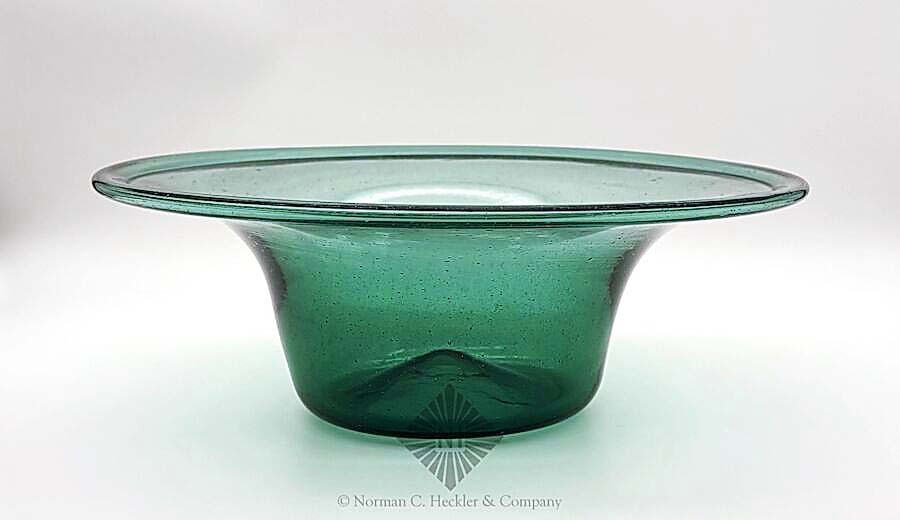
A free-blown bowl from New York was cataloged as having “Stunning size and presence.” The Nineteenth Century bowl was in a shade of emerald green and featured areas of attractive “seed bubbles,” as described in the catalog. Ultimately, it more than doubled its high estimate to bring $3,218.
Heckler’s next auction featuring antique bottles and glass will be in autumn, date to be announced.
Prices quoted include the buyer’s premium as reported by the auction house. For information, www.hecklerauction.com or 860-974-1634.