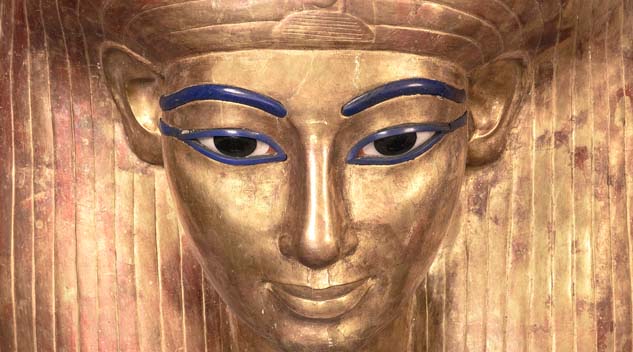
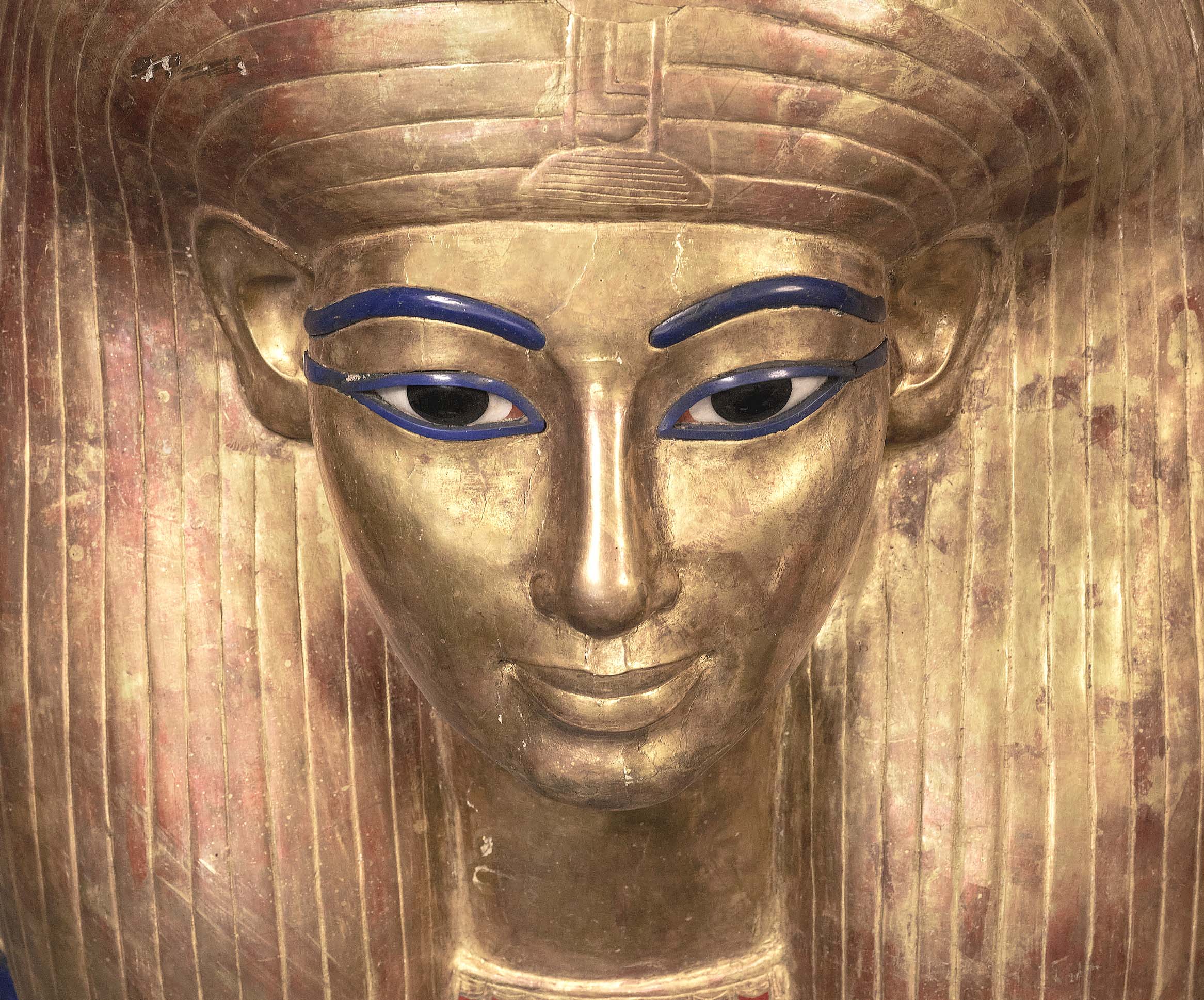
Outer anthropoid coffin lid of Thuya, Luxor, Valley of the Kings, Tomb of Yuya and Thuya (KV 46), New Kingdom, Eighteenth dynasty, reign of Amenhotep III, wood, gilded stucco with inlays of blue glass, obsidian (eyes), light blue, dark blue and red glass, 86 by 26½ by 37 inches. Egyptian Museum in Cairo, JE 95232.1&2, CG 51006.1&2, SR 4/8.1&2. Photograph by Massimo Listri.
By James D. Balestrieri
SAN FRANCISCO — Ma’at. It’s really the key concept that guided the philosophy that underpinned the political and social structure of ancient Egypt.
The word ma’at stands for the cosmic order that the pharaoh, as both man and deity, must maintain. It’s a balance between realms that, ideally, filters down through society, a devotion to truth, justice and propriety that might, just might, have influenced Aristotle’s notion of the golden mean.
Yet truth, justice and propriety do not, by definition, preclude the creation of objects of splendor. Indeed, the divinity of the pharaoh, and his role in ensuring everything from the fertility of the land to oversight of the creation of miraculous wonders, such as pyramids and dams, demanded displays of wondrous, priceless objects that would have appeared to have been inspired and perhaps even wrought by gods and would surely have appealed to them.
Featuring some 130 of these royal treasures and associated objects, and with a lively, lavish, and informative catalog by rockstar Egyptologist Dr Zahi Hawass, the de Young Museum, one half of the Fine Arts Museums of San Francisco, is playing host to “Treasures of the Pharaohs,” the first venue in the United States for the touring exhibition that spans nearly three millennia of Egyptian history from the First dynasty, circa 3100 BCE, through the Ptolemaic period, which came to an end in 332 BCE.
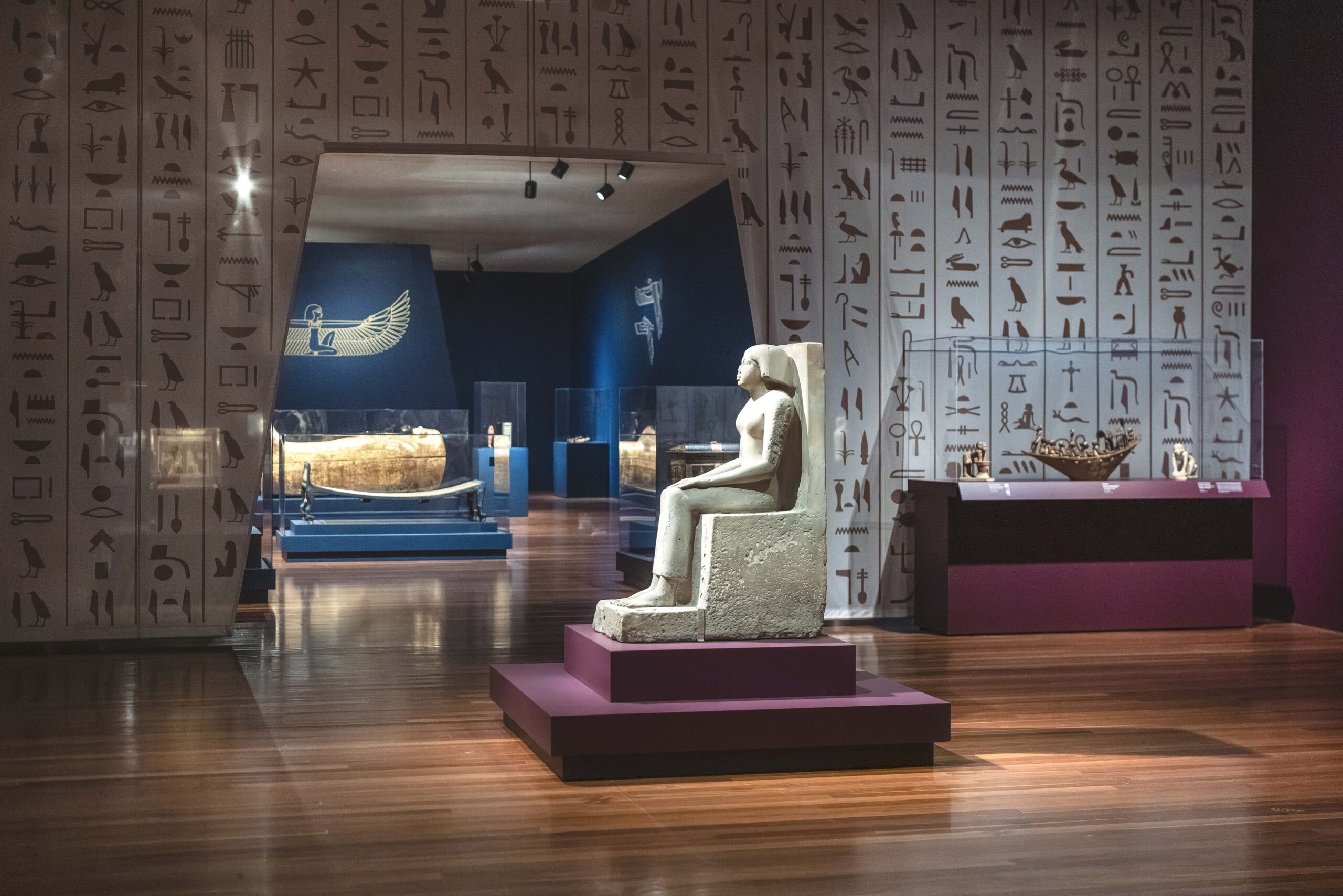
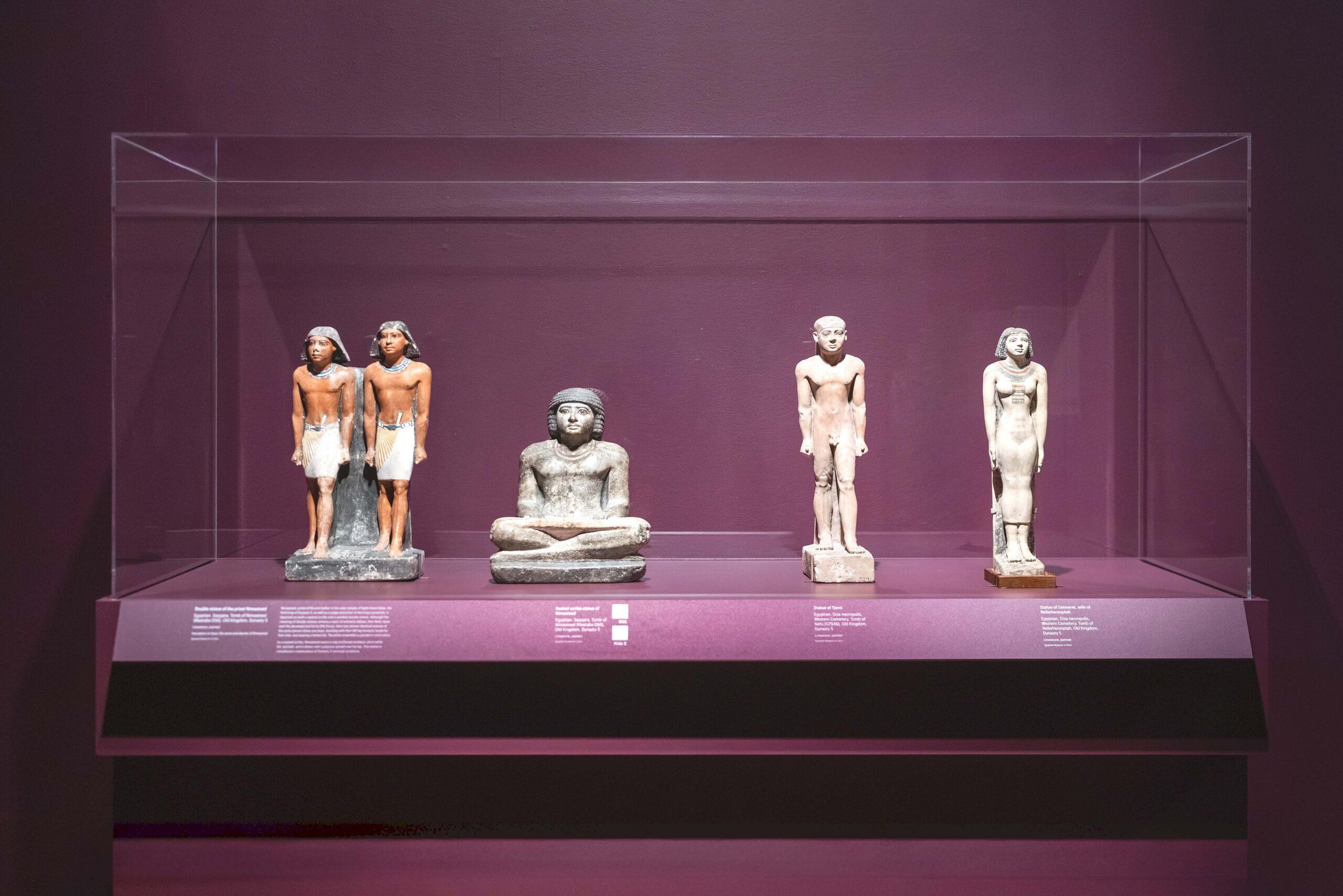
Installation view of “Treasures of the Pharaohs” at the de Young Museum, San Francisco, 2026. Photography by Gary Sexton. Image courtesy Fine Arts Museums of San Francisco.
On view at the de Young through January 31, the exhibition is divided into six sections, each of which, as the accompanying text states, “offer insights into daily life, social structures, religious practices and the society’s lasting impact on the modern world.” The sections are: “Divine Kingship”; “People Surrounding the Pharaoh”; “The Golden City”; “Religion and Beliefs”; “Daily Life”; and “Death and the Afterlife.”
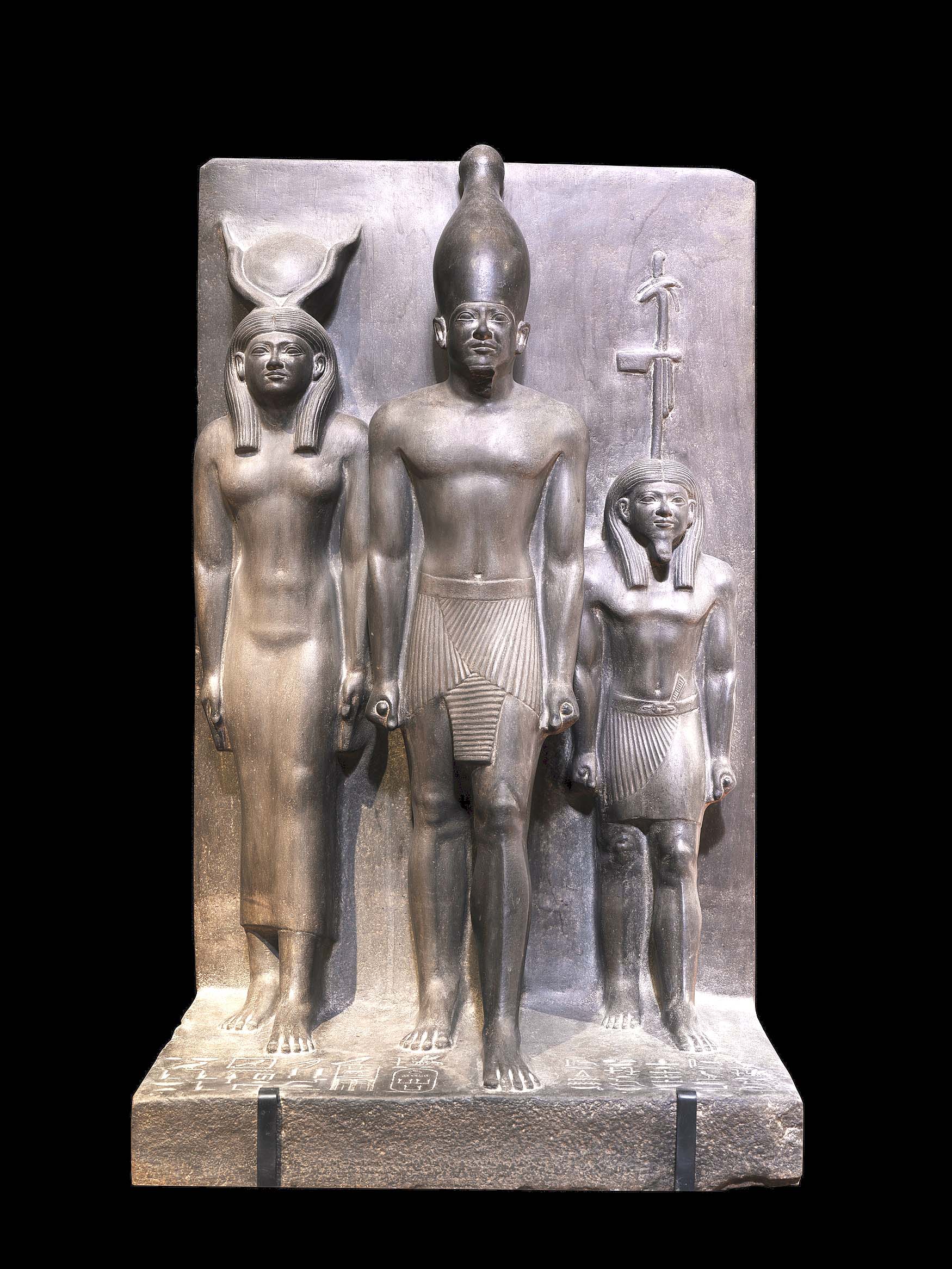
Striding confidently in step towards the viewer, the stately “Triad of Menkaure” from the Fourth dynasty of the Old Kingdom epitomizes the concept of “Divine Kingship,” as King Menkaure is flanked by the goddess Hathor at his right, and, smaller in scale, a representative personification of the province of Thebes. All three are named in the inscription on the base. As the catalog text states, “[T]he depiction of the king among the gods and symbols of the provinces is a powerful acknowledgement of and support for his kingship institution” and signifies “the absolute control exerted by the king and strict administrative organization of all the country’s wealth and resources.”
The administration required to govern Egypt was large, bureaucratic and rigidly hierarchical in shape. Though as time went on, appointment and advancement became more meritocratic in nature. Ranked directly below the pharaoh, or king, were members of the aristocracy, priests who served the gods that validated kingship and the various ministers who served the king. These people and their families comprise the section of the exhibition called “People Surrounding the Pharaoh.”
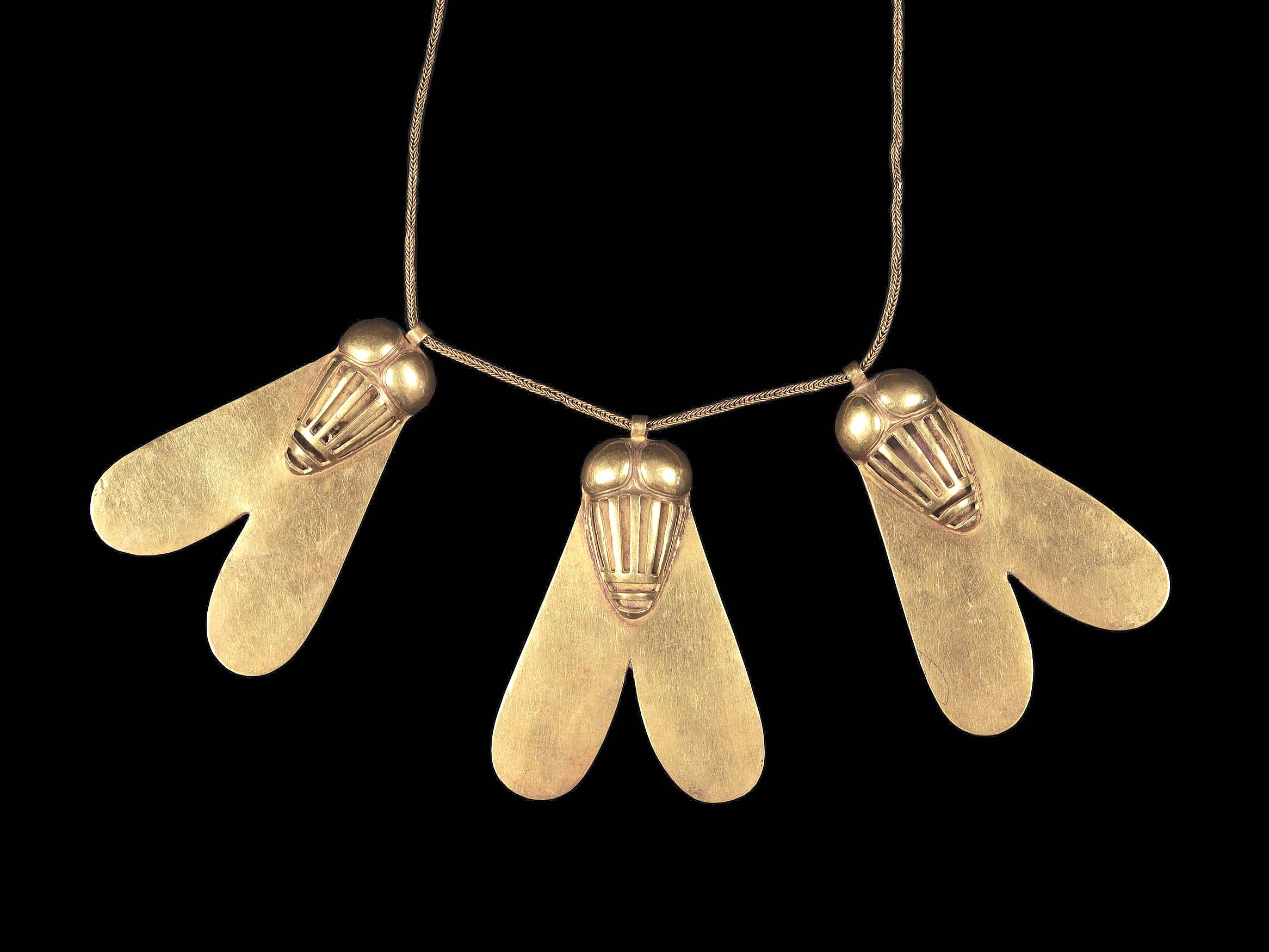
Necklace of Ahhotep II with Golden Flies, Second Intermediate period, late Seventeenth dynasty or early Eighteenth dynasty, New Kingdom, reign of Ahmose I, gold, Tomb of Queen Ahhotep II, Dra Abu el-Naga, West Bank of Luxor, approximate length of chain: 23 inches, pendants: 3½ inches. Luxor Museum, 854. Photograph by Massimo Listri.
One of the most intriguing and beguiling objects in the exhibition is Necklace of Ahhotep with Golden Flies. From the Second Intermediate period, Eighteenth dynasty, it was a military order of valor — Egypt’s highest at the time, primarily awarded for bravery. However, as the catalog reveals, “its presence in Queen Ahhotep’s collection is unique, probably explained by the fact that this queen played an important role during the war of liberation against the Hyksos.” All well and good, but one wonders: What role did the queen play? Did she lead an army? And what do flies have to do with valor, especially three realistically rendered flies? If there is a finer example of the ways in which symbols and metaphors shift over time from one signification to another, I would like to see it.
During his reign, King Amenhotep III built a new city, once thought lost and only recently discovered. Dubbed “The Golden City,” it may well prove to be the Pompeii of ancient Egypt. This city, one peopled by workers and craftsmen of all sorts, will offer insights into strata of ancient Egyptian life only hinted at up to now. If it is another Pompeii, whose excavations began in the Eighteenth Century, the Golden City will ensure a long and happy future for the study of Egyptology.
Amenhotep III was married to Tiye, the daughter of the nobles Yuya and Thuya. The outer anthropoid coffin lid of Thuya (Eighteenth dynasty, New Kingdom, reign of Amenhotep III) demonstrates the unusual regard the pharaoh had for his mother-in-law — in-laws were generally not permitted to be buried in gilded anthropoid coffins such as this.
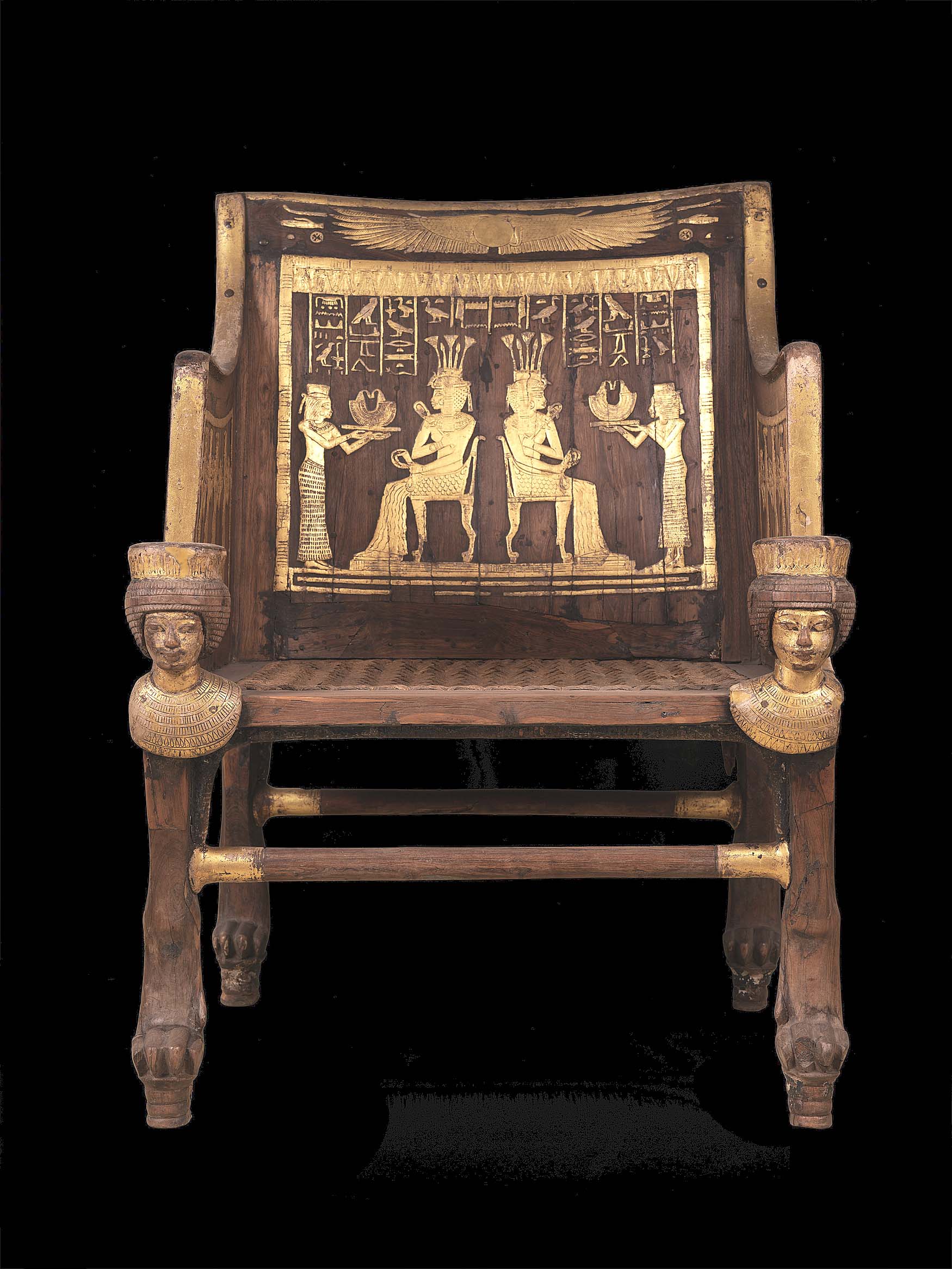
Armchair of Princess Sitamun, Luxor, Valley of the Kings, Tomb of Yuya and Thuya (KV46), New Kingdom, Eighteenth dynasty, reign of Amenhotep III, wood, gold leaf, stucco and plant fibers, 30¼ by 20½ by 21¼ inches. Egyptian Museum in Cairo, JE 69072, JE 95342, CG 51113, Sr 4/119. Photograph by Massimo Listri.
Surrounded in a mantle of gold, only Thuya’s face, a young face, shows. On the coffin, “the sky goddess Nut spreads her wings to welcome Thuya, giving her the breath of life,” and “On the box of the coffin, other deities grant their protection to Thuya, wishing her to ‘rest safe and sound in her coffin.’”
In addition to the ornate ceremonies that surrounded death, the rest of the system of “Religion and Beliefs” in ancient Egypt was easily as complex. Priests maintained temples and hosts of daily rituals that required that the gods were not only worshiped but given offerings of food and drink — some of which made their way to the priests as well as to the poor.
However, “Akhenaten and his family worshiping the god Aten” (Eighteenth dynasty, New Kingdom) marks an unusual moment — a tremor, one might say — in the continuity of religious life in ancient Egypt. Akhenaten abandoned the Golden City, moved the capital to Amarna and repudiated the pantheon of Egyptian gods apart from Aten, the sun god. No mere flirtation, Akhenaten’s 20-year monotheistic experiment allowed him, among many other things, to tax all other temples. In fact, his view of divinity reverberated through the centuries and has led to the widespread fame of his wife, Queen Nefertiti, and his illustrious son, Tutankhamen.
In “Akhenaten and his family worshiping the god Aten,” we also see something new to ancient Egyptian art: “the depiction of the royal family and their daily activities, whether playing and having fun with their children or worshiping the god Aten, embodied in the sun disk.” Humanizing the divine is, of course, a concept we in the West know well, and it is fascinating to learn of one of its origins in the mind of Akhenaten.
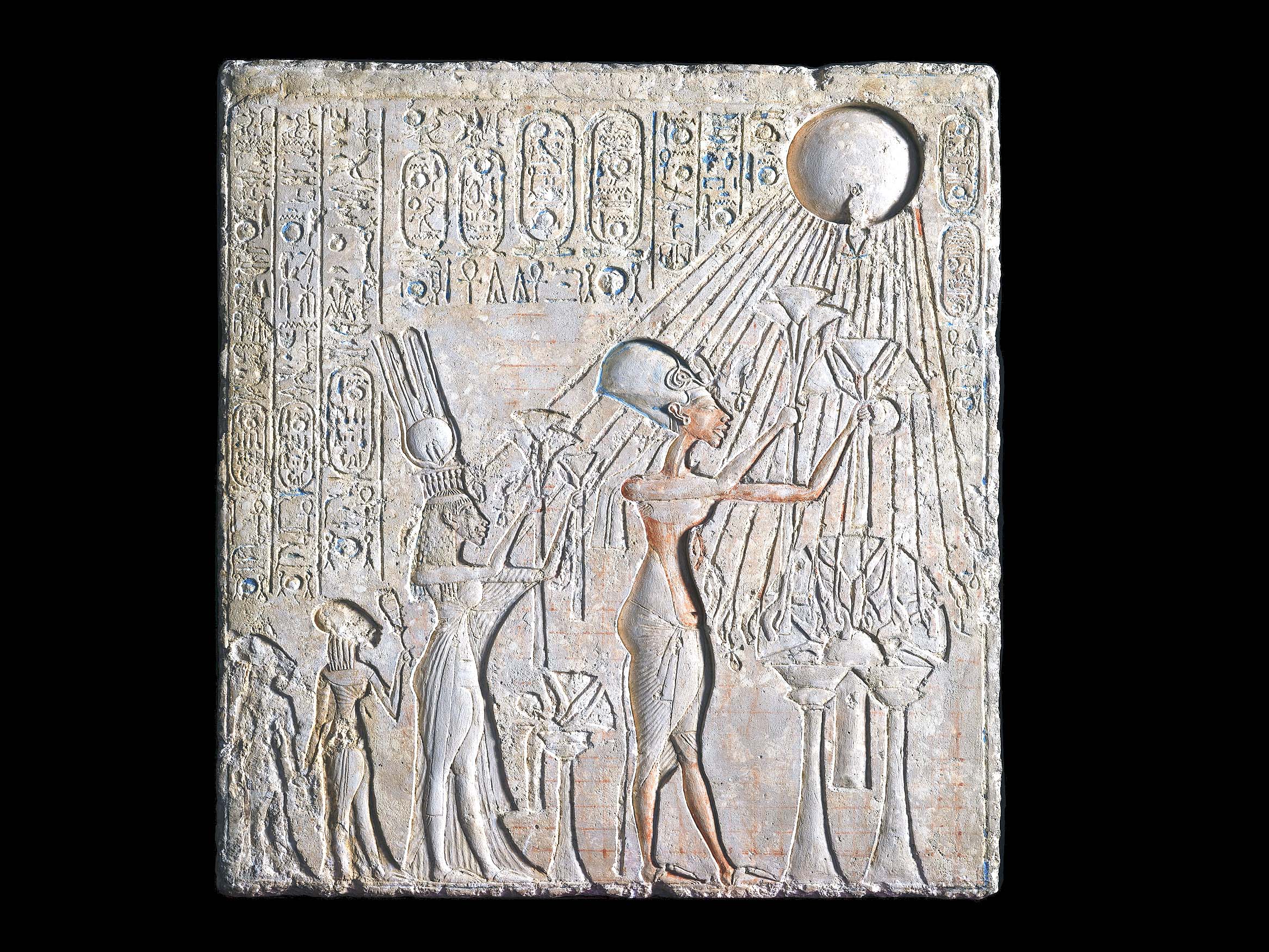
Limestone relief of Akhenaten, Nefertiti and two princesses worshipping the Aten, New Kingdom, Eighteenth dynasty, Akhenaten, limestone and pigment (unspecified), 20⅞ by 18⅞ by 7-1/16 inches. Photograph by Massimo Listri.
The activities of “Daily Life” in ancient Egypt must have been quite busy and rich in variety. “The middle class, comprising scribes, soldiers and specialized professionals such as artisans and artists, played a central role in Egyptian society’s accomplishments. Below them were peasants, construction and quarry workers, sailors and fisherpeople, while the servant class, consisting of cooks, brewers, weavers and household servants, occupied the lowest tier,” according to the catalog.
Yet even in this lowest tier, a kind of pride in craft shines through depictions such as “Servant Brewing Beer” from the Fifth dynasty of the Old Kingdom. As the catalog explains, “Unlike wine, beer was affordable to all classes of people in ancient Egypt — it was in fact their favorite drink and an integral part of their culture. The funerary offering formula, ‘May he be given bread and beer’ was an abbreviation for all the different kinds of offerings that the deceased wished to receive in the afterlife.”
Perhaps fashioned to accompany a soul to the afterlife, the servant looks up from his work as if someone has just asked him if it’s okay to take his picture. His posture as he looks up suggests that he knows precisely how to stand in order to maximize the downward pressure of his hands and arms, and prevent himself from injuring his back. The details of the brewing vessel, especially the spout for the fermented barley juice, aligns this with many small carved and painted limestone works depicting professions that have allowed us incredible insights into a time and culture that can sometimes seem so removed from our own. In the case of beer, recipes from ancient Egypt have survived and have been revived by contemporary craft brewers — a delicious reminder of the threads, and beverages, that bind us all. Ma’at might also dwell in the foam at the top of a tankard.
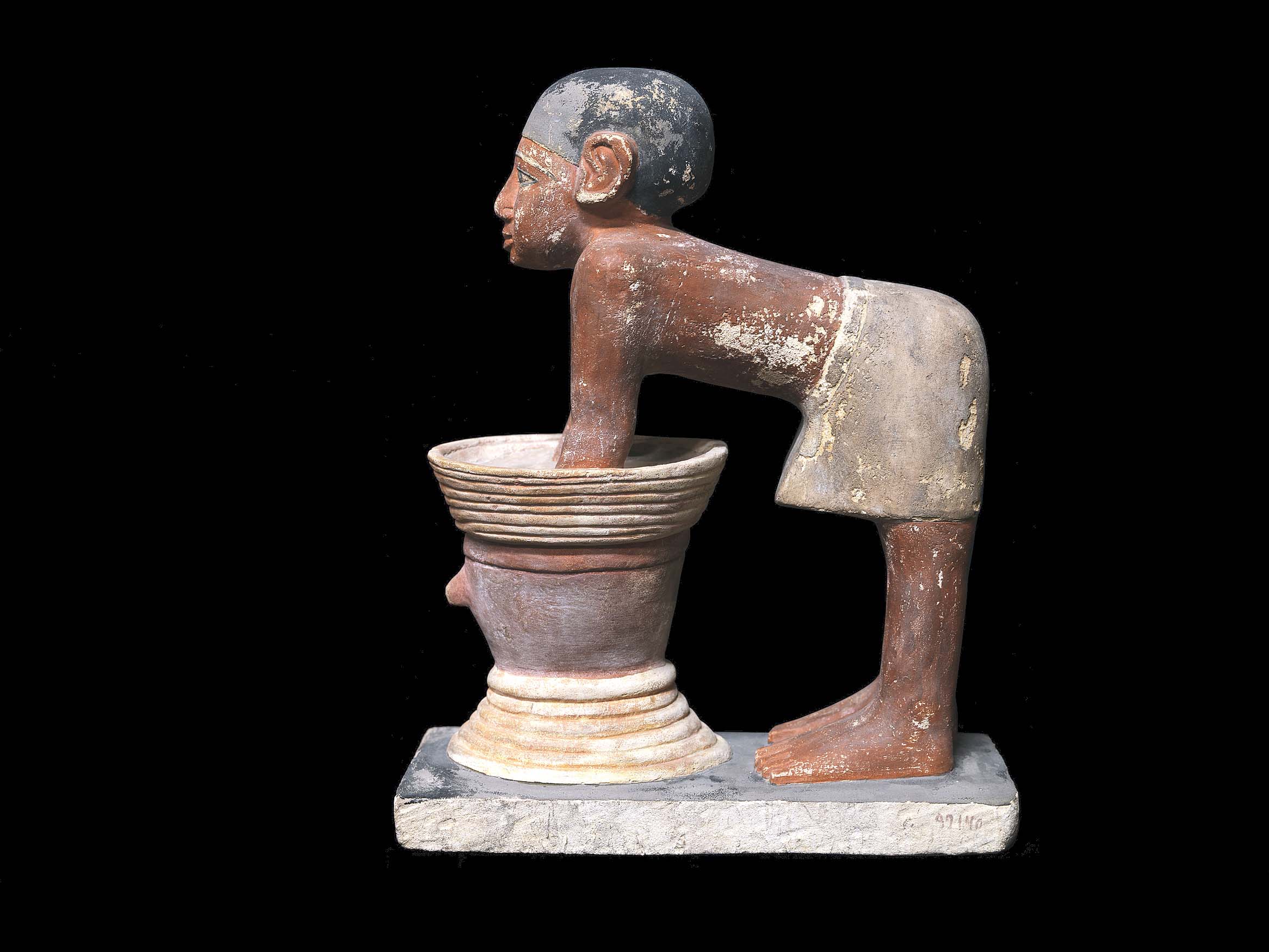
“Servant brewing beer,” Giza Necropolis, Old Kingdom, Fifth dynasty, limestone, painted, 11 by 8¼ by 4-5/16 inches. The Egyptian Museum in Cairo, JE 99140, SR 2/19478. Photograph by Massimo Listri.
The River Nile was the heart of ancient Egypt, its waters depositing rich, alluvial soil that ensured the lives and prosperity of the people. The River Nile was a god as well, one to be propitiated in times of drought. It wouldn’t surprise me to learn that the ancient Egyptians also saw Egypt as the heart of the world and the Nile as the veins that pumped life into it. Life and death.
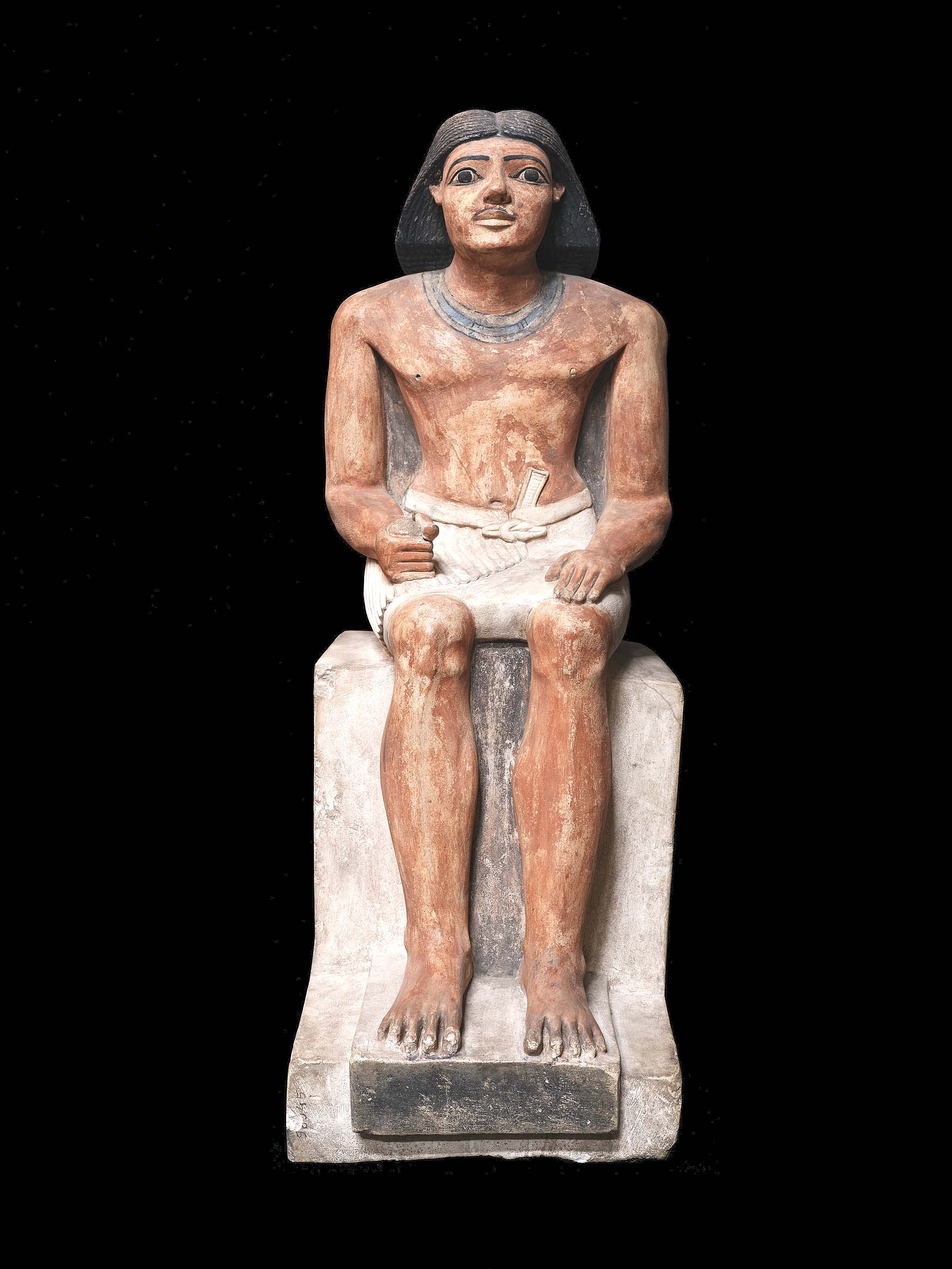
Rivers play a central role in the rituals outlined in the “Death and the Afterlife” section of the exhibition. Souls, accompanied by gods, carry the dead from this world to the next on boats across a river that is also the sky. Hearts, too, play a crucial role, for the heart of the deceased is weighed, and if its ma’at is insufficient, the deceased is not permitted to enter the realm of the dead. I don’t know if the painted limestone sculpture “Inty-Shedu, ‘Overseer of the Boat of the Goddess Neith’” (late Fourth dynasty or early Fifth dynasty, Old Kingdom) relates to the rituals that attended Egyptian funerals, but Neith is one of the goddesses of protection. “Inty-Shedu” is one of few names of middle and working class Egyptians preserved in history, and something strikingly individual in his face and in the way he carries himself, chin up and out, transforms him, in my mind, into a boatman ferrying ma’at worthy-souls to the eternal ease of the netherworld.
“Treasures of the Pharaohs” will travel to the Kimbell Art Museum (Fort Worth, Texas) in March.
The de Young is in Golden Gate Park at 50 Hagiwara Tea Garden Drive. For information, www.deyoungmuseum.org or 415-750-3600.