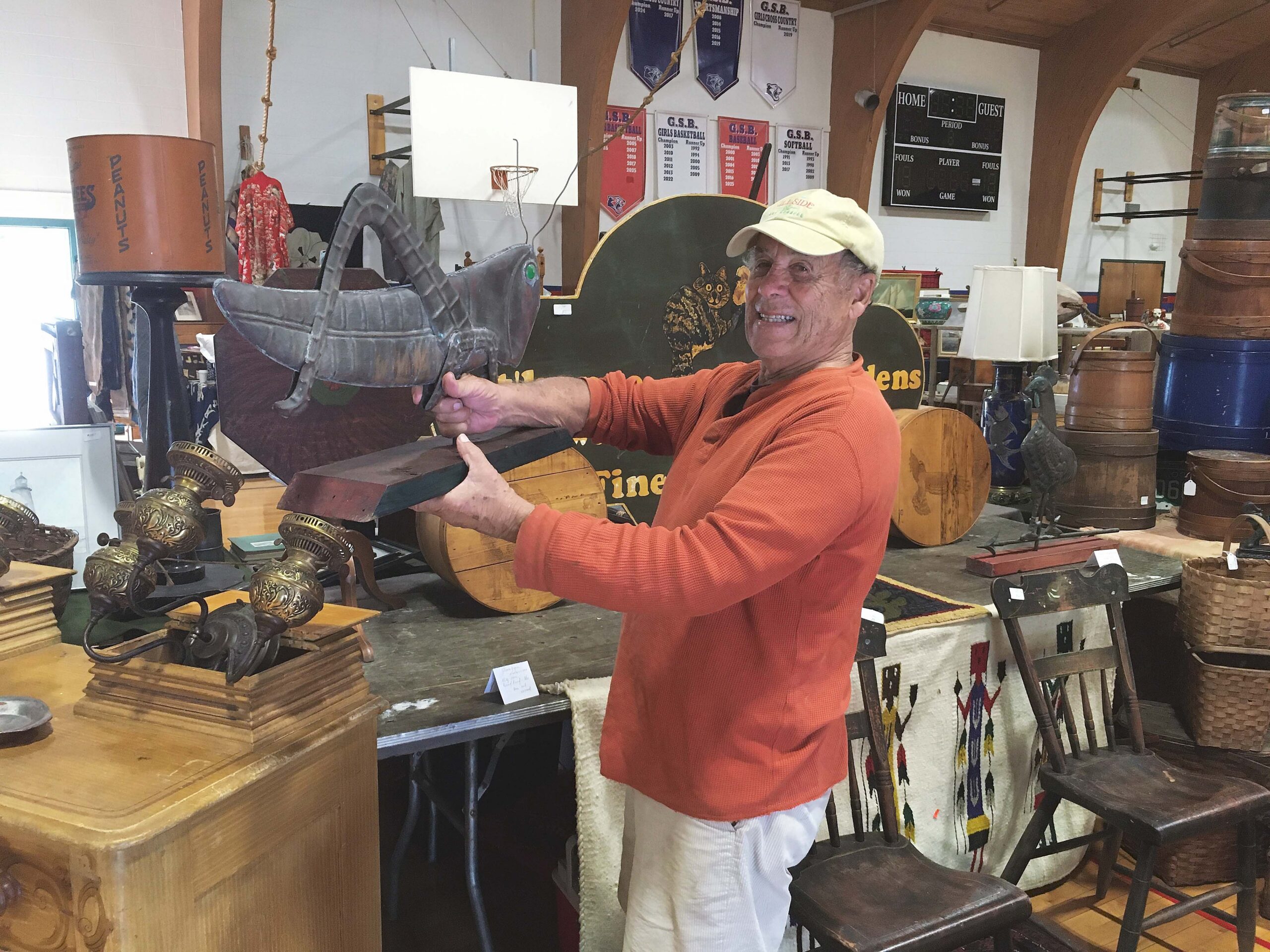
Dealer Joni Lima proudly holds up a grasshopper weathervane, crafted from copper in the early 1900s. Damariscotta, Maine.
Review & Onsite Photos by Jordan J. Estrada
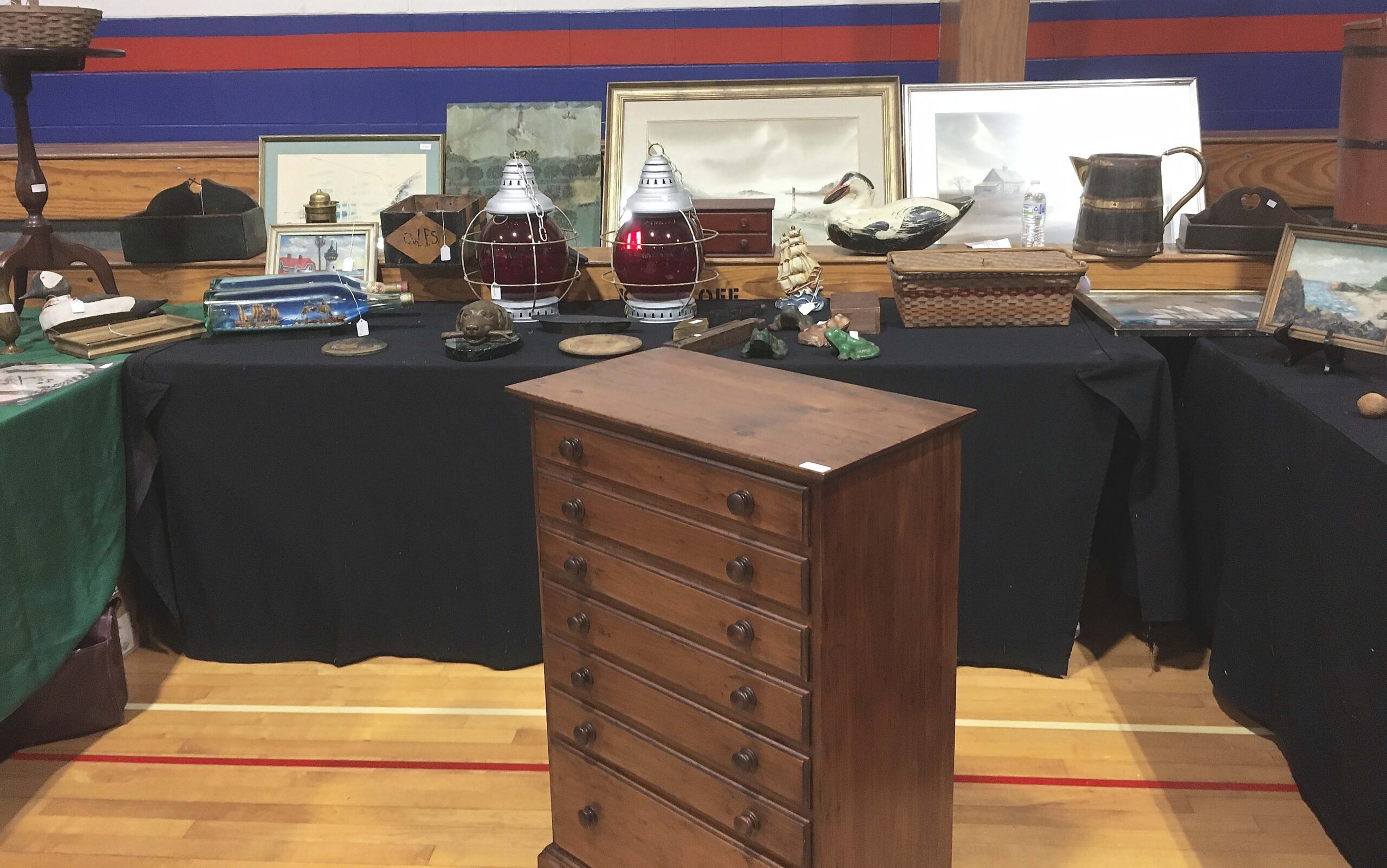
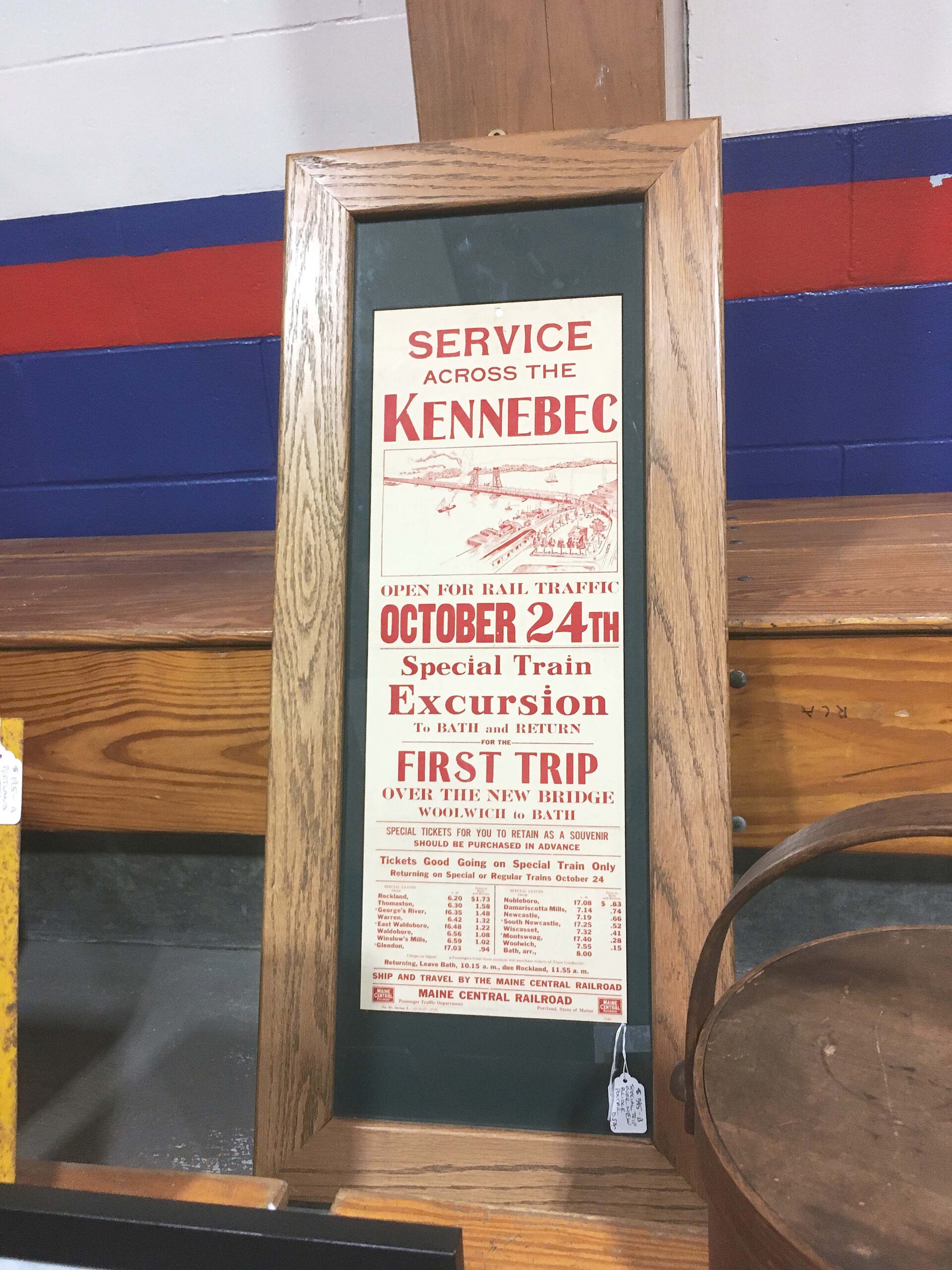
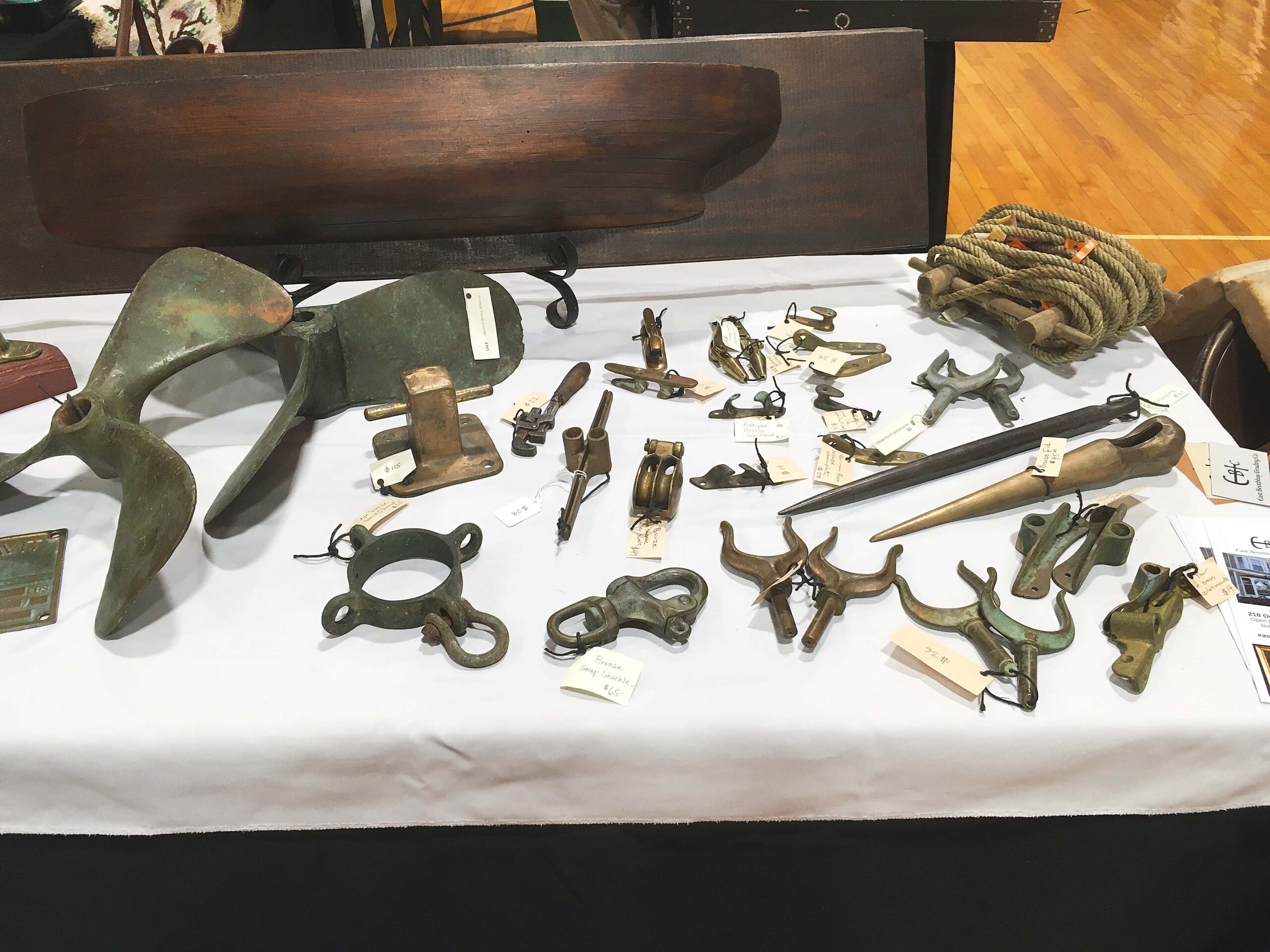
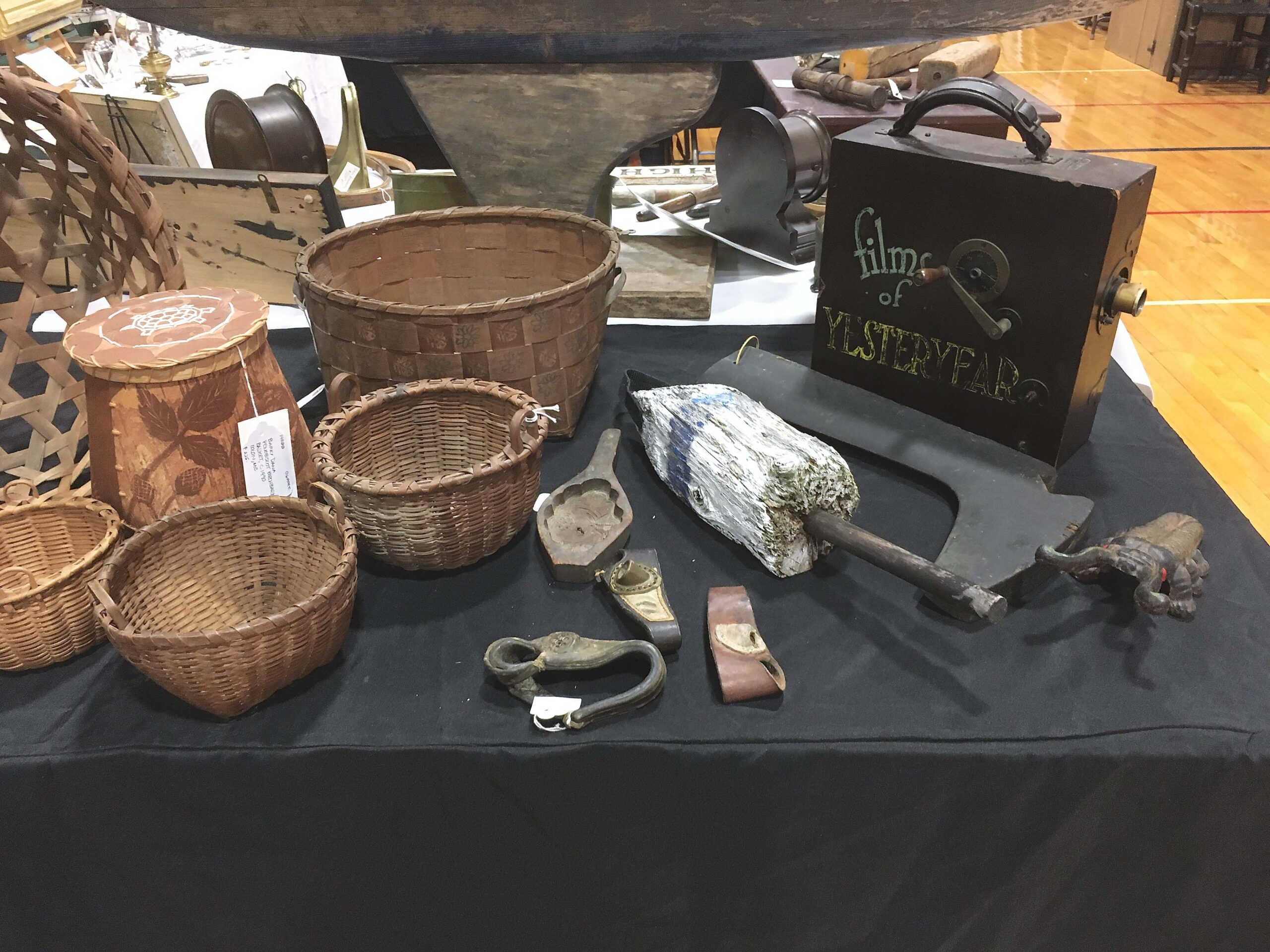
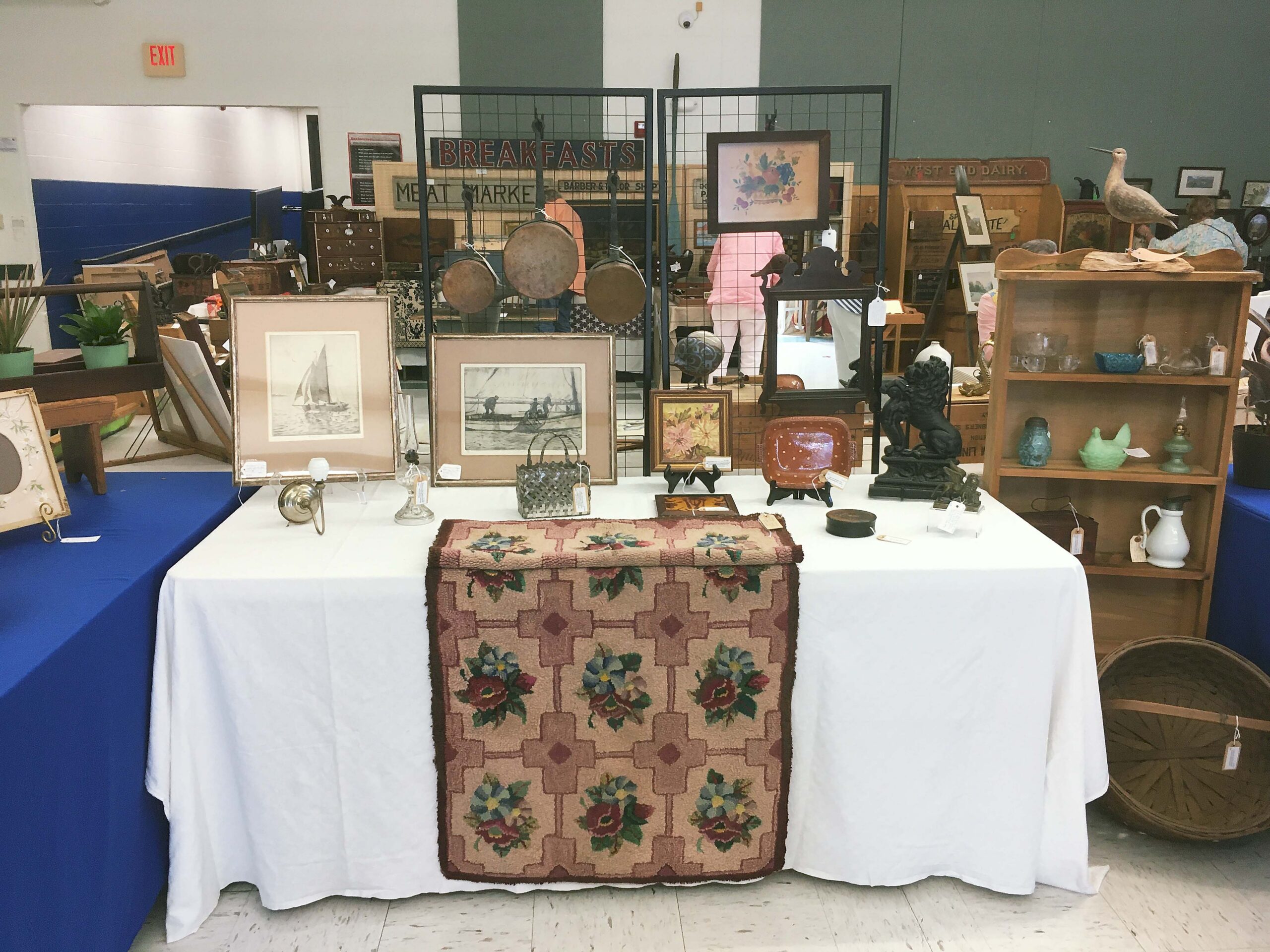
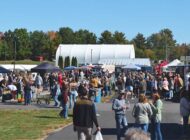
DAMARISCOTTA, MAINE — On a breezy, 76-degree morning, 31 dealers and more than 300 collectors gathered to set up at the Maine Antique Dealers Association’s (MADA) 27th annual Coastal Summer Antique Show at Great Salt Bay Community School. Enjoying weather that might be perfect for a day of sailing, the show exhibited a decidedly nautical theme — hardly a surprise in a coastal Maine town. Almost every table featured collectables from the historical sailing industry, with something for any fan of Herman Melville or the Age of Sail.
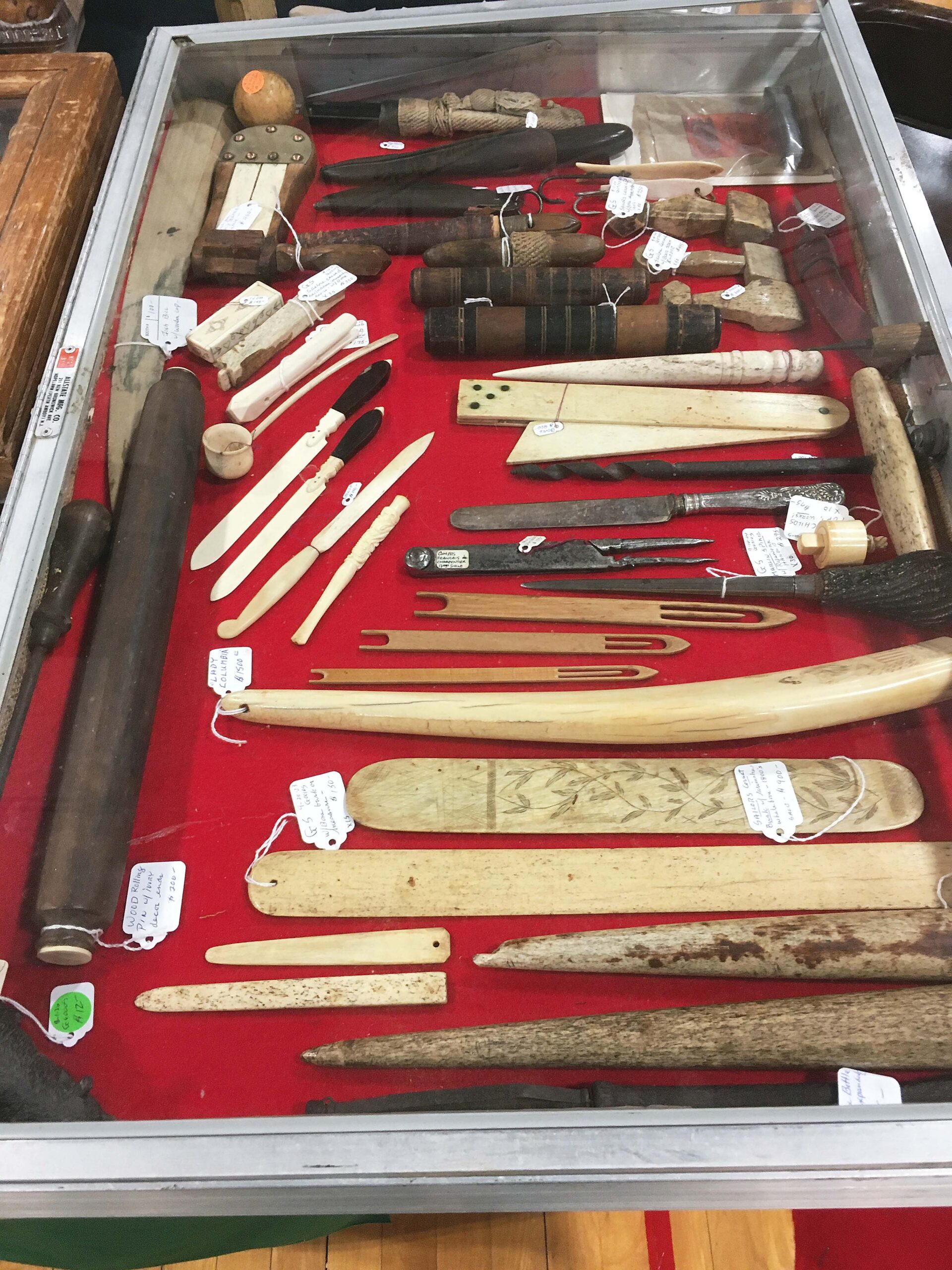
Many tables were resplendent with well-preserved nautical salvage, passenger and crew ephemera, and oceanic folk art. One display from Maritime Gallery featured an assortment of carved whalebone items, intricately crafted by period sailors and whalers into everything from canes to clasp knives. Many of these items were not only functional, but heavily adorned with intricate hand-etched detailing.
In addition to physical objects, several unique marine paintings were also up for sale. Dealer Dave White, of White’s Nautical Antiques, displayed an impressive oil on canvas depiction of the schooner John M. Keen by late Eighteenth Century/early Twentieth Century American painter William P. Stubbs.
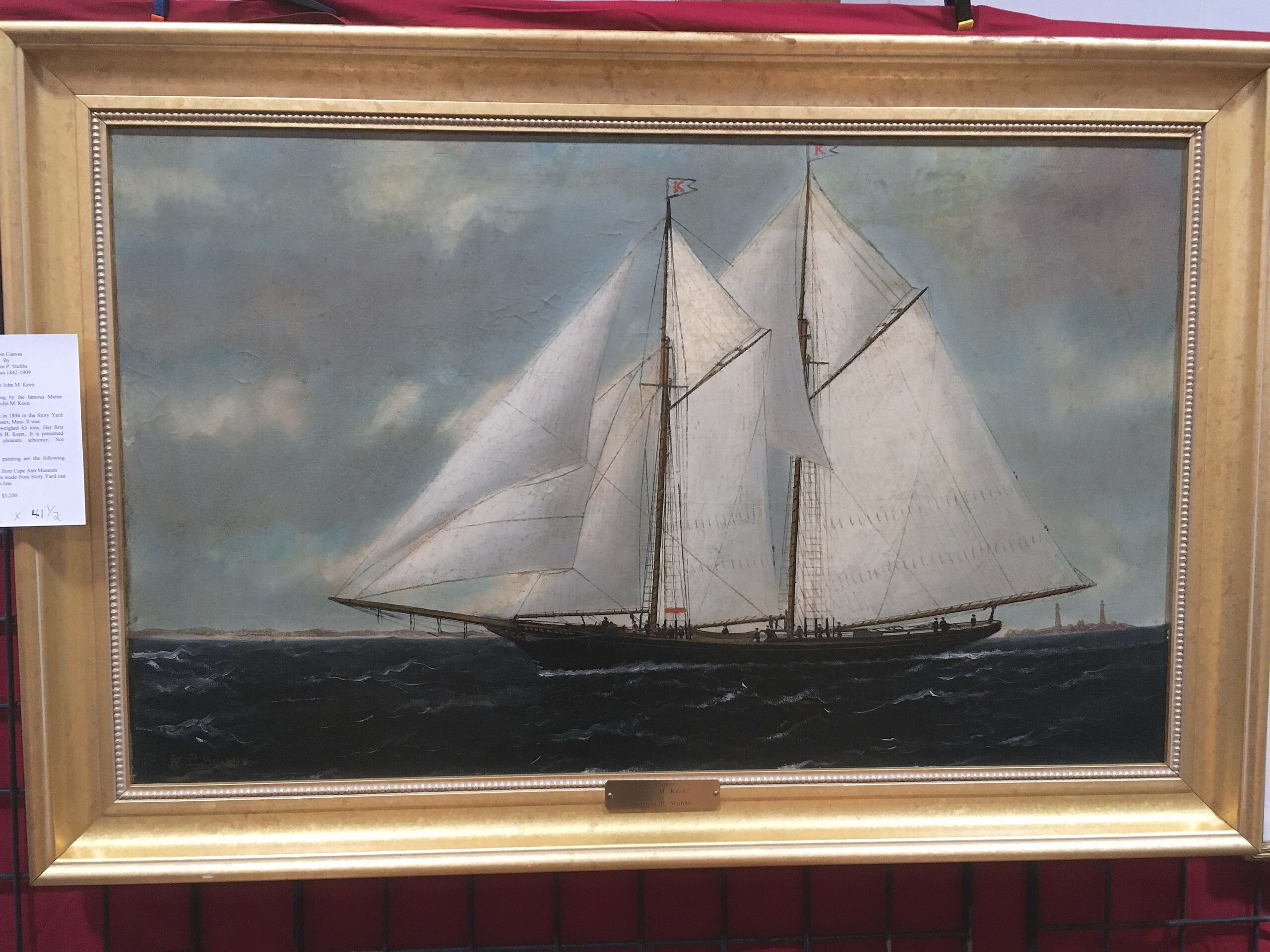
This oil on canvas of the schooner John M. Keen by late Eighteenth Century/early Twentieth Century American painter William P. Stubbs (1842-1909) was on offer at White’s Nautical Antiques, Yarmouth, Maine.
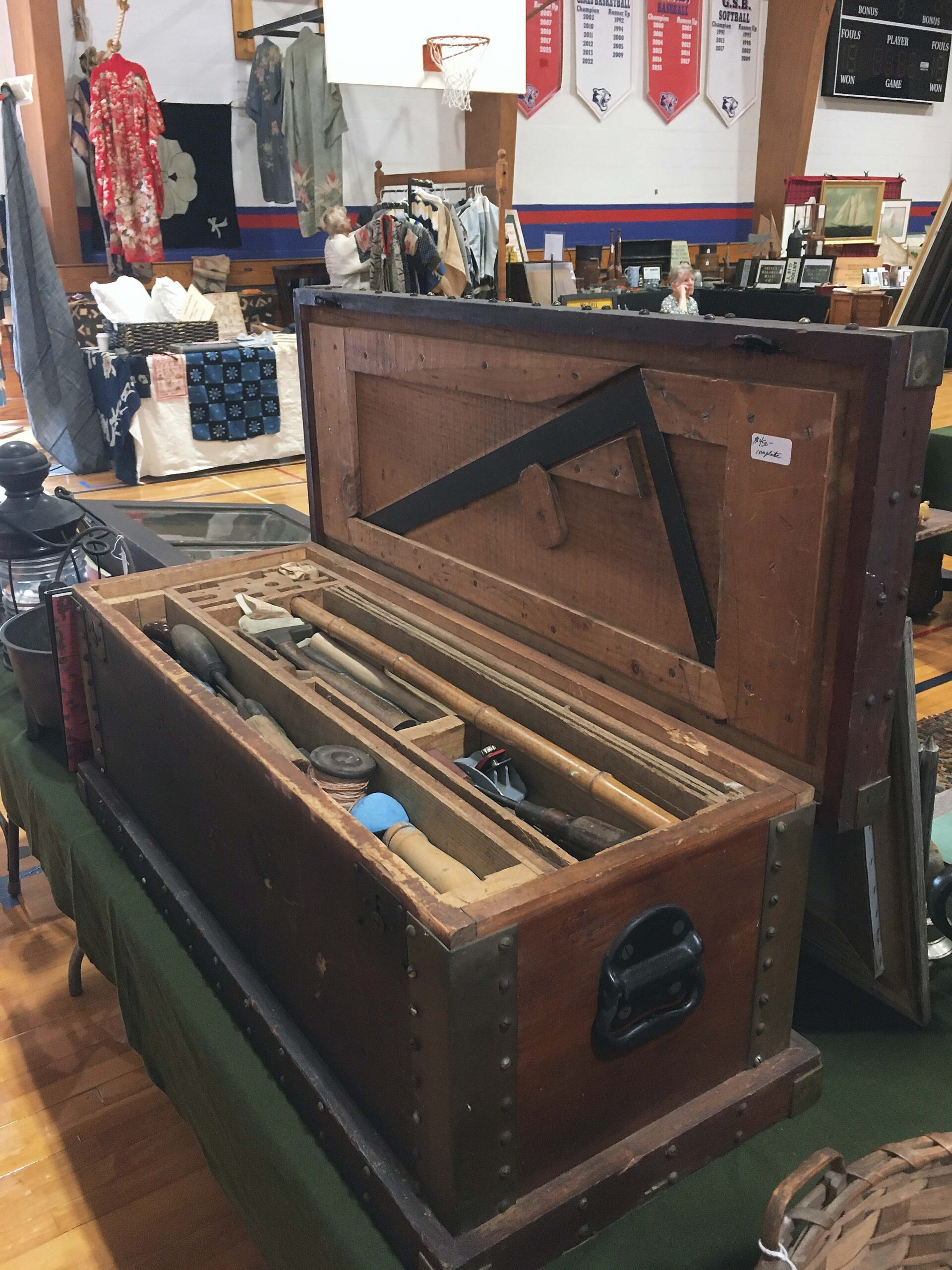
However, the shipping and naval industries were not the only historic trades represented. Another dealer, Christopher Stanley, showed off a unique carpenter’s toolbox, handmade by a southern Maine tradesman in the 1880s and stocked with a collection of historical tools, including a beautiful draw knife for shaping wood. Stanley reported that he received this time capsule of historic carpentry with one restriction from the previous owner. “It must be sold with all the tools in it.” One could see why — without the tools, it was just a unique box. But the tools inside showed a man’s life work: the instruments he used to carry out his trade every day, thoughtfully encased in an age before modular plastic toolboxes could be snatched from every big box store.
On the other side of the hall, the fire service was represented by a pair of vintage fire alarms — bold bronze flared horns paired with an accordion style squeeze box, that dealer Owen Shugard said were used broadcast signals during a fire emergency. Asked for a demonstration, Shugard wisely refused as they were far too loud for indoor use.
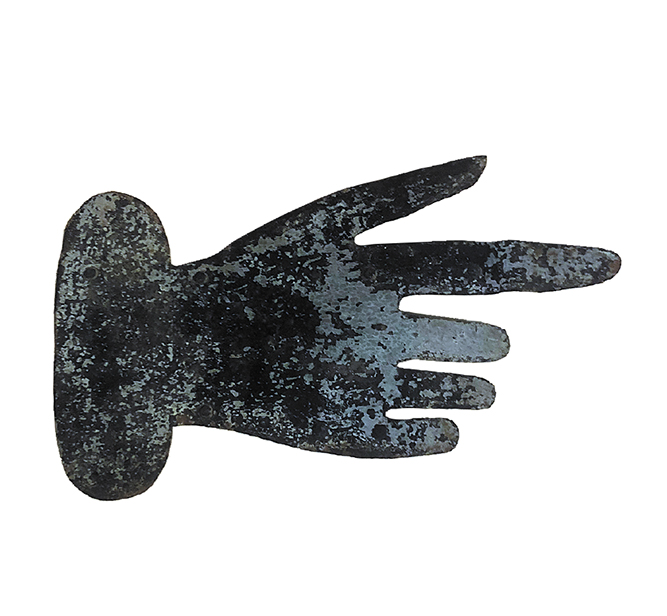
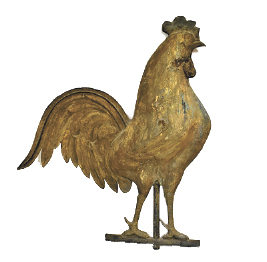
Farm memorabilia is always a staple of antiques shows, given farming’s role as the prominent pre-industrial occupation. We were consequently intrigued to see multiple historic pieces depicting locusts. While a farm weathervane typically boasts a rooster, or perhaps a horse, a locust or grasshopper is historically a harbinger of loss, crop failure and divine judgement. Dealer Joni Lima was excited to show off his rare grasshopper weathervane, fashioned from copper in the early 1900s. A second grasshopper was also on display in Joel White’s Curiosity Antiques booth. This later specimen was carved from wood and dated back to the 1920s.
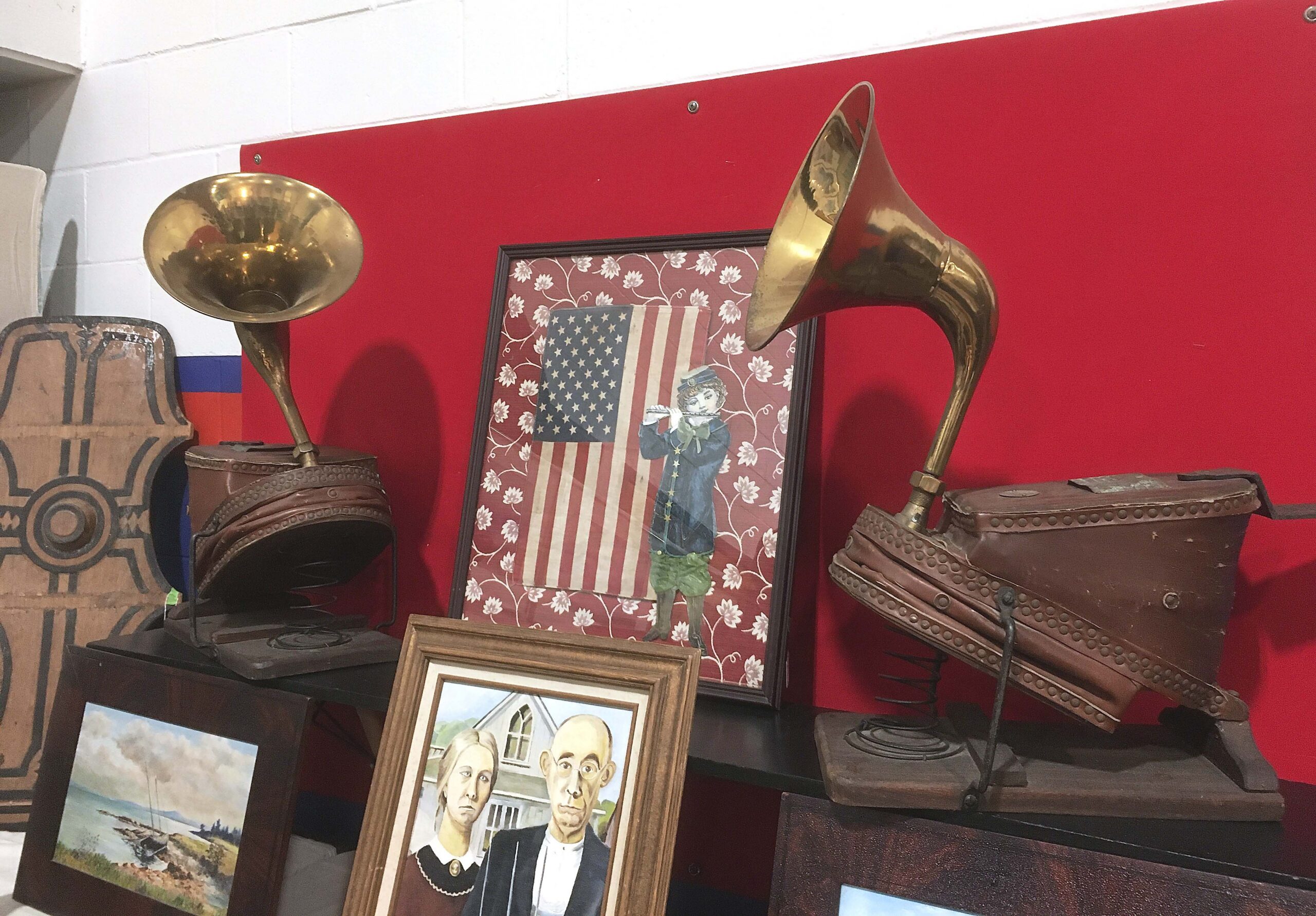
A pair of vintage fire alarms with bold, bronze flared horns paired with an accordion style squeeze box. Used to broadcast signals and alarms at the scene of a fire, they were presented by Owen and Leslee Shugard, Union, Maine.
We imagine these folk-art whimsy pieces celebrated a reprieve from plaguing locusts like the Rocky Mountain locust, which was responsible for so much crop devastation in the 1800s, and last seen in North America in 1902.
This is the 27th year for the MADA Coastal Maine Show, and many participants have been collectors and dealers for decades longer. While some antiques shows feature collections padded by thrift store items or everyday smalls, the items here boasted quality, value and rarity. Each table had rare, unique and highly sought-after collectibles, and some of these held stories too special to be replicated.
Steve Hanly (Bickerstaff’s Books, Maps &c.) agreed. “I’ve always enjoyed doing this show,” he said. “While it’s a small show in the grand scheme of things, it punches above its weight in terms of providing a great mix of dealers, from the well-established to those who rarely exhibit at shows. That provides collectors with a wide range of material to view in a casual and unhurried setting.”
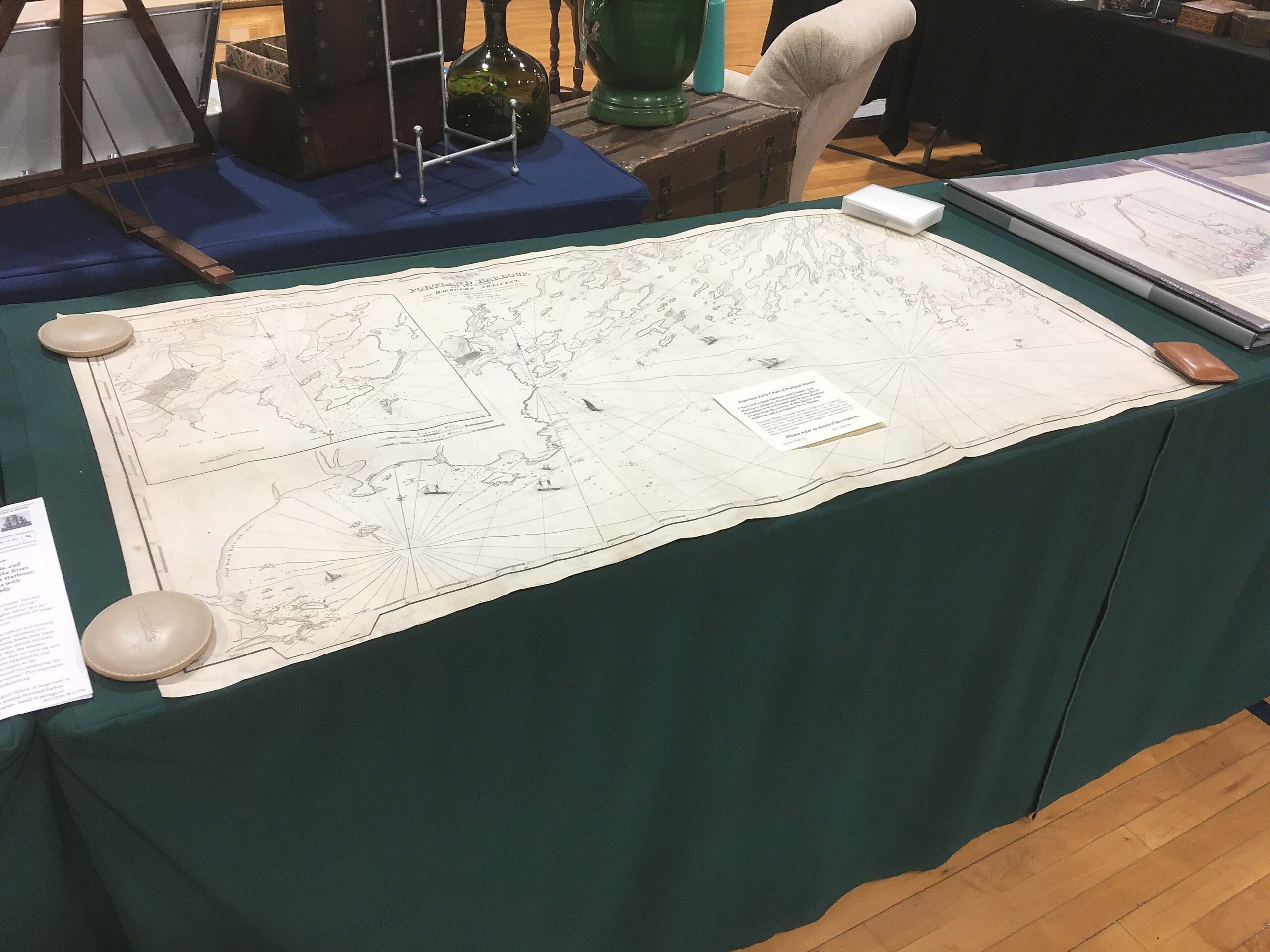
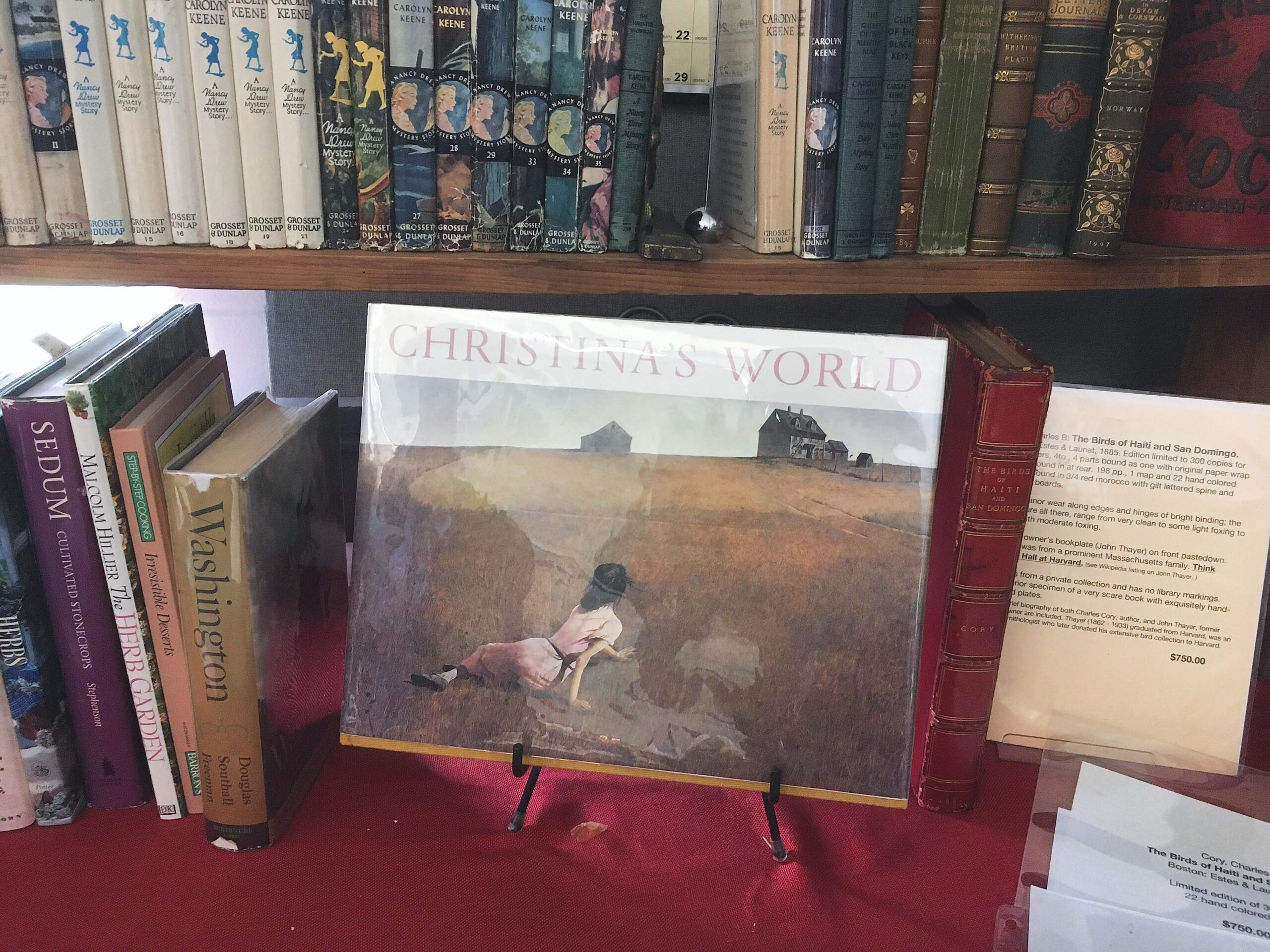
Charts and ephemera from the Age of Sail. Bickerstaff’s Books, Maps &c., Scarborough, Maine.
Visitors could enjoy a bit of this unhurried exploration at Guy Gerhard’s booth showcasing historic weapons from the Revolutionary War period. At the center of his display, a portrait of George Washington looked down sternly over a pair of dueling pistols. Famous for prohibiting his officers from participating in duels, Washington might be happy that these pistols are likely to never be used again and instead will occupy a place of honor in some lucky collector’s panoply. This pair dated back to 1770 with brass barrels and stained walnut furniture. Yet somehow, they were exceptionally light to handle with perfectly hand-fitting ergonomics in an age when the word didn’t even exist. This light weight would have caused quite the recoil with the 62-caliber chambering. These pistols also had grotesques — ornately carved butt plates featuring faces graven in anger, agony or fear; very fitting to the emotions that might have accompanied the sport of dueling.
In keeping with the show’s (and the region’s) nautical adjacency, Gerhard also had a scratch-built model of the World War I-era USS McFarland. Unlike many model kits today, this ship was built completely from homemade parts that would have been designed and fabricated by its builder. Wood, metal and perhaps some laminated cardboard completed the build, without a scrap of plastic anywhere.
As well as the sea, Americana was the prevailing theme of most tables, but Barbara Hepburn with Antique & Vintage Textiles presented something completely different. Hepburn’s booth offered a collection of excellent-condition Asian clothing and accessories from the Eighteenth and Nineteenth Century. On display were kimonos, scarves, bags, and one immaculately preserved sleep kimono (a roomy, extra-large garment bridging the gap between nightgown and sleeping bag) from the 1850s.
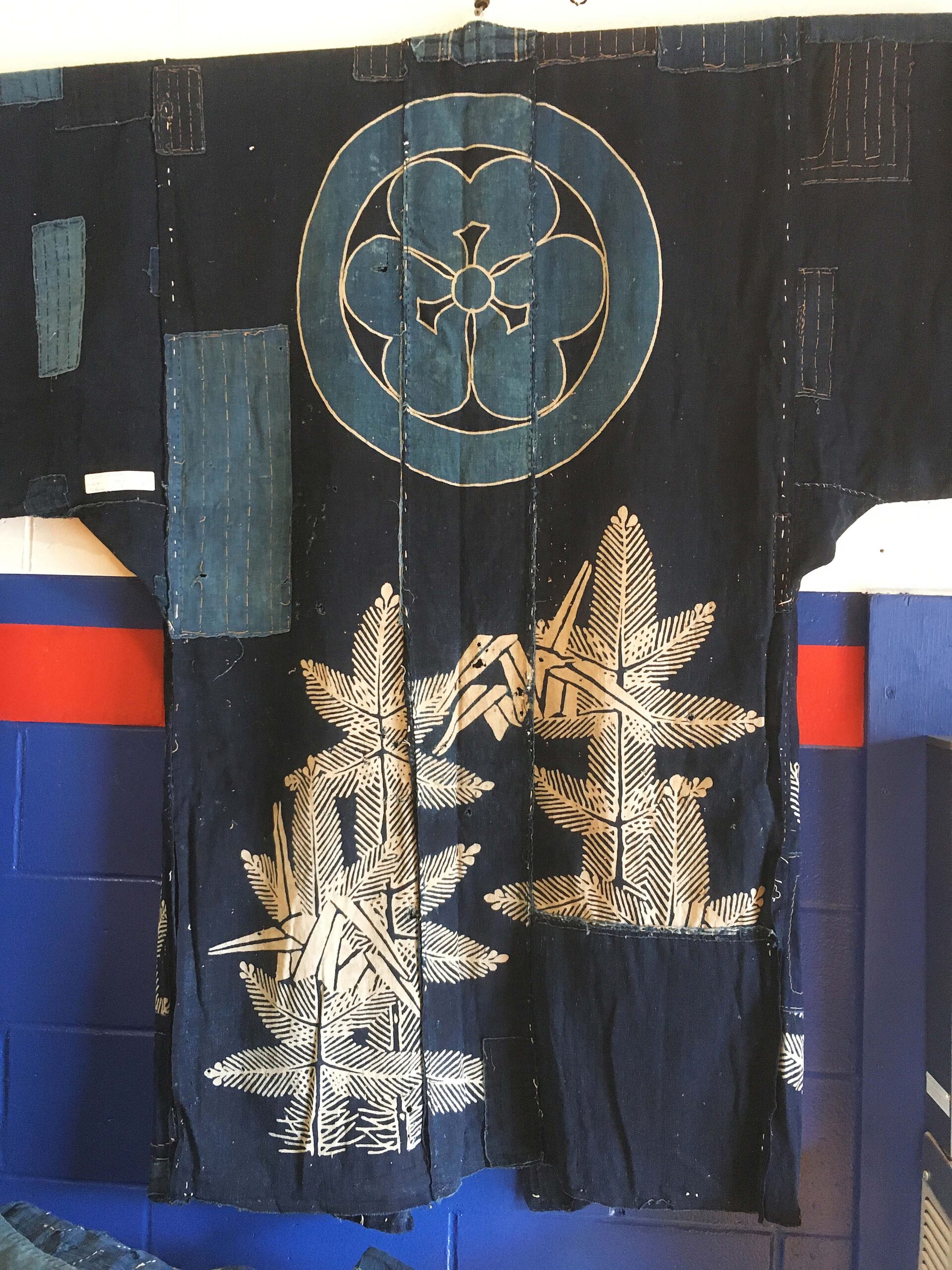
Antique & Vintage Textiles showcased this immaculately preserved sleep kimono from the 1850s. Fiskdale, Mass.
Browsing the show were two longtime collectors, Maine locals Peter and Susan Glueck. They have been antique enthusiasts for 50 years and said they each brought this shared passion into their marriage. Peter grew up in a home full of antiques, while Susan contributed the pieces that started their newlywed collection.
“We have only one piece of modern furniture,” Susan said to this writer with pride. “What piece is that?” Peter rejoined. “We’ll get rid of it.”
“I have no desire to buy anything new,” Peter added, noting his favorite pieces in their home included several nautical paintings as well as an 1876 children’s sled. Susan’s favorite is a small needlepoint sampler with the meaningful inscription “Contrition Done” meticulously stitched by a juvenile rascal as a bygone act of penance.
Like other attendees of the show, the Gluecks were excited to enter, but free from the stress of needing to get good deals, beat the crowd, or even an early sneak peek. Many of the participants exhibited this mature calm; it was clear that they were there to relish the spiritual experience that comes when one stands in the presence of history.
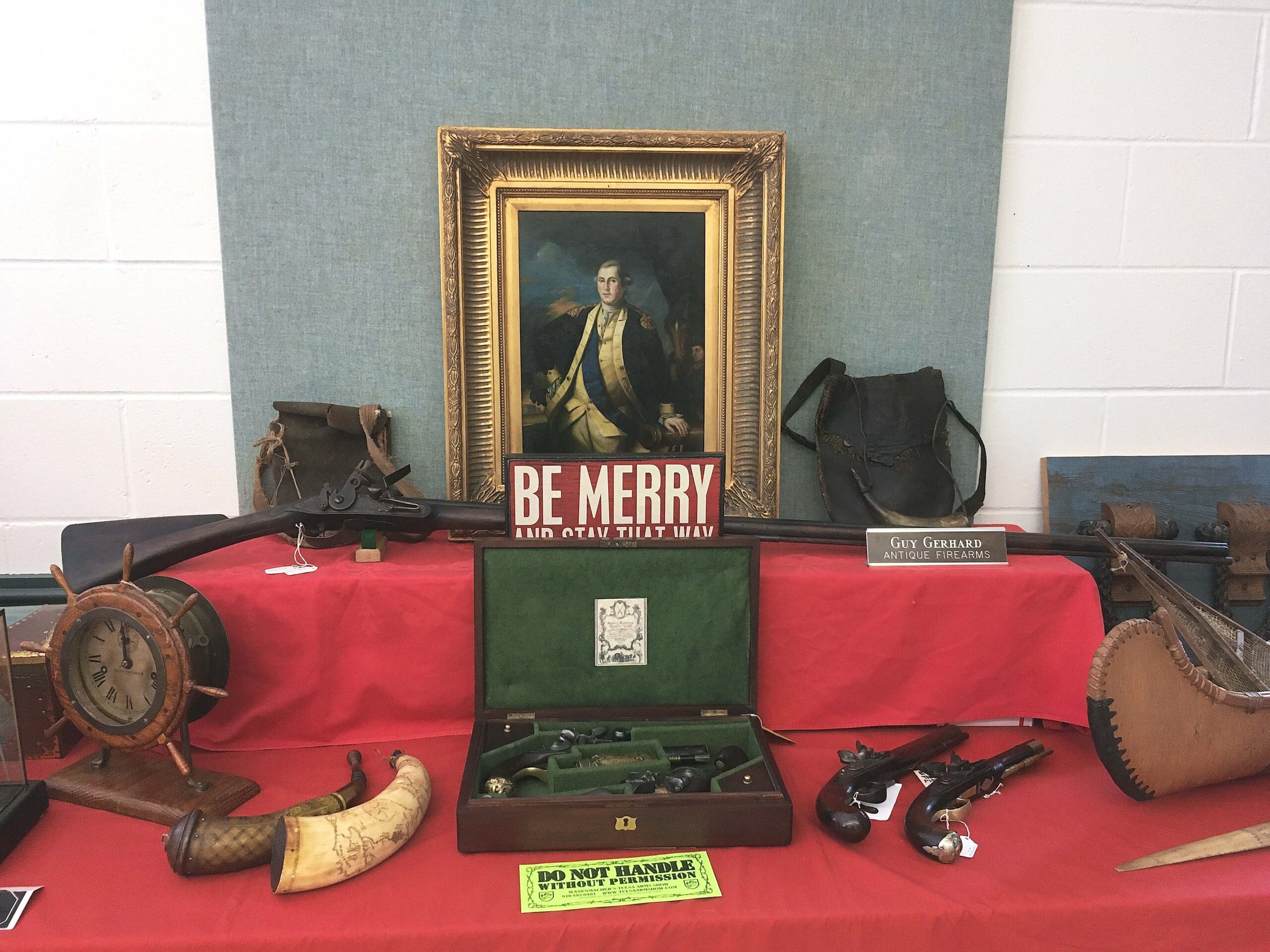
A portrait of George Washington looks down sternly over a pair of ornate dueling pistols, with the comically placed “Be Merry and Stay that Way” placard between them. Guy Gerhard’s Antique Firearms, Richmond, Maine.
There was also a strong sense of community cohesion around this event. Participants enjoyed and praised the quality of food provided at the venue, cooked and catered by the mothers of the local school football team. While these caterers were there to support the show, some participants took the opportunity to return the favor. Lima commented that he bought food for the week and brought it home to support the team. “One of the nicest things about the show,” he commented.
Fortunately, Lima’s grasshopper did not bring any bad luck to the show. “The show was amazing; beautiful booths, great attendance, perfect village location for visitors and residents,” he reported after the show. “So far, it’s the best show we’ve had the entire year. What a great event.”
Deirdre O’Callaghan of Partridge Hill Antiques, and a second vice president of MADA’s board, agreed. “I can say that we were very pleased with both the quality and variety of merchandise brought by our MADA members, as well as by the size and enthusiasm of the crowd attending. The crowd was geographically diverse; I sold items to people from Los Angeles, Chicago, New York, Greenwich, Conn., and Rhode Island, in addition to Maine.”
The 28th iteration of the annual MADA Coastal Maine Show will occur in August 2027. For information, www.maineantiques.org.