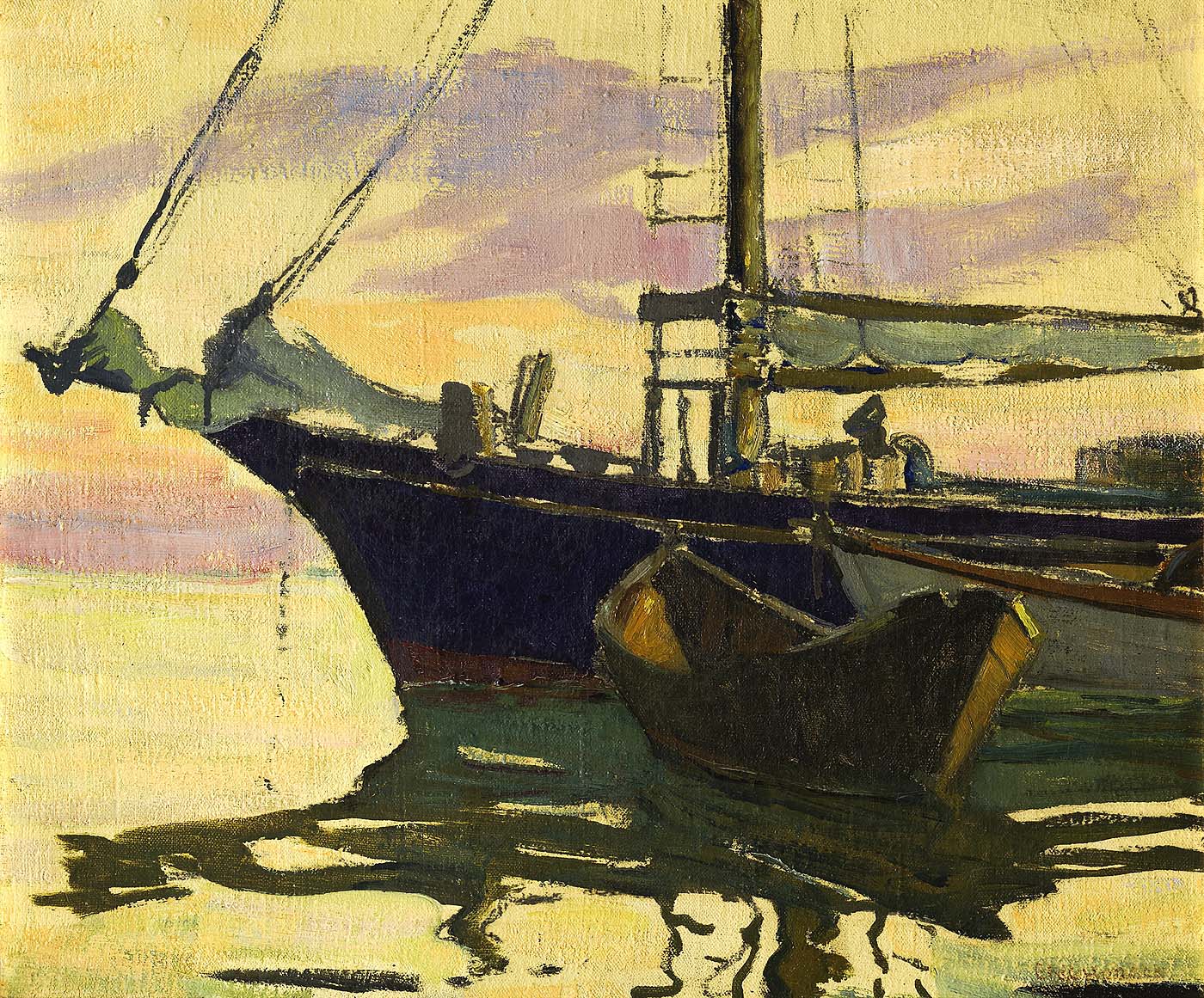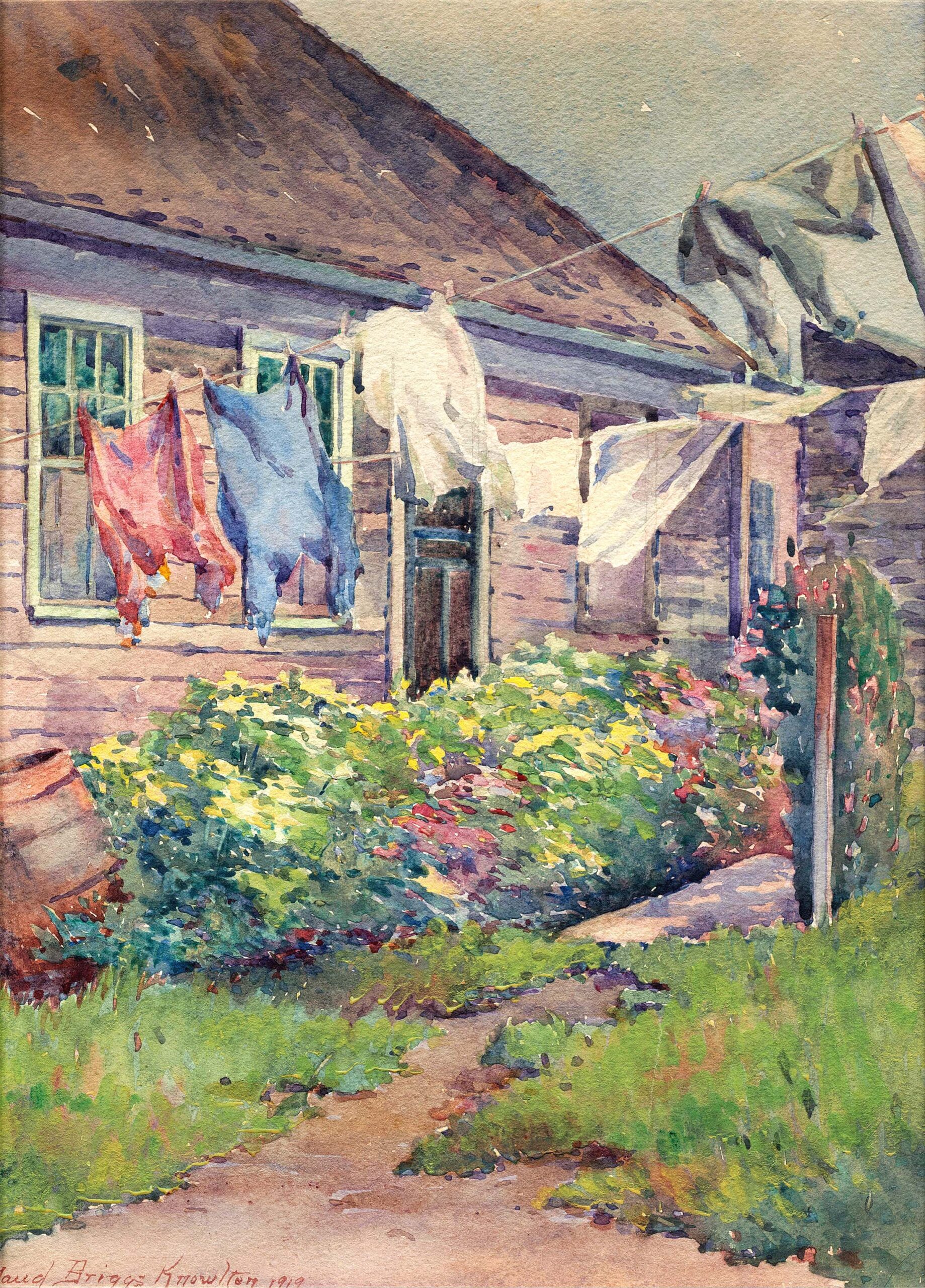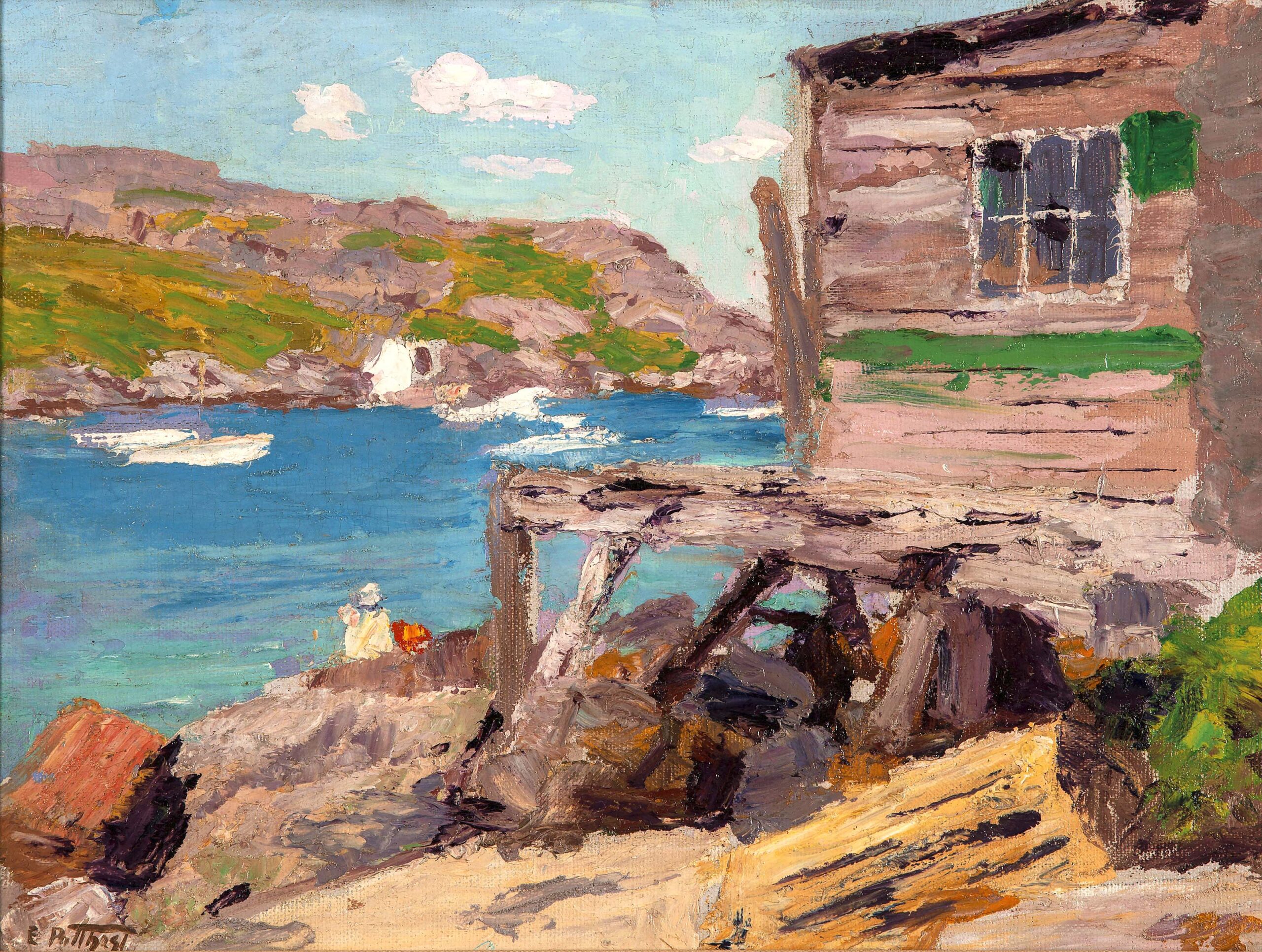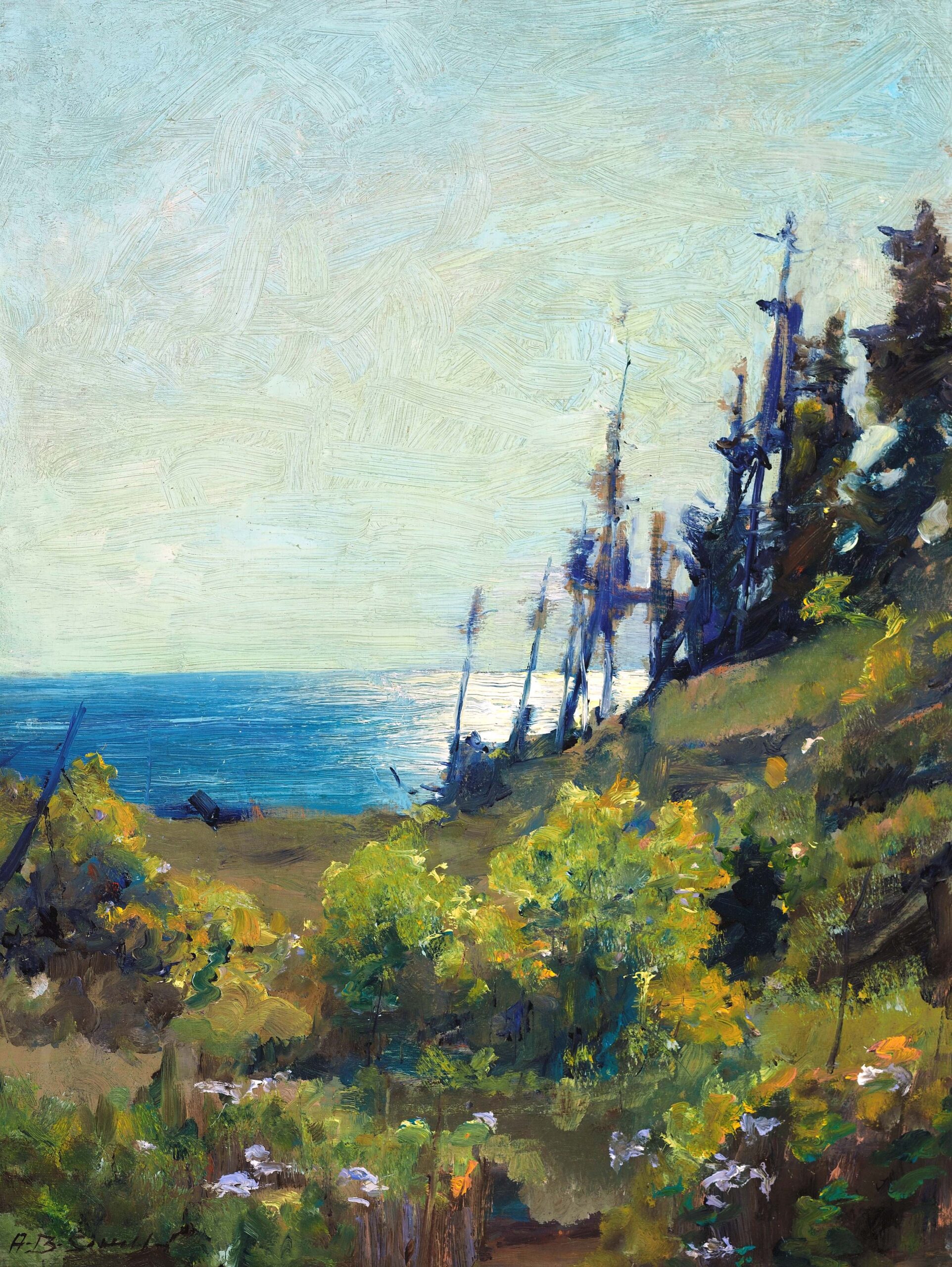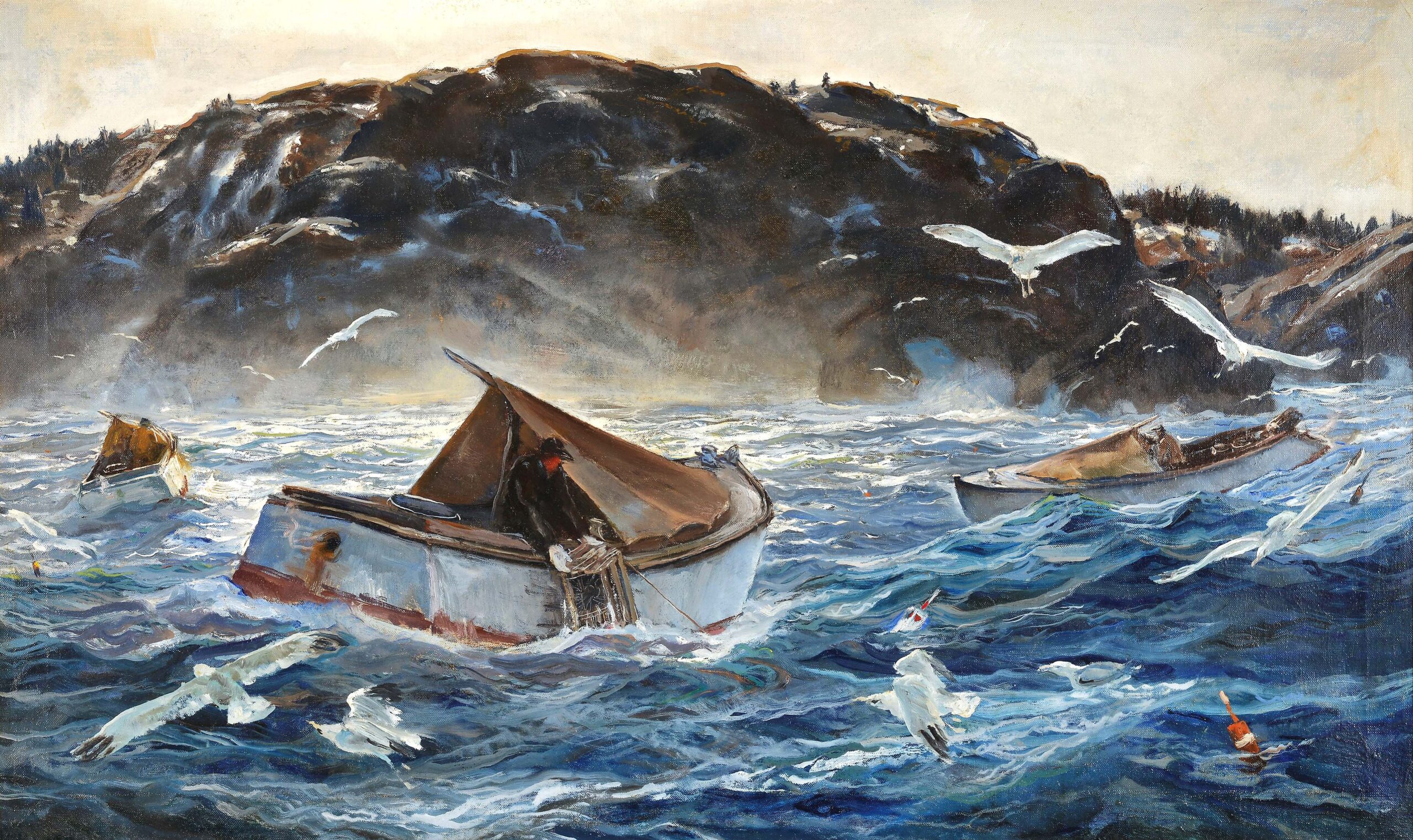
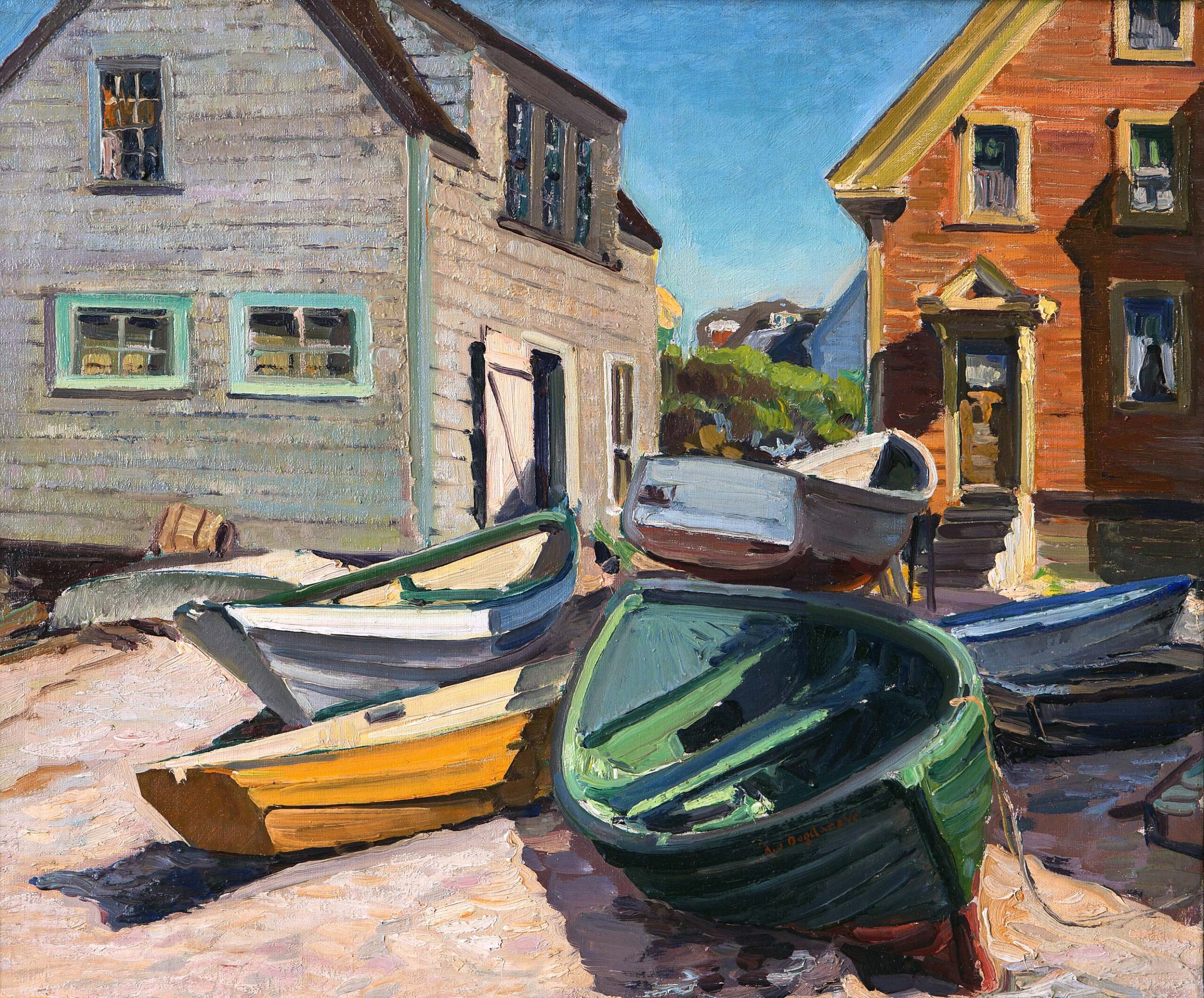
“The Boat Nest” by Abraham J. Bogdanove (1886-1946), circa 1925, oil on canvas, 25 by 30 inches, signed lower right (on stern of green boat): “A. J. Bogdanove.” Promised gift to the museum.
By Kristin Nord
Photos from the Susan Bateson & Stephen S. Fuller Collection, courtesy Monhegan Museum of Art & History
MONHEGAN, MAINE — “To Monhegan, With Love: The Susan Bateson and Stephen S. Fuller Collection” is up in its totality for one run only through September 30 at the Monhegan Museum of Art and History, where this gift of 90 paintings and one sculpture will firmly put the museum on the map as a go-to destination.
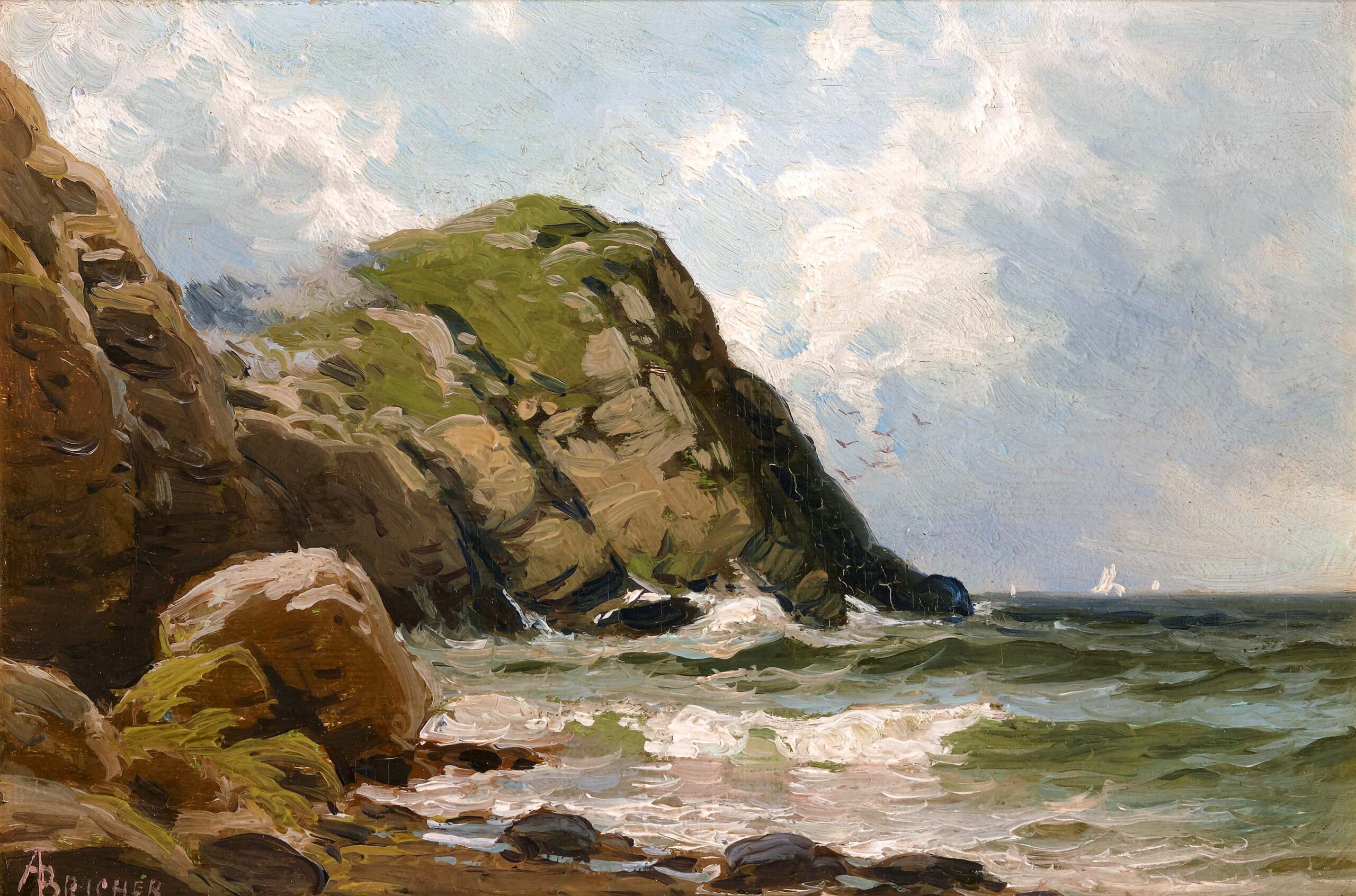
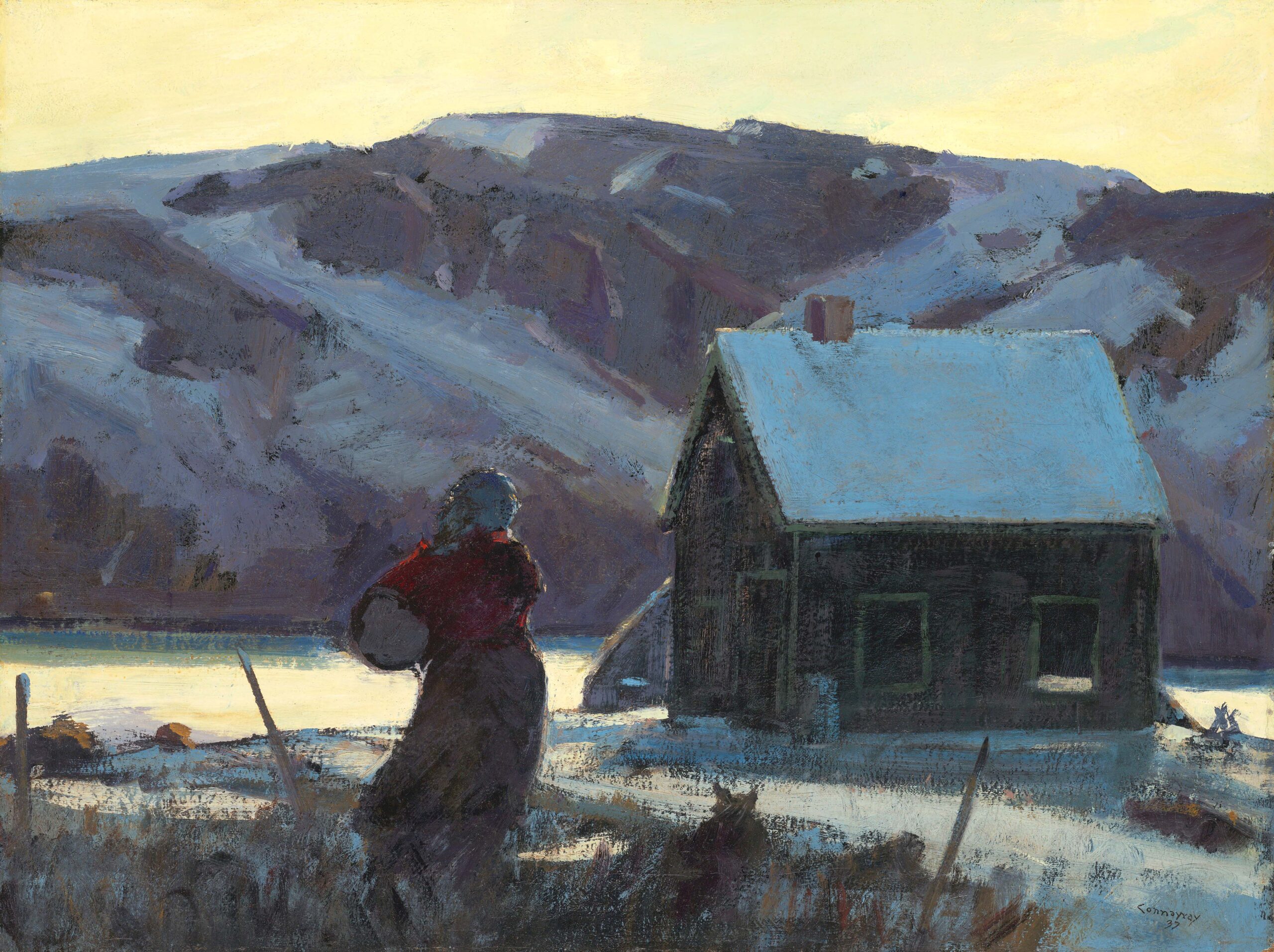
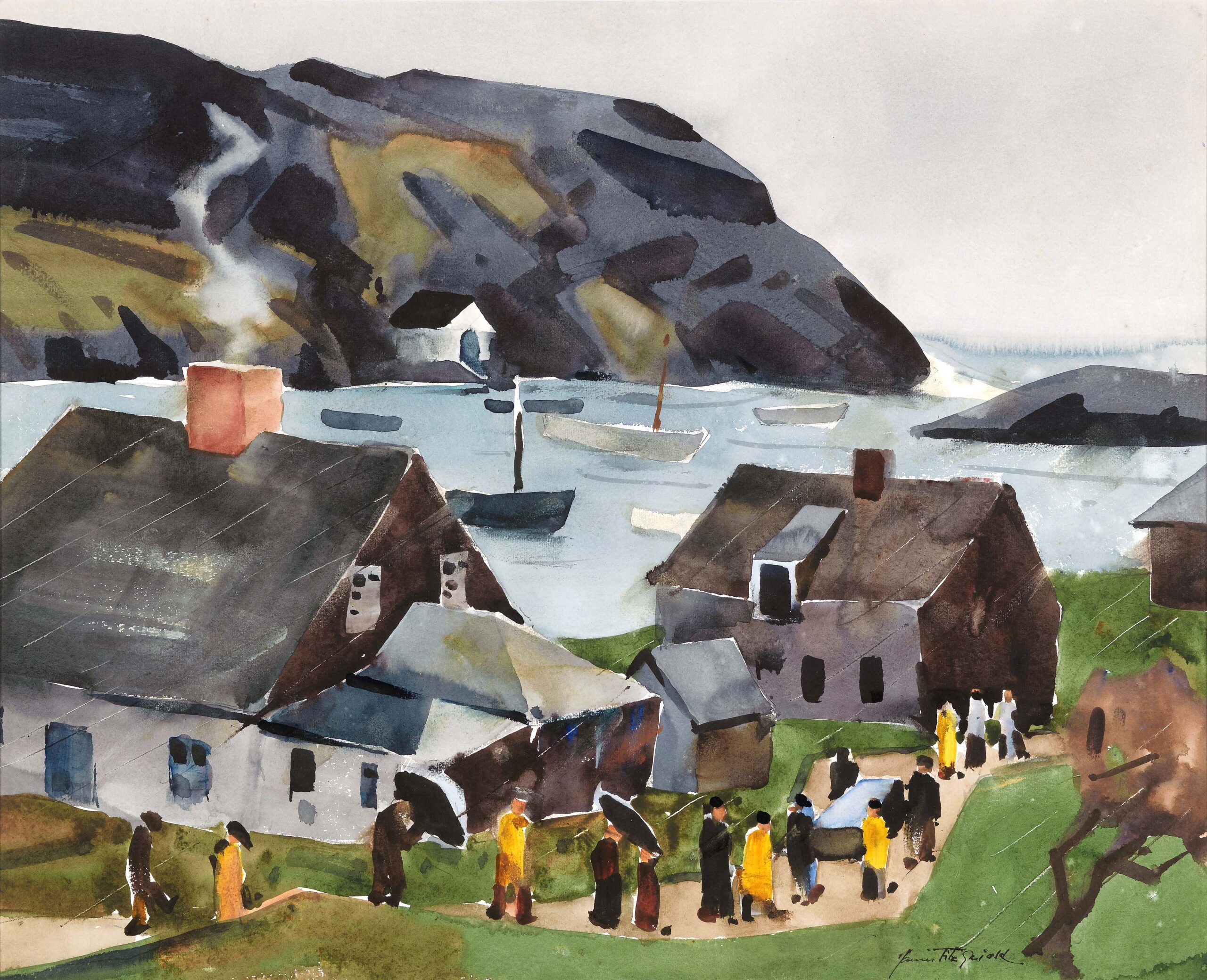
The show, which focuses on art produced between the late 1890s and the 1950s, includes paintings by George Bellows, Constance Cochrane, James Fitzgerald, Robert Henri, Elena Jahn, Rockwell Kent, Zero Mostel, Edward Potthast, Edward Redfield, Reuben Tam and others. This collection will be on display in its entirety throughout the Assistant Keeper’s House Gallery and the Keeper’s House history displays on Lighthouse Hill, as well as at the Kent-Stoddard-Fitzgerald Studio on Horn’s Hill. It’s likely that this will be the only time this collection will be so inclusively presented across these three venues.
At a time when art critics nationwide have been bemoaning the lack of contemporary arts patrons, Stephen Fuller and Susan Bateson’s generosity has arrived as a breath of fresh air. The couple were drawn to the island’s magic as sailors and come-from-aways, who began buying a few paintings of the island to take home with them to Virginia. Over 19 years, their holdings expanded into a major collection.
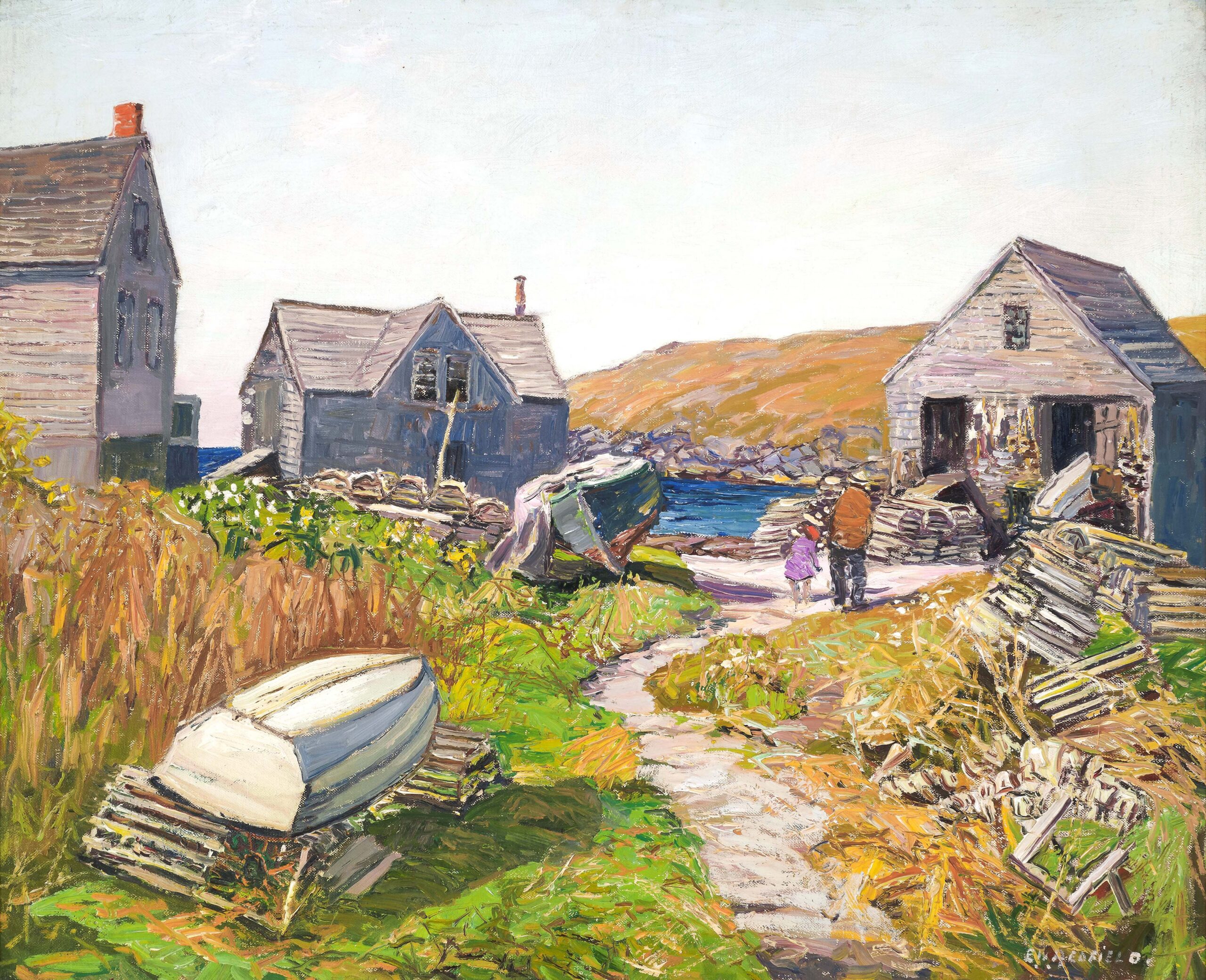
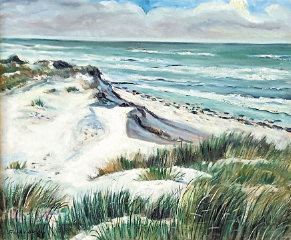
“The Path to the Beach” by Edward Willis Redfield (1869-1965), circa 1928, oil on canvas, 26¼ by 32¼ inches, signed lower right: “E. W. Redfield.”
Both Fuller and Bateson were in the middle of successful careers — Fuller was a professor of public policy and Bateson was a corporate executive in human resources — when they married and found they shared a passion for this rugged place.
From the start they looked for works that were completed between the 1890s, when Monhegan emerged as a bona fide art colony, and through the 1950s. While the majority of works date to before the mid-Twentieth Century, significant works by number of postwar modernists are represented as well.
The two became fascinated not only with the art itself, but with the behind-the-scenes stories of the painters, the village and the characters they chose to depict. Seeing their collection in total offers visitors the chance to delve into this rich history as much as they did.
As their collection grew, Fuller notes, he and his wife were pulled back to the island year after year by the chance to research the works in their possession. Their quest also led to deep friendships with the late Ed Deci, Monhegan museum president and director emeritus, and Jennifer Pye, director of and chief curator of the museum. Adam Blumenthal, president of the Monhegan Museum of Art and History, noted in the forward to the exhibition’s catalog:
“Many have fallen in love with Monhegan. Some fall in love with the geography — the stark headlands rising out of the Gulf of Maine, the quiet paths through the woodlands, the dusty dirt roads and weathered cedar houses of the village, all crammed together on about six hundred acres of land. Others fall in love with the people — the amalgam of fishermen, artists, carpenters, small-business people and summer residents — some proudly laying claim to three, four, five, six or even seven generations of roots on the island.”
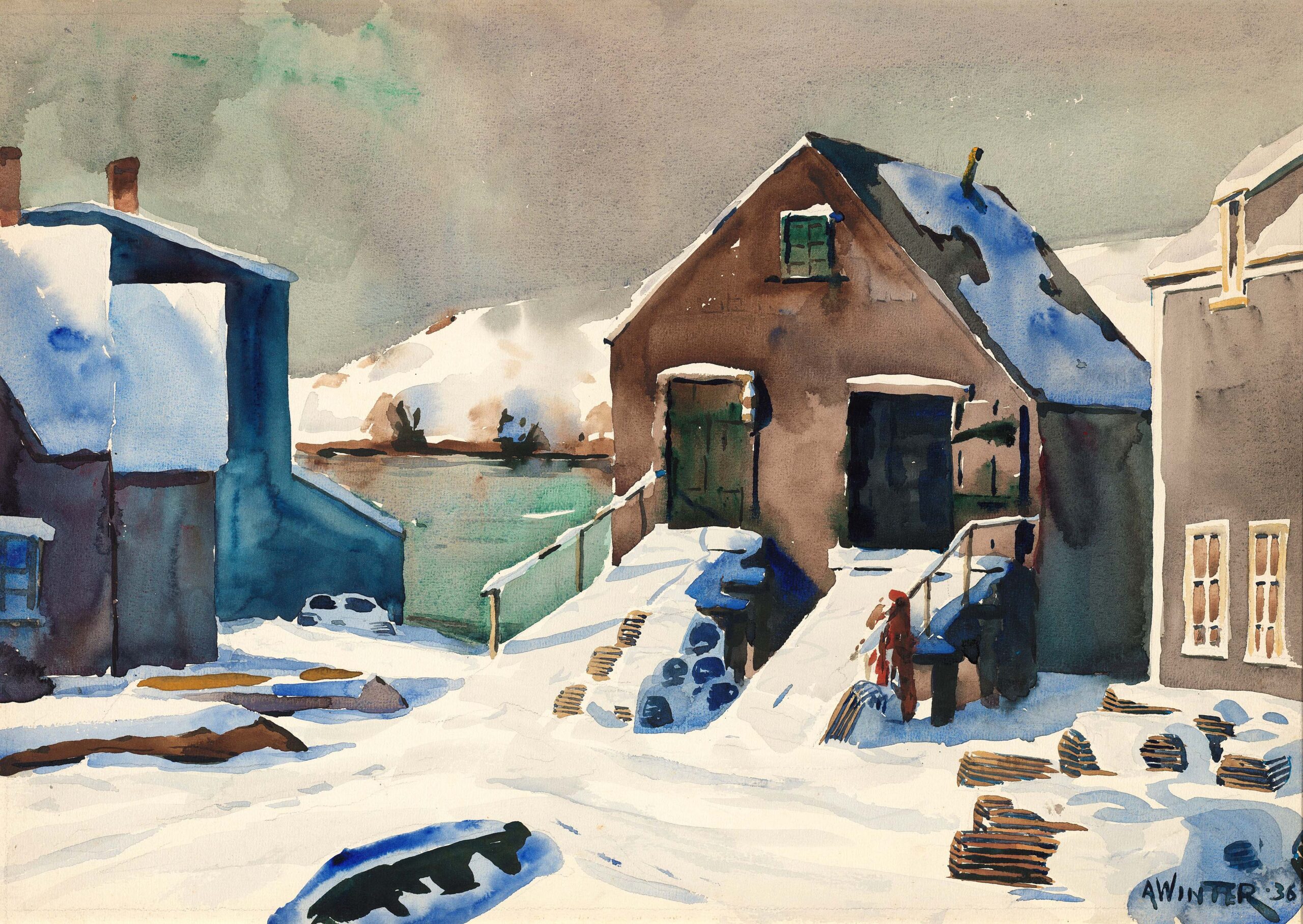
“Old Fish House, Monhegan” by Andrew Winter (1892-1958), 1936, watercolor on paper, 14½ by 21½ inches, signed lower right: “A Winter – 36.”
For Bateson and Fuller, he added, their collecting grew from their personal love affair as well. Monhegan’s allure as a summer destination escalated after the Civil War, when steamboat companies offered day trips and residents began offering meals and lodging. By the 1890s it had achieved a widespread reputation as a rustic summer retreat.
One of its obvious charms, according to Earle G. Shettlesworth, Jr, Maine’s State historian, “was that it evolved from a remote fishing village into a thriving seasonal community without sacrificing the essential character that was its primary asset.”
People who have summered on special islands like this can certainly attest to its emotional resonance. One has to wonder what stories we might tell if we all returned from our summer sojourns and trained fresh eyes on the places we call home.
Monhegan has been source of endless fascination and inspiration for the artists who came first at the behest of formidable teachers from Boston and New York, and then, in turn, found themselves returning season after season as well.
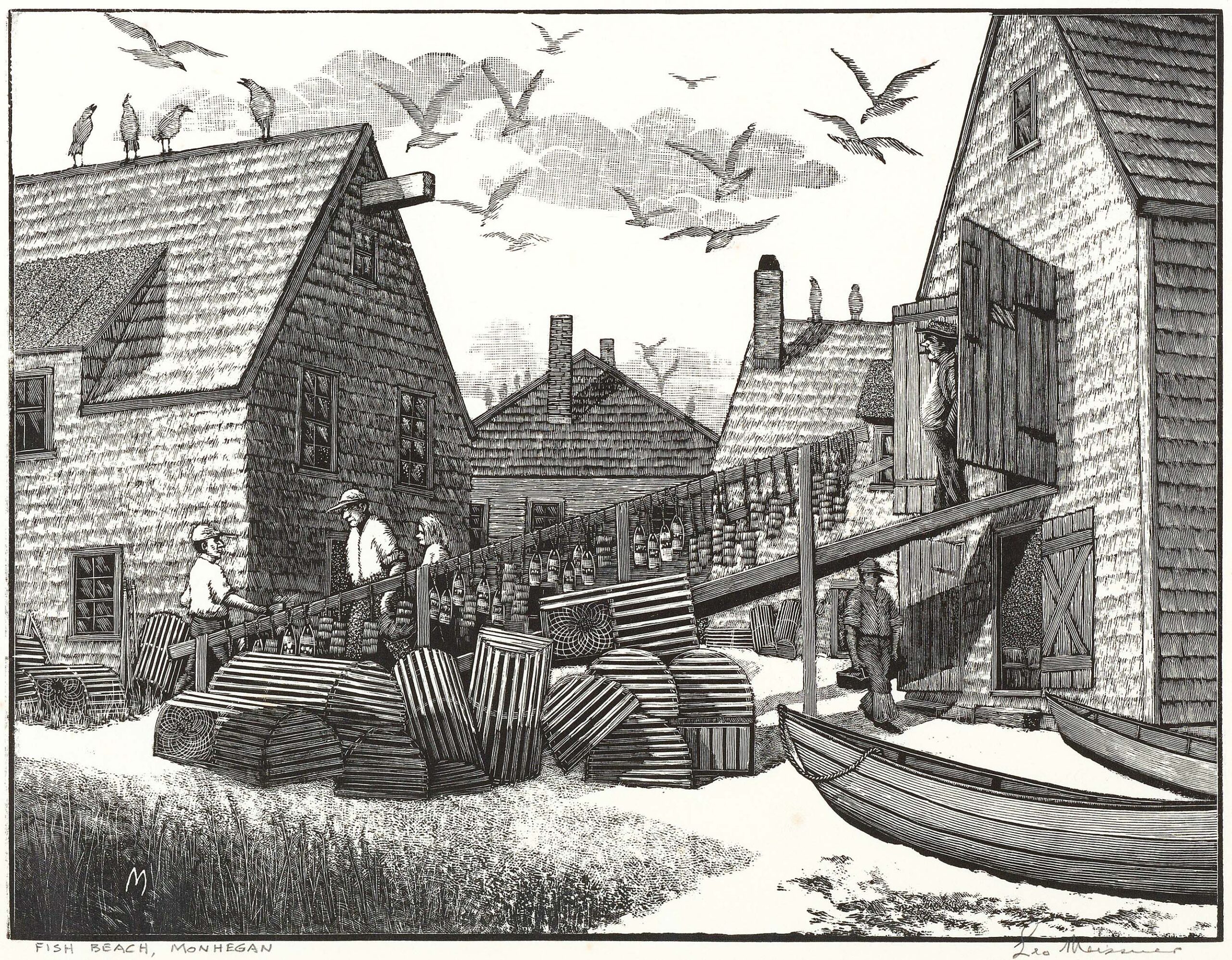
“Fish Beach, Monhegan” by Leo Meissner (1895-1977), 1932, wood engraving on paper, 12 by 9¾ inches, signed lower right: “Leo Meissner.”
Robert Henri, a legendary teacher at the Art Students League of New York, wrote to his parents after his first visit to the island: “This is the real thing. I have never seen anything so fine…from the great cliffs you look down on a mighty surf battering away at the rocks…and then you can disappear from the sea into the pine forests — they are wild…It is a wonderful place to paint — so much in a small place that one could hardly believe it.”
Among Henri’s students who would follow him to the island was Rockwell Kent, who would set down roots here for a time. He, too, would wax poetic about the experience: “Monhegan: its rock-bound shores, its towering headlands, the thundering surf with gleaming crests and emerald eddies, its forests and flowering meadowland… And the people, those hardy fisherfolk, those men garbed in their sea boots and their black or yellow oilskins… It was enough for me, enough for all of my fellow artists, for all of us who sought “material for art. It was enough to start me off to such feverish activity in painting as I had ever known.”
Fuller and Bateson had their own memories to share. “I think it was very much — as we learned stories and explored the island from the shore, the more it enchanted us,” Bateson said. Fuller added, “I learned not only about the artists, the biographical history, how they made a living doing this, what was going on in the world at the time…we also got to learn about the styles of paintings and effort.”
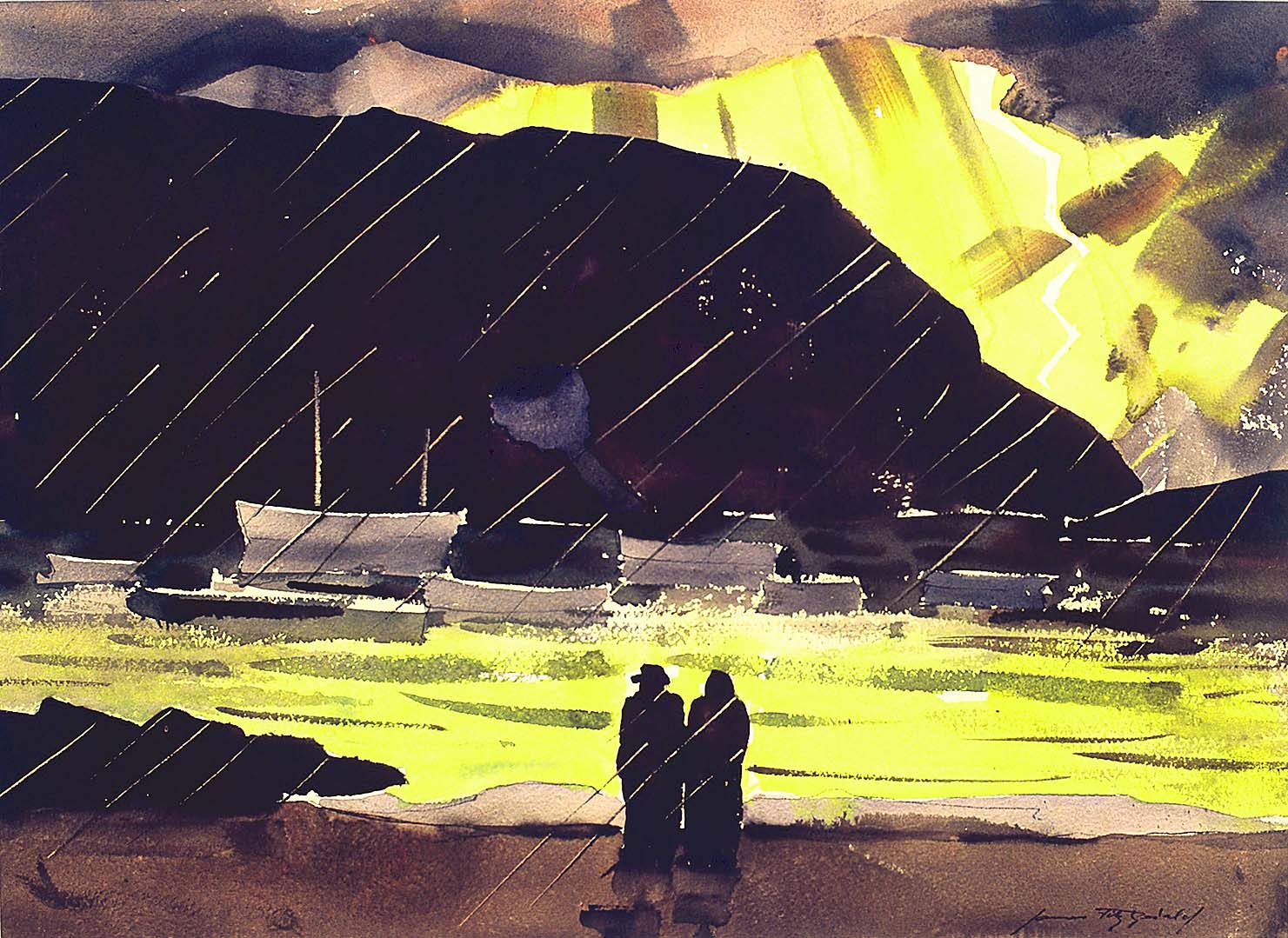
“Thunderstorm, Monhegan” by James Fitzgerald (1899-1971), circa 1955, watercolor and Chinese ink over graphite on paper, 15 by 21 inches, signed lower right: “James Fitzgerald.” Promised gift to the museum.
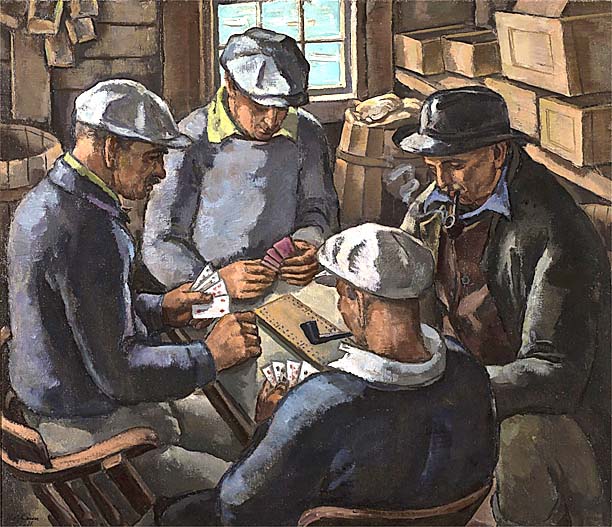
And they encountered many compelling narratives here, from Emil Holzhauer’s depiction of men playing cribbage, to Sean Gallagher’s scene of four fishers hauling in a fish-filled seine net into their dory. One can dip into Monhegan’s historic fish market as rendered by Robert van Vorst Sewell’s or catch a glimpse of the artist Edward Redfield painting en plein air.
There is James Fitzgerald’s moving depiction of an island funeral as well as an everyday scene of men salting mackerel. These works, and the stories of the artists that came here year after year, including Joseph De Martini, who painted there for close to 40 summers on the second floor of the Black Fish House, remain sources of enduring fascination. Take the modernist Reuben Tam, who writes of an old man who painted “nothing but the sea.” “I thought, here was a man who was driven by some deep urge to gather the seas into his life and unleash it as an expression or extension of himself,” he wrote.
It would seem there are stories hidden like this around many twists and turns. Tam observes, “It is as if the sea had organized some fraternity whose members had one god in common.”
As Bateson and Fuller continued to build their collection, they envisioned a time when they would bequeath it to the museum. The couple retired and moved full time into their seasonal home in Georgetown, Maine in 2019, and Bateson has been board member of the Monhegan Art and History Museum for a decade.
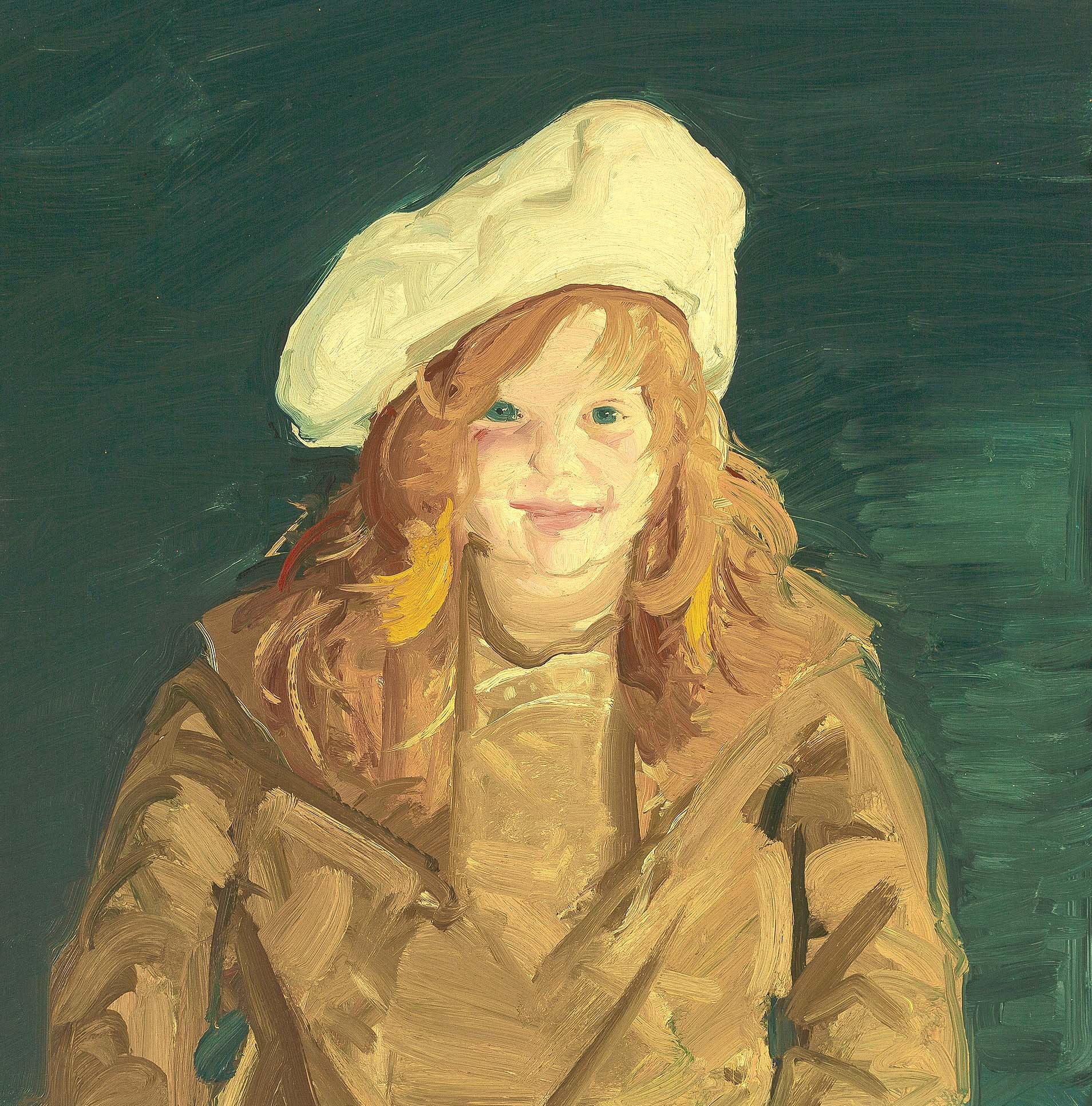
“Jackie” by George Wesley Bellows (1882-1925), 1914, oil on panel, 24½ by 24¾ inches, unsigned.
The couple worked closely with Deci and Pye to help them locate what they deemed important paintings by artists who may have come only once or twice, or those whose Monhegan art was not perhaps widely known.
And they were thrilled when they were able to bid upon George Bellows’ portrait of the then four-year-old island Jackie Hudson, the daughter of the artist Eric Hudson, who grew up to become an artist in her own right and who help found the museum.
“One might wonder what has motivated our collecting journey. We do not live on Monhegan, nor do we have any family history connecting us to Monhegan; or even to Maine. Our history is deeply rooted in sailing along its coast. Mohegan has, almost always, been our first stop on this journey — including on our honeymoon.”
The Monhegan Art and History Museum oversees more than 2,000 works of art already, in exhibition and storage spaces built into the Monhegan Island Light Station and in historic artist homes and studios. It has been built and sustained by donations. though nothing as extensive as this one now.
Pye has installed the exhibition, which is hung salon style — in the gallery building, and spills over into the adjacent history museum, and a separate artist studio building, originally built by Rockwell Kent.
“It’s the largest gift we have ever been given,” Pye said.
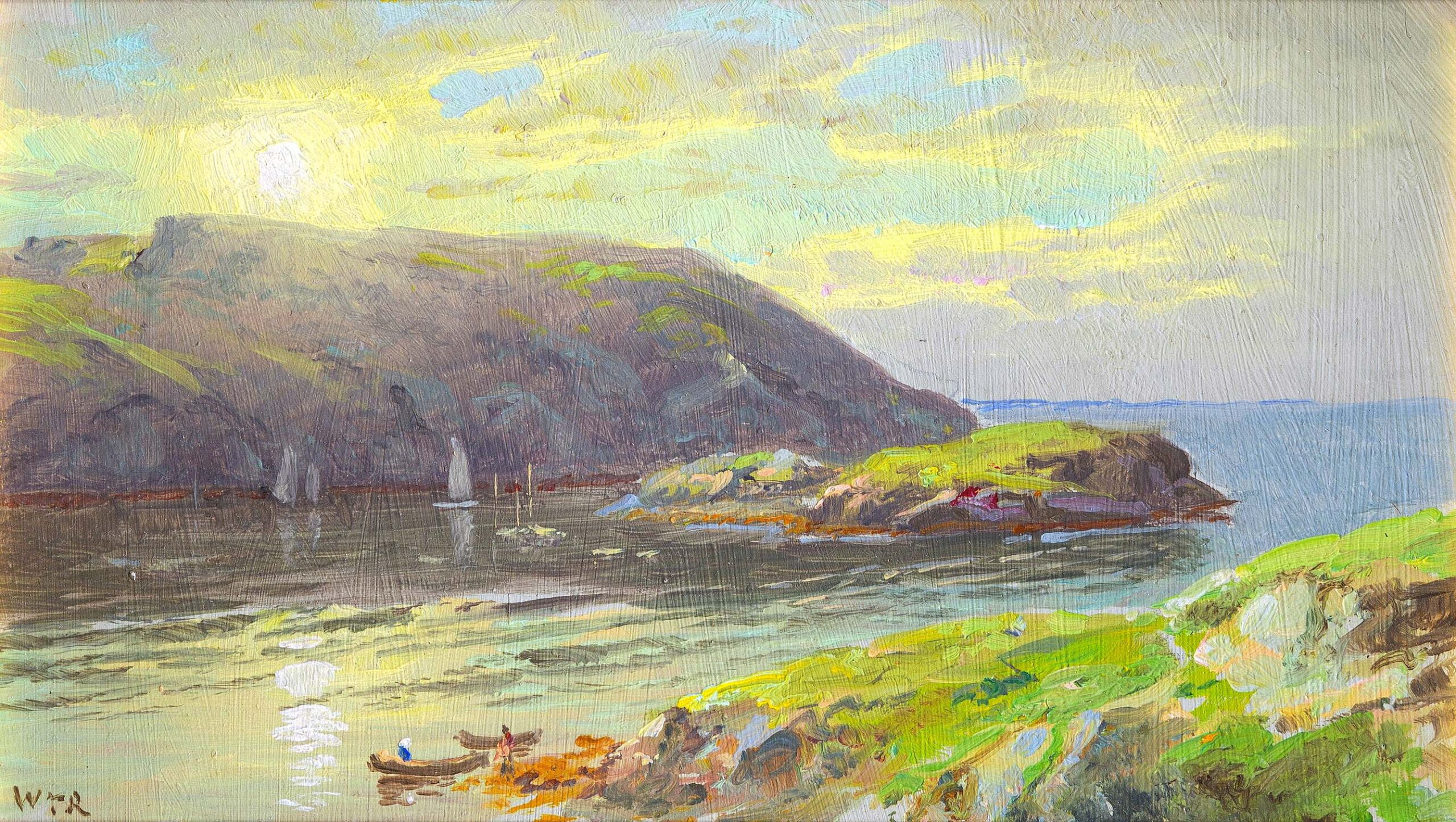
“Courting at Sunset” also called “Harbor at Monhegan” or “View of Monhegan” by William Trost Richards (1833-1905), 1895, oil on panel, 5 by 9½ inches, signed lower left: “WTR.”
“They will never be hung all together again. This is it,” Fuller said recently, and seeing them in juxtaposition with each other had been a way for her to encounter them as if for the first time. They will be used in future years as parts of other exhibitions and potentially placed on loan with other museums.
“We got so much joy in collecting and learning about all these artists,” Bateson said, “We knew sharing the collection with the public would bring us joy as well. Seeing these works hung salon-style helped me see the collection as if it were new again. I had the wonderful sense that these artists were engaged in lively conversation — across time.”
The Monhegan Museum of Art & History is at 1 Lighthouse Hill. For information, www.monheganmuseum.org or 207-596-7003.