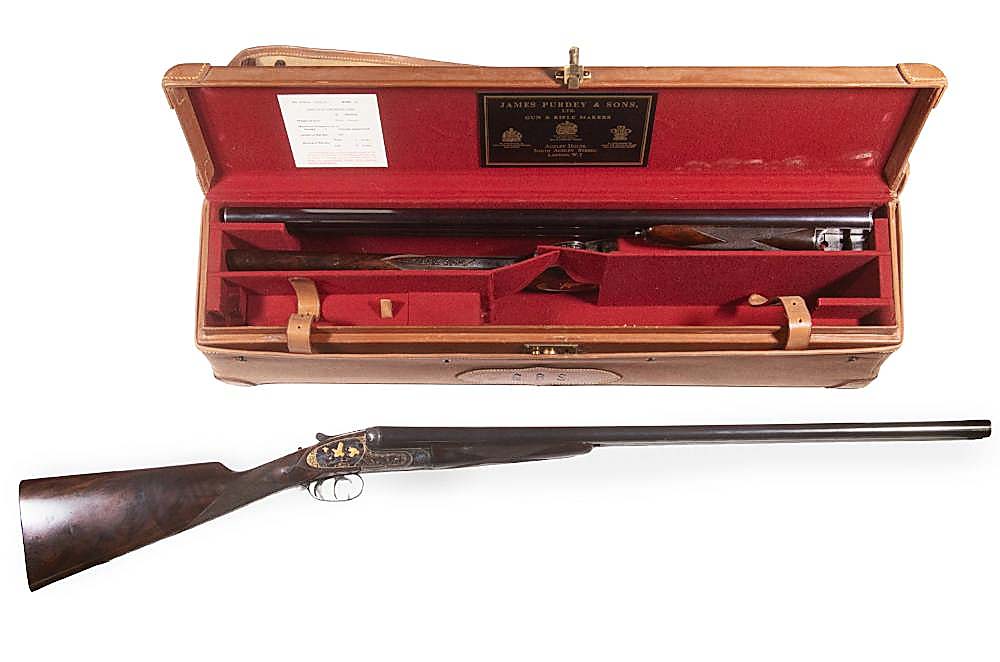
The top lot of the auction was this pair of matched Purdey shotguns that achieved $144,000 ($100/150,000).
Review by Jessica Skwire Routhier
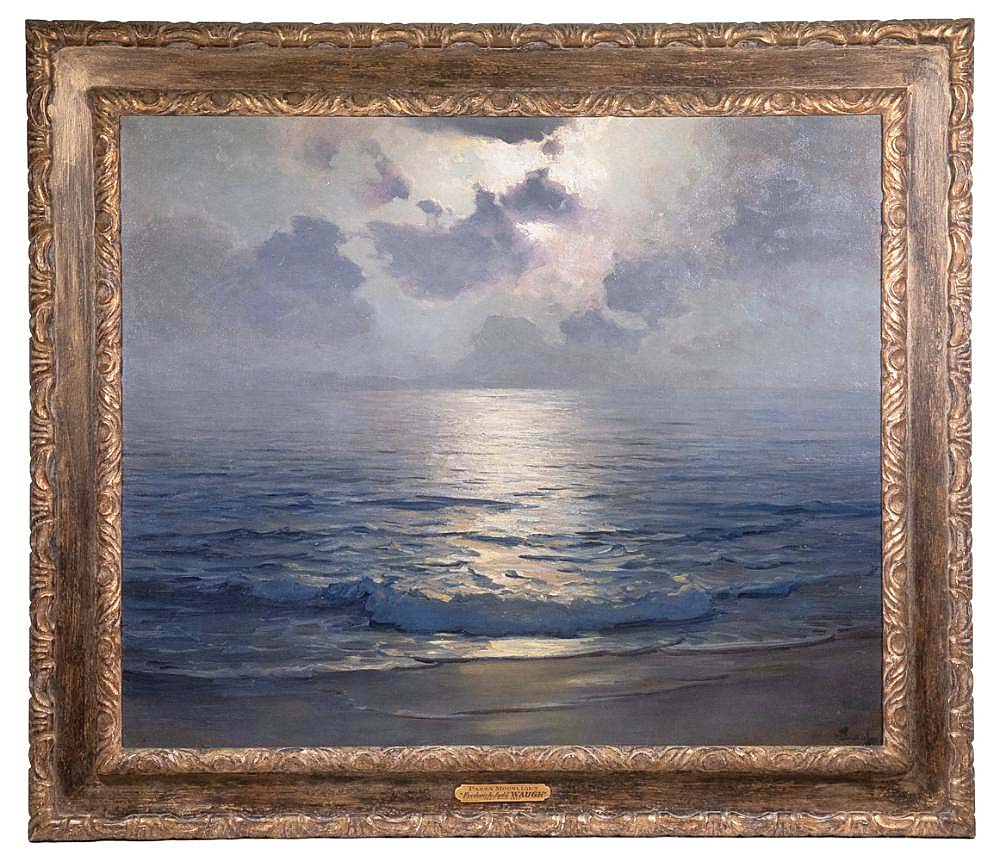
THOMASTON, MAINE — On the evening of Friday, August 28, social media feeds were filled with New Englanders’ photos of a magnificent full “sturgeon moon” as it rose over the Atlantic and cast a golden path across the darkening waters. It was perhaps, then, a strategic move that Thomaston Place Auction Galleries saved Frederick Judd Waugh’s “Moonlight Serenade” — a luminous oil on canvas that looked like it had been transposed from those very skies — for the following day during its three-day auction that ran August 28-30. The painting clearly struck a chord in more than one buyer, selling for double its high estimate at $28,800.
Enthusiasm in general was high for Thomaston Place’s end-of-summer sale, appropriately titled Summer Grandeur. Owner and auctioneer Kaja Veilleux said, “It seems that we always tend to get an enthusiastic crowd at this time of year, with a strong in-house turnout for all three days.” In addition, he reported heavy bidding activity online and on the phone. Overall, the sale realized $2.3 million, with an almost 90 percent sell-through rate.
Exciting as the Waugh bidding was, the top lot of the sale was in a whole other category, in more ways than one. A pair of matched shotguns by James Purdey & Sons, in their original leather case, went for $144,000 in the first session. “We have a firearms expert on staff who helps to curate and authenticate the pieces we offer,” Veilleux explained. “This particular sale was very strong in sporting arms as hunters prepare for the coming season.”
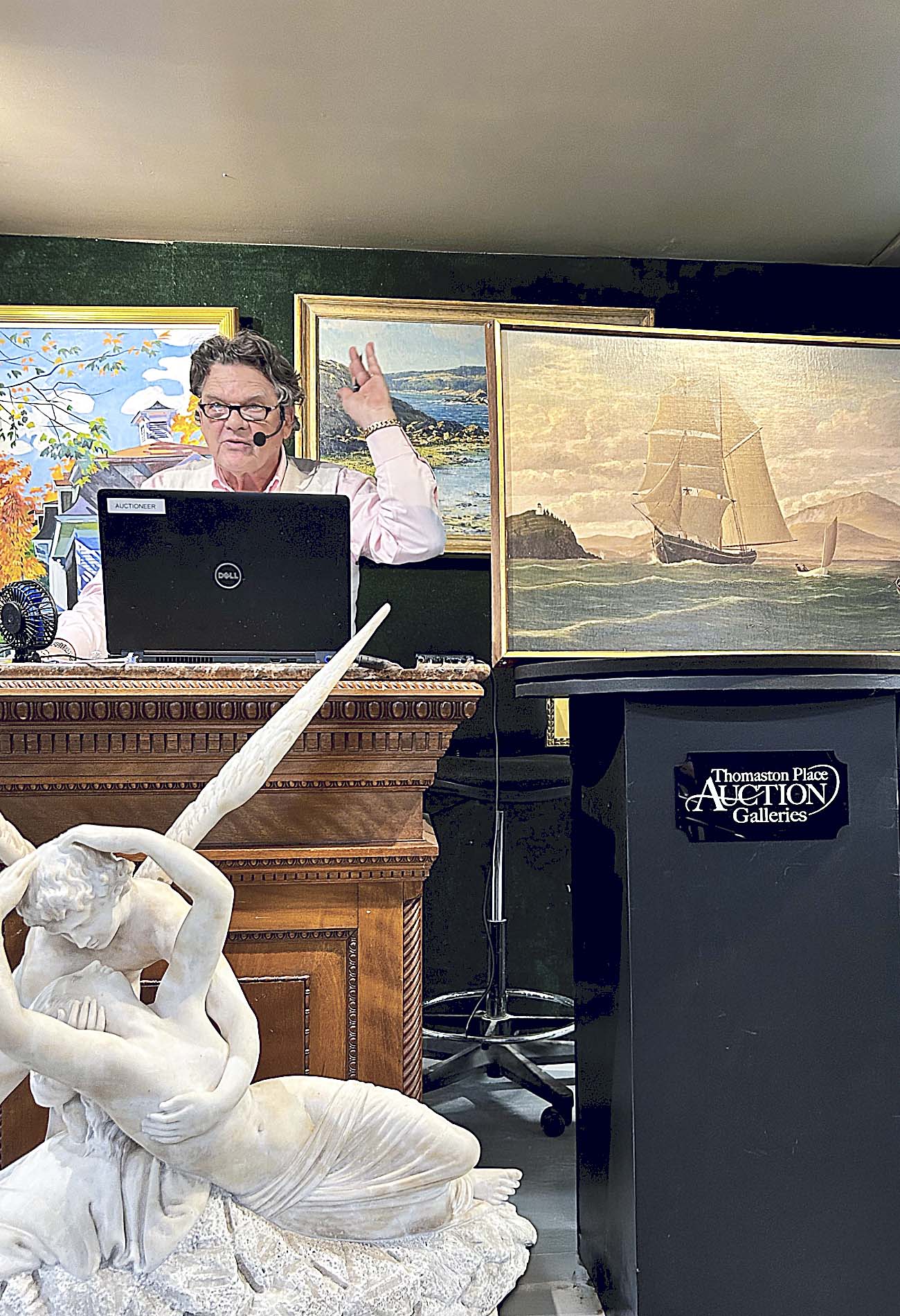
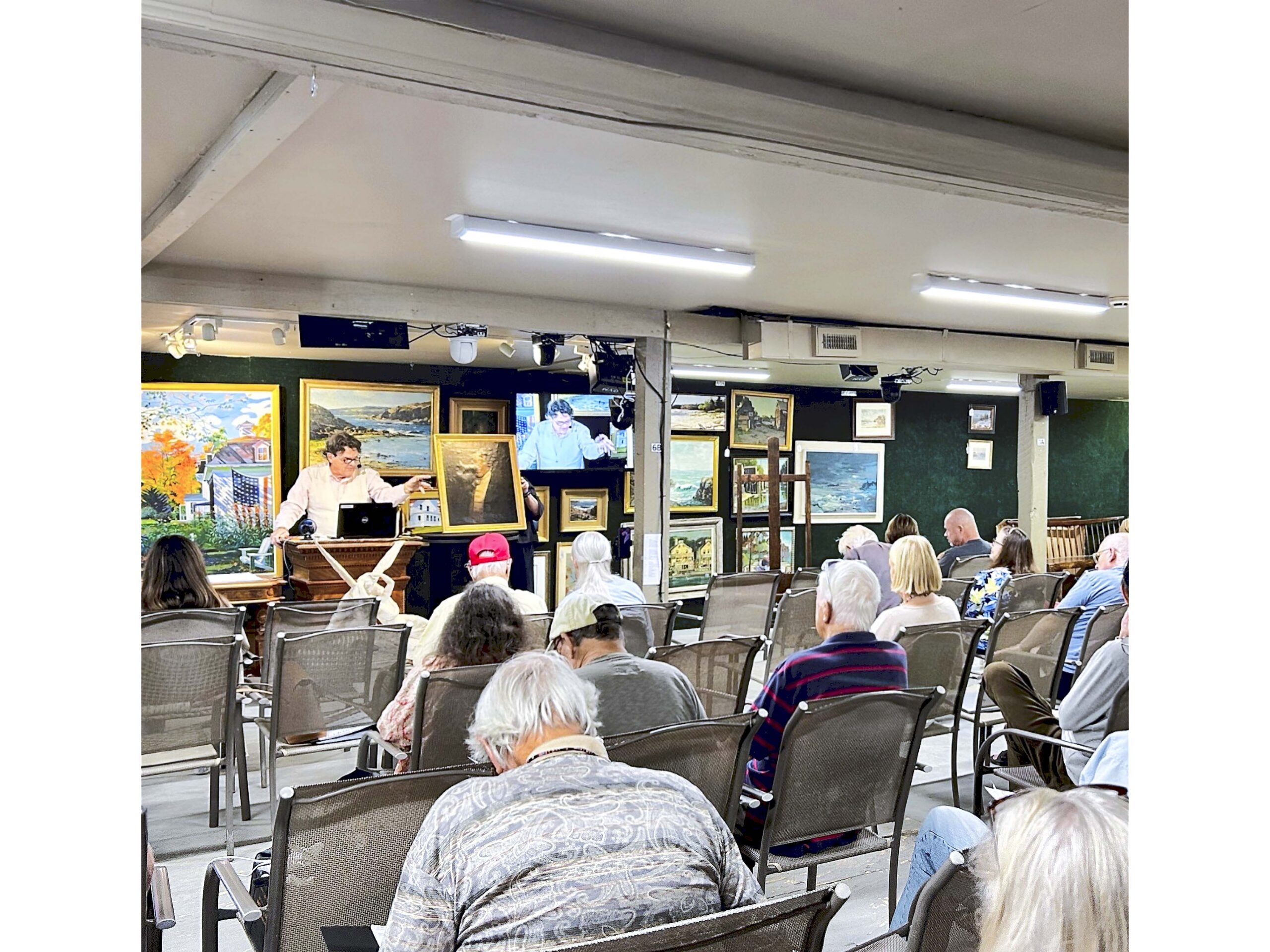
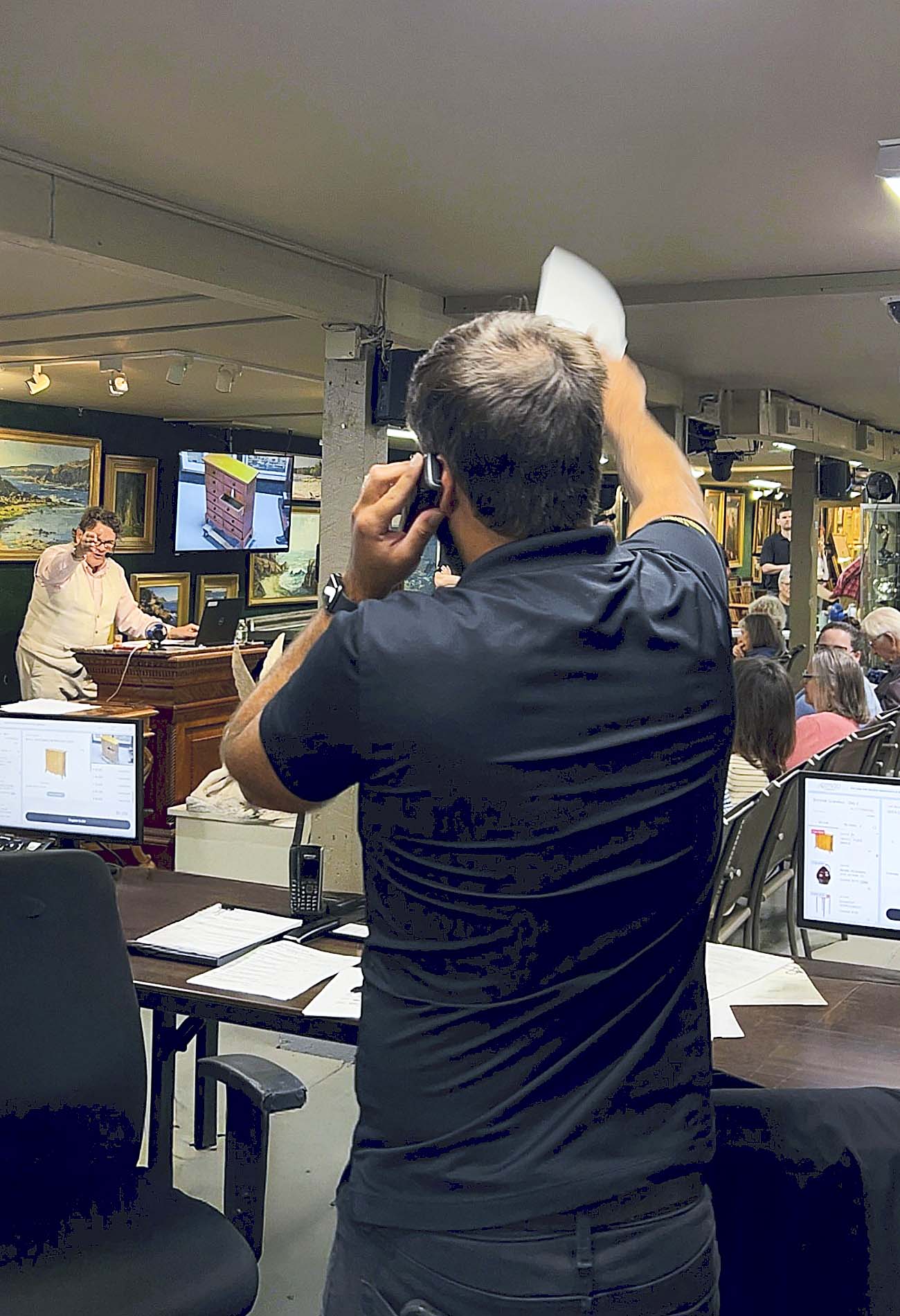
Thomaston Place owner/auctioneer Kaja Veilleux takes the helm during the sale.
Two other top lots from the first day were also firearms: one by gunmaker Henry Atkin, who trained at Purdey, went over estimate at $5,100 and a shotgun by the Italian firm of Battista Rizzini featuring lock plates and other fittings engraved with wild birds and floral designs performed well at $12,000. “We were particularly excited in this sale to have the privilege of offering several extremely high-end birding guns of European manufacture,” said Veilleux, “and we made a point of contacting specialists and collectors around the world to alert them about these pieces.”
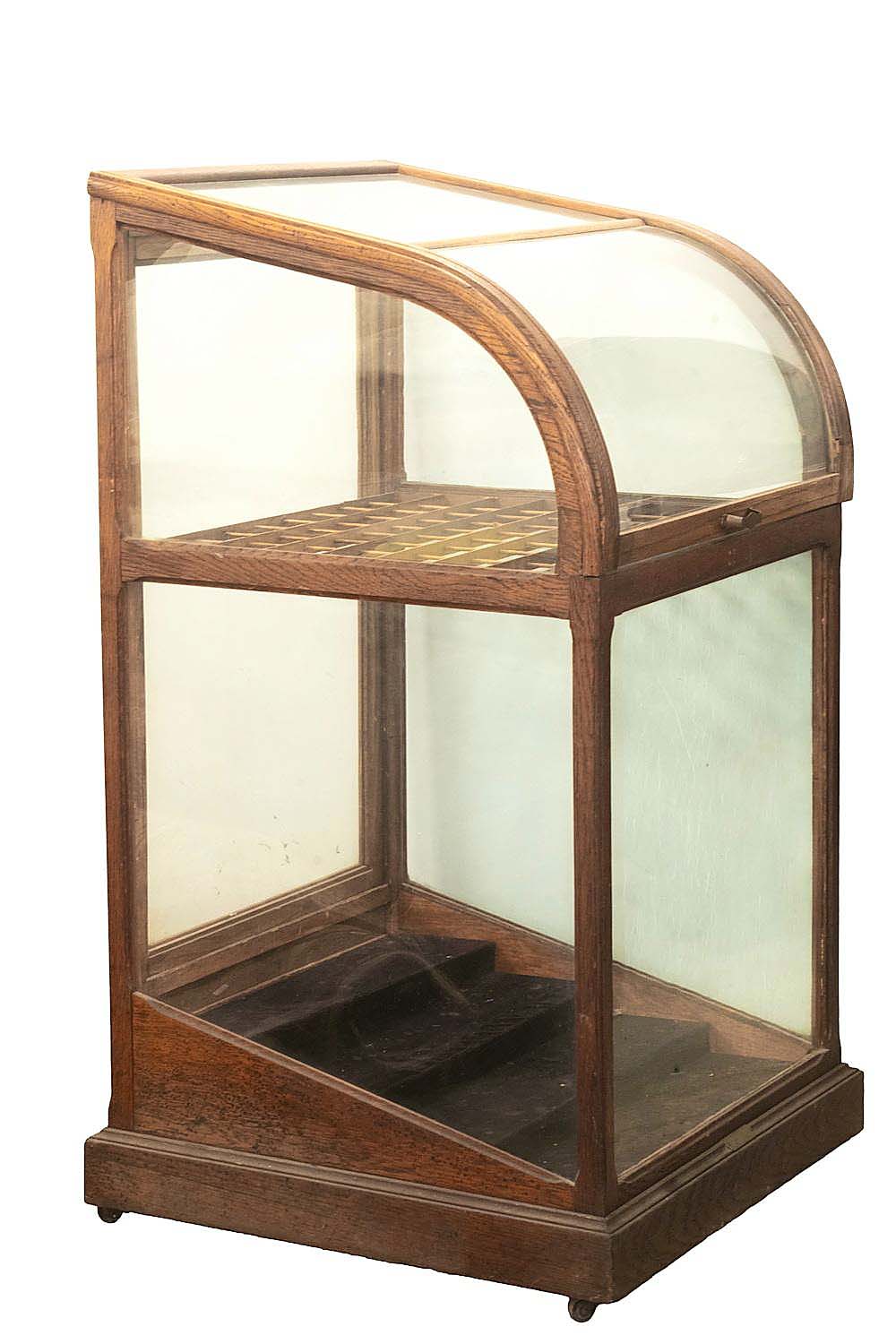
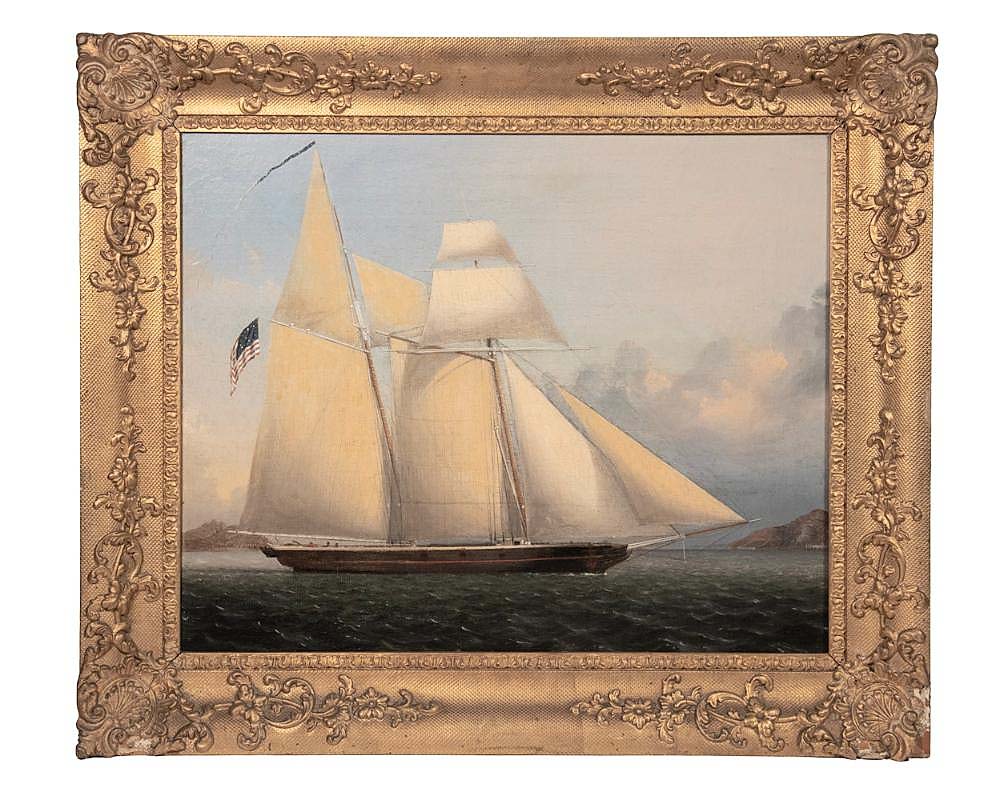
Day one brought several surprises in addition to the firearms. A pair of French neoclassical bronze wine urns, reflecting a surging taste in ornament and French revival styles filtering outward from the White House made $10,625, and an oak and glass walking stick display took $8,125. Both went for ten times their estimates. A drawing of Scottie dogs by illustrator Marguerite Kirmse fetched $4,062 and a China Trade painting of an unidentified American schooner entering Hong Kong Harbor, selling for $4,200, also exceeded estimates. The latter was perhaps buoyed by its original gilt corner frame with extensive applied ornament and cross-hatching.
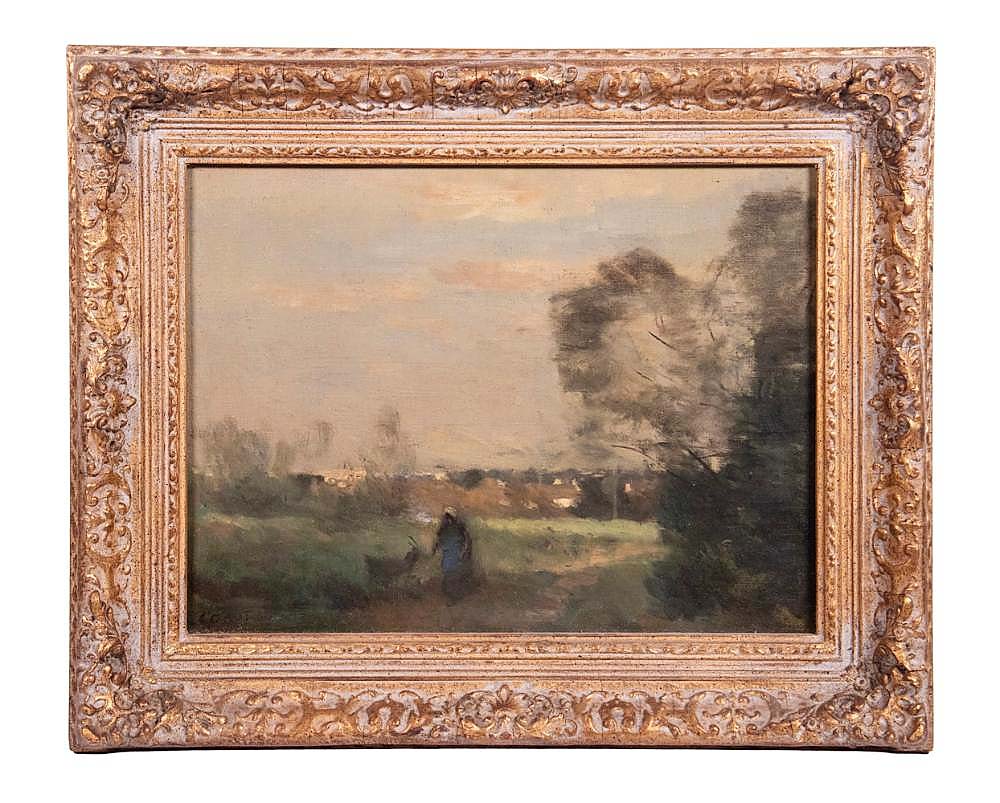
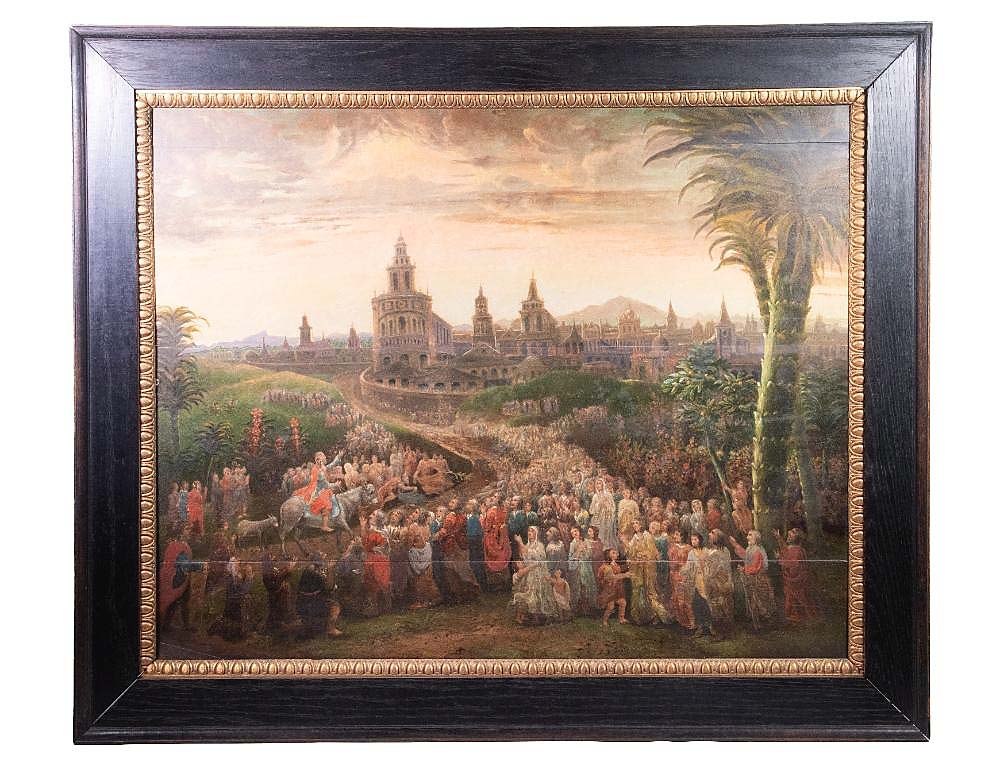
The Waugh was the standout on day two, closely followed by a suite of European works: a small tonal landscape by Jean-Baptiste-Camille Corot, delicate in both its color palette and its handling ($28,750); an unusual oil of Christ’s entry into Jerusalem, perhaps Hispano-Flemish ($13,750); and a small marble by Pieter Barranti, after Antonio Canova’s “Psyche Revived by Cupid’s Kiss” went for $13,200 against an estimate of $1/1,500. The Eighteenth Century marble was originally conceived as a souvenir for the Grand Tour; Cupid’s wings were removable for safe packing and transport.
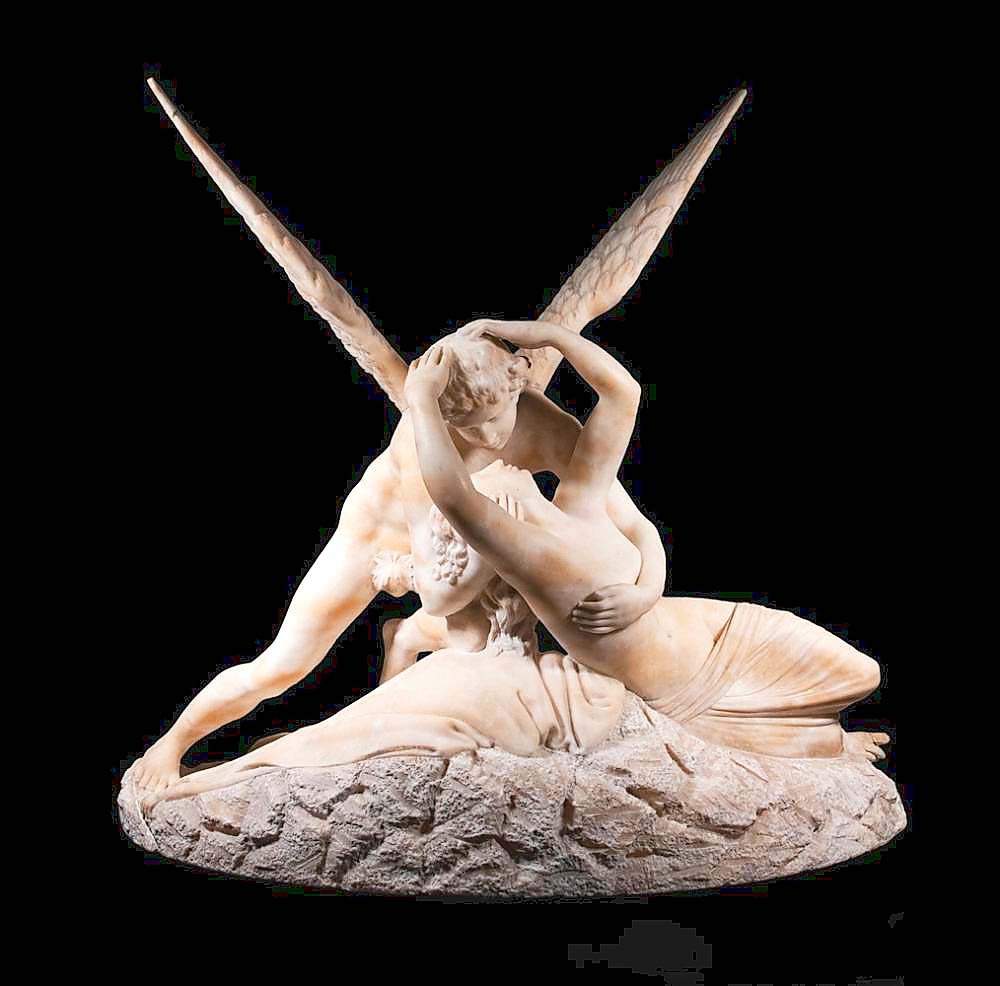
This version of Canova’s “Psyche Revived by Cupid’s Kiss” by Pieter Barranti was claimed for $13,200 ($1/1,500).
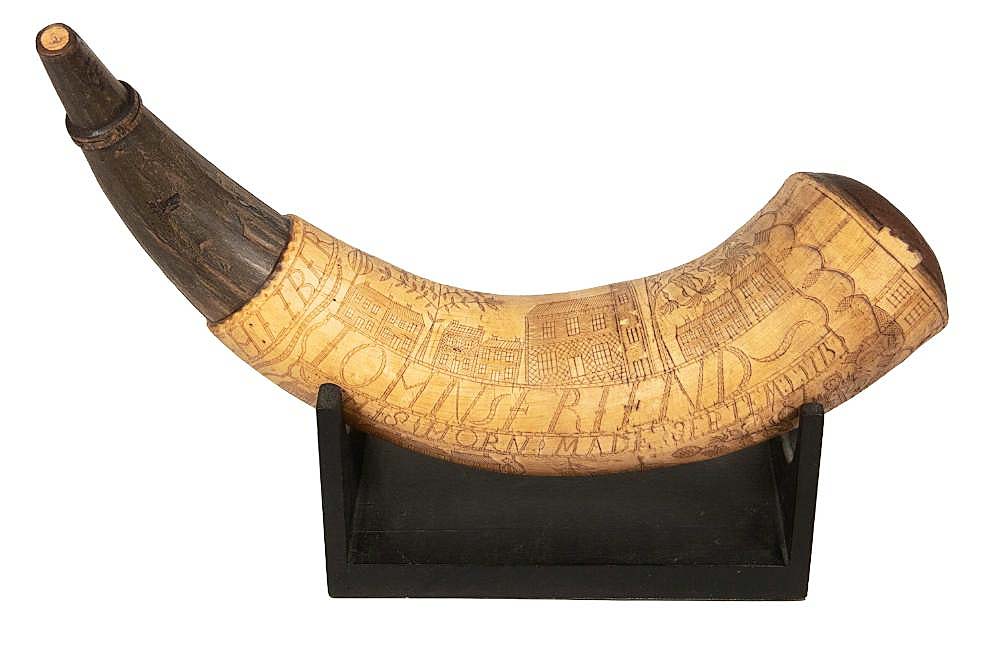
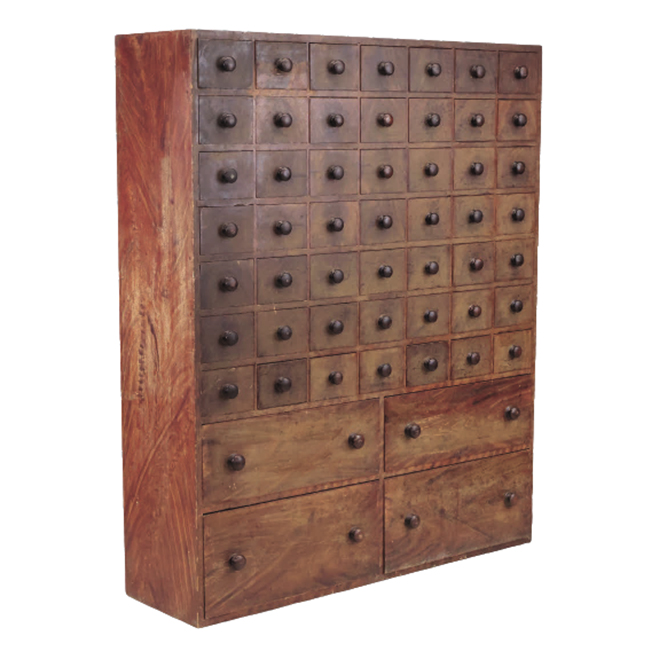
Two pieces of Americana stood out on day two: a painted chest of drawers from 1840s Maine that sold for $12,000 and an engraved powder horn from 1775 that went for $15,600. Driving the bidding on the powder horn was the unusual fact that both the owner (John Friend III) and carver (Colonel Daniel Gage of New Hampshire) were known, as well as the military context: the capture and subsequent defense of Fort Ticonderoga by the Continental Army during the first engagements of the American Revolution. The elaborate carvings included a plan view of the fort and the unambiguous rallying cry, “Liberty or Death.”
“Handling a piece of this historic significance really does underline the role that auction houses play in helping to preserve one-of-a-kind artifacts for the appreciation and study of future generations,” commented Veilleux.
Exceptional works of decorative art led the pack on the third and final day of the sale, August 30, although the top lot was a more contemporary item: a 2019 Volkswagen Golf GTI that took $24,600. “Estate vehicles are a regular feature of our feature sales,” Bergman explained. The next-highest price realized was for a Tiffany Studios lamp shade in the firm’s understated Acorn pattern, which went for $20,400 against an estimate of $3/5,000. Tiffany introduced the design (originally called Vine Border) around 1895 and continued to refine it in the following decades. For that reason, a particular moment in its design and manufacture may lure certain collectors; indeed, a full lamp with an Acorn shade went for far less on that same day.
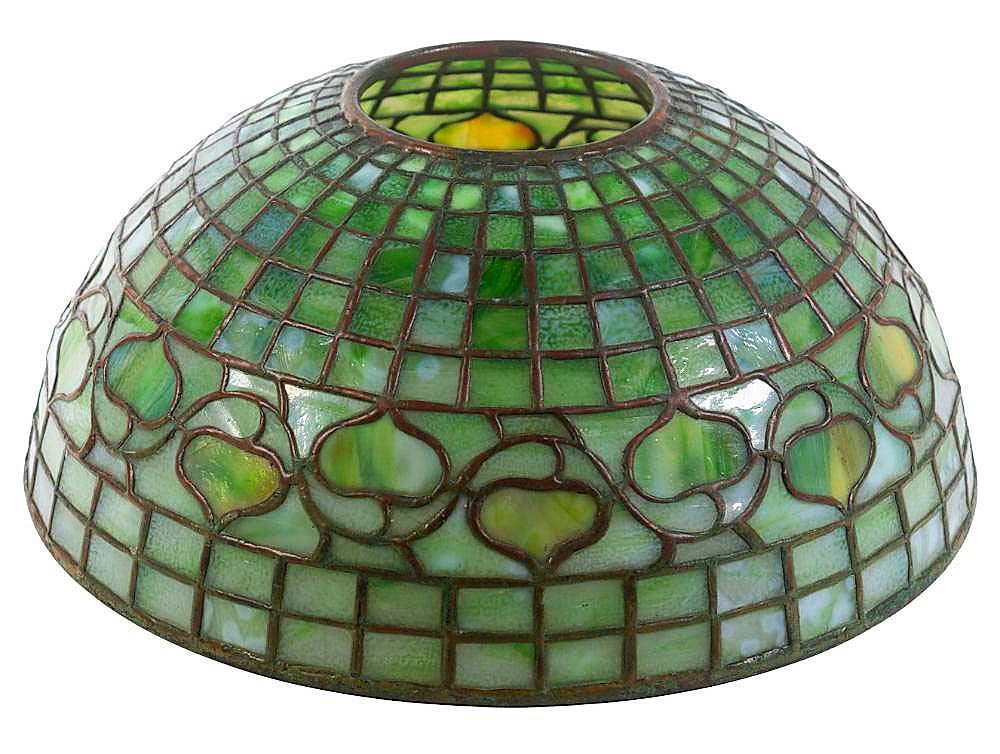
This Tiffany Studios lamp shade in the Acorn or Vine Border pattern earned $20,400 ($3/5,000).
“Tiffany lamps and Tiffany lamp shades attract a very knowledgeable and very specific group of collectors,” shared Veilleux, noting “a very deep body of research in which the nuances of manufacture are just as important as the visual impact of the piece… As with any collectible, rarity of variety is king.”
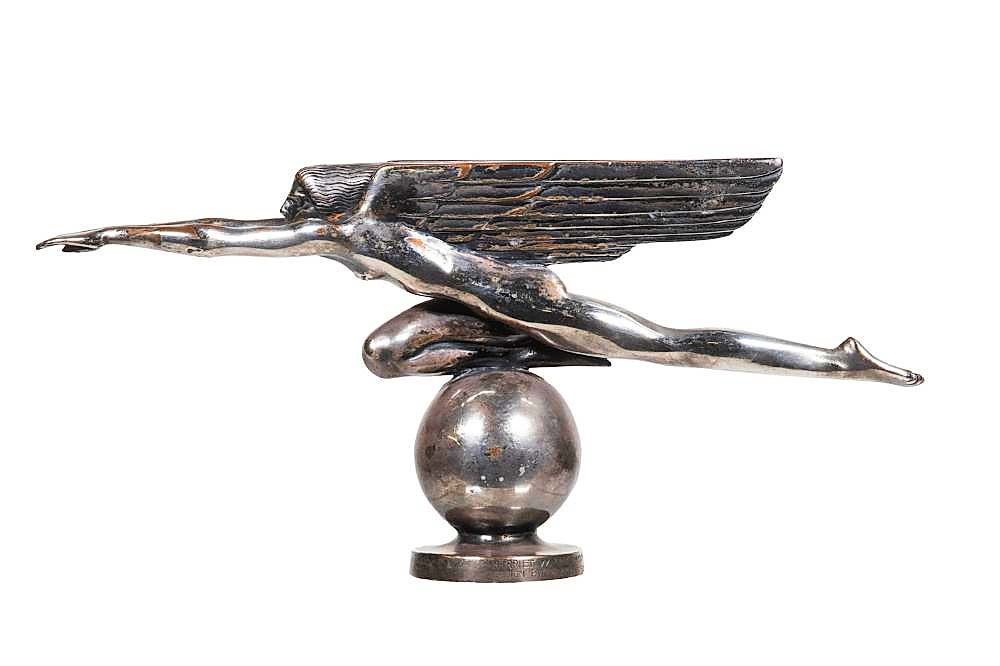
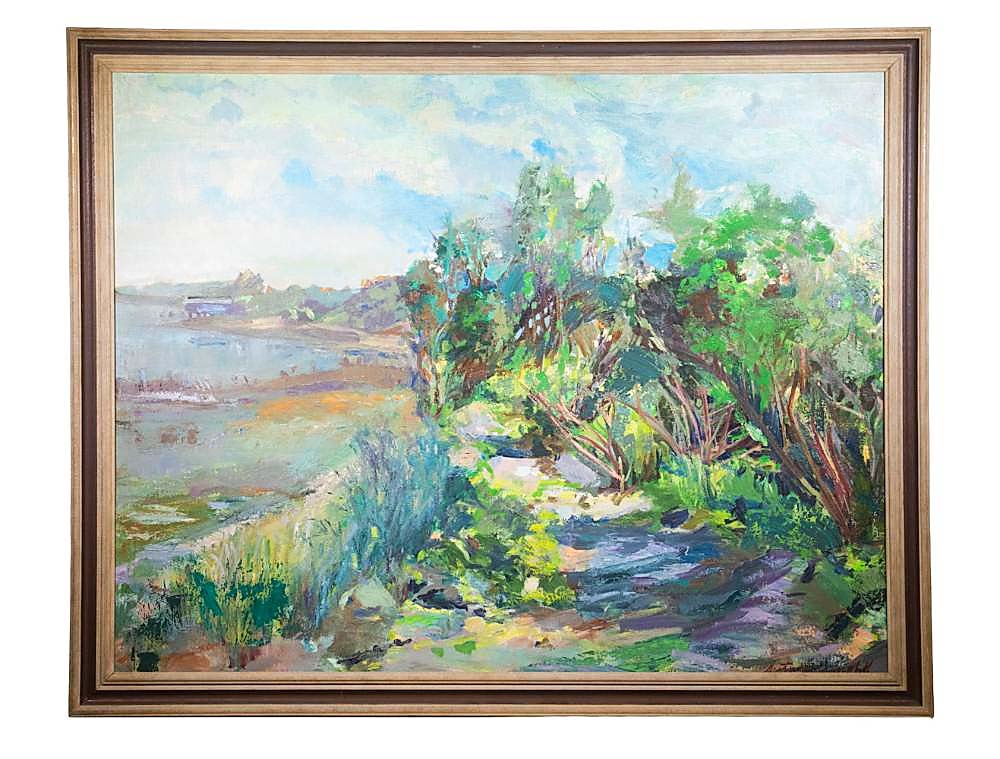
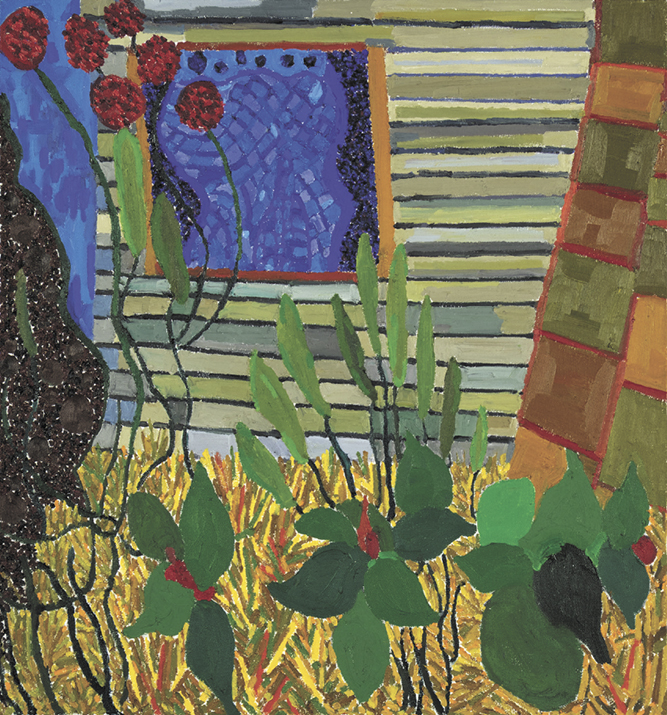
Two of the top sales on day three demonstrated what Veilleux described as a burgeoning interest “in women artists of the Twentieth Century, many of whom have gone underappreciated or overlooked for so long.” A silver-plated bronze hood ornament designed by sculptor Harriet Frishmuth, in the form of a winged woman surging over a globe, conveyed the speed and dynamism of both the modern woman and the emerging Art Deco movement in 1921. It might not suit the VW Golf, but someone was able to envision it in the right context; it closed at $14,400. A painting by Gretna Campbell, a member of the early cohort of Abstract Expressionists, showedhow she united that group’s brushwork with landscape forms. Titled “Rose Bushes on Shore,” it dated to 1982, when she was spending her summers on Maine’s Cranberry Islands. It brought $18,750.
The universal appeal of Maine — as a subject for art, as a respite and a destination, as a place of discovery — was perhaps best encapsulated in Eric Hopkins’ “Another Great Day on the Bay” ($11,250) from 1983. Hopkins has long been known for his abstracted aerial views of the islands in Maine’s Penobscot Bay, but this work dated from his first experiments with the motif. It is perhaps for this reason that it exceeded its $2/3,000 estimate by so much — or it could just be that more than one bidder felt compelled to bring home a piece of Maine land, sea and sky as the summer draws to a close.
Prices quoted include the buyer’s premium as reported by the auction house. Thomaston Place’s next auctions will be Home Furnishings & Décor on October 2 and Autumn Majestic 2026 November 13-15.
For information, www.thomastonauction.com or 207-354-8141.