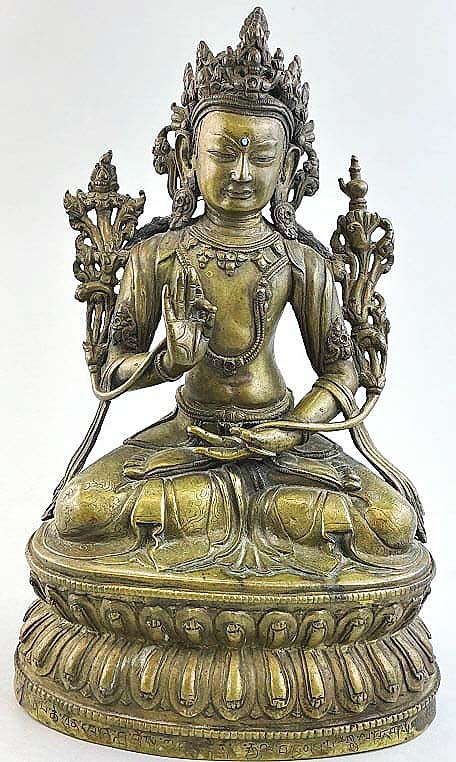
Top-lot status was awarded to this Qing dynasty seated Bodhisattva Avalokitesvara bronze statuette, 9½ inches tall, which was marked with the Vishvavajra symbol of Tibetan Buddhism. It far exceeded its $1/2,000 estimate to make $27,940.
Review by Kiersten Busch
MYERSTOWN, PENN. — Kleinfelter’s Auction closed out the month of May with its Online Asian, Tribal & Oceanic Antiques sale, an 814-lot event offering a single-owner collection on May 31, which earned a 90 percent sell-through rate by the fall of the last gavel.
The $27,940 finish for a Qing dynasty Chinese seated Bodhisattva Avalokitesvara bronze statuette marked the highest price of the day. Likely made in the mid Nineteenth Century, the work depicted a deity “who has attained the highest level of enlightenment and compassion,” according to catalog notes. The base of the figure was engraved with Chinese characters, while its bottom was incised with the Vishvavajra symbol of Tibetan Buddhism.
A few other deity statues earned high prices, including a Nineteenth Century Qing dynasty Tibetan gilt-bronze statuette of Vajrapani, the revered protector of Buddha, which finished just above its $1,500 estimate at $1,524. With Vajrapani depicted in the warrior stance, the figure stood upon a lotus platform, trampling snakes and holding a vajra (thunderbolt scepter). Following behind at $1,270 was a 28-inch-tall Buddhist altarpiece with the goddess Shyama (Green Tara) flanked by Sita (White Tara), transcendental Buddha Amitabha and Bodhisattvas Vajrapani and Avalokiteshvara. The work was done after the artist Kumaradeva, who was active during the Eighth Century in India.
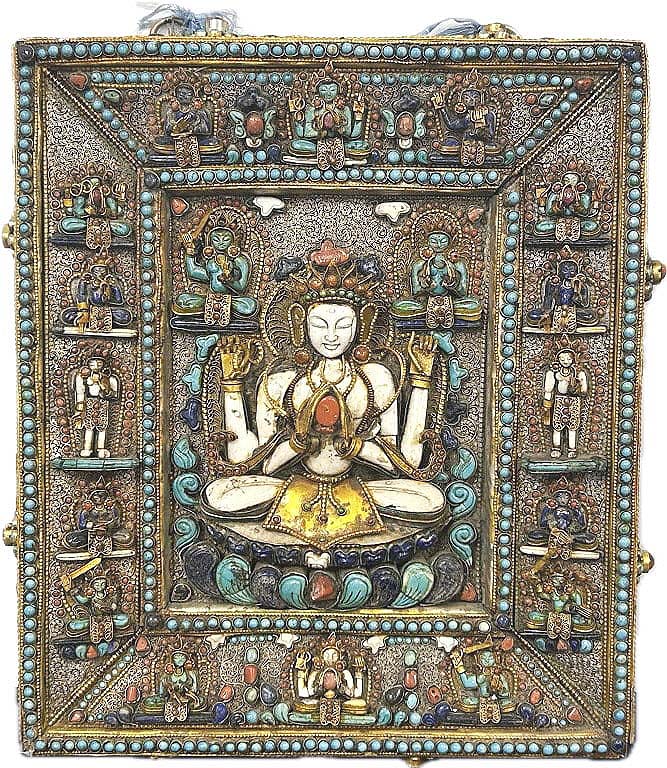
This Nepalese Buddhist copper votive wall plaque mandala, Nineteenth Century, 13½ by 11¾ inches, depicted Shadakshari Lokeshvara surrounded by Buddhist deities and hung for $2,540 ($300/500).
Also earning $1,270 was a bronze statue of the Hindu deity Lord Vishnu, who was depicted sitting on the coils of the serpent Ananta Shesha, his five heads “poised above [Lord Vishnu] giving him shelter,” as described by catalog notes. In addition to Lord Vishnu, Lord Hanuman is seated on the front of the base in full lotus position (padmasana), with his hands clasped in front of his chest in the namaste (or anjali mudra) position.
Other Buddhist treasures included an antique Nepalese Buddhist copper votive wall plaque mandala of the four-armed Shadakshari Lokeshvara surrounded by powerful Buddhist deities. Made in the Nineteenth Century, the plaque had ornate detailing, down to the Buddhist figures being delineated in turquoise, coral and lapis lazuli stones, placed into small, thin copper wire frames. With a conservative $300/500 estimate, the plaque soared above expectations, earning $2,540. Another mandala, this one a three-dimensional sculpture of a lotus mandala representing the celestial abode of Chakrasamvara and his consort Vajravarahi, was also embellished with lapis lazuli, coral and turquoise and realized $1,905.
The second highest price of the sale — $4,763 — went to a Cambodian silver metal offering box (boite a offrandes) in the vintage Thai rattanakosin style, which originated in India. The piece had filigree repoussé floral, foliate and scroll motifs, a conical cover and came with a matching betel nut leaf holder. The offering box was marked “DAC,” which, according to catalog notes, “relates to a control or arts association mark as it is found upon a stylistically wide variety of Cambodian vessels from the early to mid Twentieth Century.”
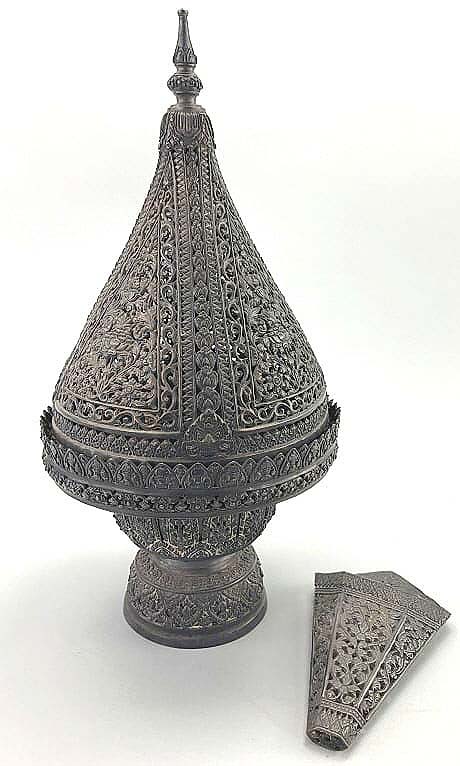
Reaching $4,763, this Cambodian silver metal offering box in the vintage Thai style, 12½ inches tall by 6 inches wide, had a conical cover and was accompanied by a matching betel nut leaf holder (1.145 troy ounces) ($100/200).
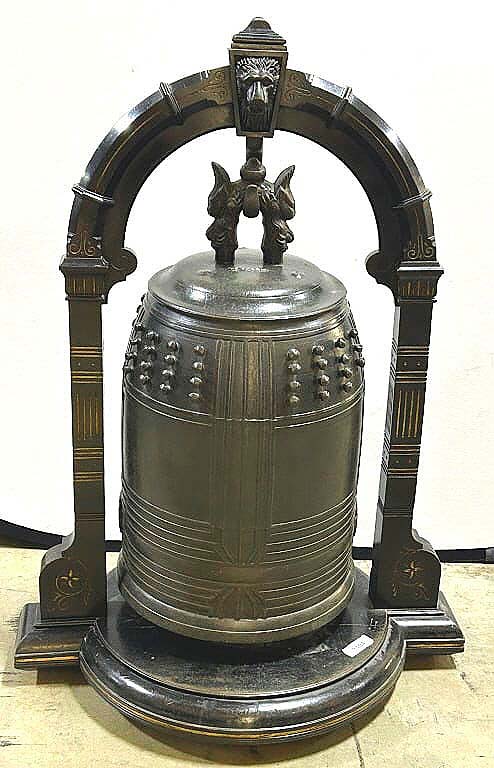
Several temple bells from different nations earned bidder attention, led by a late Nineteenth or early Twentieth Century bonsho, or Buddhist bronze temple bell, with twin dragon head supports (ryuzu) and boss protrusions (chi chi or nyu), which improved the resonance of the bell’s sound. It was mounted on a period-correct Victorian Eastlake support frame and still had its original ebony and gilt finish with an applied bronze lionhead plaque. Explained in the catalog notes, “Rather than containing an interior clapper, bonsho is struck from the outside, using either a handheld mallet or a beam suspended on ropes. Traditionally used to summon Buddhist monks for prayer.” The bell sounded for $4,128, more than double the high end of its $1/2,000 estimate.
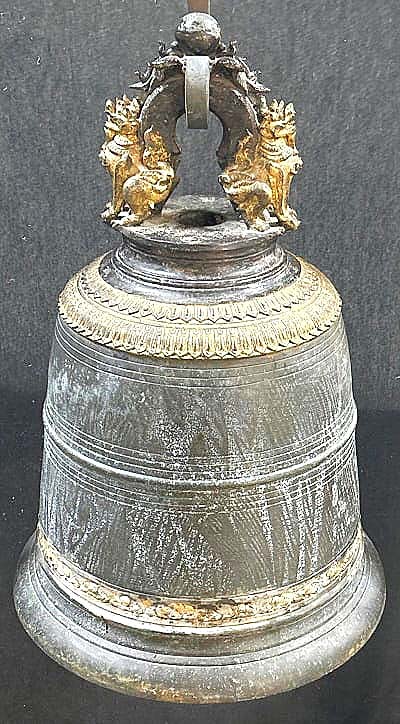
A large Nineteenth Century Burmese bronze temple bell, known as a Chinthe bell, rung for $2,667. It featured a suspension loop with a pair of stylized guardian lions (Chinthes) and had raised horizontal band across its body, a flared mouth and a lotus petalband on its shoulder. Another Burmese bronze bell, this example a Buddhist temple bell, followed behind at $2,159. Its top was adorned with a stylized lotus design in the form of two figures from Burmese folklore, possibly Nagas, surrounded by waves.
Following the top lot, Chinese wares were led by a large antique porcelain jardiniere featuring twin dragons chasing a flaming pearl. The pot’s underglaze was blue, with iron red details, and it filled up for $4,128 against a $100/300 estimate. Other Chinese ceramics included a late Nineteenth or early Twentieth Century porcelain bulbous form covered jar with illustrations of a phoenix among flowers and foliage and household items which realized $1,905, and a blue-and-white porcelain temple jar from the late Qing dynasty containing an underglaze of lotus flowers, water lilies and classic geometric and floral ruyi cloud patterns, which totaled $1,778.
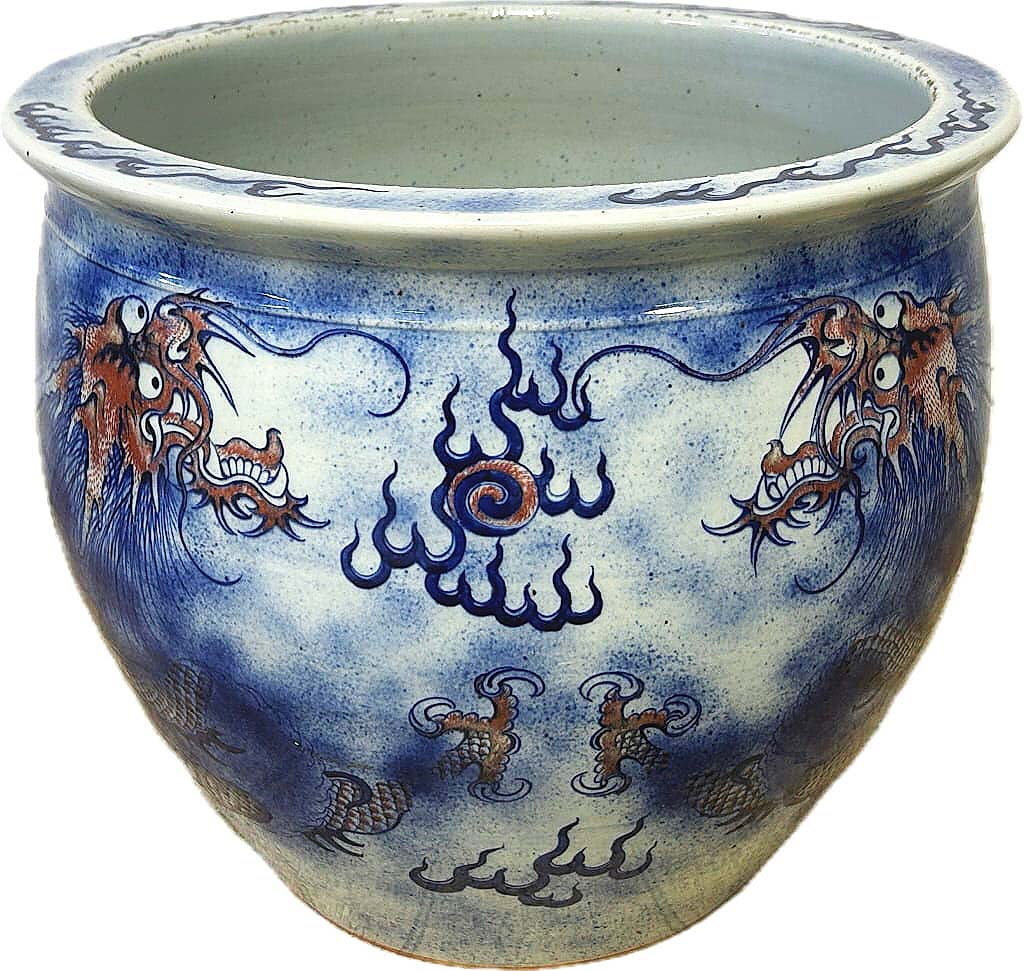
Adorned with twin dragons chasing a flaming pearl, this Chinese porcelain jardinière, 16½ inches tall by 18½ inches wide, approximately 40 pounds, far surpassed its $100/300 estimate at $4,128.
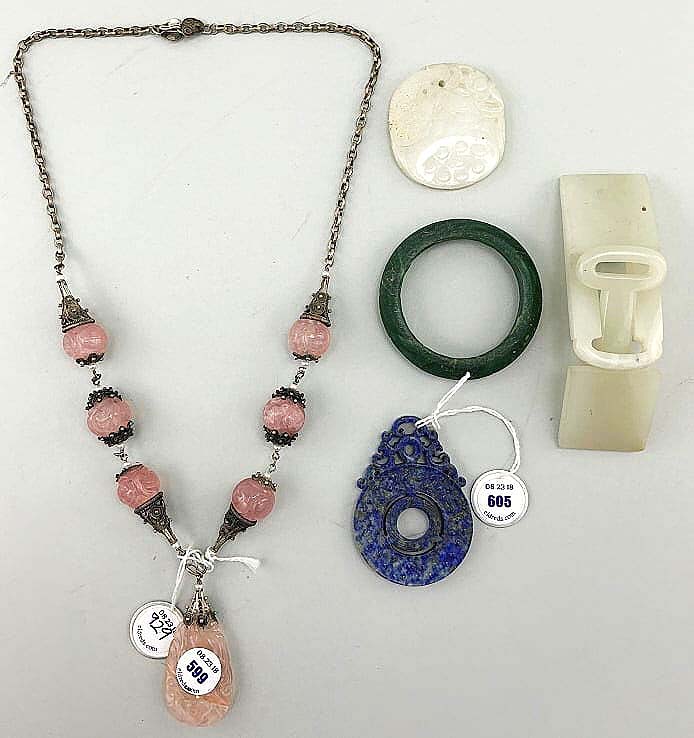
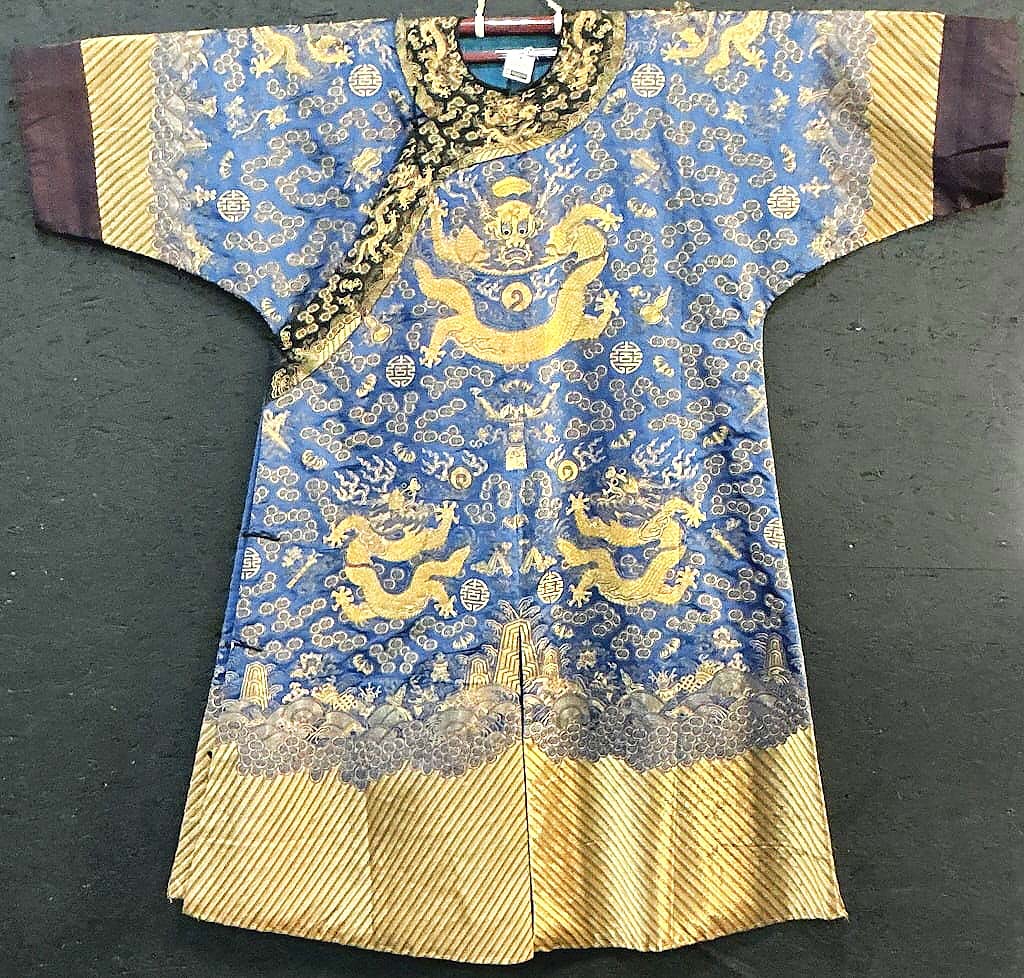
A Chinese Qing dynasty (Nineteenth Century) silk imperial robe with gold-thread embroidery on blue ground led textiles at $2,667. It depicted five-clawed dragons chasing flaming pearls, surrounded by ruyi clouds, bats and symbols for longevity. To accessorize any textiles for sale, bidders were drawn to a lot of Chinese gemstone jewelry, which included a silver and carved rose quartz necklace, a carved white jade plaque pendant, a spinach-green jade bangle bracelet, a lapis lazuli biform pendant with carved openwork and a rice design and a white jade two-piece belt buckle. The lot sold for the same price as the robe, $2,667.
Prices quoted include buyer’s premium as reported by the auction house. For information, 717-272-7078 or www.kleinfelters.com.