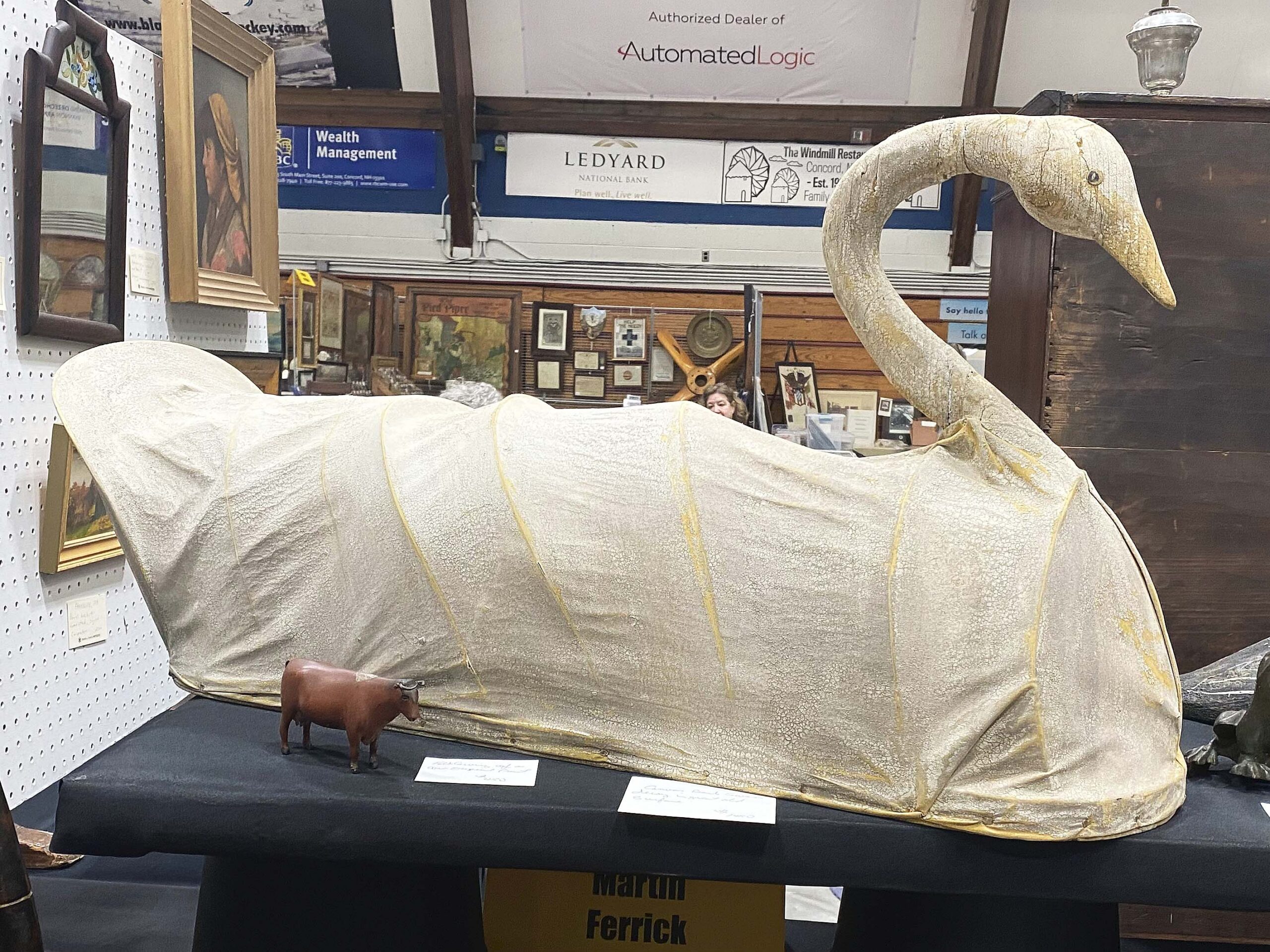
Found in a Maine attic, this circa 1930 swan decoy was likely crafted in Maryland and was remarkably preserved with its original canvas, wire and paint intact. Jewett-Berdan Antiques, Newcastle, Maine.
Review & Onsite Photos by Z.G. Burnett
CONCORD, N.H. — The announcement at the June 7 NHADA Members Antiques Show (and the concurrent Northern New England Book Fair) was clear about “no early buying,” but that did not stop hopeful customers from lining up outside the Douglas N. Everett Arena, just in case doors opened before scheduled.
Inside, more than 60 exhibitors were putting finishing touches on their booths and browsing their colleagues’ collections. Each was a familiar face of the northern New England antiques scene and those who were not selling would be there to buy shortly at the 10am opening. The majority of dealers brought folk art and early decor and were joined by rare book and ephemera sellers to create a comprehensive offering of categories.
Antique and vintage signage is trending among newer collectors, and New Hampshire Antiques Dealers Association (NHADA) members were more than happy to comply. Representing Nathan Liverant and Son Antiques of Colchester, Conn., Kevin J. Tulimieri presented one piece that fit the category but did not begin its life with such intention. “It was once an apothecary drawer for ‘Saleratus,’ which was baking soda’s predecessor,” he explained. The fragmented drawer front dated to circa 1825-45, was American and in good condition. Retaining most of its original paint and careful gold lettering, it had two ceramic pulls and was fixed with later hooks on the top for convenient hanging.
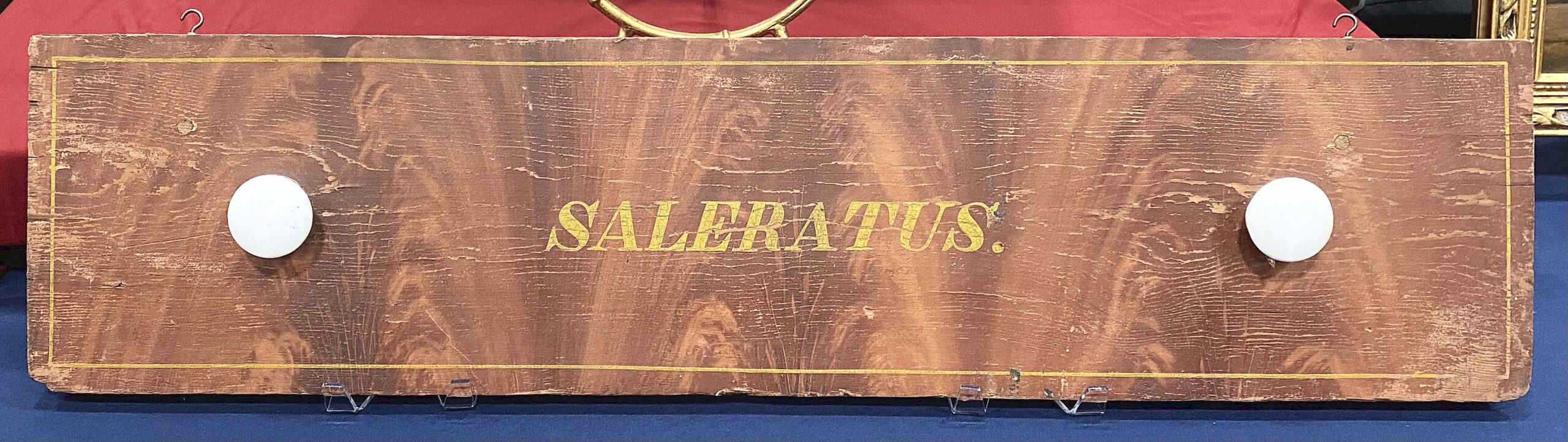
Marked for “Saleratus,” or early baking soda, this apothecary drawer front, first half of the Nineteenth Century, was refashioned into a hanging sign and offered by Nathan Liverant and Son, Colchester, Conn.
For local customers, Erik D. Wohl of Washington, N.H., debuted at NHADA with a handpainted, double-sided trade sign for Laconia Shoe Repair that was inscribed by its manufacturer, Upstate Signs. The paint was bright and in fantastic condition, probably made in the early to mid Twentieth Century. Bettina Krainin Antiques (Bethlehem, Conn.) showed another double-sided hang sign of the same date range that advertised “Book Studio,” appropriately shaped like an open tome and illustrated with a friendly-looking owl. Krainin shared that the person from whom she bought the sign acquired it from fellow Woodbury, Conn., dealer, David A. Schorsch.
Dennis Raleigh and Pumpkin Patch Antiques (Searsport, Maine) displayed what could have been mistaken for a hanging sign, but was actually a folk painting on panel by a Milford, Conn., limner. It showed a brightly-colored angel bearing a banner that read “Victrix casta fides,” which translates to “victorious pure faith.” The date “1857” was inscribed on its reverse, only a few years after the completion of St Peter’s Episcopalian Church in 1850-51. Unlike the Separatist Puritans who settled Milford in the early Seventeenth Century, the Church of England worshippers, who arrived nearly a century later, were more accepting of religious imagery. This attitude would have welcomed commissions or personal creative projects such as this painting.
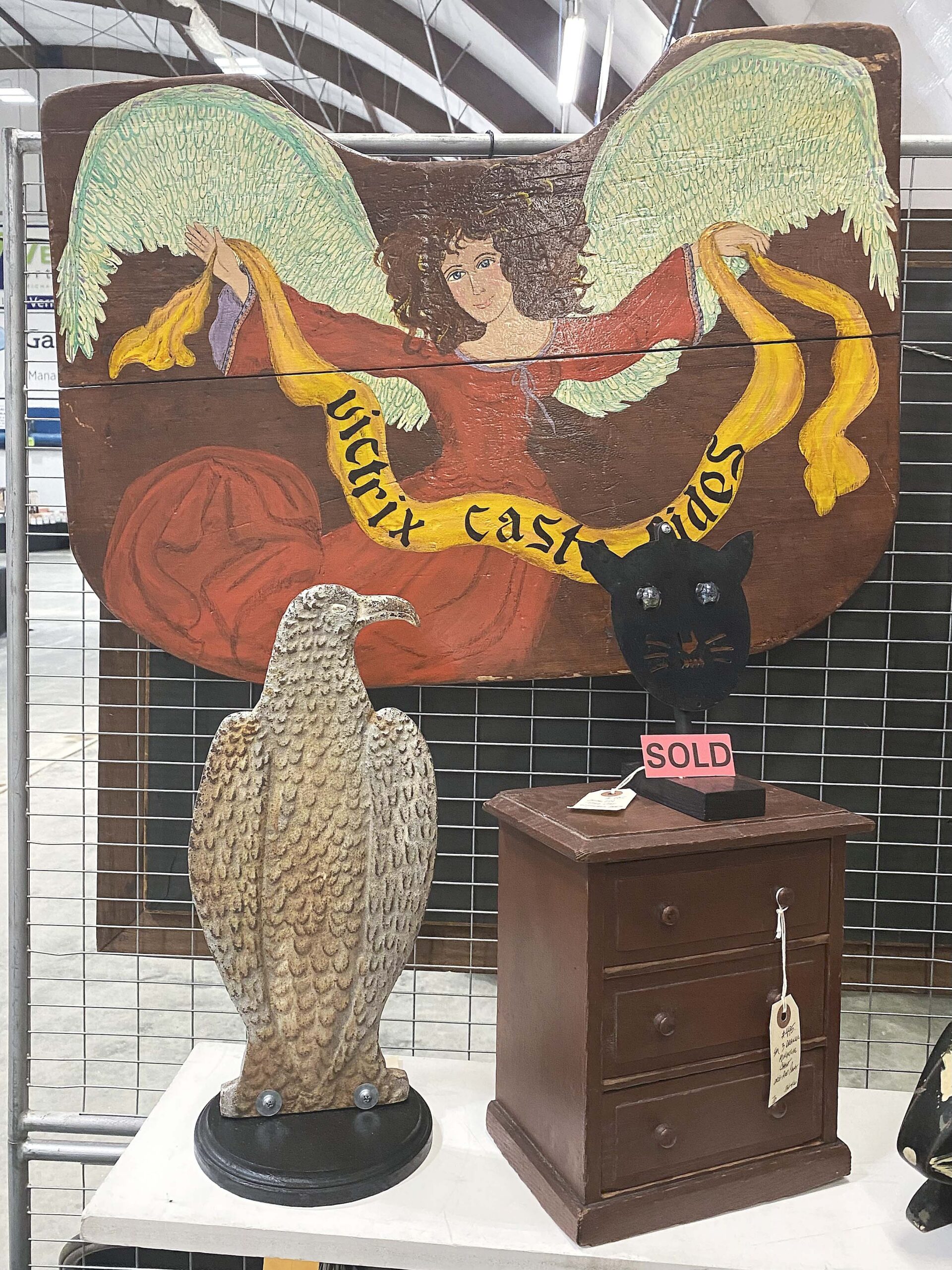
Beneath the lively mid Nineteenth Century folk art angel, Dennis Raleigh and Pumpkin Patch Antiques presented a cast iron windmill-weight eagle (1900-20), an early miniature chest with original paint and a Twentieth Century tin “tree cat” with glass eyes that sold shortly after opening. Searsport, Maine.
Though religious history is a regularly discussed topic at antiques shows, politics is currently off the table unless half a century or so has passed. Even then, it can be dicey. Richard Mori (Nashua, N.H.) sidestepped controversy with a 1978 artist’s proof serigraph of president Jimmy Carter, signed and numbered by Polish artist Krystyna Marek (1920-2008). Titled “National Treasure,” it shows Carter’s face framed by the headdress on Tutankhamun’s golden funereal mask. The image is a reference to “Treasures of Tutankhamun,” an exhibition that traveled across the United States from 1976-79. Organized by director Thomas Hoving of the Metropolitan Museum of Art, it became the first “blockbuster” exhibition, prompting Tut-mania, a pop cultural trend that utilized imagery and themes from its many artifacts and brought them into the mainstream, perpetuating the show’s success.
Next for NHADA, the 69th annual New Hampshire Antiques Show will be in Manchester, N.H., August 6-8. For information, www.nhada.org or 603-501-9911.