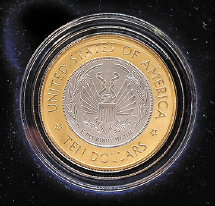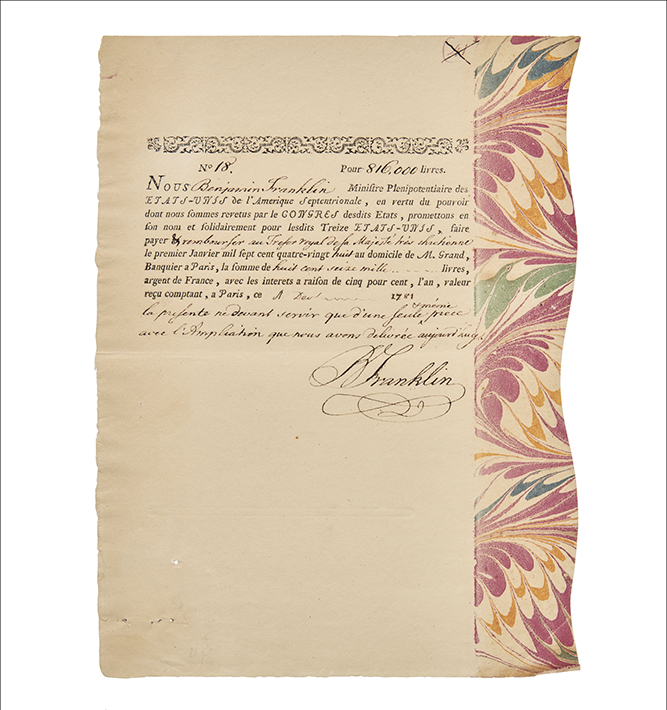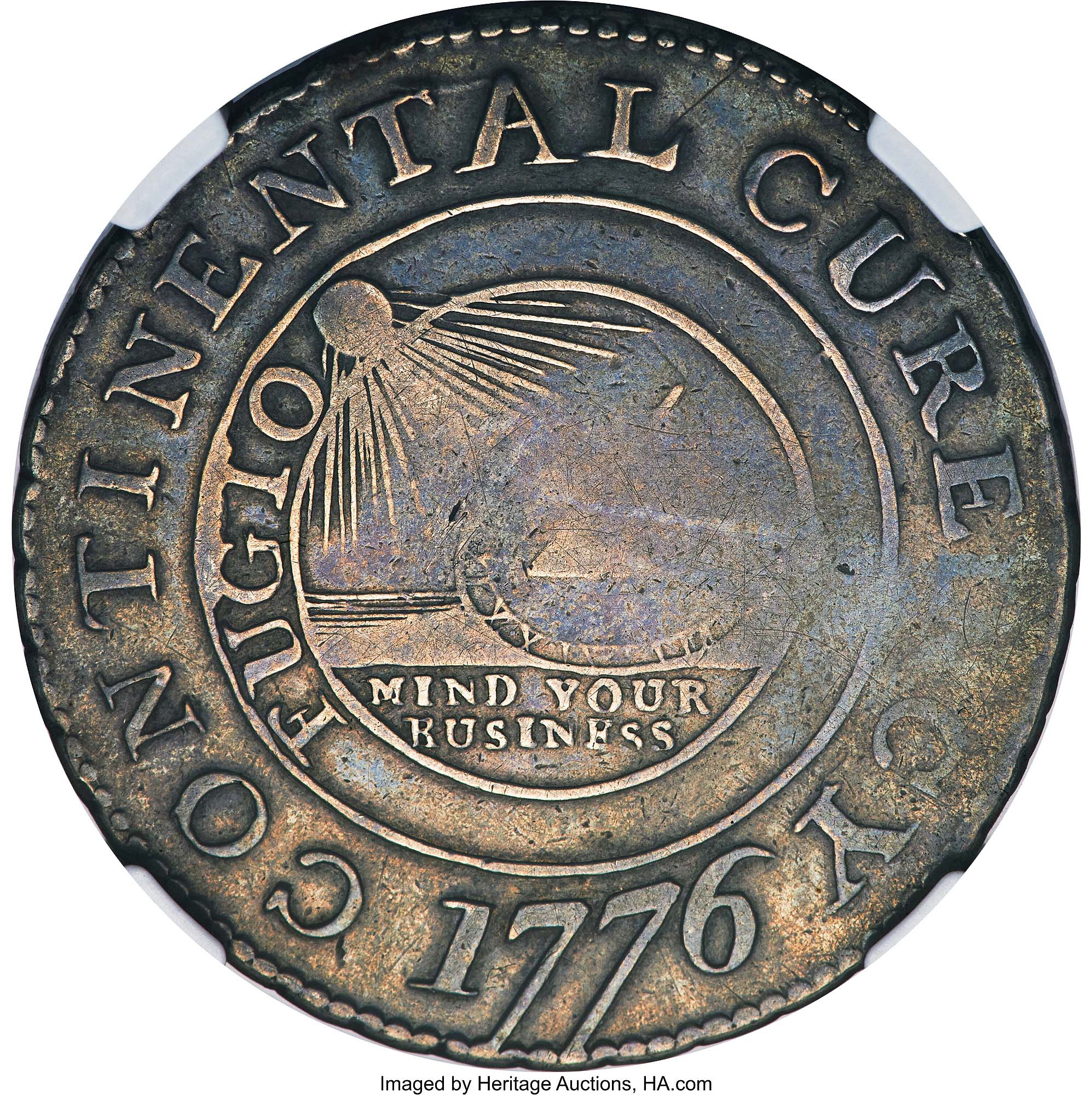
The highest individual-lot price of Heritage’s entire week of auctions celebrating America250 — $1,312,500 — was awarded to this 1776 $1 Continental Dollar believed to have been designed by Bejamin Franklin, only one of four known silver examples.
Review by Kiersten Busch
DALLAS — To close out Heritage Auctions’ weeklong celebration of American history, the firm conducted a select, 82-lot auction titled Liberty & Legacy: 250 Years of the American Spirit, which garnered $3,616,875, on June 25.
Heritage’s director of historical America, Caroline Tamposi, reported, “I am very happy with the turnout of the sale. Sometimes with very eclectic sales such as this, it can be difficult to amass high competition in one area, but I think the strong results are a good indicator that true collectors love the aspect of the hunt… Our team at Heritage experienced more happy surprises than disappointments with a good showing from presidential portraits, the Peter Force Declaration printing, the Teddy Roosevelt signed safari flag and the Light Infantry Sword from the captured Tory and the Battle of Yorktown.”
The top six lots of the sale all totaled $100,000 or more, including the sale’s top lot, a 1776 $1 Continental Dollar struck in silver, which brought $1,312,500 — the highest price of the entire week. “Believed by many scholars to have been designed by Benjamin Franklin, the legendary coin is one of only four known silver examples and bears the enduring motto ‘Mind Your Business’ alongside interlocking ring symbolizing the original 13 colonies,” described a post-sale press release.
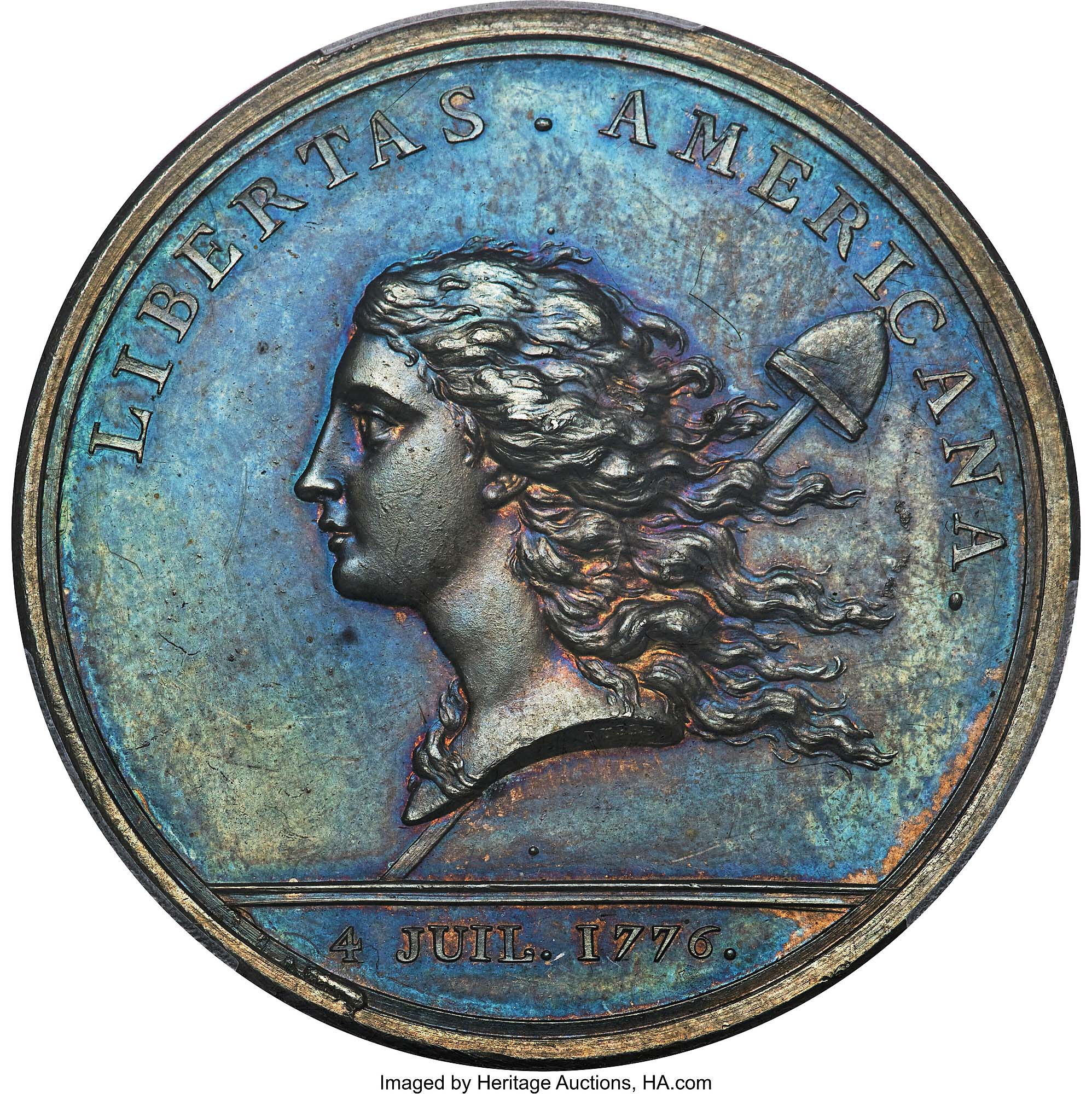
With personified Liberty and Classical motifs decorating both sides, this 1783 Libertas Americana silver medal was commissioned by Benjamin Franklin to celebrate the country’s independence, changing hands for $475,000.
The second highest selling lot of the day was a 1783 Libertas Americana silver medal commissioned by Benjamin Franklin to celebrate American independence. Cataloged as “possibly the finest known example,” the medal’s obverse design contained a female head, representing Liberty, facing left with her hair flowing back and a pole cap over her shoulder. The reverse design featured an infant Hercules in his cradle, meant to represent the US, strangling two serpents while Minerva protected the infant from a lion. Previously sold at Stack’s Bowers in 2024 for $336,000, it brought even more this time at Heritage, flipping to $475,000. “Both of the coins were exceptional and/but performed as expected,” Tamposi added of the sale’s top two lots.
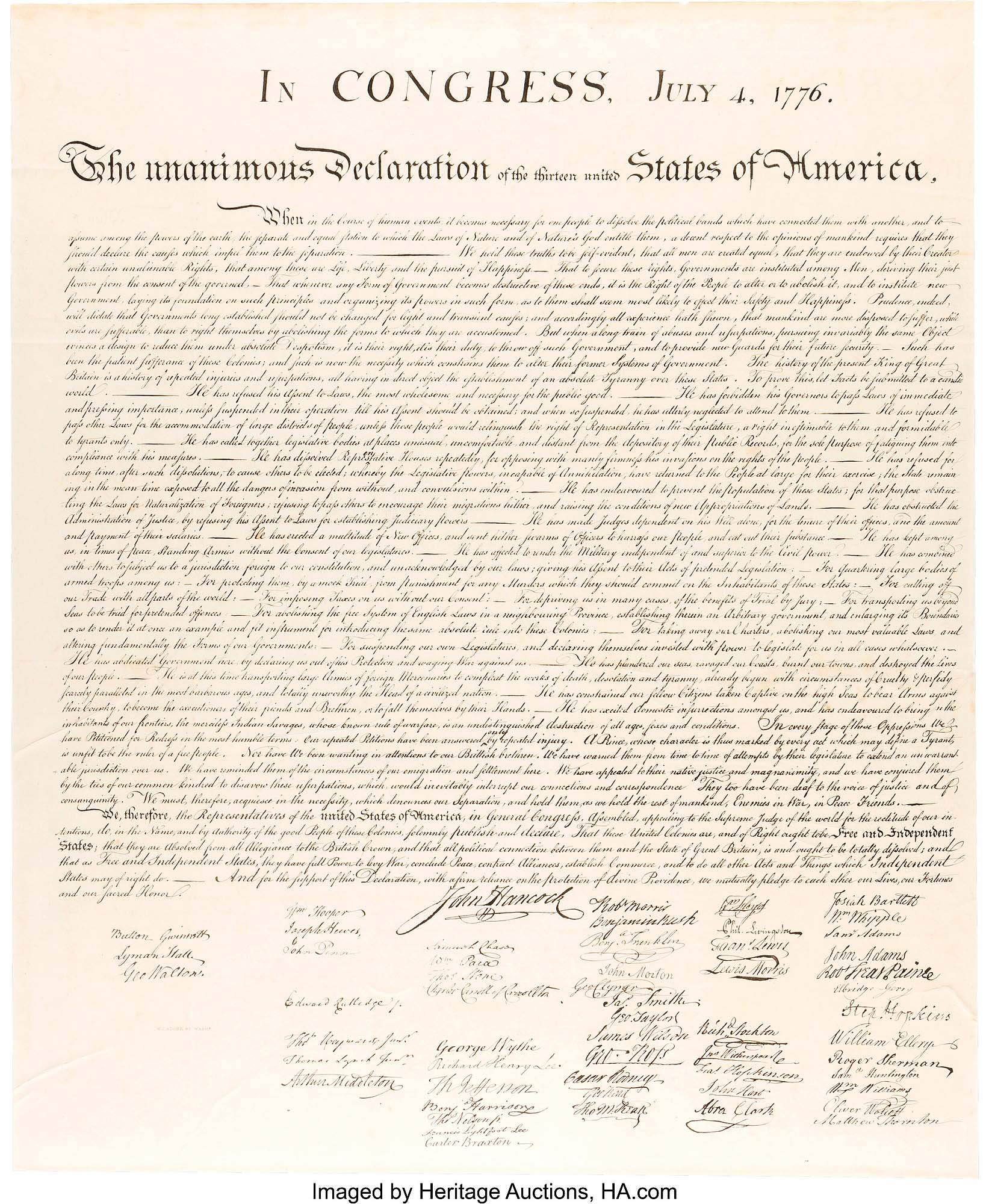
A copy of Peter Force’s 1833 printing of the Declaration of Independence was “one of the strongest performers of the sale,” explained Tamposi. “These tend to bring $20/30,000 and this brought over triple the usual amount at $100,000. The timing for this was right, and it was in excellent condition.” The copperplate engraving on rice paper appeared as an insert in Force’s American Archives: A Documentary History of the United States of America, Series V, Volume 1, and is one of only a few hundred surviving copies of the document.
A copy of the Gazette of the United States (Philadelphia: John Fenno) dated April 14, 1792 — marking the earliest published account of the United States Mint — sold for $47,500. The four-page section of the magazine discussed “An Act Establishing a Mint, and Regulating the Coins of the United States”: the April 2, 1792, act passed by Congress that introduced a decimal-based monetary system. Tamposi added, “The performance of this newspaper shows that coin collectors are starting to diversify and include historic material that support their collections.”
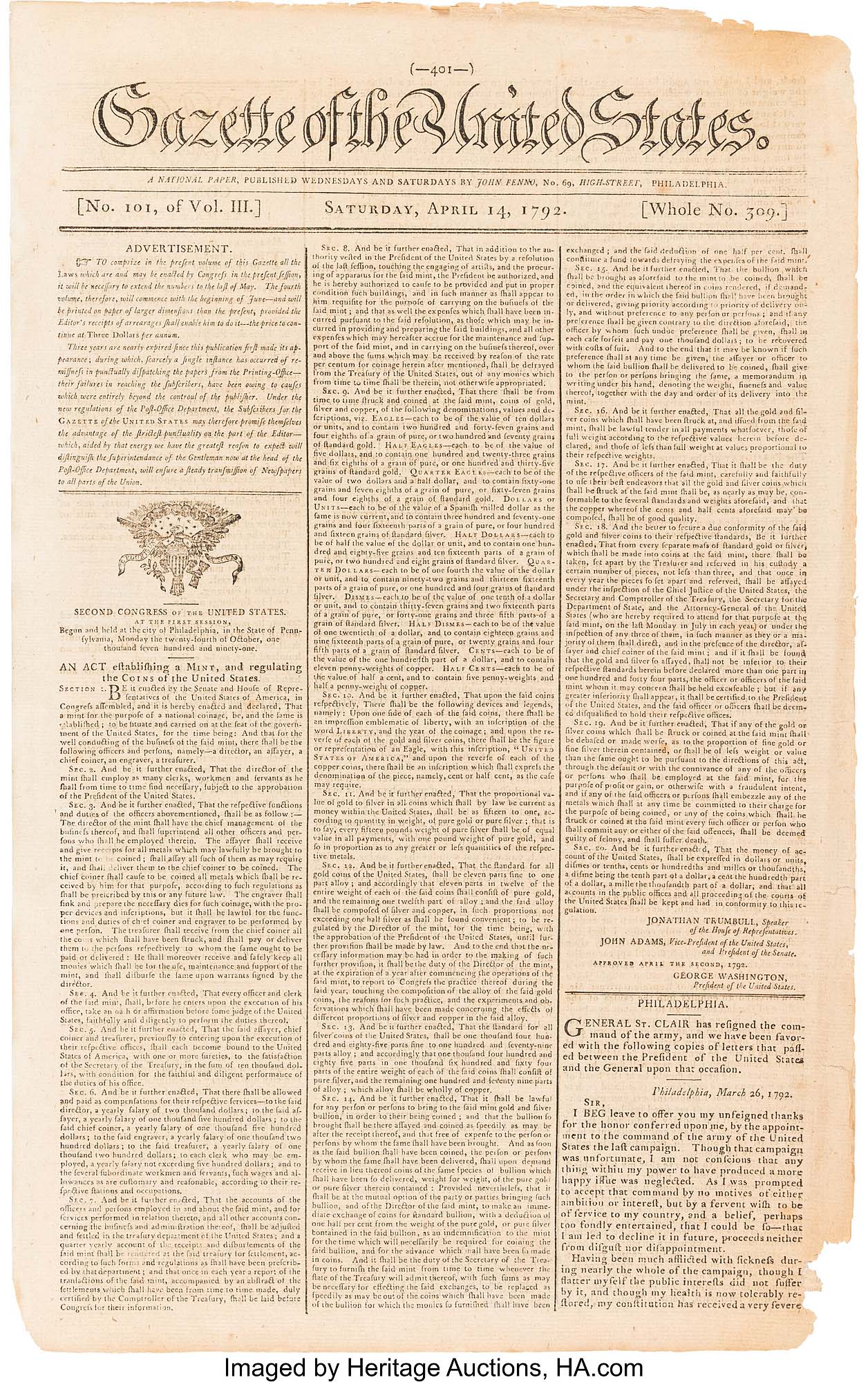
Dated April 14, 1792, was this copy of Gazette of the United States (Philadelphia: John Fenno), which contained the earliest published account of the United States Mint; it cashed out for $47,500.
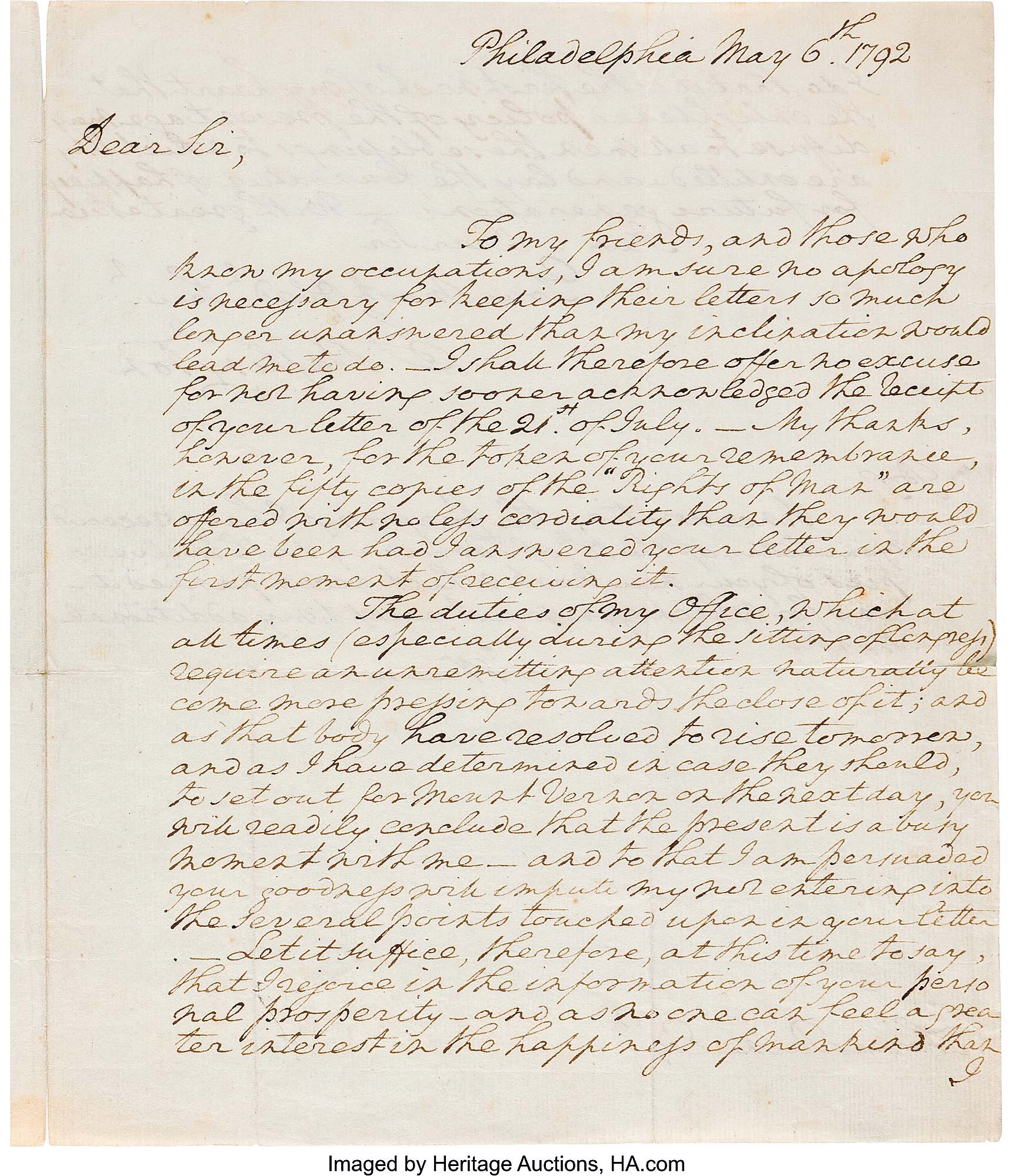
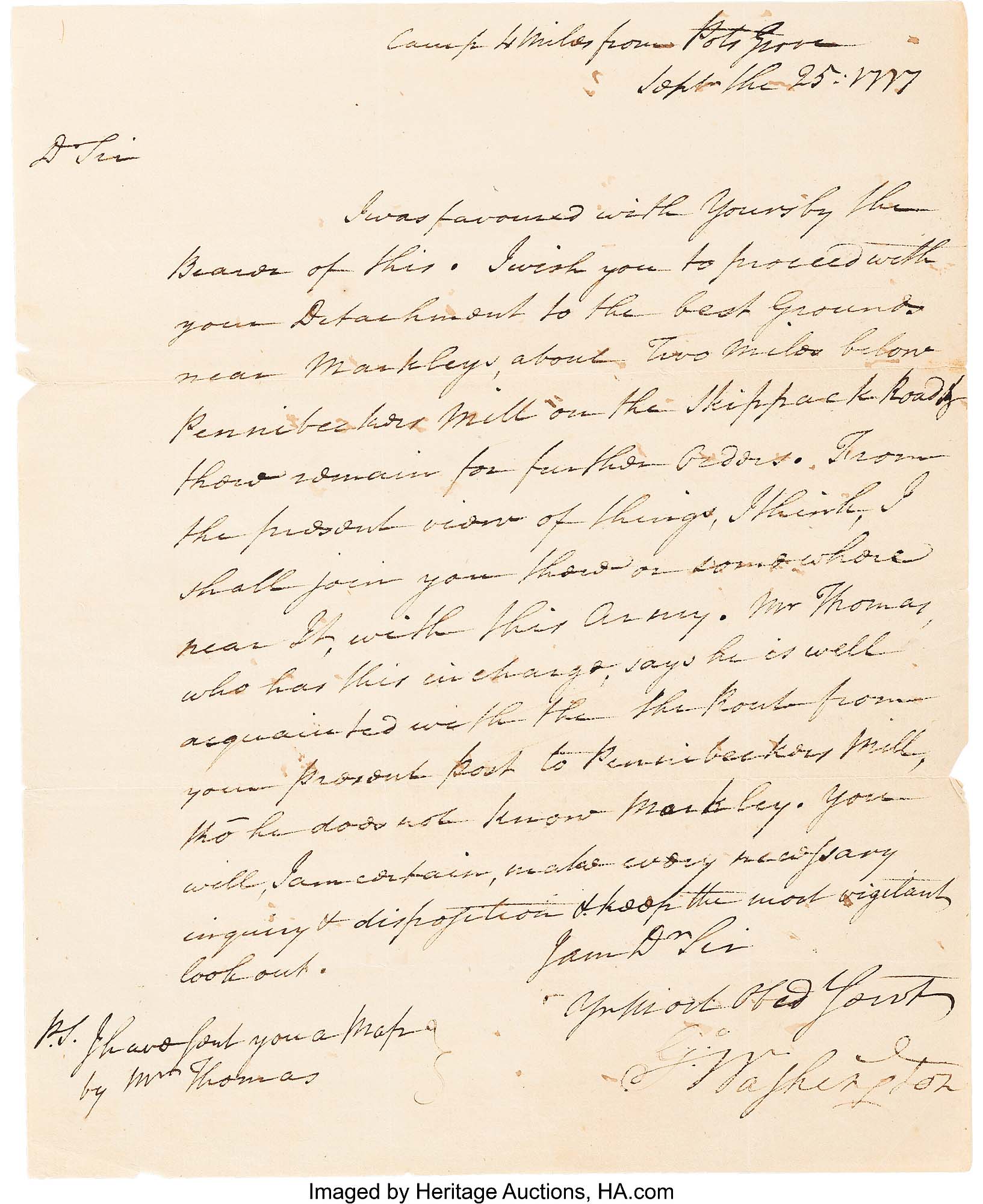
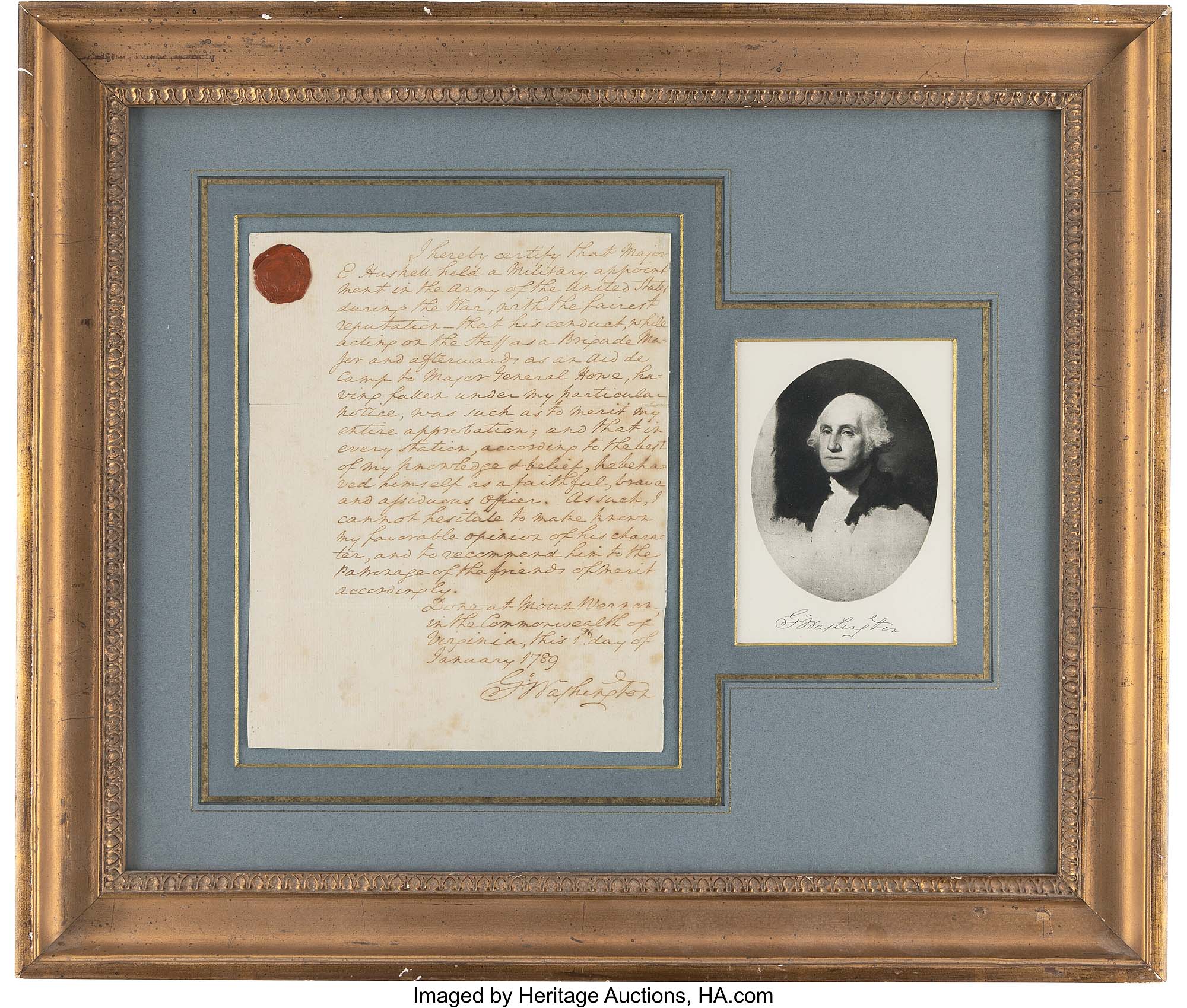
Autographed documents signed by the founding fathers were populous, including a May 6, 1792, letter from President George Washington to author Thomas Paine, which briefly addresses Paine’s work Rights of Man. The final letter the first president wrote to Paine, it is the only one in private hands. Tamposi added, “The George Washington letter to Thomas Paine is yet another example of how strong the market is for founding father manuscripts, as seen by the Freund collection the week before.” Earning the fourth-highest price of the sale, the letter signed off for $187,500.
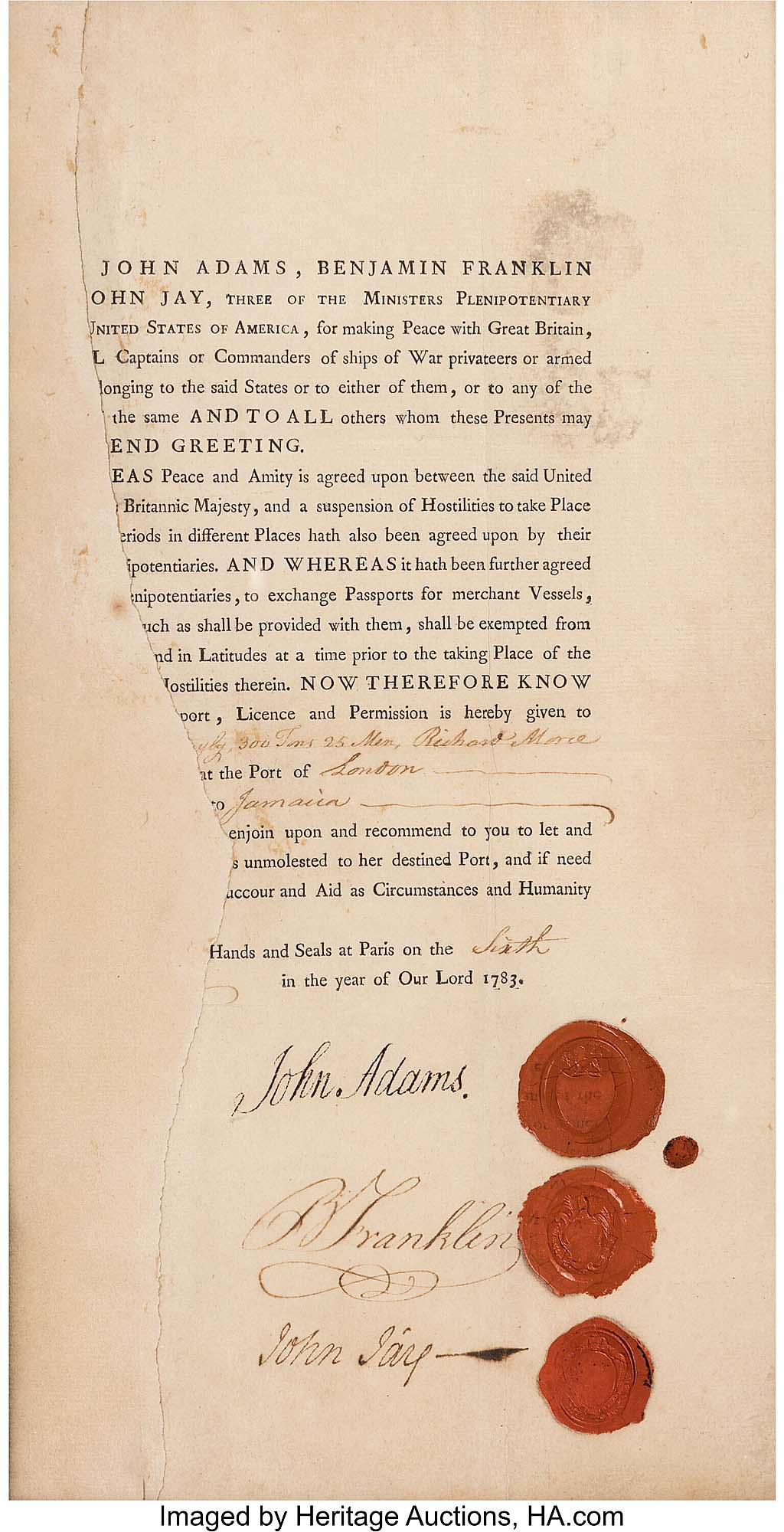
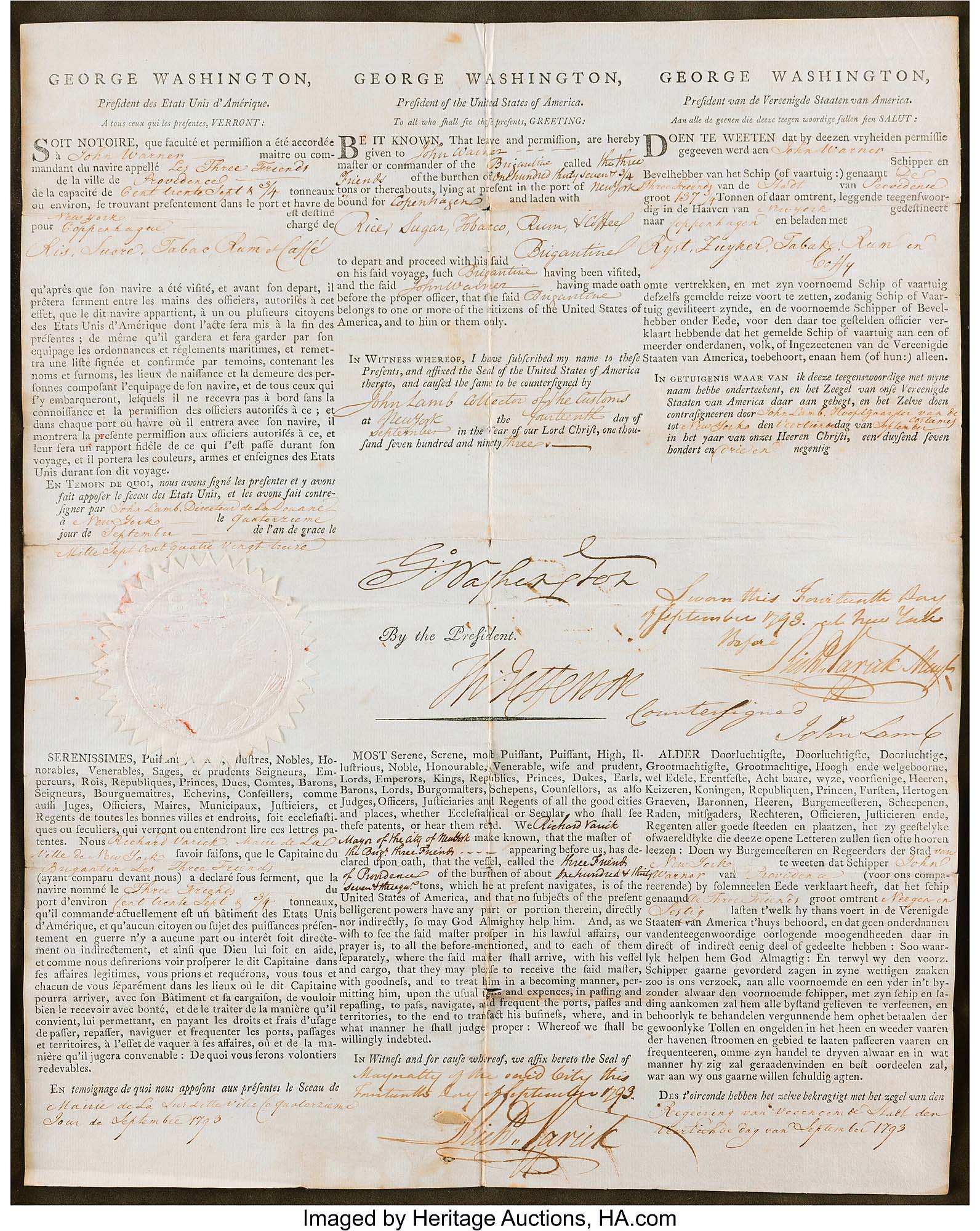
An “important and scarce” example of an early American ship’s passport for the British vessel Nathaniel Bailey, signed by John Adams, Benjamin Franklin and John Jay in Paris, the February 1783 document crossed the block for $68,750. According to catalog notes, the passport “belongs to that brief transitional period when war had formally ended but its practical consequences were still being resolved at sea.”
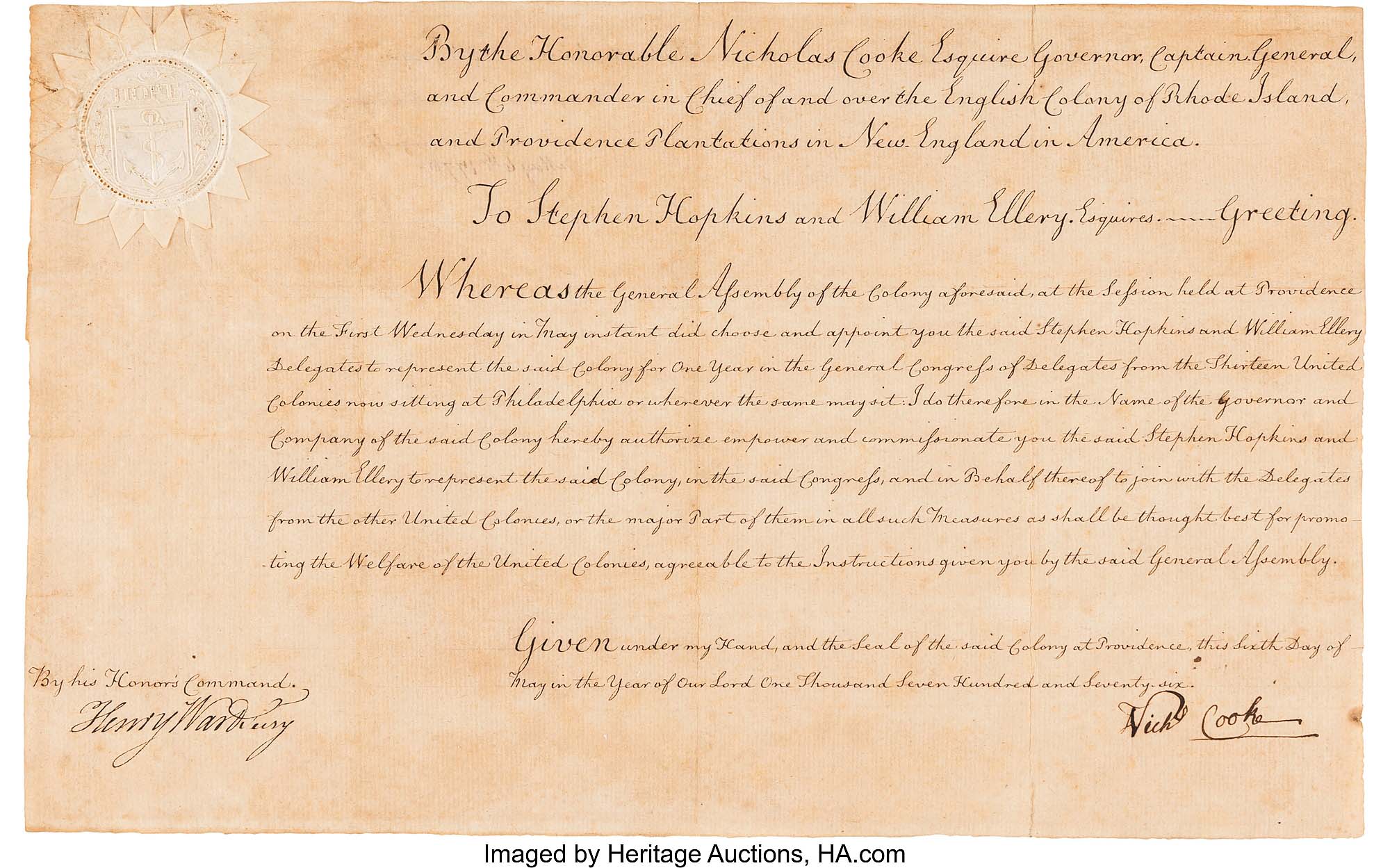
“William Ellery and Stephen Hopkins’ 1776 Continental Congress credentials was another exciting turning point in the Revolutionary War. The credentials are incredibly rare; everyone in Congress had to submit credentials but few examples have survived,” said Tamposi of the document appointing Ellery and Hopkins as Rhode Island’s delegates to the Continental Congress. Dated May 6, 1776, to Providence, R.I., the credentials were signed by Nicholas Cooke, the first governor of the state, and countersigned by Rhode Island’s secretary of state Henry Ward, earning $100,000.
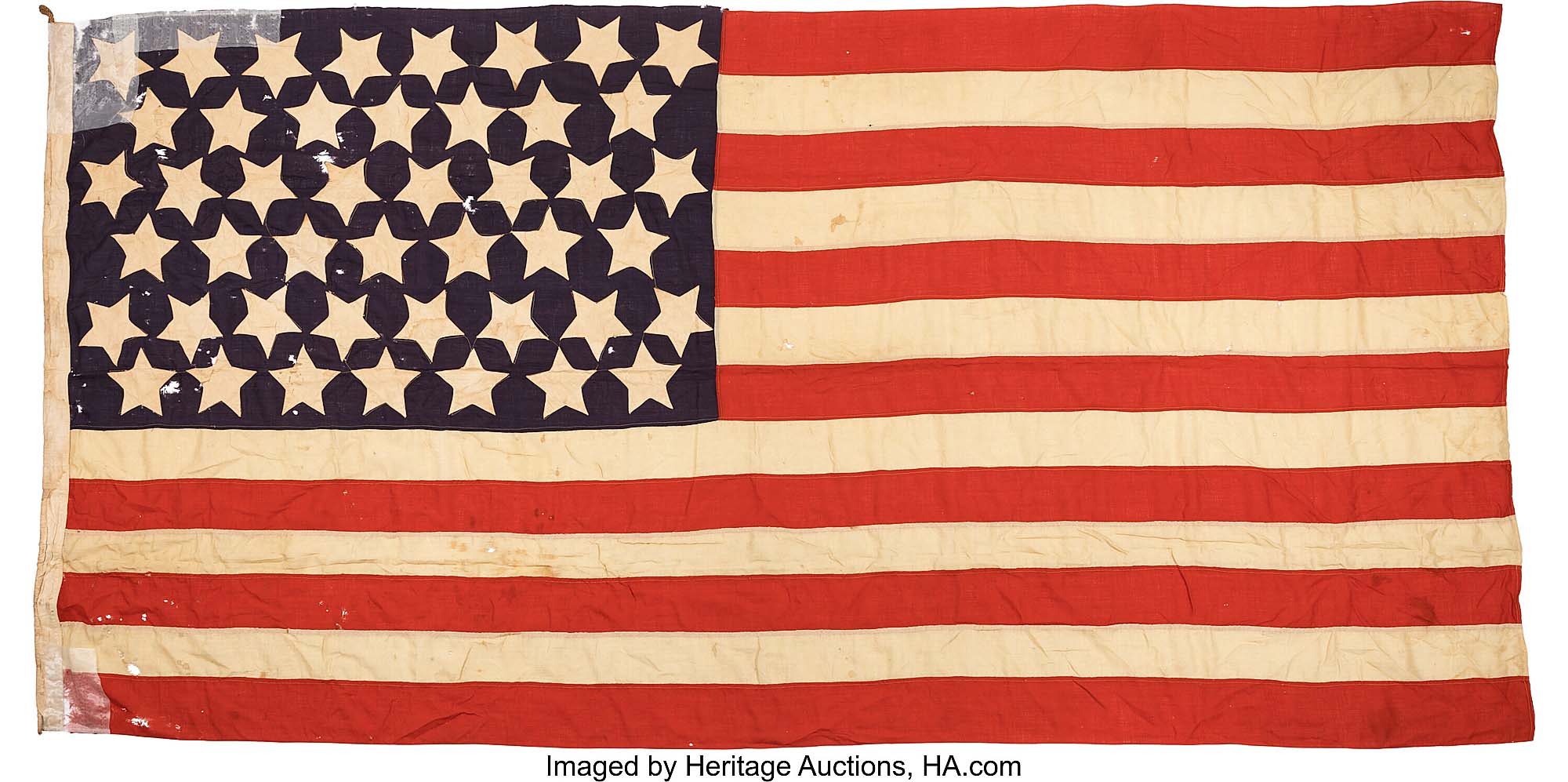
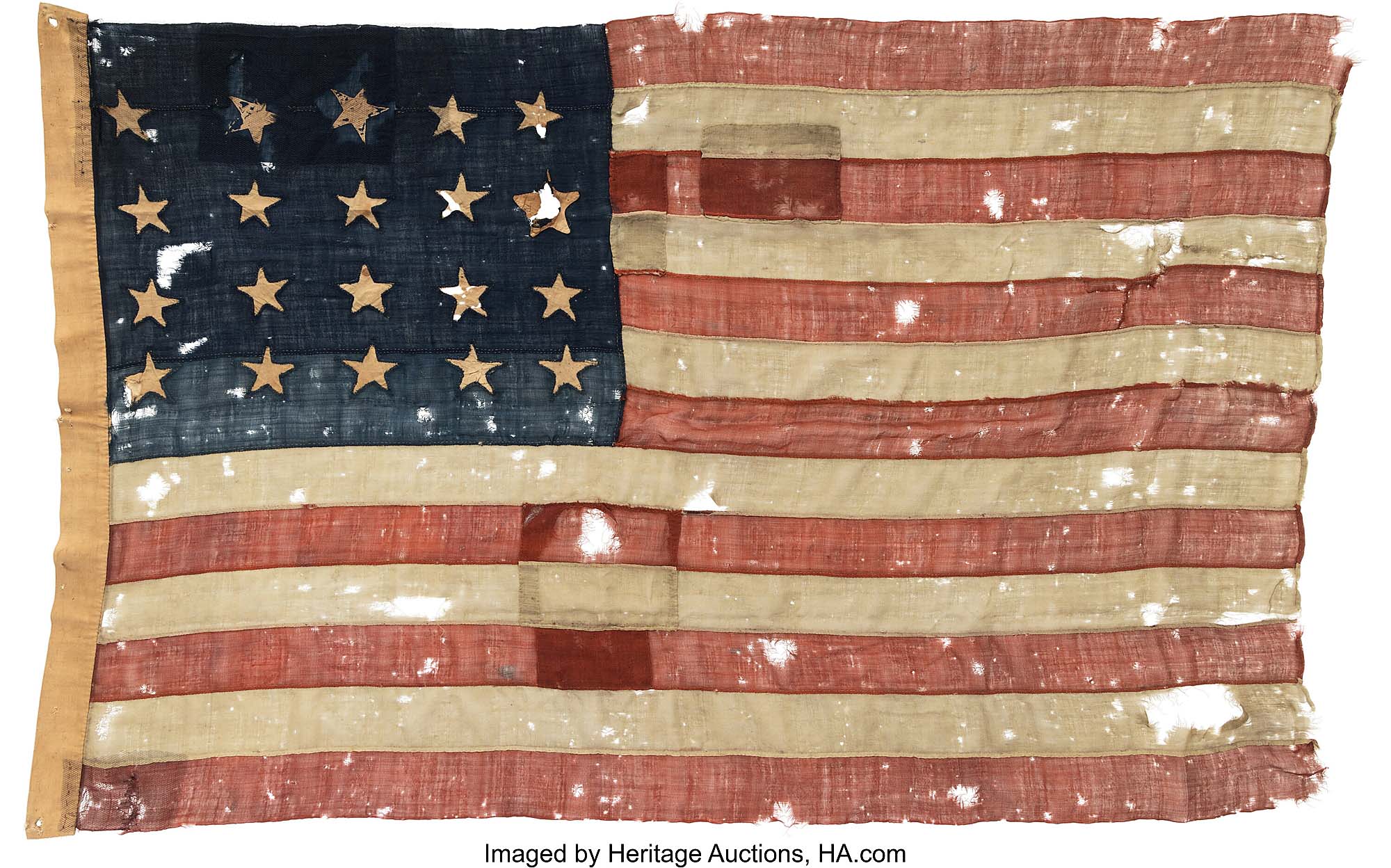
Flying to new heights at $212,500 was this 45-star American flag, machine-sewn, wool bunting, approximately 68 by 138 inches, signed and presented by Theodore Roosevelt to Major C. H. Ringer to commemorate Roosevelt’s 1909-10 African Expedition.
It would not be an auction concerning our nation’s history without a few American flags on offer, which included a 45-star machine-sewn presentation flag signed by Theodore Roosevelt, which earned the third-highest price of the sale at $212,500. Presented to Nairobi hotelier Major C. H. Ringer (“Ju-Ju Major”), the flag was documented heavily as being in use during Roosevelt’s 1909-10 African Expedition. “The Teddy Roosevelt flag was actually part of the Elwood Taylor collection, and we wanted to showcase it in this sale because we knew how special it was. Taylor had an incredible flag collection that sold earlier in the week online,” elaborated Tamposi.
“Flags were perhaps one of our strongest category performers of the week of sales,” she continued. “This flag carries an incredible and exciting story.” The flag in question was an early Nineteenth Century 20-star American national flag, which flew for $30,000. The flag’s three-line inscription, “S.C. Green / Co. C 12th ME Reg. / N.O. LA,” identified Samuel C. Green, a private and sergeant in Company C of the 12th Maine Volunteer Infantry. Included with the lot was a penciled note attempting to connect the flag with a wartime event but was mistaken in that Fort Sumter was located in South Carolina, rather than New Orleans, where the note described.
A more modern entry into the top performing lots was an oil study of Ronald Reagan’s official White House portrait by Everett Raymond Kinstler inscribed by the former president. The 30-by-36-inch framed oil on canvas, done in 1990, depicted Reagan seated on the Truman Balcony of the White House, with the Jefferson Memorial in the background. Reagan’s inscription read, “Dear Ray- My heartfelt thanks and dearest friendship / Ronald Reagan.” It was exhibited at an unspecified Annual Exhibition at the National Academy of Design in New York City, as well as The Bellarmine Museum of Art’s (Fairfield, Conn.) exhibition titled “Pulp to Portraits,” which ran June 14-September 2, 2012. It was bid to $45,000.
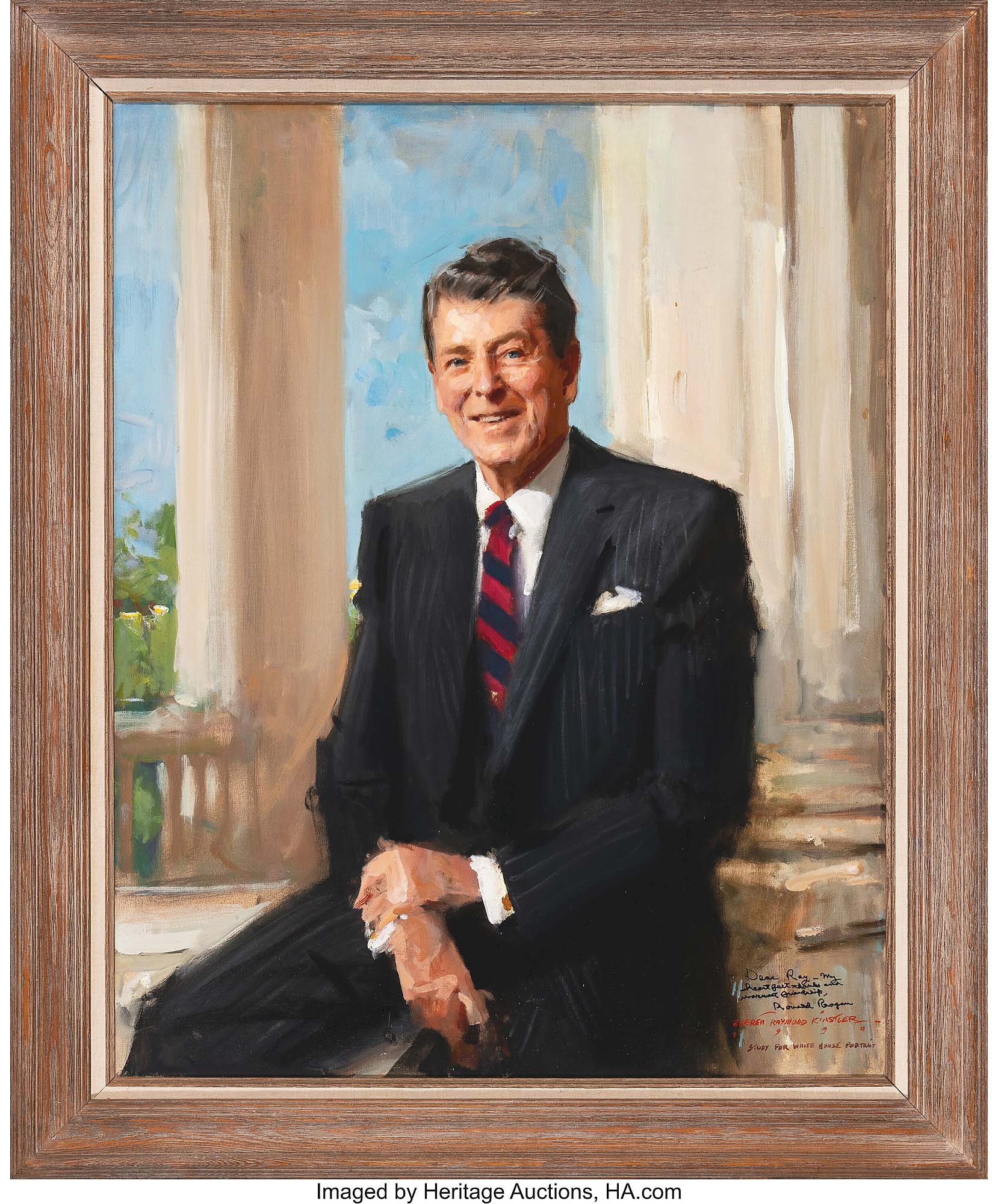
This oil on canvas portrait of Ronald Reagan by Everett Raymond Kinstler, 1990, 30 by 36 inches framed, was a study for Reagan’s official White House portrait that hangs in the Oval Office today; it realized $45,000.
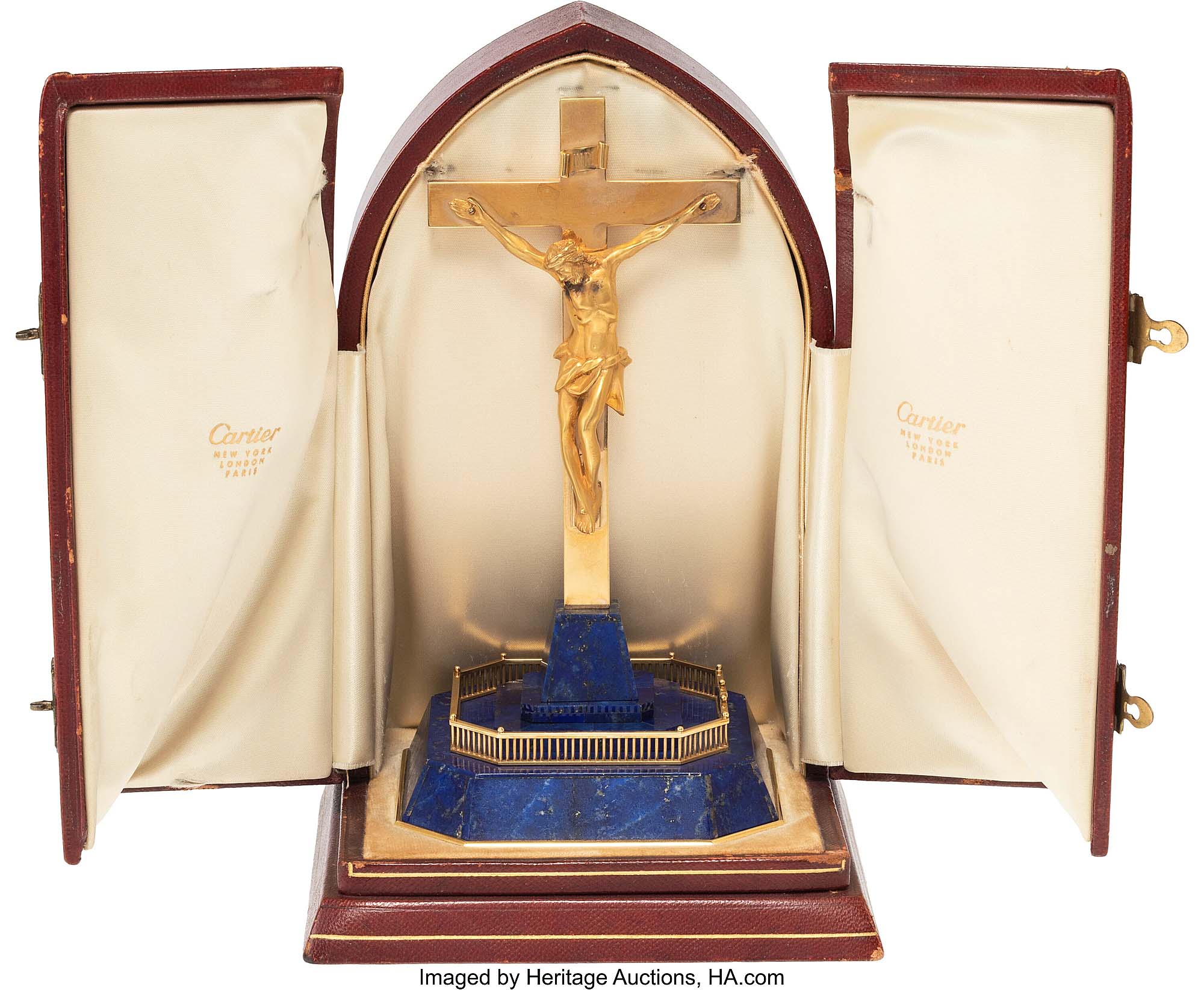
“We had some very esoteric items that I was unsure about that overperformed,” explained Tamposi. One of those was a cased Cartier free-standing tabletop Crucifix that had provenance to the estate of Charles E. Schalebaum, Jr, of Allentown, Penn. “The Cartier Crucifix previously brought $11,875 in a 2017 Heritage Auctions sale and basically tripled to bring $35,000 in this sale,” she explained, pleased with the increase in value. Tamposi continued, “This was a surprise to us, but the intrinsic value of the gold and lapis and Cartier craftsmanship is certainly a driver. When researching this piece, there were very few examples and/or comparables that appeared online. The personal crucifixes appear to be very rare.” The 6½-inch-tall, 18K gold and lapis lazuli piece was engraved with the monogram “EJU” and came in a fitted Cartier leather cathedral-form case.
On July 30, Heritage “will be offering the Alfred Orendorff Archive: Treasures from the Law Offices of Abraham Lincoln, comprising 30 lots of never-before-offered Lincoln autograph signed legal manuscripts, documents and furniture directly from the future 16th President’s law offices,” Tamposi added in closing.
Prices quoted include the buyer’s premium as reported by the auction house. For information, www.ha.com or 214-528-3500.