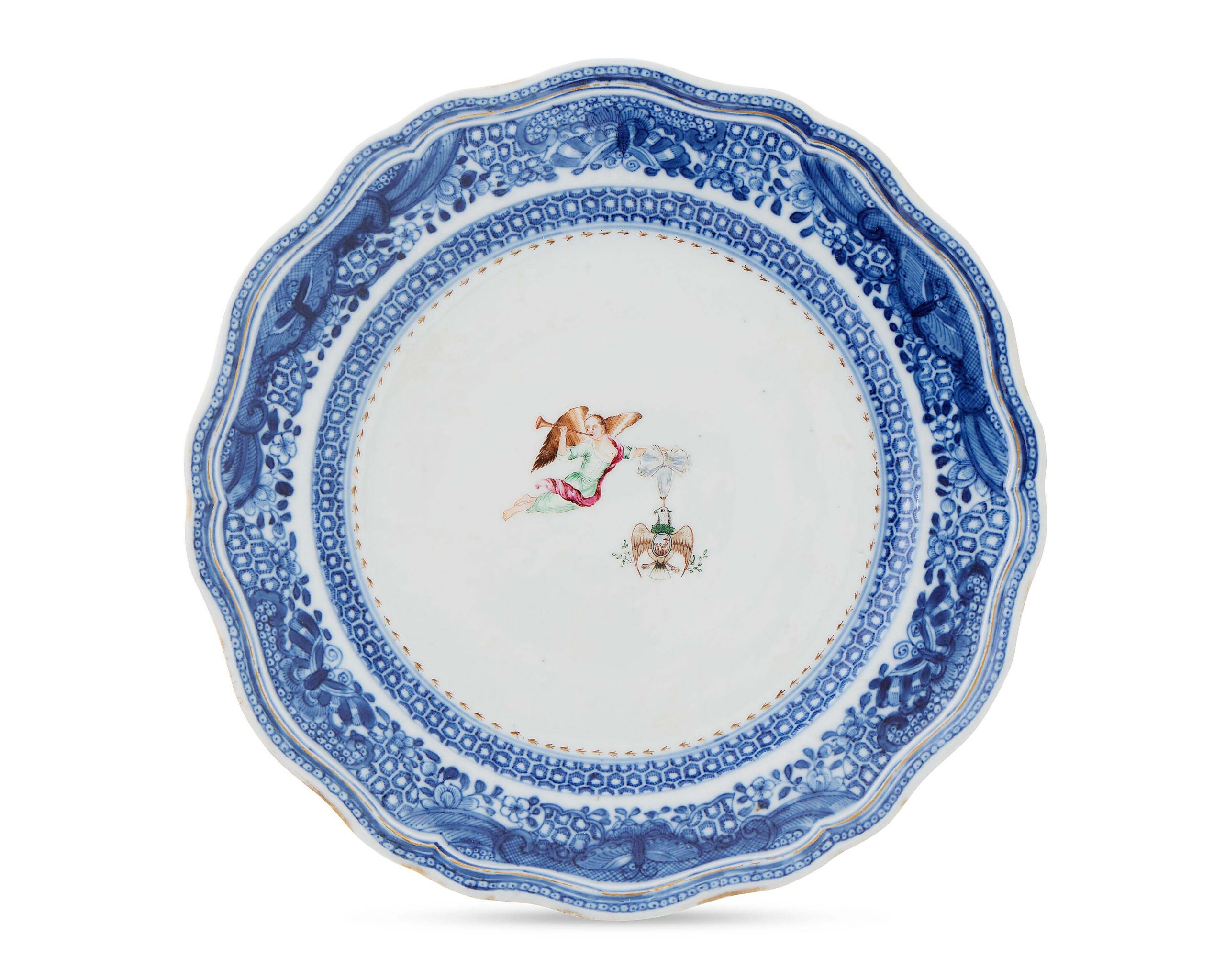
This Fitzhugh cobalt blue underglazed Order of the Cincinnati plate, circa 1785, 9⅝ inches in diameter, was designed by Pierre Charles L’Enfant and belonged to a service owned by George Washington; it earned the highest price of the sale at $137,500 ($30/50,000).
Review by Kiersten Busch
BOSTON — On June 4, Grogan & Company conducted the sale of the Jason King Binder collection of Chinese export porcelain, a “culmination of over 40 years of passionate collecting and scholarship,” the auction catalog noted. Featuring more than 200 lots, the collection encompassed Chinese export porcelain made for the American market spanning the Eighteenth through the early Twentieth Centuries, and included rare armorial wares, grisaille enamels and objects connected to prominent American families and historical figures. Totaling $492,282, the sale only had six lots go unsold, making for a 97 percent sell-through rate.
The top lot of the sale was a “rare and exceptional” circa 1785 Order of the Cincinnati plate, which belonged to a service owned by George Washington. Featuring a scalloped rim, the plate bore the Order of the Cincinnati badge, designed by Pierre Charles L’Enfant, with a hovering personification of Fame blowing her trumpet. Its Fitzhugh border was decorated with gilt rim and cobalt blue and had geometric, butterfly and floral motifs. More than doubling its $30/50,000 estimate, the plate made a presidential $137,500.
The second- and third-highest earning lots were also Chinese export plates, although both differed greatly from the top lot in design and color. Earning $18,750 was a circa 1810-20 plate in the hand-painted Black Fitzhugh pattern, which had floral and butterfly motifs on the plate itself and its border. According to catalog notes, the plate, which was monogrammed “ASC,” was most likely ordered by a Bristol, R.I., family, and had additional provenance to Dore & Rees (Frome, UK).
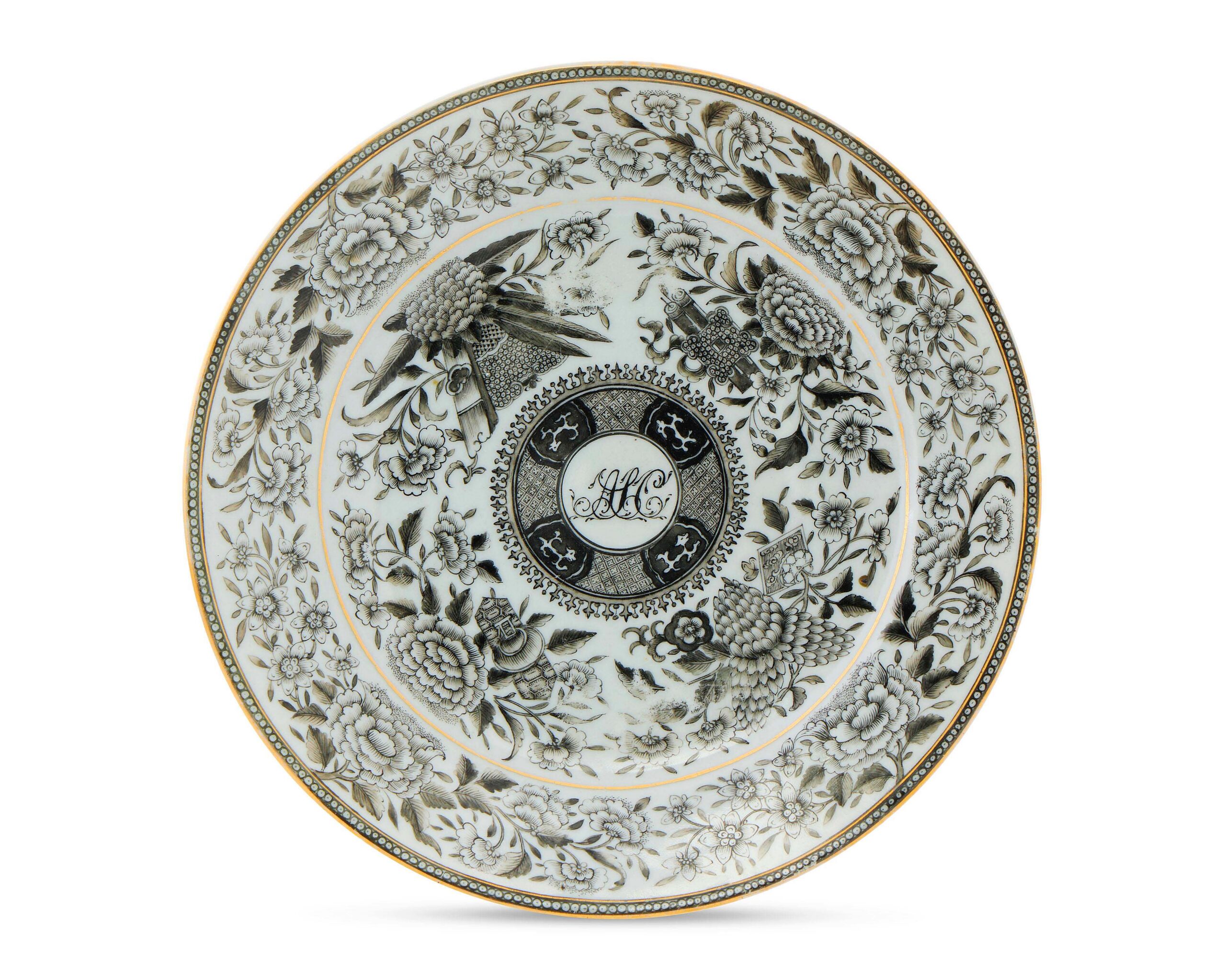
Most likely ordered by a Bristol, R.I., family, this hand-painted Chinese export plate in Fitzhugh’s Black pattern, circa 1810-20, 8 inches in diameter, was monogrammed “ASC” and served up an $18,750 finish ($500/800).
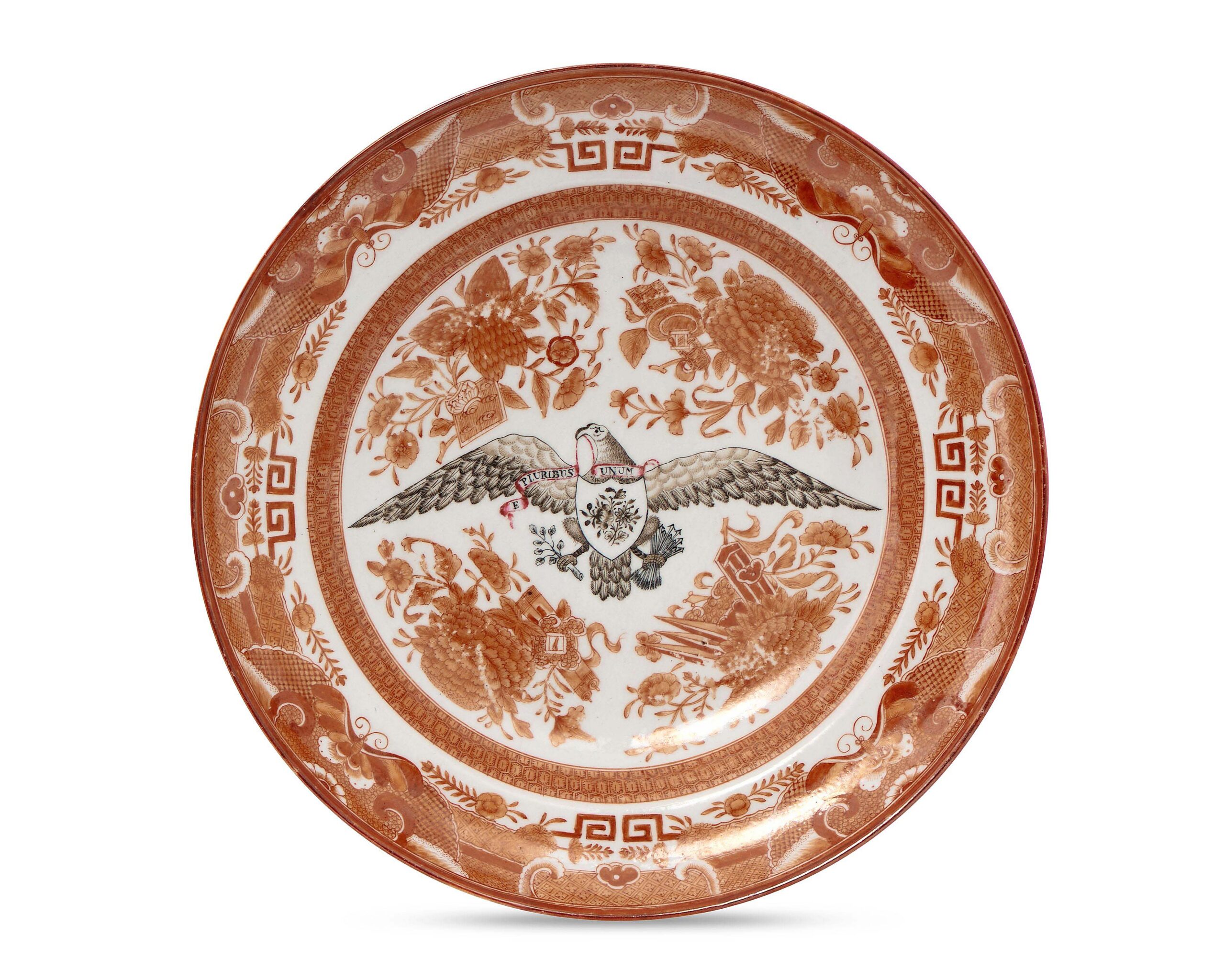
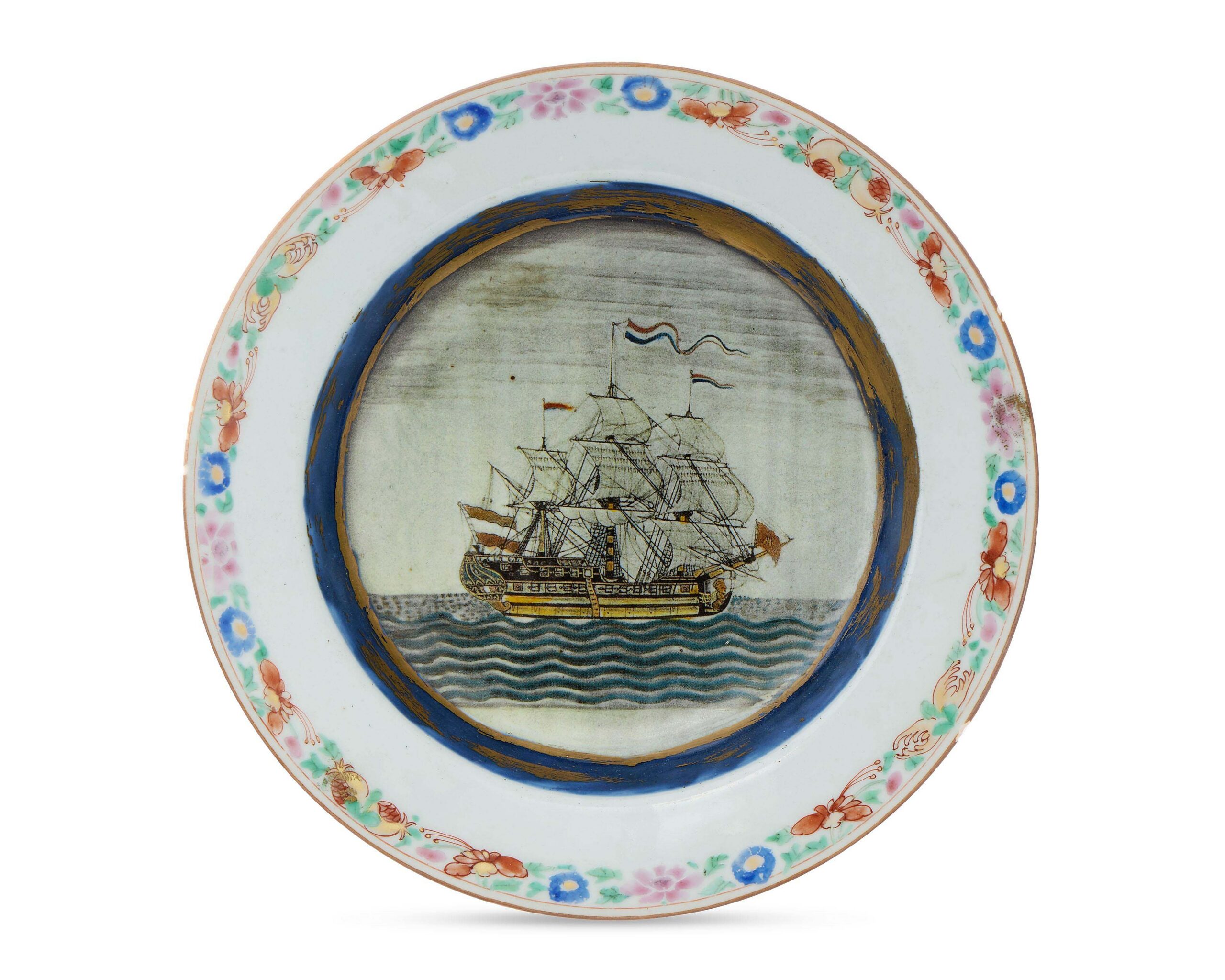
Following the black enamel plate at $12,500 was another example by Fitzhugh, this one with orange enamel and belonging to a service owned by Captain William Orne of Salem, Mass. The circa 1800-10 plate depicted a spread-wing eagle holding an “E Pluribus Unum” banner in its beak, and had an orange butterfly, foliate and trellis border. Additional pieces from Captain Orne’s service can be found in the collection of the Diplomatic Reception Rooms of the US Department of State.
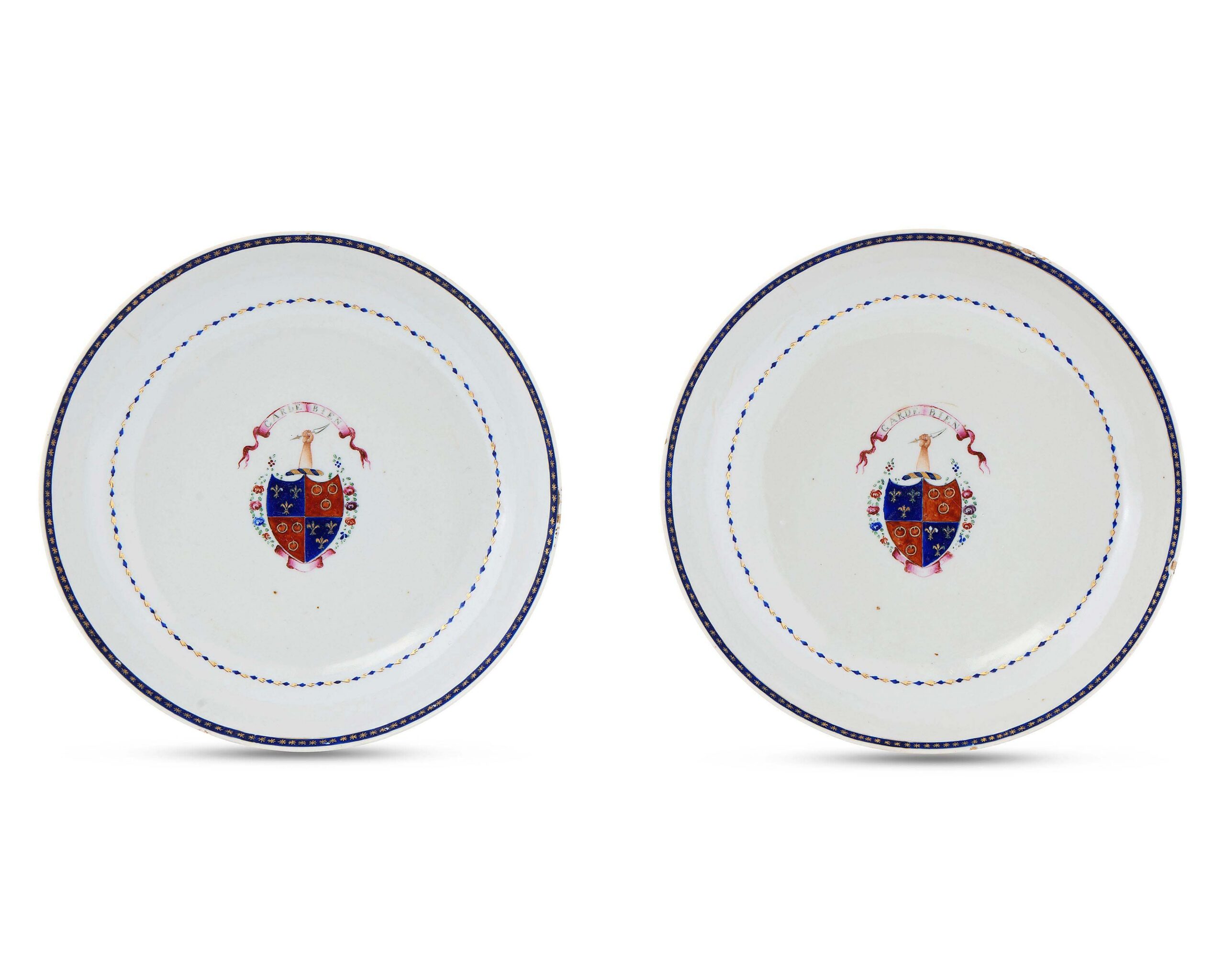
Straying away from Fitzhugh, several other Chinese export plates far surpassed their estimates to earn top prices. One such lot was a pair of circa 1773 American market Armorial plates ordered by Revolutionary War hero Richard Montgomery, which far surpassed their $200/400 estimate to serve up a $7,800 finish. Montgomery, according to the auction catalog, was a British expat who previously fought in the French and Indian War before marrying into the prominent Livingston family of New York. After being elected to the New York Provincial Congress in May 1775, he was made a brigadier general in the Continental Army and eventually led the unsuccessful invasion of Quebec, in which he was killed. The plates bore Montgomery’s familial coat of arms, which were inscribed with a banner reading “Garde Bien.” The plates also had a cobalt blue and gilt star border.
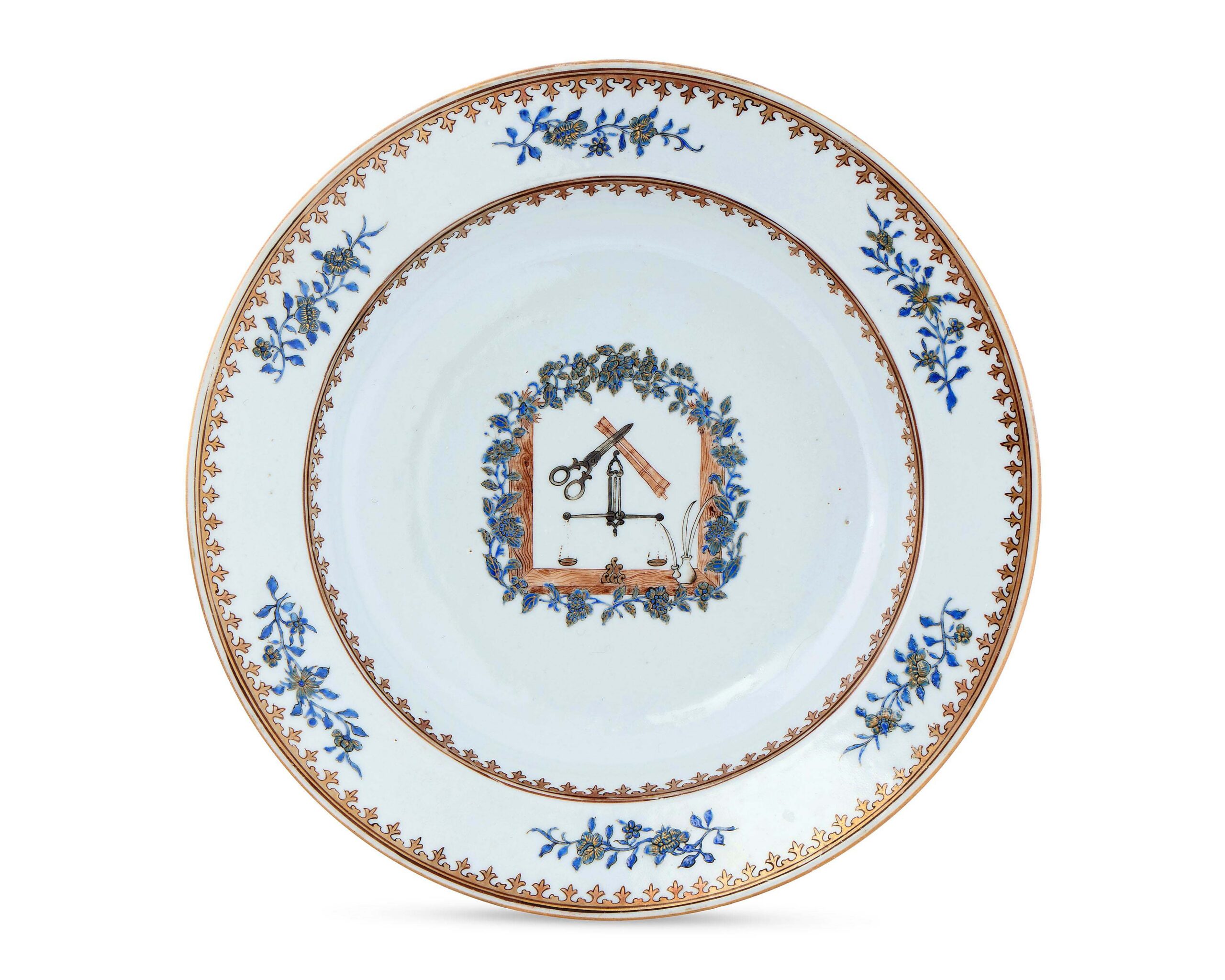
Depicting the instruments of a shroff (money-changer or assayer) in its center, this circa 1745 soup plate, 9 inches in diameter, traded a $300/500 estimate for a $5,937 total.
Earning more than ten times its $300/500 estimate at $5,937 was a circa 1745 soup plate depicting the instruments of a shroff, including scales, a stamp and a small pile of cut money with a gilt spearhead border and cobalt blue floral sprays. Auction catalog notes further explained, “The subject of this plate may be read as a visual shorthand for the China Trade itself. It depicts the tools of a shroff, or money-changer and assayer, whose work was essential to commerce between Chinese merchants and foreign traders.” The plate had provenance to Leslie Hindman Auctioneers (Chicago) and was published in David Sanctuary Howard and John Ayers’ Masterpieces of Chinese Export Porcelain and Francois and Nicole Hervouet and Yves Bruneau’s La Porcelaine des Compagnies des Indes à Décor Occidental.
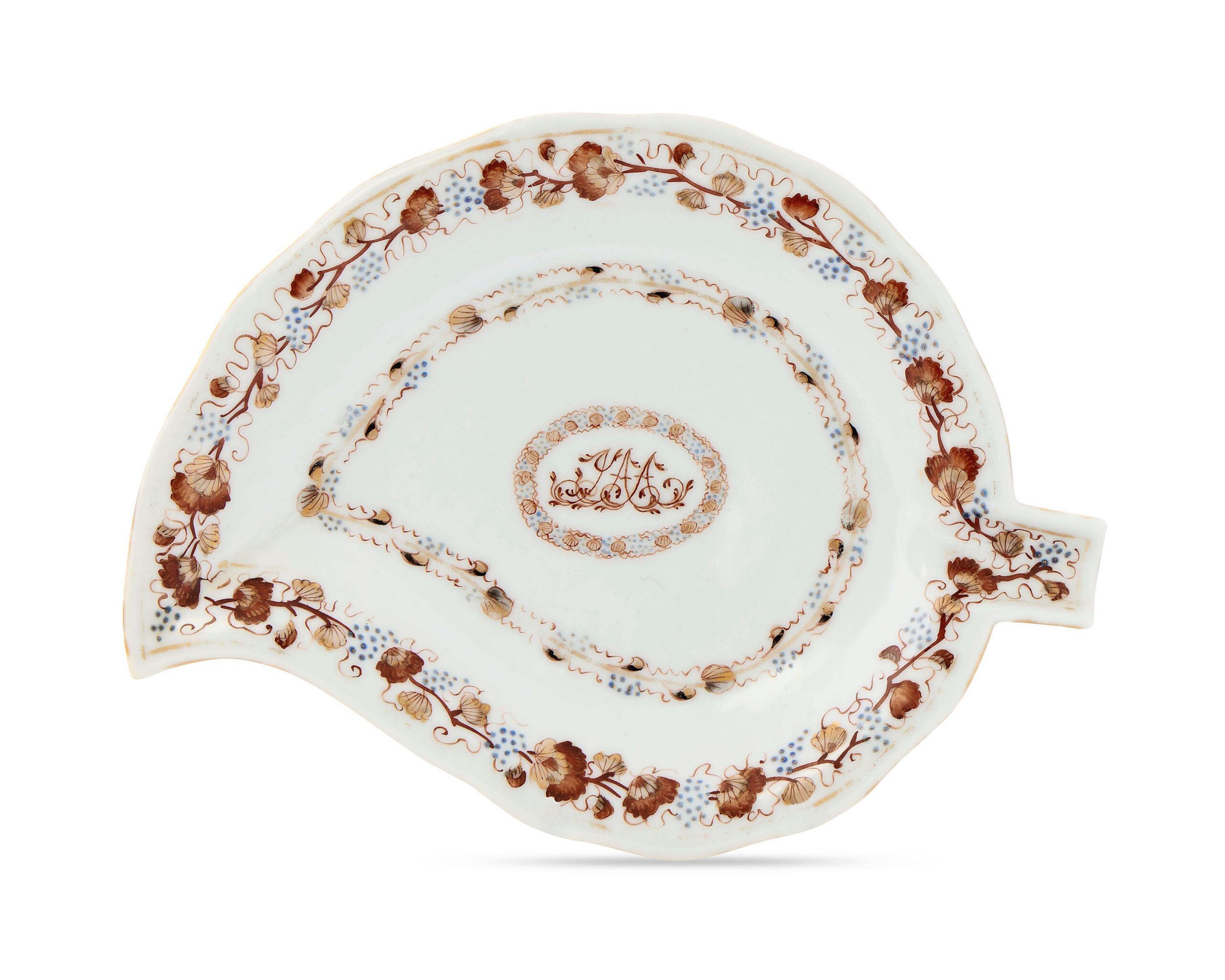
Hailing from a private Boynton Beach, Fla., collection was an American market leaf-shaped dish from the service of John and Abigal Adams, which bore a central “JAA” monogram. The circa 1800 dish had a gilt, brown and blue grapevine border and measured 7½ inches in length. It grew to $6,875, far past its $400/600 estimate.
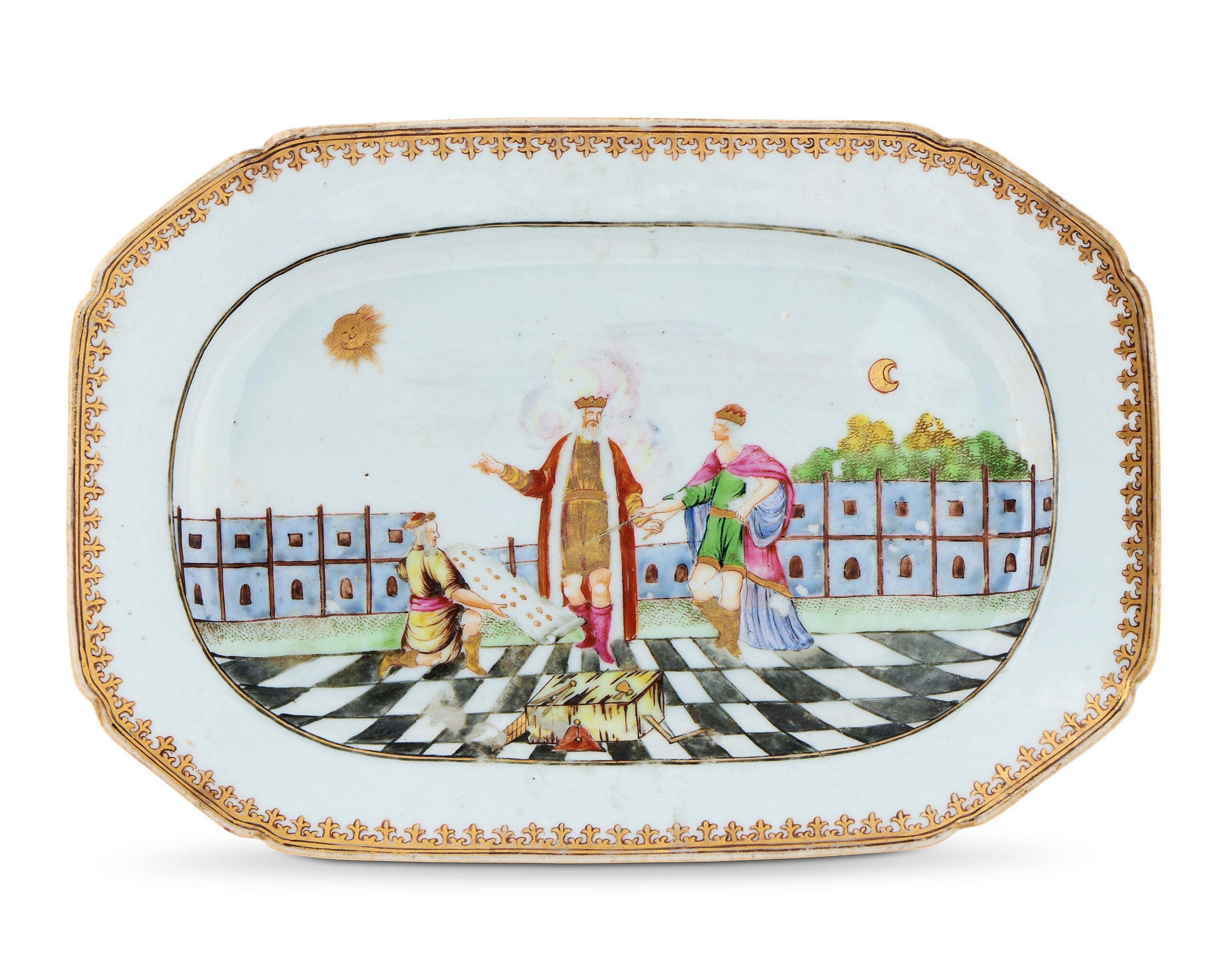
A circa 1760 English market “1 Kings 6” octagonal polychrome enamel platter depicting King Solomon and two other figures standing around a wooden box with provenance to Pandolfini Casa d’Aste (Florence, Italy) sold for $5,312. In the image, King Solomon is shown looking at plans, surrounded by mason’s tools: the gavel, square, compass, level and plumb-rule.
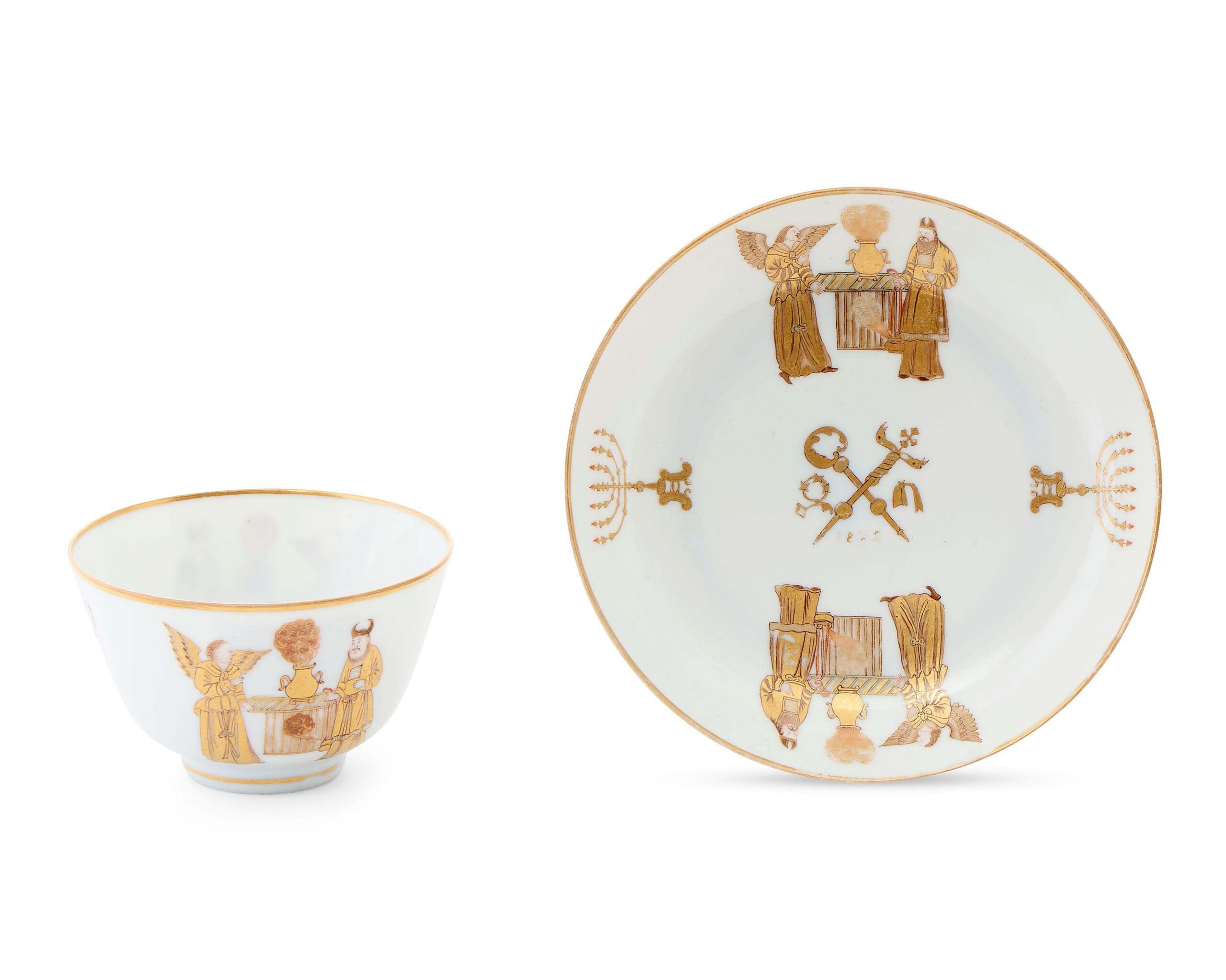
Another piece of porcelain with Masonic motifs that attracted bidder attention was a circa 1790 polychrome and gilt enamel American market punch bowl which sold for $5,625. The bowl included several well-known masonic symbols, such as the sun, moon, seven stars of Pleiades, waters of heaven and checkered pavement with the pillars Jachin and Boaz. The inside of the piece depicted a central sunburst inscribed with the letter “G.”
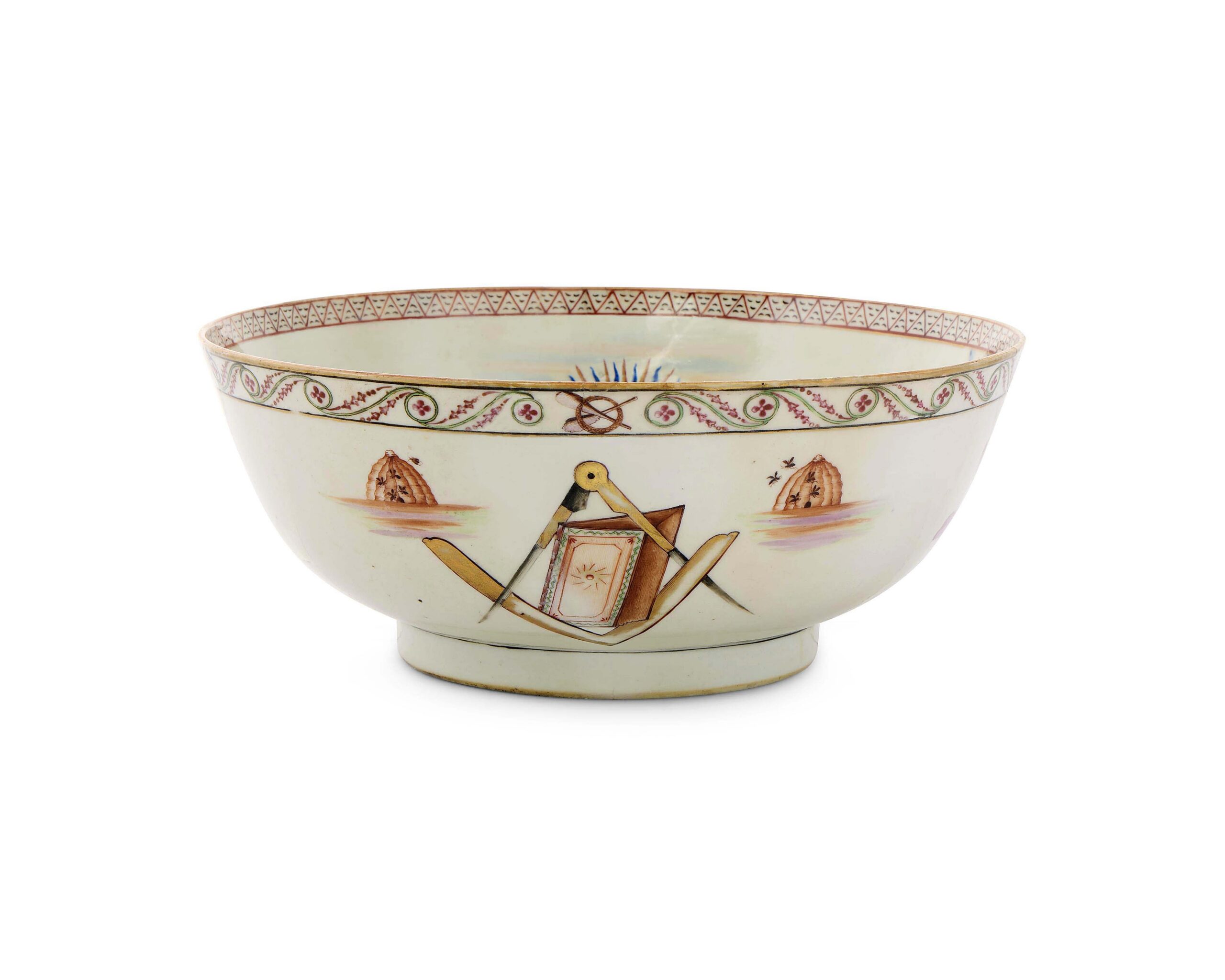
Featuring several Masonic motifs, this polychrome and gilt enamel punch bowl made for the American market, circa 1790, 11½ inches in diameter, realized $5,625 against a $1,5/2,500 estimate.
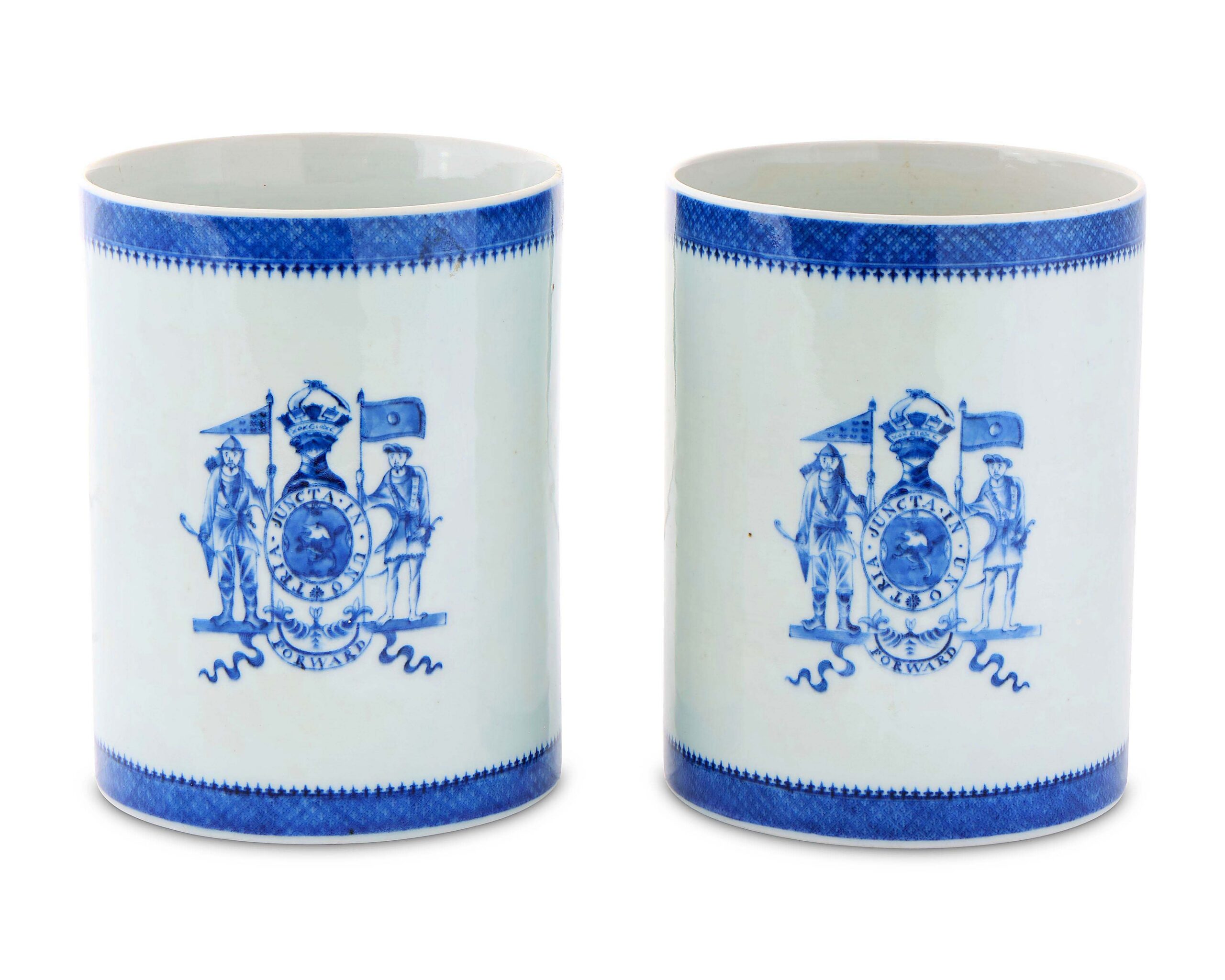
Leading Chinese export mugs was a pair of armorial mugs from the service of British naval officer Admiral Sir Edward “Hot ‘n Hot” Hughes. The circa 1790, 8-inch-tall pieces each had two double-strap handles with floral terminals, while their bodies were decorated with the coat of arms of the Hughes family, which depicted supporters dressed as foot soldiers, holding pennants and a shield encircled by the ribbon of the Order of the Bath. They previously sold at RWB Auctions (Royal Wooton Bassett, England) in February 2025 for an undisclosed price but sold at Grogan’s for a within-estimate $10,625 ($10/20,000).
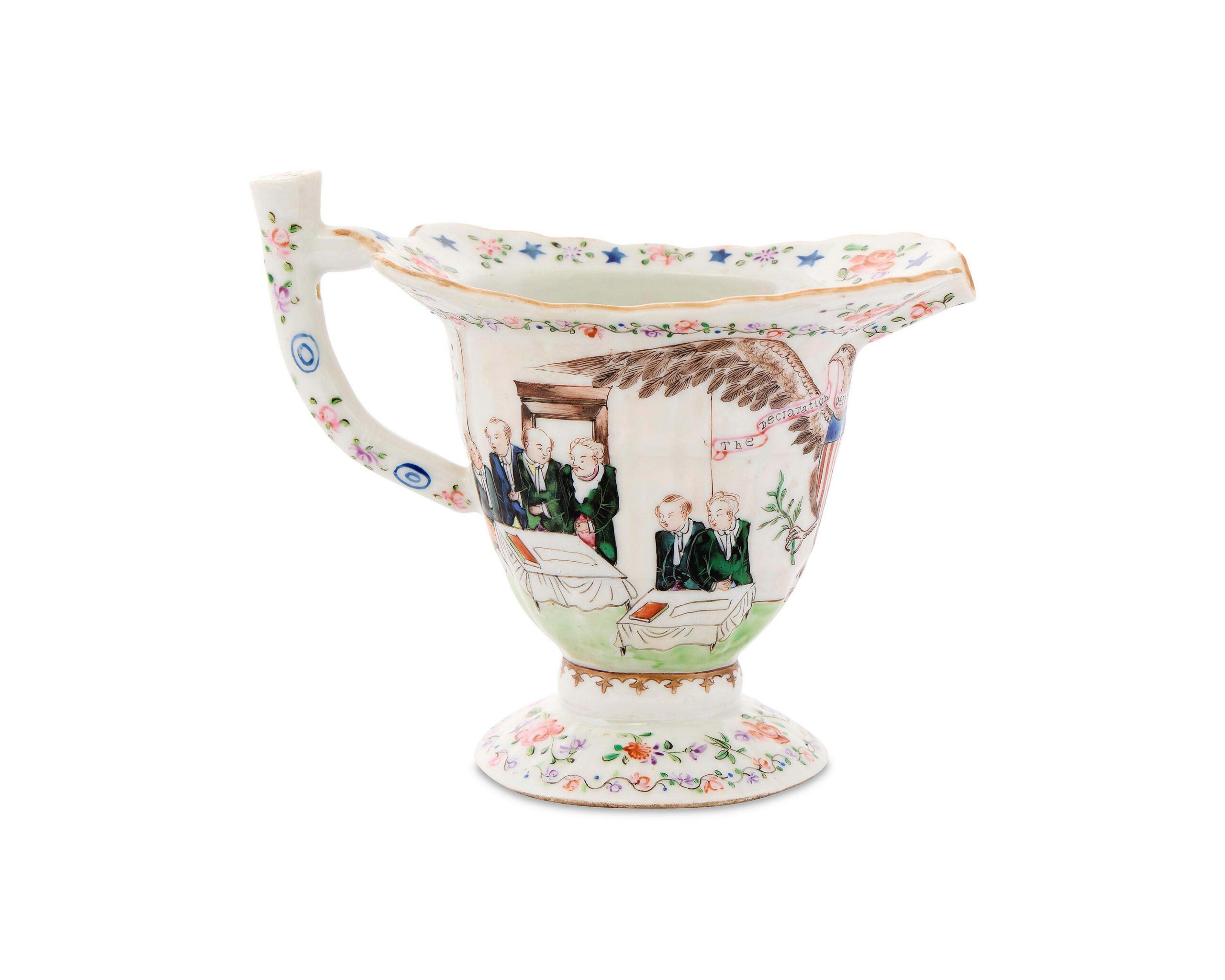
While not mugs, a few other decorative vessels sold for high prices, including an American market helmet pitcher depicting the signing of the Declaration of Independence, most likely modeled after John Trumbull’s painting, “The Declaration of Independence.” Made circa 1926, the pitcher centered a large American eagle holding a “Declaration of Independence” ribbon, with the date “1776” above it; it had a polychrome floral and star border. Previously sold in 2018 via Sarasota Estate Auction, the pitcher poured out for $4,375 at Grogan’s.
A pistol-handled urn made for the American market made more than four times the high end of its $700-$1,000 estimate at $4,062. In its center was a depiction of the allegorical figure of Hope, alongside a shrouded urn and an anchor. It was also decorated with gilt and cobalt blue foliate swags. The urn had recorded provenance to Wiederheim Associates Appraisers and Personal Property Consultants in Chester Springs, Penn., and was initially manufactured for a Rhode Island family circa 1785-90. Catalog notes explained that the specific design on this urn was unrecorded, but many similar designs can be found on structurally identical urns made for other American families.
Prices quoted include the buyer’s premium as reported by the auction house.
Grogan’s next upcoming auction, Important Jewels, will take place on November 1. For information, 617-720-2020 or www.groganco.com.