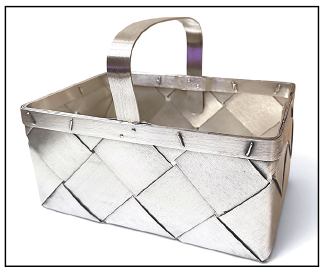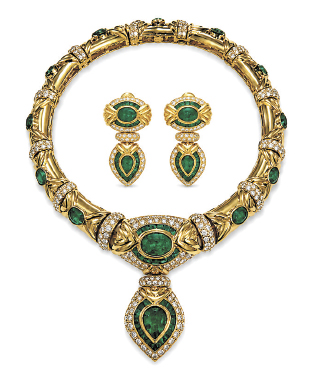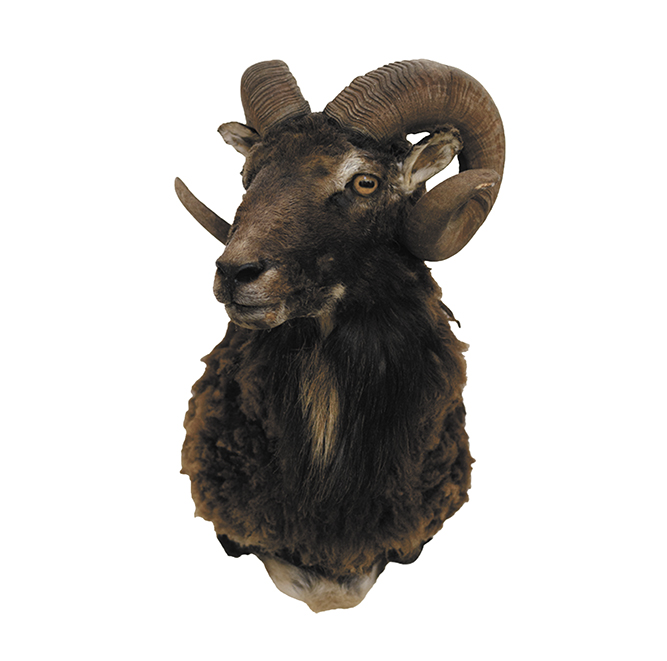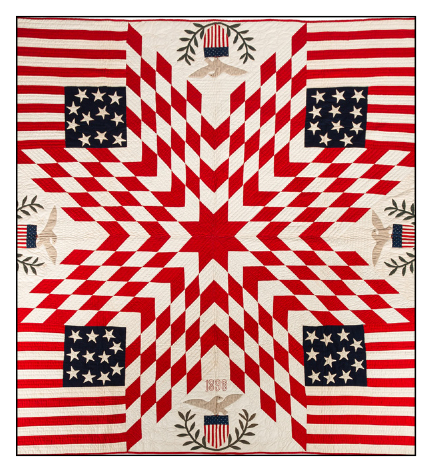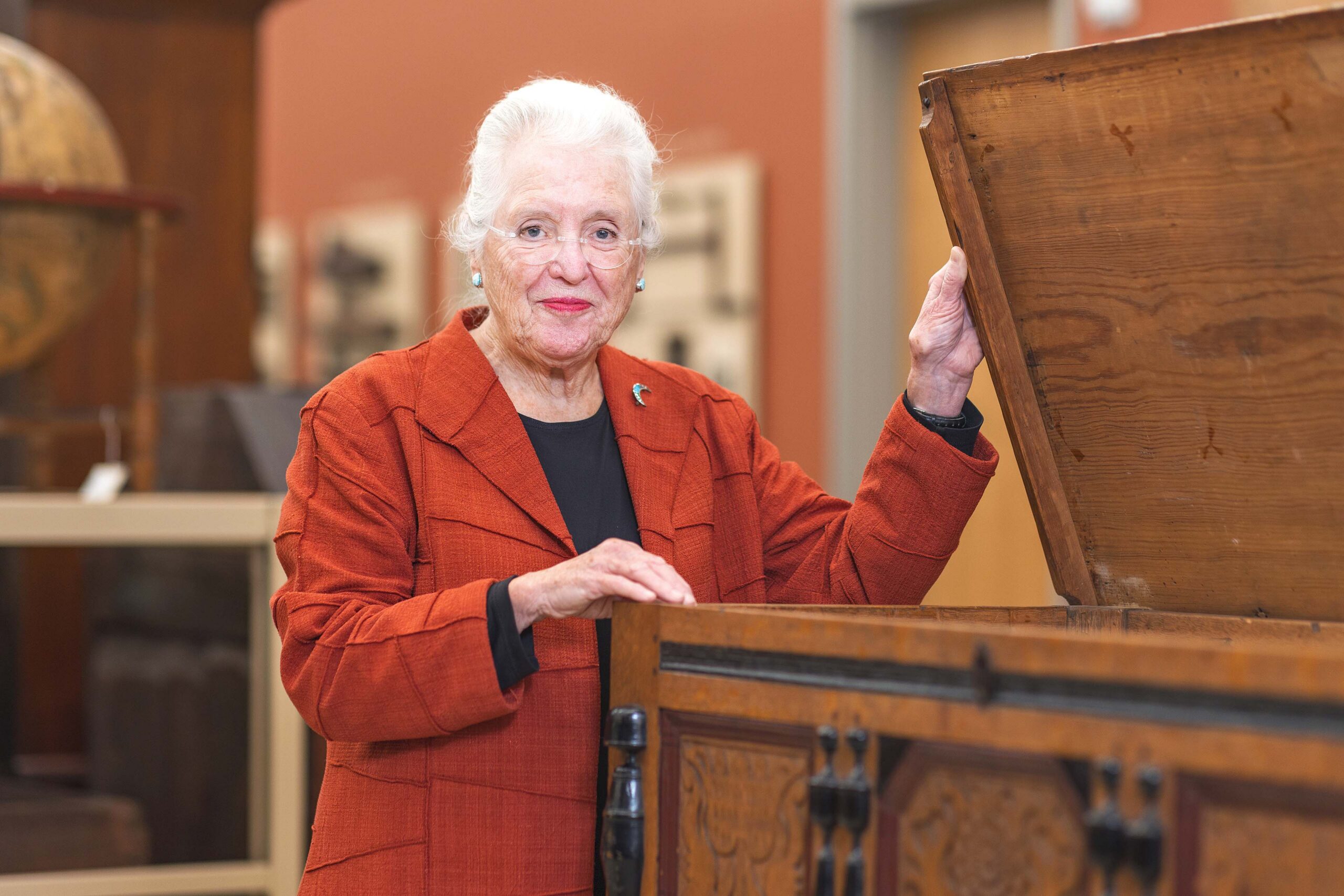
Taken around Kane’s 55th anniversary at Yale, she is pictured in the Leslie P. and George H. Hume American Furniture Study Center. Courtesy Yale University, photo by Robert DeSanto.
By Andrea Valluzzo & Yale University Art Gallery
NEW HAVEN, CONN. — Patricia E. Kane, the Friends of American Arts curator of American decorative arts at the Yale University Art Gallery, died on July 8, 2026, at Yale New Haven Hospital after a brief illness.
Kane was a widely respected expert in American decorative arts who inspired — and mentored — generations of scholars, collectors and museum professionals during her 58 years as a curator at the Yale University Art Gallery. Early American furniture was her passion, although she demonstrated a remarkable intellectual range that spanned Seventeenth Century silver to contemporary craft. She was a consummate and passionate researcher who set the gold standard for scholarship undertaken with patience, dedication and sans ego or artifice.
Kane was born in 1944 in Bridgeport, Conn., and later moved to West Hartford, Conn. Family visits to the Wadsworth Atheneum sparked an interest in museums but a summer internship at the Connecticut Historical Society (now the Connecticut Museum of Culture and History) introduced her to the field of decorative arts. After graduating from Chatham College (now Chatham University) in Pittsburgh, she went on to receive an MA from the Winterthur Program in Early American Material Culture at the University of Delaware in 1968. At Winterthur, she planned to write about textiles with legendary scholar Florence Montgomery, but instead, Florence’s husband, Charles F. Montgomery, took Kane under his wing and suggested she write her master’s thesis about Seventeenth Century furniture from the Connecticut River Valley.
In 1968, Andrew Carnduff Ritchie, director of the Yale University Art Gallery, hired Kane as the assistant curator of the Garvan and Related Collections of American Art and she worked alongside Theodore E. Stebbins, Jr, the associate curator of the Garvan and Related Collections. In 1970, she was reunited with her mentor when Yale hired Charles Montogomery as a professor in the history of art and curator of the Garvan and Related Collections of American Art. After Montgomery’s unexpected death in 1978, Kane became curator, the position she held for the remainder of her life. She began a doctoral degree at Yale under Montgomery and then with professor Jules D. Prown, completing her dissertation on the early Massachusetts silversmiths John Hull and Robert Sanderson in 1987.
Kane was an inveterate connoisseur of objects. At the time of her 55th anniversary at Yale she said, “Being able to touch them — to get a sense of surfaces, what their weight is, how they feel in the hand — is also an important part of connoisseurship. Certainly, when you are working with three-dimensional objects, being able to examine them firsthand by the hand and with your eyes is a two-part process that is critical and very illuminating.”
Kane enjoyed looking at objects with her students and interns but also with collectors, and over the years she became a resource for collectors including Linda and George Kaufman, Anne and Philip Holzer and Martin Wunsch. She also appreciated the visual knowledge that dealers amassed, as they saw a greater range of material than ends up in a museum. Visitors to the Americana auction previews in New York City would often find her laying on the floor examining the underside of a chest or table. Small crowds would gather hoping to learn about what she saw.
She worked with Montgomery on “American Art: 1750-1800, Towards Independence,” an exhibition arranged to coincide with the Bicentennial in 1976. It traveled from the Yale University Art Gallery to the V&A in London, and incorporated a film designed by the Eames Office. In 2001 she partnered with the Wood Turning Center (now the Museum for Art in Wood) in Philadelphia and engaged Glenn Adamson, then a graduate student at Yale, to mount the traveling exhibition “Wood Turning in North America Since 1930,” which drew attention to the vitality of wood within the realm of contemporary craft. Her final exhibition was “Art and Industry in Early America: Rhode Island Furniture, 1650-1830,” which was accompanied by a web-based database, the Rhode Island Furniture Archive that launched online in 2011. Alongside her own projects, she promoted the work of emerging scholars and made space for them at Yale to mount their own exhibitions and pursue their own research.
In addition to her exhibitions and installations, Kane was a prolific scholar and many of her publications have become indispensable resources in the field, including 300 Years of American Seating Furniture: Chairs and Beds from the Mabel Brady Garvan and Other Collections at Yale University (1976); Colonial Massachusetts Silversmiths and Jewelers: A Biographical Dictionary Based on the Notes of Francis Hill Bigelow and John Marshall Phillips (1998); and Art and Industry in Early America: Rhode Island Furniture, 1650-1830 (2016). Among her many accolades, she received a grant from the Henry Luce Foundation, was the inaugural recipient of the Wunsch Americana Award in 2013 and was presented with the 2017 Award of Merit by the Antiques Dealers Association of America.
As encyclopedic as her knowledge was, she remained a lifelong learner. In a 2013 conversation with Antiques and The Arts Weekly, she said of her tenure at Yale: “I’ve never gotten bored. One is always learning new things, especially as scholarly approaches to objects change.”
She was also generous with her knowledge, said antiques dealer Arthur Liverant in a phone call. “Pat was such a charming and wonderful person. She was a bounty of information and knowledge and she was so gracious in sharing her knowledge. And she was always anxious to learn. That’s what made Pat who she was,” he added. “She never felt as though she knew it all. She was always wanting to know your opinion. She would come into our shop or at a show and ask our opinion as if our opinion was important. She made us feel important because maybe we shared something that she had missed. She wanted to know as much as she could and she was phenomenal with how much information she retained. She wrote the Rhode Island Furniture Archive, which is a huge depository of information.”
In 1977 she married W. Scott Braznell, an independent scholar specializing in silver, who survives her. Together they would scour antique fairs and catch up with their wide network of dealers and experts. They also shared a love of dancing and travel, including annual trips to St Barts. Kane was a dedicated gardener and was a fixture at the garden plots in Edgerton Park. She contributed her professional expertise through serving on the museum committee of the New Haven Museum, the advisory committee of Historic Deerfield, the editorial board of Winterthur Portfolio, the advisory board of The Magazine Antiques and was a past board member of the Chipstone Foundation, the New Haven Preservation Trust and the Collectors of Wood Art.
In addition to her husband, she is survived by a nephew, Justin Kane, of Waterville, Maine, and a niece, Lauren Kane, of Wells, Maine. She was predeceased by her brother, John Riley Kane. A celebration of Pat’s life will be held later this year. In lieu of flowers, donations may be made in her memory to the Yale University Art Gallery’s Friends of American Arts at Yale, to the Edgerton Park Conservancy or to a charity of one’s choice.
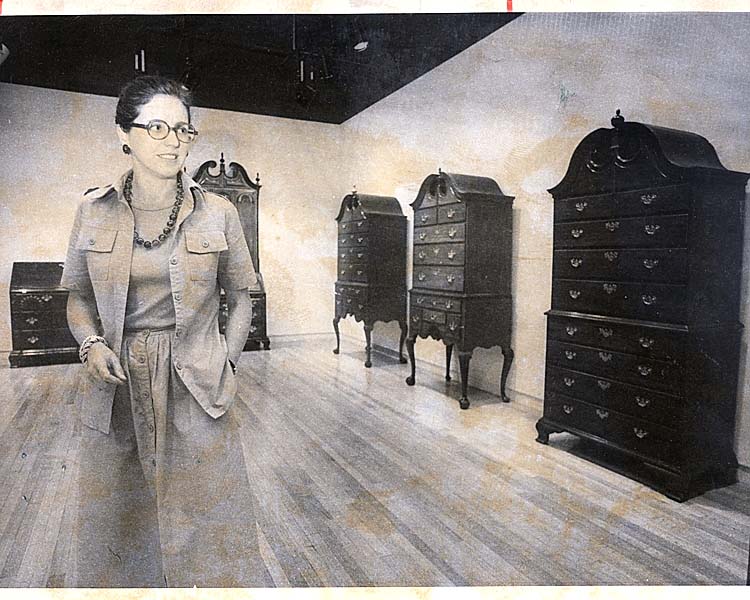
Patricia Kane in 1978, shortly after she was named curator of American decorative arts at Yale.
Patricia E. Kane (1944–2026) In Memoriam
Compiled by Andrea Valluzzo, Editor
As a curator, Pat shaped the [Yale University] Art Gallery’s collection of American decorative arts with extraordinary thoughtfulness and dedication. She oversaw three complete reinstallations of the permanent collection galleries, each time rethinking and broadening the parameters of what constituted American art. She believed in the power of objects to communicate across time and space, not only as exemplars of beauty or skill but as a means of accessing the mindset of their makers and owners.
As a teacher and mentor, Pat taught with patience, conviction, honesty and humor. She drew on deep expertise in areas like early New England furniture and silver but was always eager to learn about new subjects. She believed passionately in the importance of connoisseurship as the foundation of art historical scholarship. Examining an object with Pat was an exceptional experience that anyone who had that opportunity will never forget. She was quiet and methodical, assessing every detail of construction and condition, never rushing to conclusions.
Pat’s life’s work will forever be part of the Art Gallery and its collections, its staff, faculty and students, and the many communities of collectors and friends that she reached.
David Barquist
The H. Richard Dietrich, Jr, curator of American decorative arts, Philadelphia Museum of Art
Patricia (Pat) Kane was an absolute rock star in the field of early American decorative arts. She earned the unparalleled respect of her colleagues and the entire decorative arts community. Pat has left us with an extraordinary gift of scholarship that will continue to inform and inspire future generations of enthusiasts.
Her unprecedented body of work, spanning almost six decades, covers too many collecting categories to list here. Her books, articles, reviews, exhibitions and lectures vastly deepened our knowledge and understanding of numerous fields. The depth and breadth of her knowledge were enviable, and her willingness to share that knowledge was inspiring.
She dedicated her entire adult life to the interpretation, preservation and documentation of early American material culture, functioning at a level of excellence that we can all emulate. Her magnum opus, the Rhode Island Furniture Archive, is nothing short of extraordinary — an online database of all known examples of furniture made in, or attributed to, Rhode Island. What a legacy!
With regard to the database, I tried to be her eyes and ears in the field, giving her access to my Rhode Island furniture discoveries and informing her of relevant Rhode Island objects that appeared on the market.
I almost made a strategic blunder of epic proportions when Pat asked me to write the clock section for her then-upcoming book, Art & Industry in Early America: Rhode Island Furniture, 1650-1830 (2016), which went on to become a multi-award-winning publication. I explained that I was simply too busy writing an overdue book on early American musical clocks and would have to decline her kind offer. When I hung up the phone, my colleague Matt Buckley, who had overheard the conversation, said sternly, “When Pat Kane calls from Yale, YOU DON’T SAY, ‘NO!’” He was right. I quickly corrected my error, and I can now say that working with Pat on that book and exhibition was one of the highlights of my career. Thank you, Matt.
Pat Kane was a fine person and an inspiration. I’m proud to say I knew her. She will be deeply missed. My most heartfelt condolences go out to her family, friends and to her tremendous team at Yale.
Gary Sullivan
Gary Sullivan Antiques
I know Pat Kane had a lot of fans, but no one was a bigger fan of Pat Kane than me. As I was starting in the antiques trade nearly 30 years ago, Pat was already an icon. Even to a rough-around-the-edges novice, she was always welcoming and inclusive. It is not so much a story that I remember when I think of Pat, it was the many moments we spent together kneeling on the ground nose deep in a piece of furniture. Every mortise and tenon, saw mark, chalk mark, scribe mark, nail, peg, area of wear and detail of design became an opportunity to share. A credit to Pat’s generosity, kindness and openness, that sharing always went both ways: “What to you think of this? Have you seen that before?” These are the moments with Pat that I will cherish. And the curiosity that Pat inspired is a gift that I will take with me every time I turn over a table or take apart a chest of drawers.
I would never have imagined my life would include the opportunity to contribute to a Yale University publication. Sharing with my parents the location of my name in the acknowledgements in Pat’s outstanding reference book, Art & Industry in Early America: Rhode Island Furniture, 1650-1830, was one of the pinnacles of my life. The humility I feel for that opportunity to contribute is enhanced by the depth and quality of that publication, a credit to Pat’s tireless efforts over decades.
Pat’s legacy as a scholar is indelibly carved in the pantheon of Americana. Her numerous publications will continue to inform and inspire and will always be a part of my toolbox as an antiques dealer and historian. While the loss of Pat is deeply heartbreaking, I am profoundly grateful for the opportunity to have known her as a colleague and, even more importantly, to have called her my friend.
Kevin J. Tulimieri
Nathan Liverant & Son
Pat was an incredible mentor and teacher, and she nurtured and inspired generations of students and colleagues over many decades. I had the good fortune of working with her on the Yale Rhode Island Furniture Project. We spent countless hours together reading old court records, rummaging through archives and traveling from town to town in search of objects — I think all told, we photographed some 17,000 Colonial records related to early Rhode Island furniture makers.
She was impressively comprehensive in her approach and utterly indefatigable. New discoveries awaited around every corner. That’s what I remember of her. Her scholarship was rock solid and based so much on primary research, yet I admired how she was always forward looking and thinking about how new technologies and innovations would shape the field. This kept her energized and productive over a long career. She was one of a kind.
Dennis Carr
The Virginia Steele Scott chief curator of American art, The Huntington