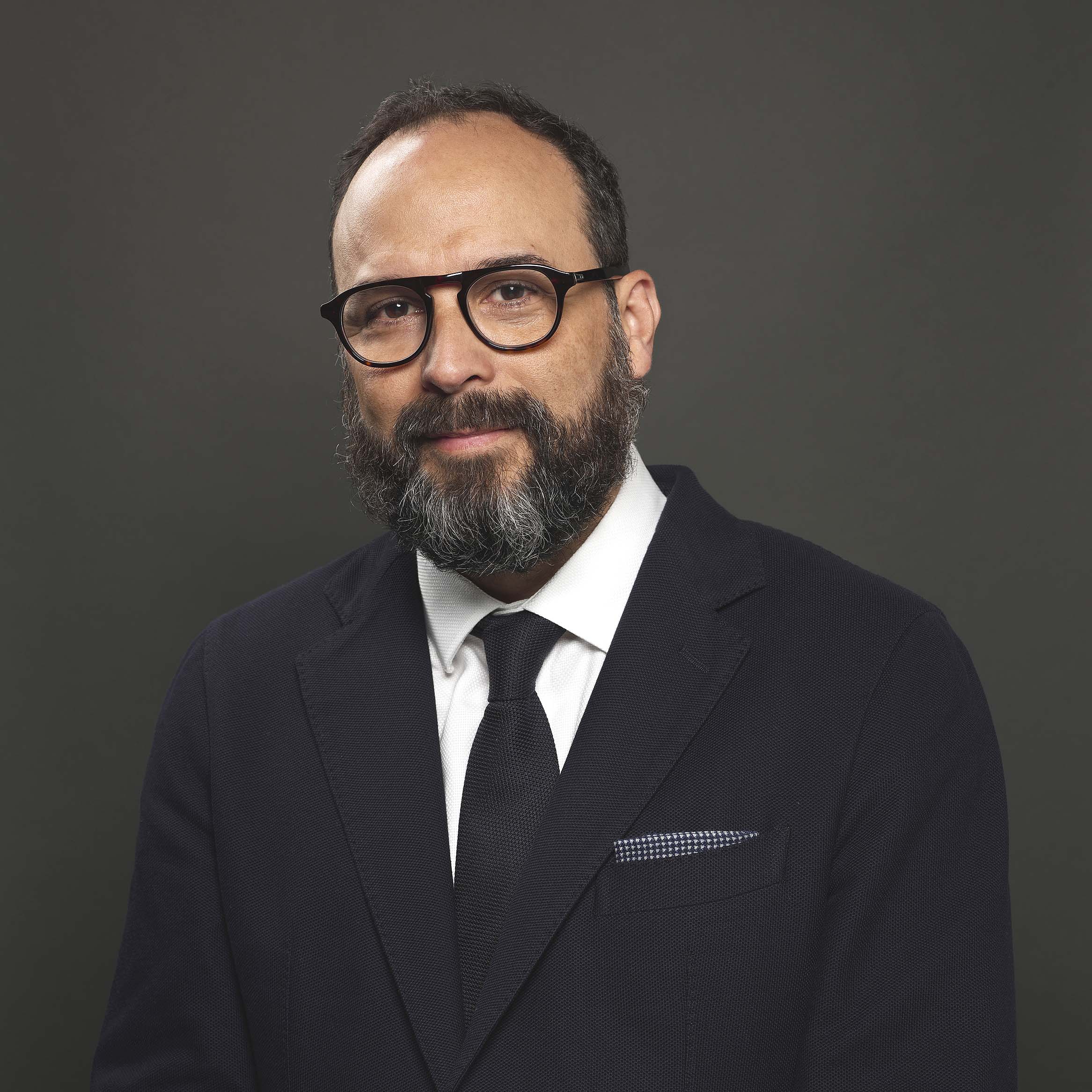
Francisco (Frank) Trujillo, Sherman Fairchild director of conservation, Thaw Conservation Center, Photography by Janny Chiu, 2026.
Francisco (Frank) Trujillo was appointed as the Sherman Fairchild director of the Thaw Conservation Center at The Morgan Library & Museum. Previously, he was the Drue Heinz book conservator after beginning his tenure at the Morgan as associate book conservator. He holds a MSLIS with an advanced certificate in conservation from the University of Texas at Austin and a BA from the University of Notre Dame. Upon hearing of his promotion, we reached out to learn more!
Congratulations on being named the Sherman Fairchild director of the Thaw Conservation Center! How does this promotion change your day-to-day activities?
I’ll have been with the Morgan for 20 years this fall! I still keep all of the tasks I’ve been doing as a conservator, just adding a lot more meetings [laughs]. For example, there’s a monthly interdepartmental meeting where the department heads give updates on their department’s activities and projects. Now I go to that meeting and it’s great because I can update all the others on what we’re doing; they update me on what they’re doing; and it’s a really great way of understanding how all the departments are working together — from visitor services to facilities to the Morgan Shop. It gets you out of your own bubble. It helps us get the bigger picture and explain the goals of the institution and where our department fits in all of that because we are involved with every curatorial department. We have tentacles throughout the building in many different projects, and that makes you realize the scope and scale of the museum, all the audiences that we’re trying to serve, all of the different things that we’re trying to do to engage audiences, and that exhibitions and loans are just the tip of the iceberg, really.
How has your background prepared you to be the best suited for this role?
I usually start my conservation story with when I started working for a conservator in private practice in book and paper conservation as an apprentice, three years before I went to graduate school. But even before that, I moved to New York out of college, and I had a literary and history degree background. And you move to New York and you’re sort of like, “Well, go to grad school, go write the Great American Novel,” that whole thing. But then you’re just sort of like, “Oh, right, I have to pay my rent.”
I worked for Sony Music and then I worked for EMI Music, jobs that paid the bills. They were large corporate environments, but they were fun.
I was interested in the rare book world, so I worked for a rare book dealer in Minneapolis. He introduced me to a friend of his who was a book and paper conservator, and his life seemed great. I was like, “This seems super cool,” because it was literary, it was rare books, it was science. It’s all these things that kept him happy and motivated and interested in work, and it seemed intellectually consuming, the sort of work I think anybody would be interested in. I worked with him for about three years, then I went to graduate school at the University of Texas, in a program that sadly doesn’t exist anymore. After that, I interned at Columbia and I stayed on there for another year for a project, then I went to the Jewish Theological Seminary for a few months to finish a fellowship. Then I went to the Library of Congress for a couple years before coming to the Morgan.
In graduate school at the University of Texas, I worked at the Ransom Center, the Benson Latin American Collection. I think there’s the university library setting, which is like its own world, and then there’s the Library of Congress, which is gigantic. I would finish this one treatment but in the few weeks it took me to do this one treatment, we’ve acquired two million books. It was a little daunting.
Coming to the Morgan, it was more specific. We have very incredible, specific curatorial collections, and I was able to dig into them with the experience of a university library, of the large national library, and it gave me different perspectives on large and small. There’s the long-term preservation and treatment of the collection, and then we have very strong exhibition and loans programs.
Where the focus of the work is generated, what it serves, that’s changed, but I think having different experiences and working with different experts in the field, learning from them and learning different management techniques from different philosophies and personalities is important.
You learn a lot over 30-something years. You remember what’s good — you try to emulate that, and you try to pass that on to other people as well, as I’ve tried to with our fellowships and such through the years here at the Morgan.
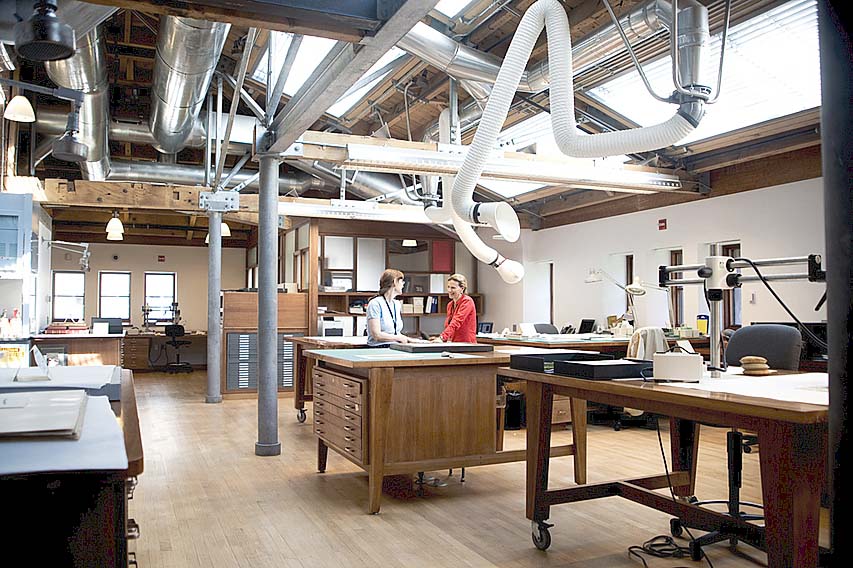
Thaw Conservation Center, The Morgan Library & Museum. Photography by Schecter Lee, 2009.
Can you talk a little about the importance of conservation and perhaps share some of what it entails?
As you can imagine, I think a really robust conservation department is the heart of any cultural institution. The conservators have a real privilege of working with and caring for the works of art on a daily basis, with a goal of making these artworks available for visitors today, and then for as long as possible into the future, and I think that that’s a real deeply held responsibility.
We’re constantly assessing the collection for condition. We think about things like how much exposure to light has each item had, and we try to limit that. We try to balance that with being able to have this available to researchers and visitors for exhibitions and for loans.
We’re past the days of having a book open to the same page for 20 years because it’s the most important thing we have in the collection. We can do that but maybe we can turn the page.
We’re always trying to get to a “yes,” but it’s a well thought out, safe yes that works for the object and for the goals of the institution. We’re really trying to work in partnership with our colleagues here at the Morgan.
We’re trying to make the argument that these works of art have been around, they will be around, for many years to come, and we’re working in partnership to make these things available.
Once you’re balancing all these things, you’re trying to get to a yes that works. And sometimes if you say “no” right now, that means that you can say “yes” down the road. Ultimately that’s the goal that we’re working towards. If we’re looking at a specific item — for example a medieval manuscript — and we check the stability of the pigments — and these pigments are hundreds of years old — we’re assessing them for stability, for imaging and for exhibition. Art paper conservators are constantly examining works of art for their material composition; they’re washing them or mending them as needed. Our preparator provides safe matting for the display of items or long-term storage for works on paper. Storage is really important to us. So much of what we do depends on the safe long-term storage conditions.
Ultimately, the importance of conservation is that it provides a means for these important works of art to be accessible and available to the world, to our audience. Being able to digitize something and make it available to someone halfway across the world…there’s a real meaning in that, and I think that access is what we’re trying to provide to people.
How does the work of a conservationist differ when they are handling a book or paper manuscript compared to other museum objects?
We have book conservators. I’m a book conservator, my colleague Lydia Aikenhead is also a book conservator. My colleagues Reba Snyder and Becca Pollock are paper conservators. Those are the two main types of collections that we have here. The works are bound and flat.
When we have something that falls outside of that — like a painting, tapestry or sculpture — we consult professional colleagues. We contract them if treatment is needed, and that’s how we get that work done. We really value the expert opinion. It’s in the same way that, curatorially, if you’re a medieval curator and your exhibition has something with a contemporary drawing, you’d want to consult our modern and contemporary curator to talk about it.
Conservation used to be more apprentice-trained, but by and large, almost everybody is trained in a conservation program now. In a lot of the programs, in your first year, everybody has the same background classes, but then you specialize. You can specialize in books, paper, paintings, sculpture, textiles, whatever the case may be. And then you get more specialized, specific treatment in how to treat those things. And you’re working on those things, so you understand and gain an expertise.
For a book conservator, I’m looking at the paper, the parchment of a text block, how it’s sewn, the boards — are they paper, wooden — the covering material — is it parchment, or is it leather? Is the leather deteriorating? I need to know about leather deterioration, but paper conservators, they talk about the making of the paper, the media used.
If we have a tapestry, painting or a sculpture, they have different considerations because there are simply material differences. Are there silk or linen threads that they can identify? In a painting, is it an acrylic or an oil paint and how do you treat that? Is it stone or a metal sculpture? We rely on outside experts to help us with these issues. Most of our collection, we’re going to be able to deal with, but when we need some help, we do look for experts.
What are some of the highlights you’ve worked on thus far?
I do always go back to the medieval manuscripts. I work on them a lot. Our Hours of Catherine of Cleves is the finest Dutch manuscript ever made. It’s a book of hours made around 1440. It was a single book by an anonymous artist called the Master of the Hours of Catherine of Cleves. Looking through this manuscript, it’s so inventive, the imagery is incredible. It has this really funny story. It’s this wonderful single book of hours that was made in 1440 for Catherine, Duchess of Guelders. Then, the vagaries of the world… It’s in a dealer’s hand in France in the Nineteenth Century. He splits it into two volumes — cuts out some pages, shuffles it up and sells it off as two different volumes. The Morgan buys one volume around 1966, and there’s this other volume that’s out there somewhere. The curator at the time discovers that it’s actually the same manuscript, and so we buy the second manuscript around 1971. There was a big exhibition in 2010 called “Demons and Devotion: The Hours of Catherine of Cleves,” and in preparing for that, we disbound both of the manuscripts and put the pages back in its original order for the first time since the Nineteenth Century. That was just a great project of being able to reintegrate and reconstruct this amazing manuscript in the way it was supposed to be originally read. I think that was just exciting. It was like detective work and it was a treatment.
It was this incredible work of art, with these incredible images, and figuring out how to put everything back together and looking for physical evidence and confirming it…it was just like a fun puzzle with the most beautiful work.
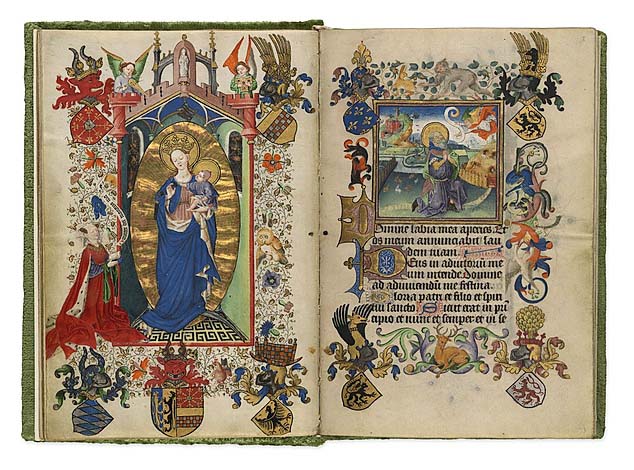
Hours of Catherine of Cleves (M.917/945) Utrecht, the Netherlands, circa 1440. The Morgan Library & Museum, MS M.917/945, vol. 1, fols. 1v-2r. Photography by Janny Chiu, 2023.
Are there any projects coming up that you’re especially excited about?
I will put a plug in for the “Tarot! Renaissance Symbols, Modern Visions” exhibition! I co-curated the Renaissance symbols portion of the show with Joshua O’Driscoll, who’s the head of our Department of Medieval and Renaissance Manuscripts.
This grew out of a conservation science research project that we started with colleagues from Yale, from the Met, artists in Chicago and colleagues in Italy. It was just simply, let’s figure out how these Renaissance tarot cards were made.
It ended up being great. I have great colleagues and great friendships as a result. The idea of an exhibition grew out of the research project, so I partnered with Josh, and we co-curated the exhibition that’s now on view through October 4. That was a great result of a fantastic project we worked on for many years.
One of the steps in making the tarot cards is that the artist used a lead point or a metal point to inscribe the image, the outline of the image into these layers of paper.
Another project I’ve worked on is for the Boxwood Sketchbook. It’s a sketchbook, with metal point on six boxwood panels that are bound together. It was recently on exhibition at the Met Cloisters. We did receive another loan request for it, but we don’t want to exhaust it. We’re not really sure, but we’re hopeful that we will be able to loan it. As part of this assessment, we’ve been asking ourselves questions. How was this made? It sort of defies logic on how these incredibly delicate drawings were made with metal point. Lydia and I are both excited to turn our attention to it, so we’re trying to drum up support for doing a research project on how this sketchbook is made. It goes back to trying to provide material evidence for why these things are incredible works of art. Why does this boxwood sketchbook defy physicality? These images are jumping off this wood. How is that possible? I think that you just get excited about trying to answer those kinds of questions, and I’m excited about hopefully being able to look into that question with Lydia and other collaborators at other institutions.
—Carly Timpson