Michael Provenzale is the production manager for the sports department at Heritage Auctions. To learn more about the current state of the sports collecting market, we reached out to him following the firm’s record-breaking Spring Sports Card Catalog Auction April 3-4 and ahead of the Spring Sports Catalog Auction in May, which went on to realize $23.5 million.
What is the current market for sports memorabilia and collectibles like?
It’s very strong right now. The sports collectibles market has been one that, I’d say since the mid 80s, has kind of steadily grown. People collect other things, they have a sports background or they are just big sports fans and slowly find sports collecting, however that may be.
It’s really exploded in the last eight to ten years, and especially during the pandemic, which was a huge growth period for us. A lot of people came into the industry for the first time; a lot came back that maybe did it as kids or teenagers or in college and kind of gave it up as they got older. We were sitting around during the pandemic and just saw a lot of growth and infusion of A: people, and B: money. The latter part of that is we’ve seen a lot of people who are in traditional investments — stock and real estate and things like that — who either got burned by it or are trying to diversify, get into the sports market. A lot of people, myself included, attributed the growth to that part of it, the investment side of it. If you grew up a sports fan, you kind of have a leg up in jumping into the industry since you know the names, the events and why things are important. Nobody grows up knowing about stocks or pork belly futures or great real estate locales. So, we saw a lot of people who were receptive to jumping into our industry.
Then, especially during the pandemic and the years after, people who maybe had never invested in anything seriously joined the industry as collectors. It’s got low entry points if you want to jump in — a lot lower than things like jewelry and art. So, it’s a friendly industry, an easy industry to jump into and to get things that you can be passionate about or love, whether you think it’s valuable or are worried at all about if it’s valuable or not.
We’ve seen a real influx of people, and especially the younger demographic, come in and the modern side of the card market — cards that were made in the 90s or later — has really taken off. They’ve had some good strategies that have captured the younger market. Twenty years ago when I was going to shows and I was in my late 20s and early 30s, I was one of the younger people there. There were a lot of people in our industry asking, “How can we bring in younger people?” And now you see so many teenagers and kids that are actively collecting, not just being dragged around by their parents, but they are passionate about it themselves.
When I was growing up collecting, learning was trial and error, or you’d go to the card shop and talk to someone, you’d go to a couple shows a year and get what information you can. But with phones and the way technology is, if you have the interest and the passion, all the information is at your fingertips, and you can become an expert a lot quicker and do research a lot easier than it used to be, whatever age you are.
How have recent and upcoming sporting events, such as the Olympics and World Cup, impacted the market?
That’s one of the fascinating things about sports collecting is you have these built-in events annually and every four years that draw attention to these mammoth sporting events, and that does have an impact on collectors.
We had an auction going on during the Winter Olympics this year. That’s kind of a smaller, niche market, people who collect Olympics material, but we had some great stuff coming out and a lot of times it’s stuff that you haven’t seen in a long time, so it’s newer material to the new audience.
Same for the World Cup. We have a lot of incredible soccer material coming up that people have been consigning over the past few months because they know there will be a lot of media attention and collector attention globally.
We’re really seeing some great soccer material right now, but you see it for the Super Bowl every year. It’s not something where prices skyrocket for any Super Bowl-related thing every February, but there’s more interest from people who maybe don’t buy as often and say, “Oh, well, my team’s in the Super Bowl. It’d be interesting to own a Super Bowl-related item.” It comes up with the NBA finals or the drafts, things like that.
That also happens when players set records or pass milestones. When Aaron Judge set the single-season home run record, that brought a lot of attention to Roger Maris, whose record he had broken. So, there was a lot more material from Judge and Maris coming out and some increased prices.
You can also see it when players pass, in certain instances. Hank Aaron passed recently and he lived a good long life, so it wasn’t a shocking death. There was a little jump because he was talked about a lot and there’s all these retrospectives and it gets people thinking, “I’d like to own a Hank Aaron thing,” but it’s not huge jump. But when Kobe Bryant passed, that was a shocking one. For collectors, it’s someone that you think, “I thought I was going to have decades of him doing events and signing autographs and photos and be involved.” Now everything he has is of a finite quality, so his material really exploded.
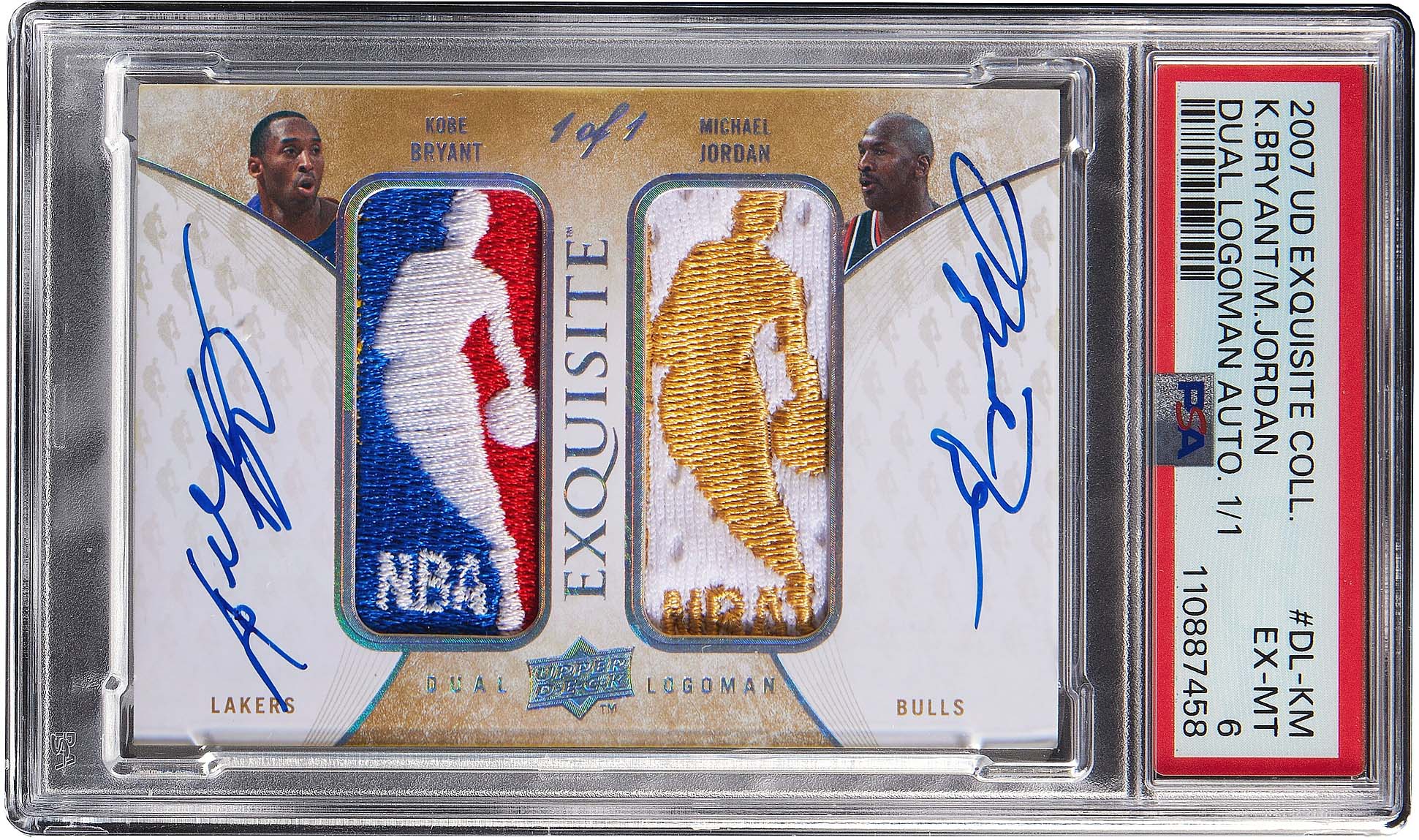
When it sold for $12,932,000 last year, this signed Michael Jordan/Kobe Bryant 2007 Upper Deck Exquisite Dual Logoman set the record for any sports card.
How does the market respond differently to items relating to athletes who are active, retired or deceased.
Consider cards from the 90s to today: If you’re collecting those, you’re collecting, for the most part, athletes that are still playing, that are still alive. One aspect of those is what we call “chase cards” or “parallel cards.” For modern cards, there isn’t much rarity — they could make a million of them. Companies combated that by having limited editions. They’d only make one of a card, or ten, or 100, and then they randomly insert them into packs. It’s like the lottery. That’s one of the things that’s really revitalized the youth to get into collecting.
But if you’re collecting modern athletes, there is an element of speculation to it, whether you’re aware of it or not. Tom Brady, Steph Curry, LeBron James — their legacies are set. You know there’s no worries there.
But someone like Zion Williamson… When he came out from Duke and was the number one overall pick, there was a lot of money thrown around the first few months of his career for his limited rookie cards and his autograph. But he’s had a lot of injuries. While he’s a very good player, he hasn’t become the player people thought he was going to be. I would say, for a lot of people who spent a lot on him, it’s not going to pay off in the end.
But then you get success stories like Wemby [Victor Wembanyama] and Luka [Dončić] and [Shohei] Ohtani. People who’ve invested in them have done great.
But you always run the risk of an injury — that could happen to any player. It’s essentially out of their control.
Then there’s the off-the-field aspect. If you’re collecting a modern athlete who’s still alive and he says the wrong thing, does the wrong thing, gets in trouble, it can have a serious effect on their collectibles.
Tiger Woods is a great example of this. He was basically the most valuable golf person there was until his wife hit him with a golf club and all his dirty laundry came out in the public… that kind of soured the prices for his material a little bit. When you’re collecting sports material, you’re representing that player. You want it to be somebody that you’re not embarrassed to talk about or doesn’t have these black marks against them. So, there was kind of a little bit of a falloff in his prices. But then he won the Masters again at an advanced age, and it was this big celebration of his career and his comeback, so prices for Tiger Woods material went up again. And now he’s had another black mark with the recent car accident. So, he’s a good example of how it could fluctuate.
The modern side has an element of speculation to it, but you know Babe Ruth isn’t going to get a DUI. You know Wilt Chamberlain isn’t going to say the wrong thing. You know Willie Mays isn’t going to have a political opinion people don’t agree with. So those vintage ones, where they’ve already passed, that’s kind of the gold of collecting. It’s very stable, it’s already limited and there’s not new things coming out for the most part.
Yes, modern material is more of a gamble, but a lot of people like that. And when you look at how prevalent sports gambling has become in our culture, it’s become popular because people are putting money into it and they like doing it. People don’t mind having that speculation. And people do that in other forms of collecting and investing. If you know any hedge fund or stockbroker people, some of them play it pretty fast and loose. They love those buy low, sell high, high-risk things. There’s an element of that in sports collecting. So, it’s kind of diversified in that whatever and however you like to collect, if you like high risk or low risk or immediate, it’s there for you now.
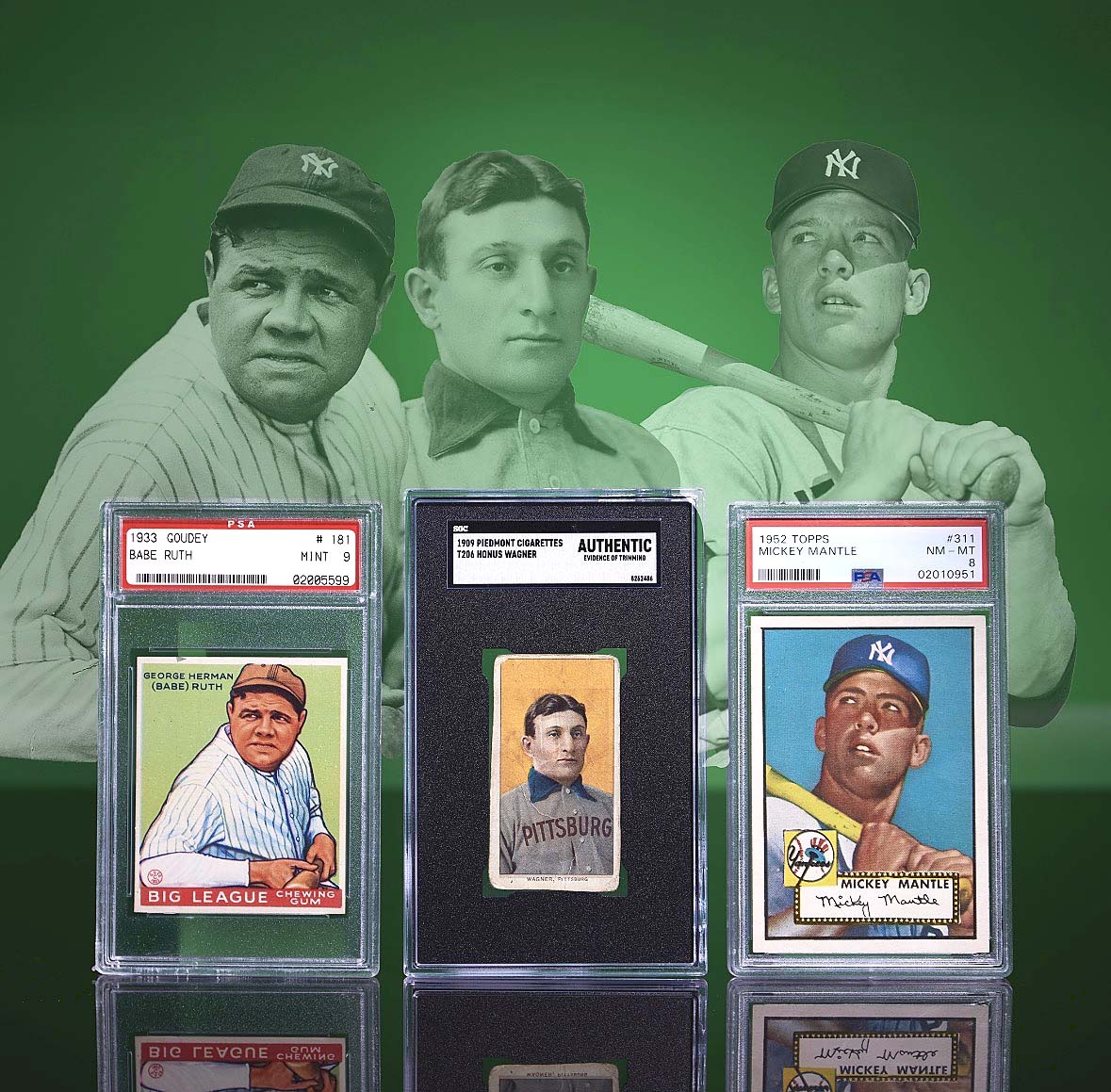
The 1933 Goudey Babe Ruth (est $2,000,000+), 1909 T206 Honus Wagner (est $4,000,000+) and 1952 Topps Mickey Mantle (est $2,000,000+) “are the three most iconic baseball cards in our industry, especially in these high grades. All three are coming up in our August Platinum Auction.”
What areas have changed in recent years, and which have always been steady?
Card collecting was how it all started, and it’s kind of the bedrock of the collecting industry. Memorabilia became a bigger part of it in the 80s and 90s and was slowly growing, but recently it has exploded.
There are really two reasons. It’s easier to authenticate it now with the technology and the information we have, like photo matching. Back in the day, you had to be like a self-made expert to know a lot of the things that are easily available online now.
And, because it’s become more readily available. When Mickey Mantle was playing, each year he’d have four uniforms: two home and two road. At the end of the year, they’d send them down to the minor leagues to be reused. They weren’t thought of as valuable, so a lot of that stuff just disappeared. But now teams know how valuable it is. Players know how valuable it is.
Players wear a lot more jerseys, use a lot more bats. Luka Dončić wears two uniforms a game. For Wilt Chamberlain, in his rookie year he had two uniforms: home and road. Luka’s putting out over 150 a season. That’s bad for rarity, but it’s good for collectors because a Luka Dončić jersey is not six figures. If you want one, you can find one that’s fairly affordable, and the leagues make them more available.
It’s a good situation for collectors where they have better access to more secure items as far as authenticity.
Are there any notable trends within collecting demographics? As you said, a lot of younger people are getting into collecting. Are they getting into the same things that more established, older collectors are into, or are they looking for different types of material?
Yeah, they’re kind of coming across the table. I think a lot of kids get into it and they’re collecting the players they watch — Ohtani, Curry, Wemby. That’s how I got into it. And if you stay in it, then you learn about the history, and you go back to the Ty Cobbs, the Jackie Robinsons, the Oscar Robertsons. And it’s easier to do that now than ever with technology. If you want to find out about a player that played in the 40s, it’s all right there on your phone.
Another big group that’s increased is women. It used to be, when at a show, a woman would walk by and I’d be like, “Wow, there’s a woman at this show.” Now it’s very commonplace for attendees and dealers, and even influencers, to be women. I have a lot of women coworkers. That’s something that was commonplace in art and jewelry and other forms of collectibles, but it’s really grown with leaps and bounds in sports. And not just them collecting, but them selling, working in auction houses, having podcasts, things like that — influencing trends. It’s a great situation for the entire industry.
Does the rise in women’s sports play into that at all?
Definitely, because there’s more available material. In the 90s, if you wanted to collect female-related sports material, there just wasn’t much. There were a few tennis players, a few golfers, Babe Didrikson Zaharias, the Rockford Peaches…it was just very, very limited. But now the women’s professional leagues are doing great.
Tennis and golf have kind of always been ahead of the curve as far as women’s sports, but the WNBA is great. And another big factor is wrestling and UFC — women really have a place at the table in those sports and some of their biggest stars are women. Thirty years ago, you’d be hard pressed to find Miss Elizabeth collectibles, or any of the few figures that existed, but now there’s a lot of iconic women athletes, and if you want to collect them, there’s material to collect. I expect that to only increase.
Do you see that men are collecting women’s sports items in earnest too?
Yeah, definitely. There’s people who do it as an investment. A lot of them are collecting the big stars coming out — Caitlin Clark, of course, was a big factor in that, and Angel Reese as well. But you also get a lot of people that have daughters. You know, guys like me who are in their 40s and 50s. You have daughters, you’re watching girls’ sports and then women’s sports, so that translates into your collecting.
Is there anything else that you’d want to say to our readers who are generally collectors of art and antiques?
Don’t be intimidated to jump in. If you can start at a $25,000 purchase, god bless you. But if you want to start with a $300 item of your kid’s favorite player, that’s a possibility, too, and a lot easier to do.
—Carly Timpson