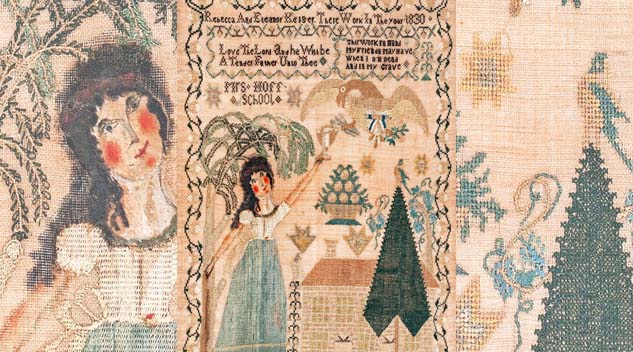
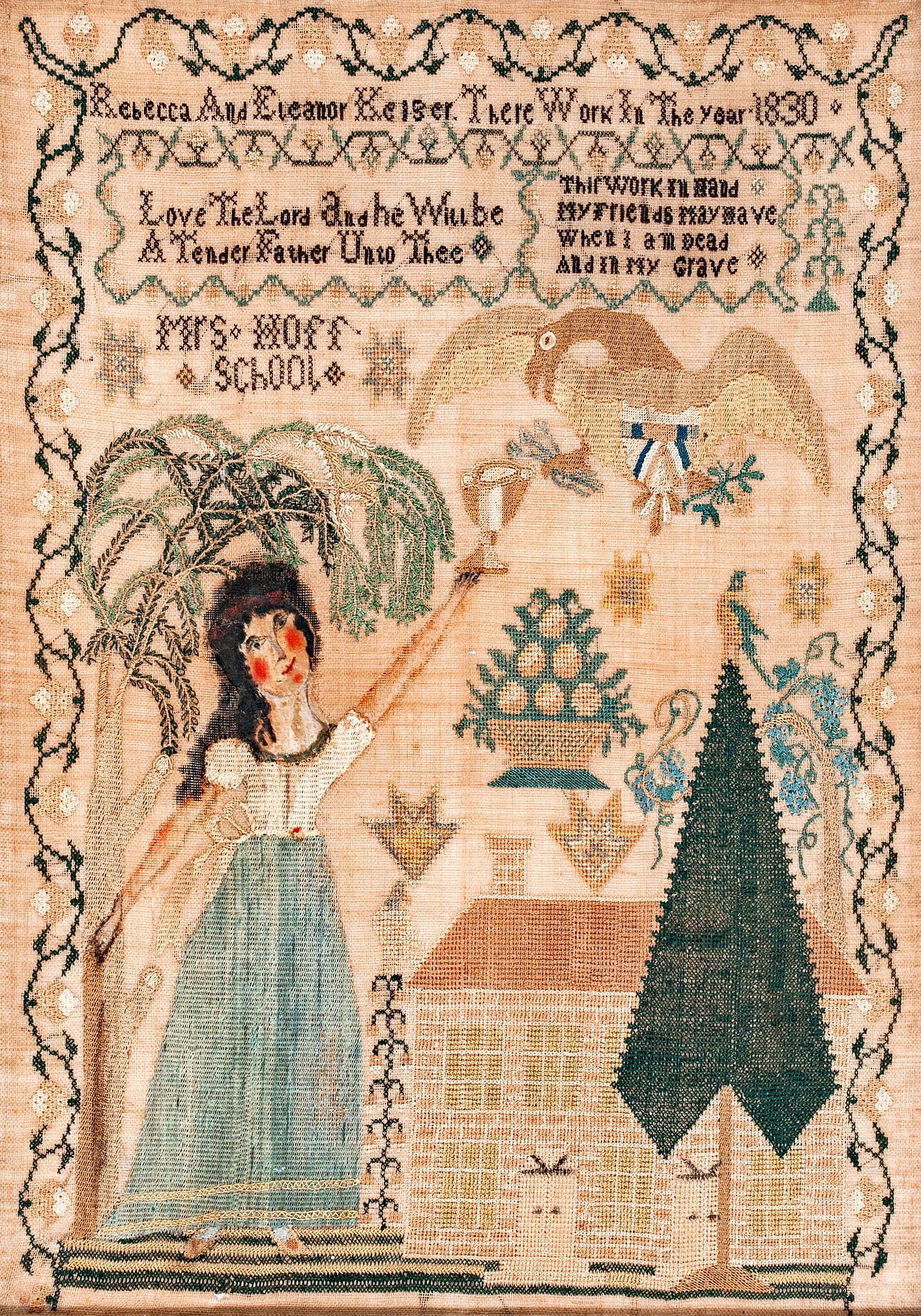
Sampler worked by Rebecca & Eleanor Keiser, Mrs Hoff’s School, Lebanon, Penn., 1830, silk, chenille and watercolor on silk and linen, 21½ by 15¼ inches. Collection of Sharon and Jeffrey Lipton.
By Madelia Hickman Ring
NEW YORK CITY — Early scholarly study on early American needlework and other forms of student artworks has, historically, focused primarily on the “Who, what, where and when,” questions that established a rigorous classification based upon attribution, schools, teachers, regional styles and chronology. The American Folk Art Museum (AFAM) takes the opportunity of its Semiquincentennial exhibition, “Locating Girlhood: Place and Identity in Early American ‘Schoolgirl’ Art,” to ask “why,” particularly when it comes to how the women of the late Eighteenth and early Nineteenth Centuries — the “Founding Mothers and Daughters” if you will — saw their own world and understood their identity and belonging within it. The exhibition is on view at the American Folk Art Museum from October 9 to February 28.
The use of landscape to convey a sense of place and self has long been an art historical construct but because girlhood embroidery and other student-made objects were implicitly undermined as “decorative,” they were typically excluded from serious discussions about the history of landscape representations. “Locating Girlhood” challenges that exclusion and shows how landscape was a dominant theme in the visual production of young women.
Emelie Gevalt, PhD, the museum’s Deborah Davenport and Stewart Stender deputy director and chief curatorial and program officer, who was the co-curator of the exhibition alongside Caroline Culp, PhD, the museum’s former Warren Family assistant curator and now the Brock curator of American art at the Chrysler Museum of Art in Norfolk, Va., explained:
“The actual visual content of girlhood artworks has gone surprisingly under the radar in a lot of Twentieth Century exhibitions — similar to the treatment of folk art more broadly, which for many decades was displayed primarily in wide-ranging, celebratory exhibitions, aimed at establishing the field. What excited us about this project was the opportunity to drill down into the ‘why’ of girlhood artworks. We could have focused on any number of key questions, but the one that most captured our curiosity was the theme of place, which surfaces over and over again in these objects across time.”
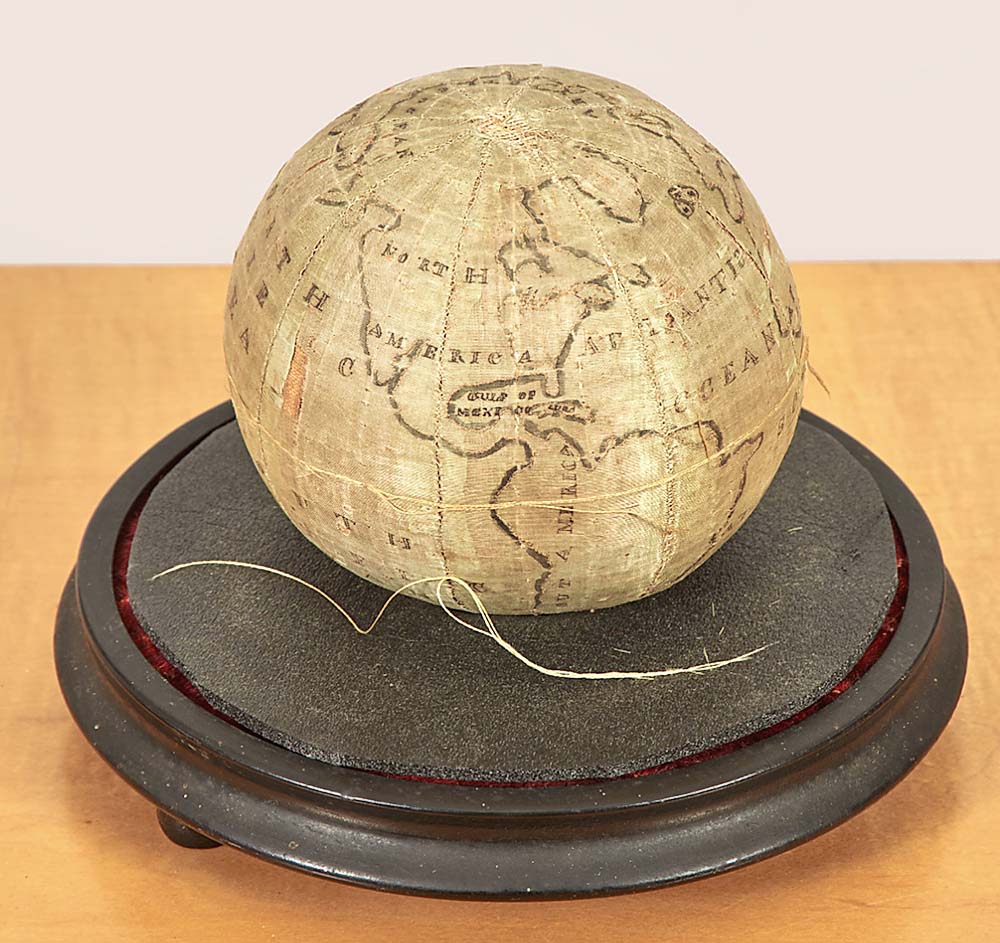
Embroidered globe by Ann Thomson (1800-1885), West Chester, Penn., circa 1814, silk and ink on silk over linen, stuffed with wool, diameter approximately 8 inches. Collection of Alexandra Peters.
A few sections divide the exhibition. “Laying Groundwork: Girls’ Education and Needlework in American Culture” reiterates among other things the idea that needlework was considered an important skill across social classes. The physical environment of the settlers and their families became inseparable to their sense of self; early on, they relied upon English and European pictorial traditions to depict this, as shown in “Landscape and Identity in the ‘New World.’” In “Construction Local Landscapes: Girlhood Arts and Architecture in the Early Republic” the inclusion of architecture — houses, schools, churches and civic buildings — in needlework functioned as an educational tool teaching needlework, drawing, geography, geometry and civic life all at once. Works on view in “Picturing Geographic Networks” show how place was impacted by commerce and travel. The “Sites of Learning” section features not only needlework but some implements like worktables and paint boxes while “‘Placing’ Family Histories” shows genealogical family “trees” in landscape settings.
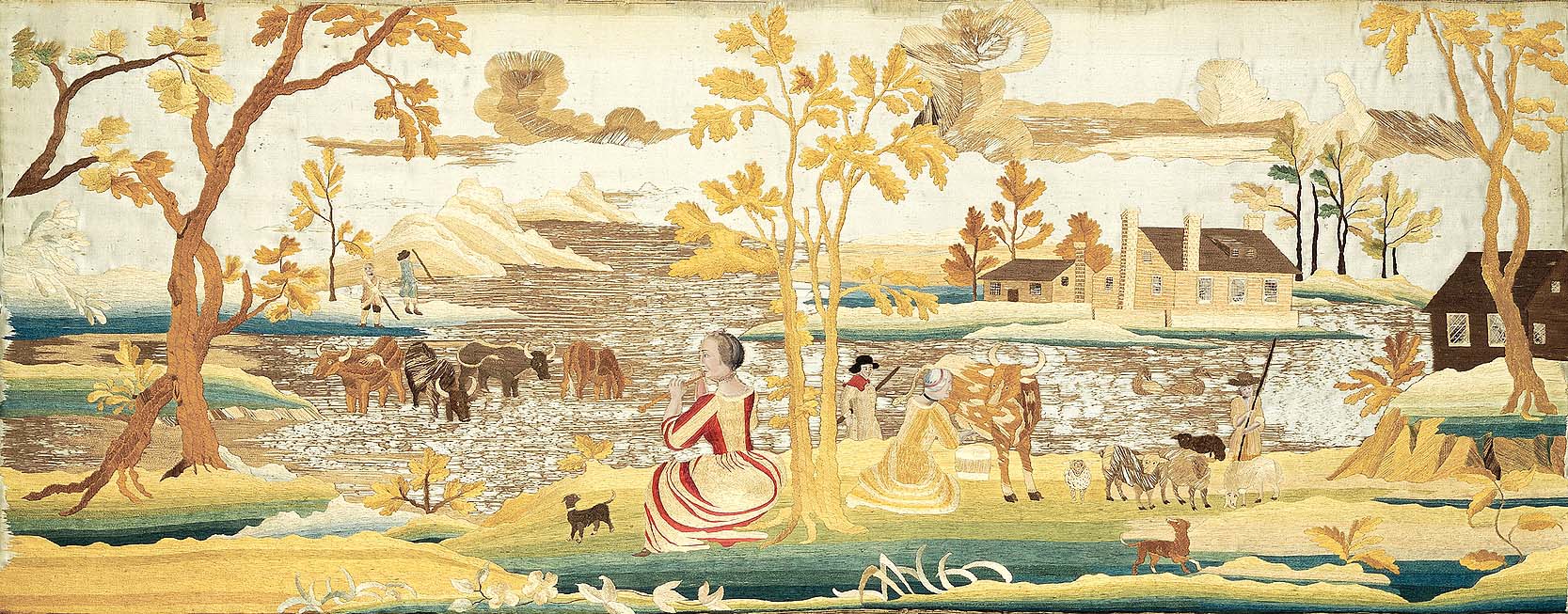
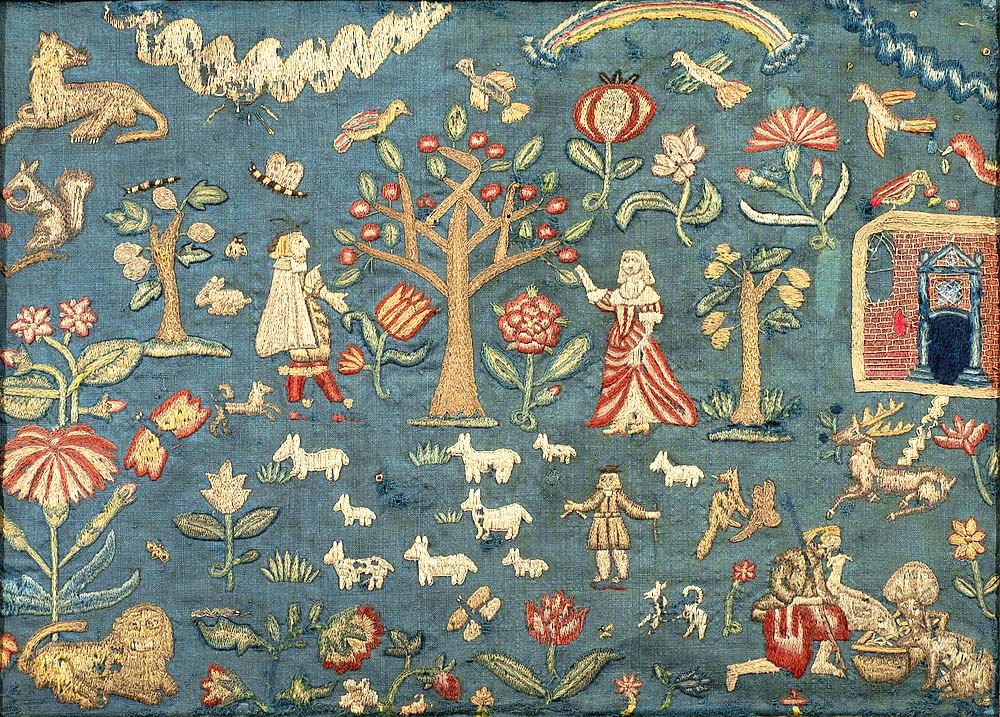
From AFAM’s collection and loans from institutions and private collectors, the curators assembled an impressive selection of about 100 works to demonstrate the theme of place, seen in the worked landscapes, gardens, town views, maps and imagined environments. It can be seen in one of the earliest pieces in the show, a Seventeenth Century needlework picture. Probably made in Boston and attributed to Sarah Phillips, it relies heavily on British precedent and shows figures in a landscape along with animals, birds, trees and a building. Following European traditions as well, a mid Eighteenth Century overmantel attributed to Faith Trumbull borrows from print sources but incorporates a distinctly Colonial landscape. A fantastical “Tree of Life” needlework picture by Mary King of Philadelphia, made in the mid Eighteenth Century, includes a lion, leopard and insects within a profusely embroidered floral and vine scene on a vibrant gold ground.
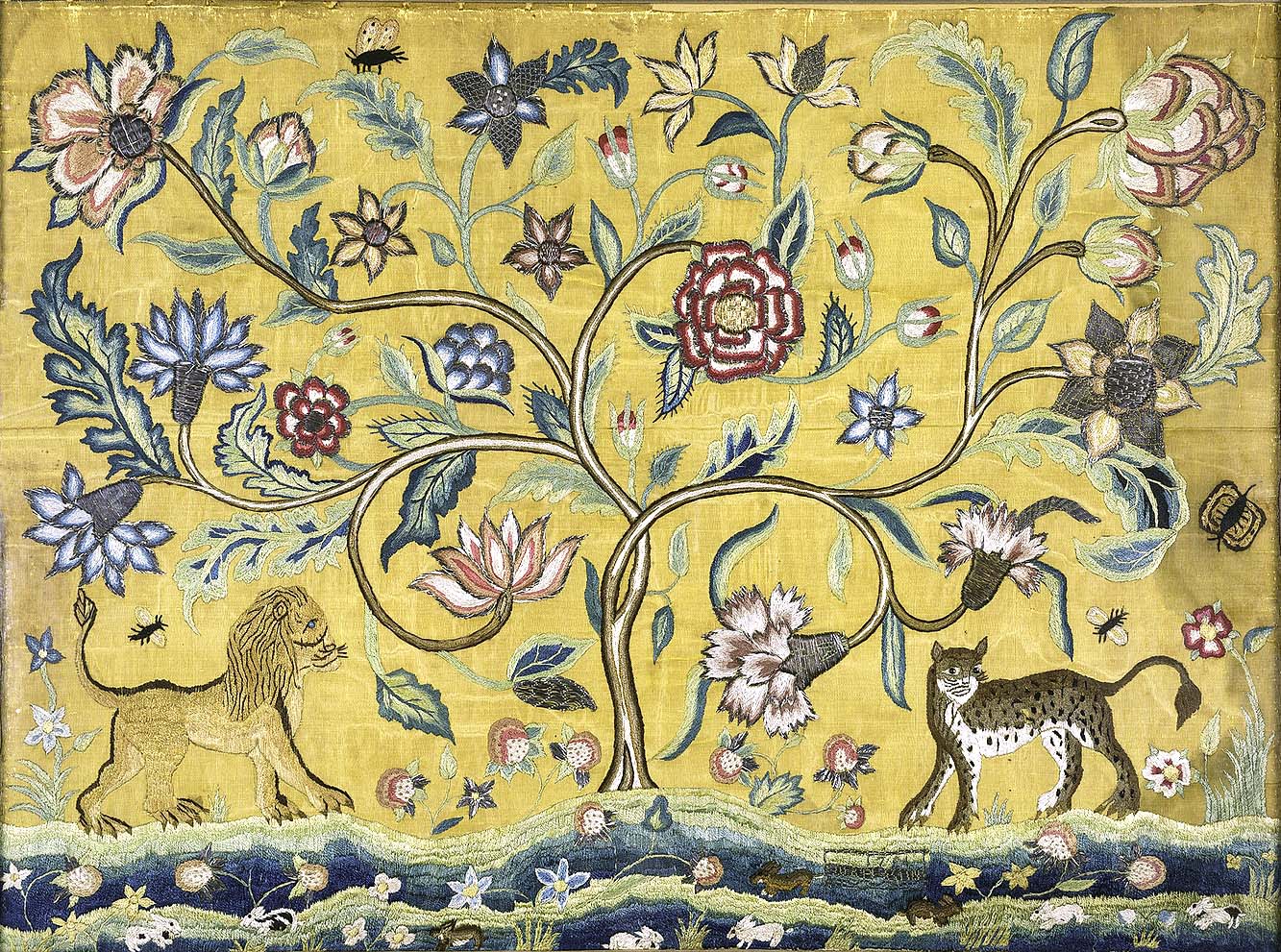
Needlework picture (Tree of Life) by Mary King, Philadelphia, 1754, silk, metallic thread and glass beads on silk, 18 by 24½ inches. Winterthur Museum, Garden & Library, bequest of Henry Francis du Pont, 1966.0978. Courtesy Winterthur Museum.
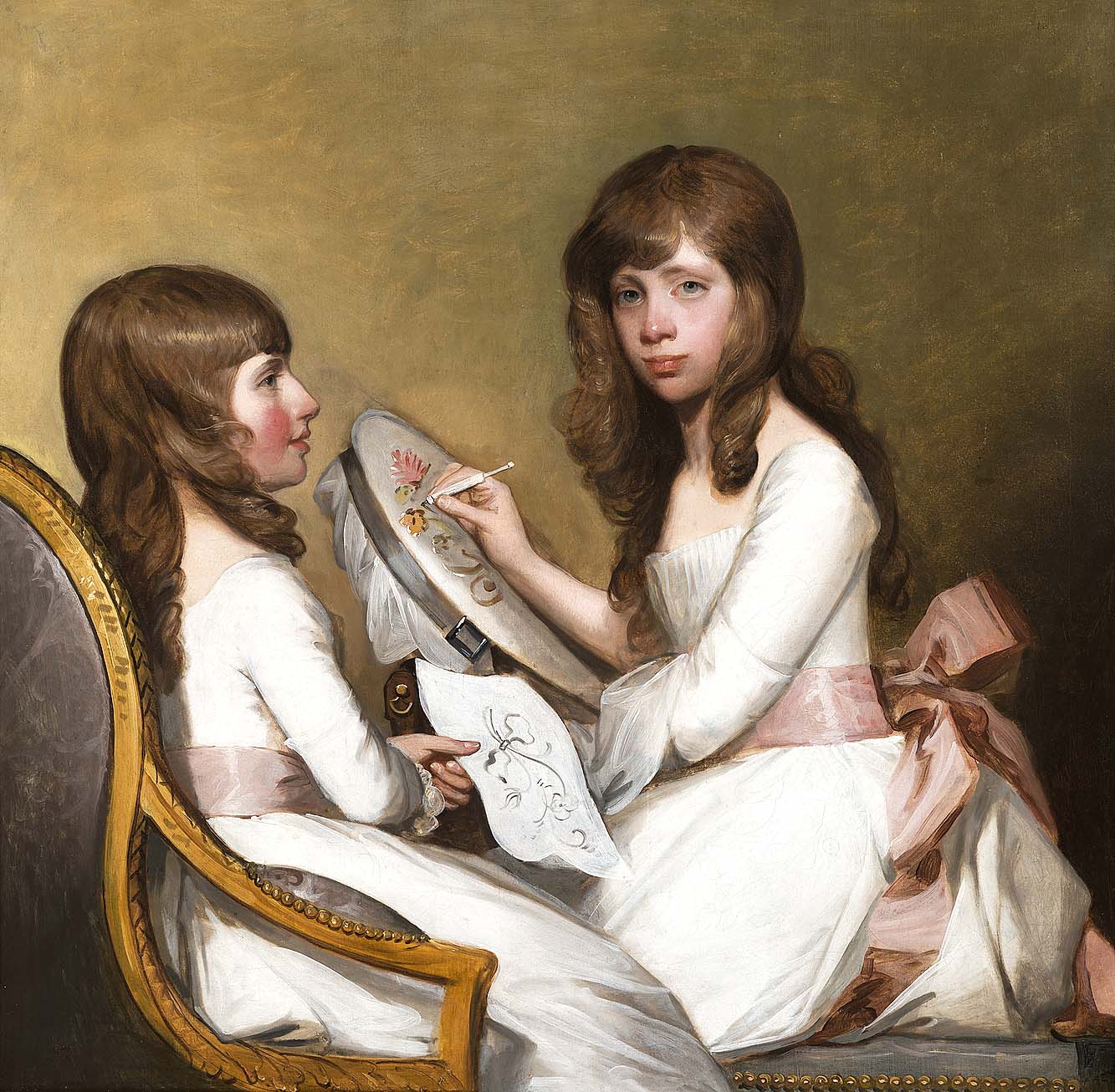
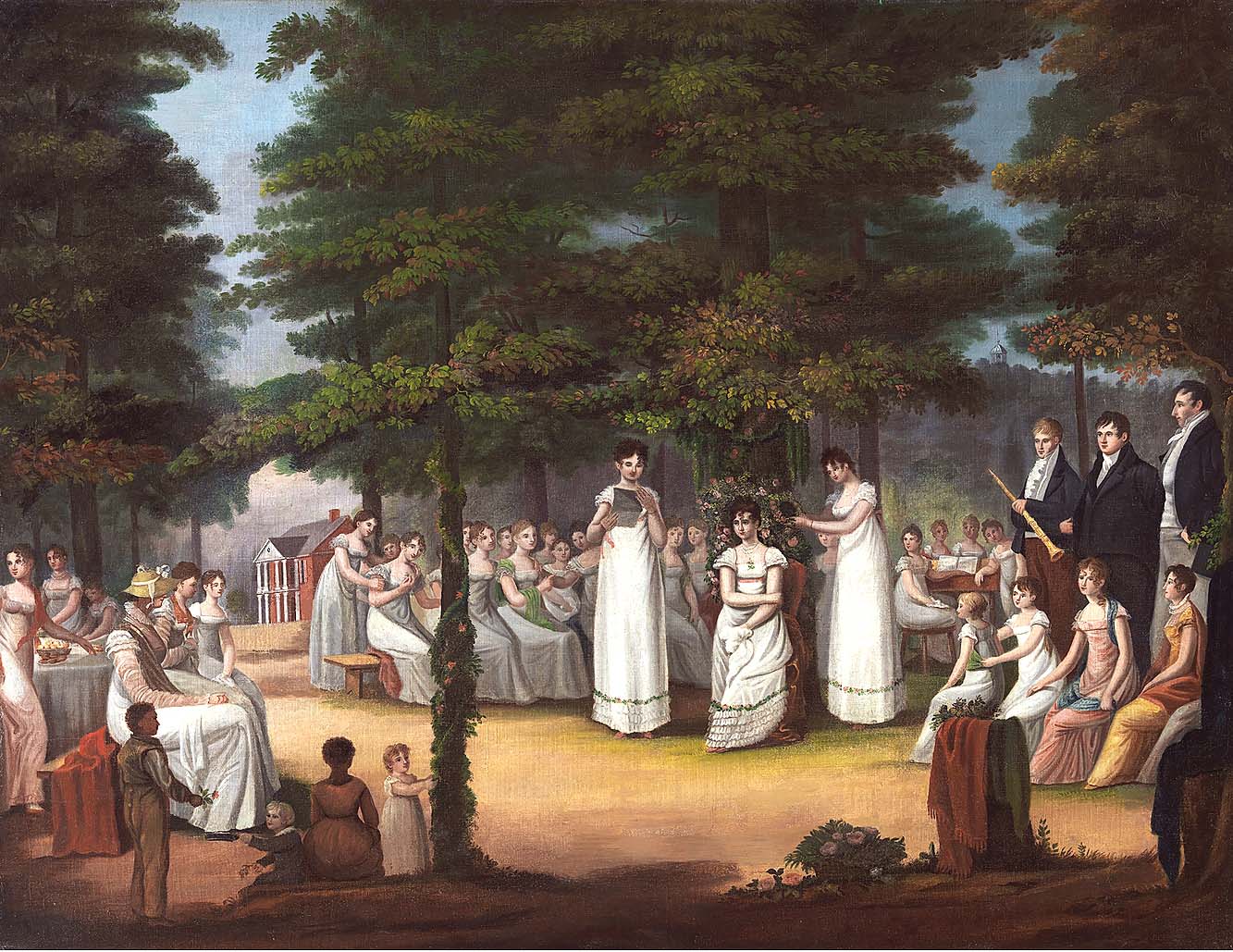
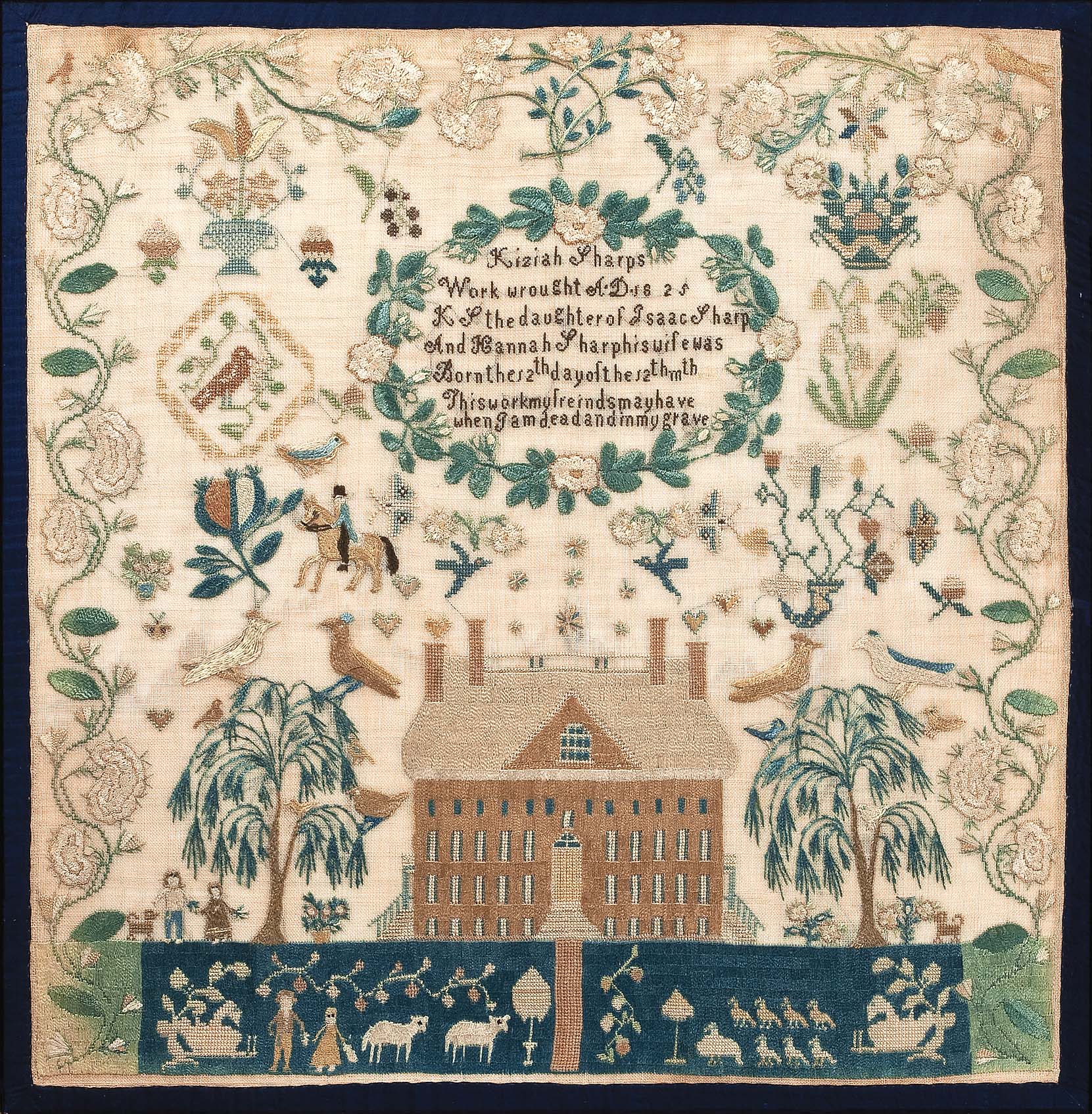
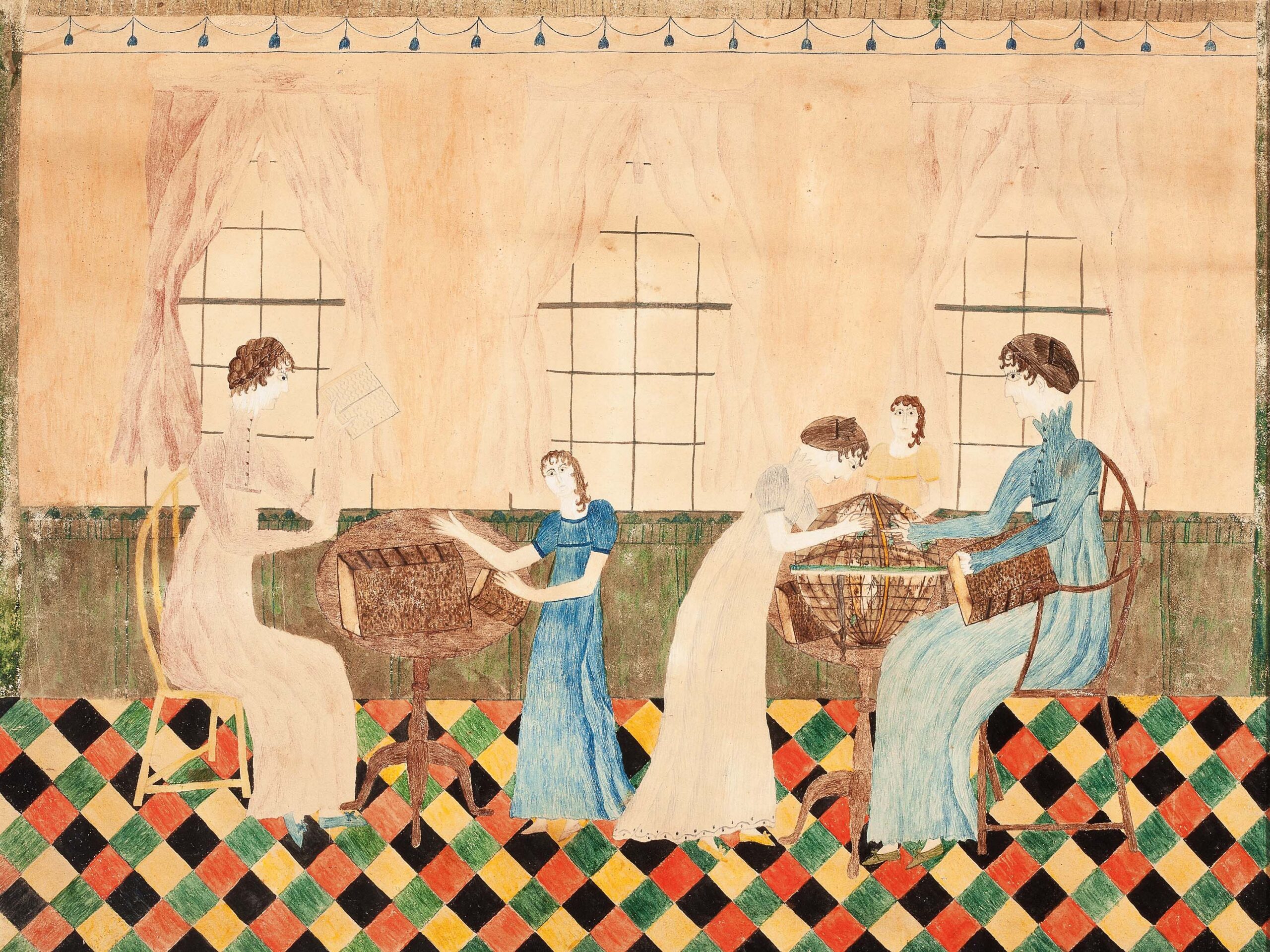
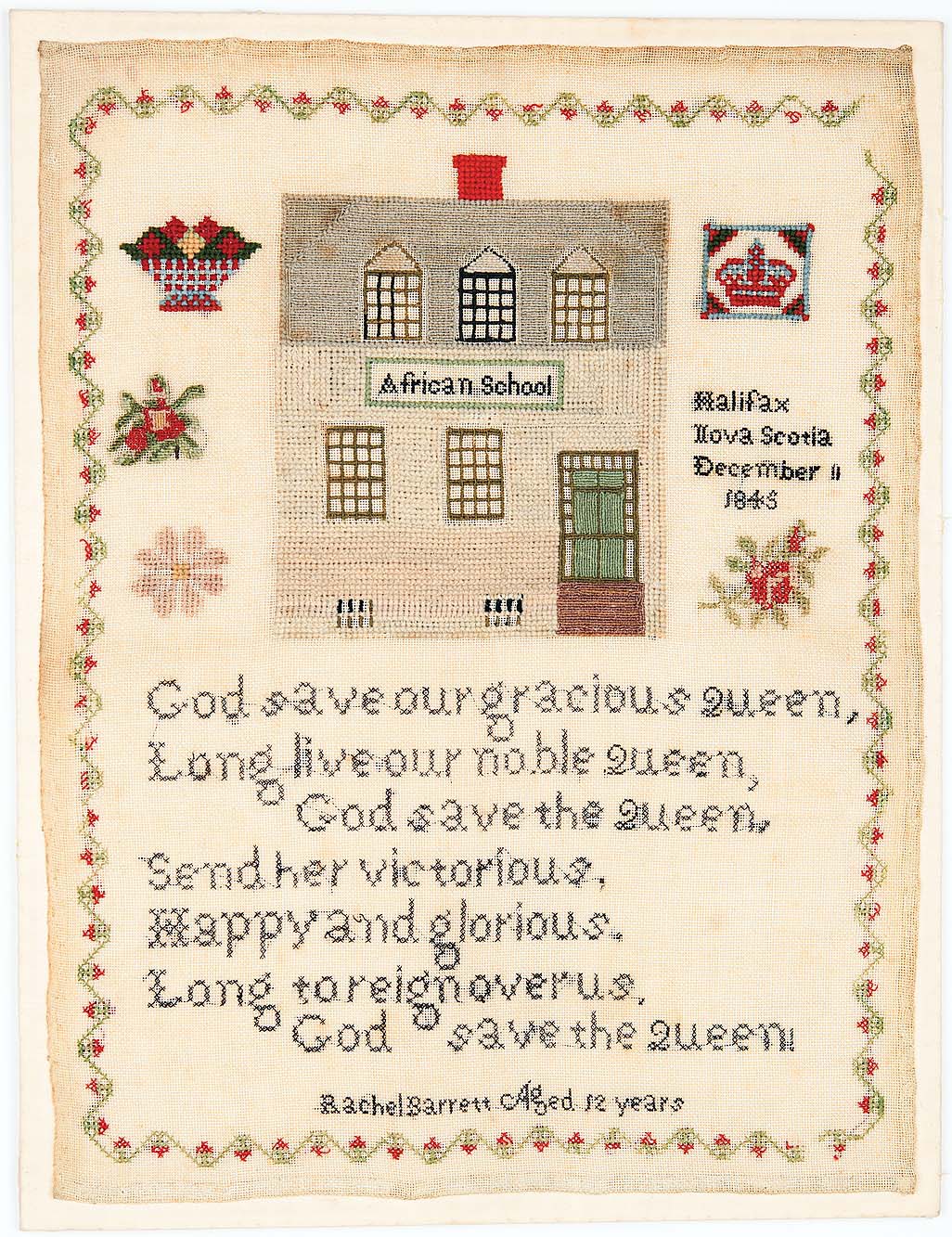
Views of girls in the act of making or receiving an education are included as well, notably in Hannah Pearson Cogswell’s depiction of female education at Atkinson Academy, circa 1811-12; a double portrait by Gilbert Stuart of Anna Dorothea Foster and Charlotte Anna Dick, one holding a floral embroidery pattern, the other making a floral picture on a tambour embroidery; and an image of the crowning of Flora, the May Queen, painted by Jacob Marling at Raleigh Academy in 1816. The composition of Rachel Barrett’s 1845 sampler centers around an African school while Kiziah Sharp’s 1825 sampler is anchored by Westtown School, the renowned Quaker academy in West Chester, Penn.
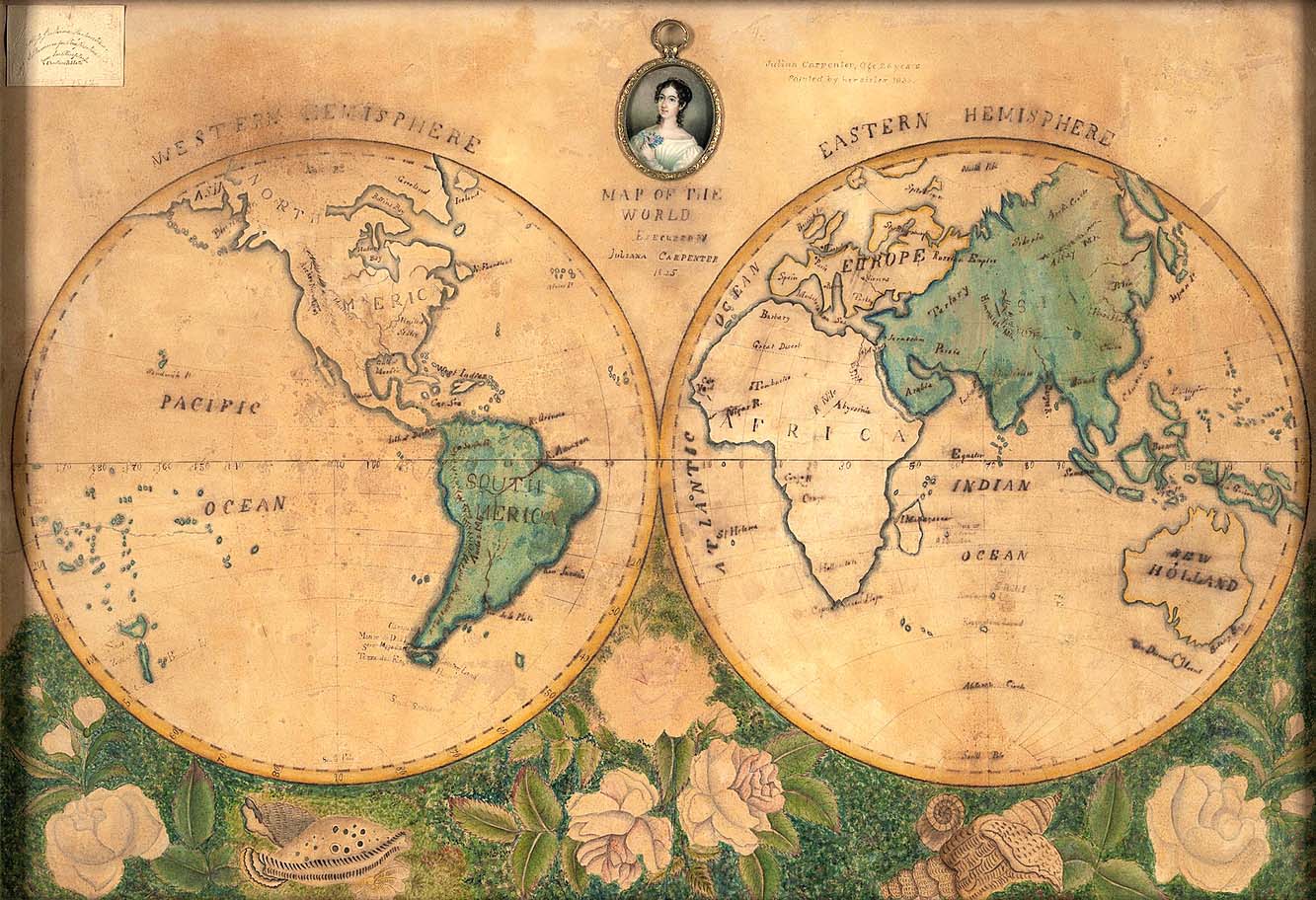
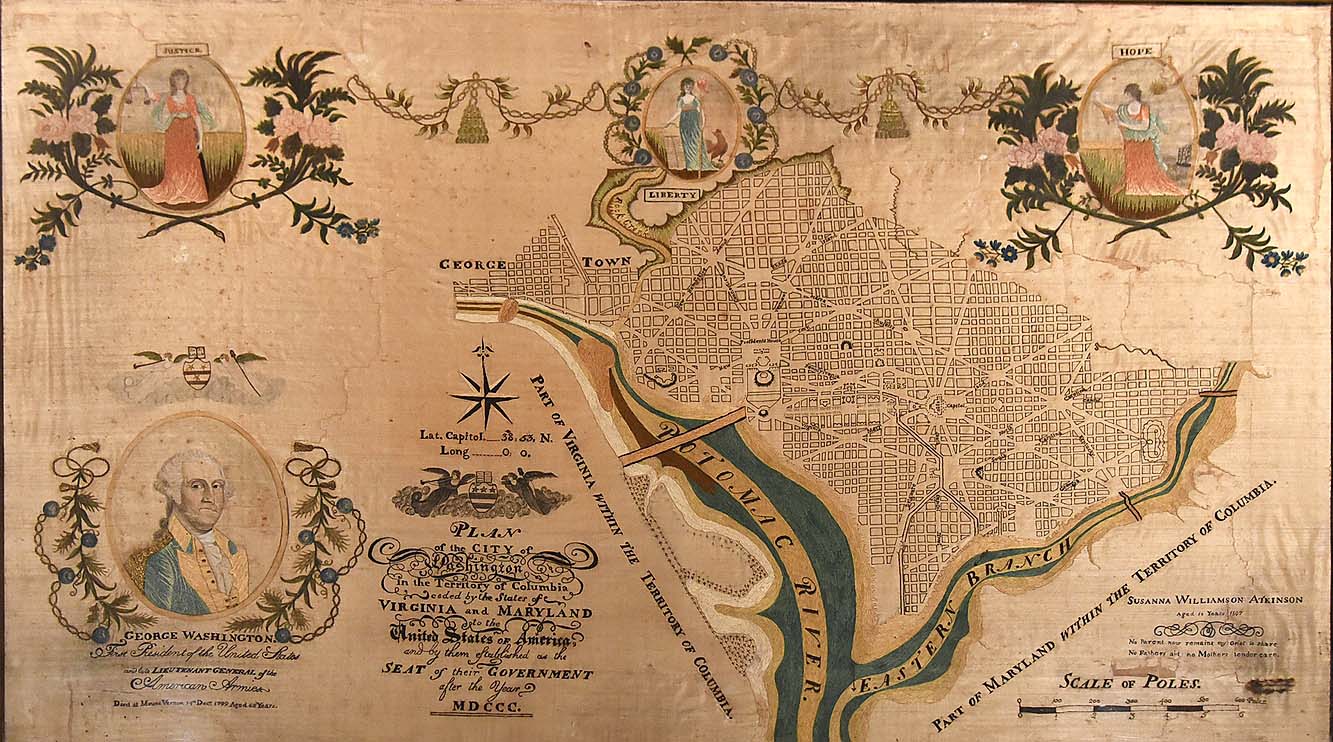
In the “Mapping National Identity” section, maps made by schoolgirls take several forms. One is a plan of the City of Washington, worked in silk, watercolor and ink on silk by Susanna Williamson Atkinson in 1807. A few years later, around 1812, Juliana Carpenter would use watercolor on paper, ink on paper and watercolor on ivory to fashion a map of the world. This two-dimensional representation evolves into a third dimension as seen in a rare embroidered globe, made at Westtown by Ann Thomson when she was around 14 years old.
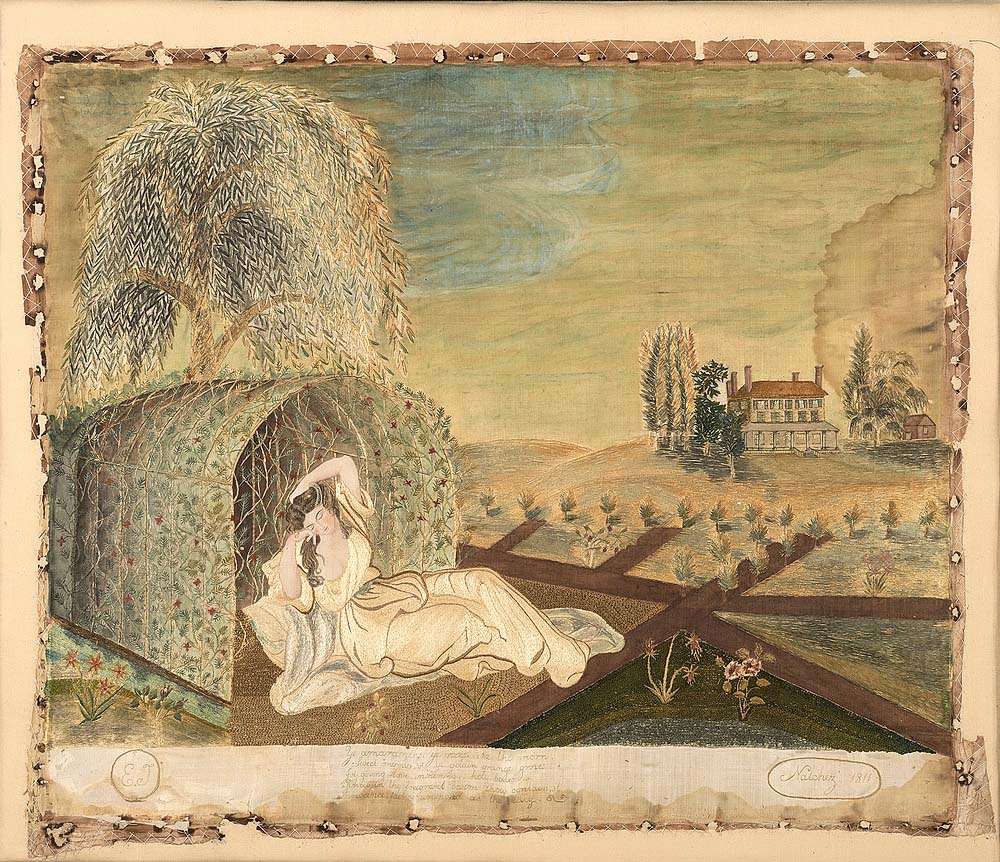
Asking the “why” allowed “Locating Girlhood” to include works made outside New England, where a significant portion of the material has historically been presumed to have been worked. These include a needlework picture made in 1811 in Natchez, Miss., by an unknown maker; an 1843 sampler by Catherine B. Allen of Warren or Edmonson County, Ky., a 1793 sampler made in St Augustine, Fla., by Maria Antonia Hill; and an 1828 sampler made on Mackinac Island, Mich., by Sophie Bailly, among many others.
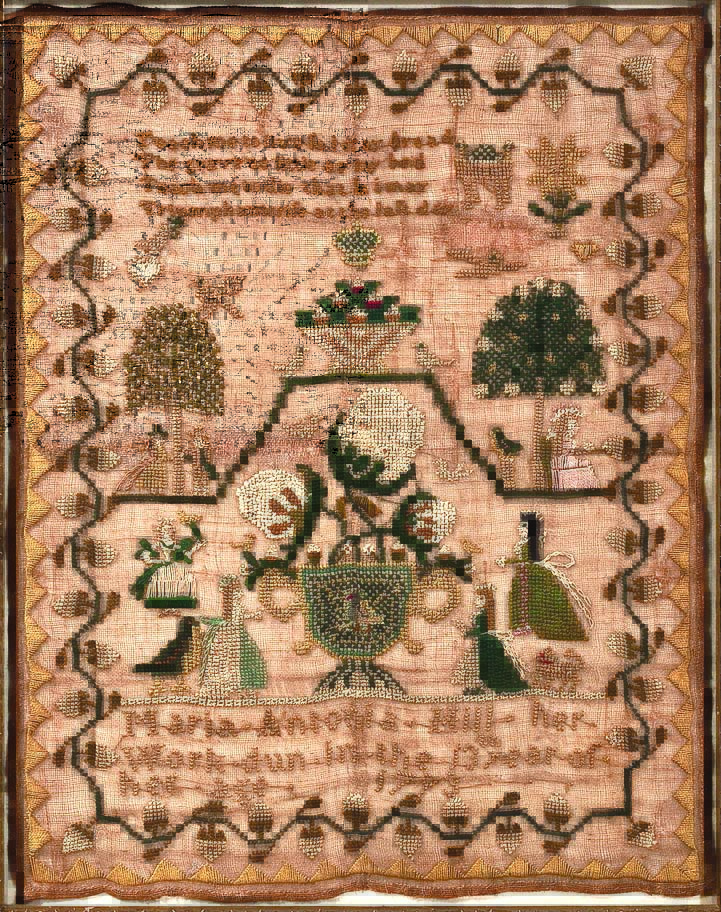
Sampler worked by Maria Antonia Hill (1779-1827), St Augustine, Fla., 1793, silk on linen, 13¼ by 10½ inches. DAR Museum, Washington, DC, 2018.11.
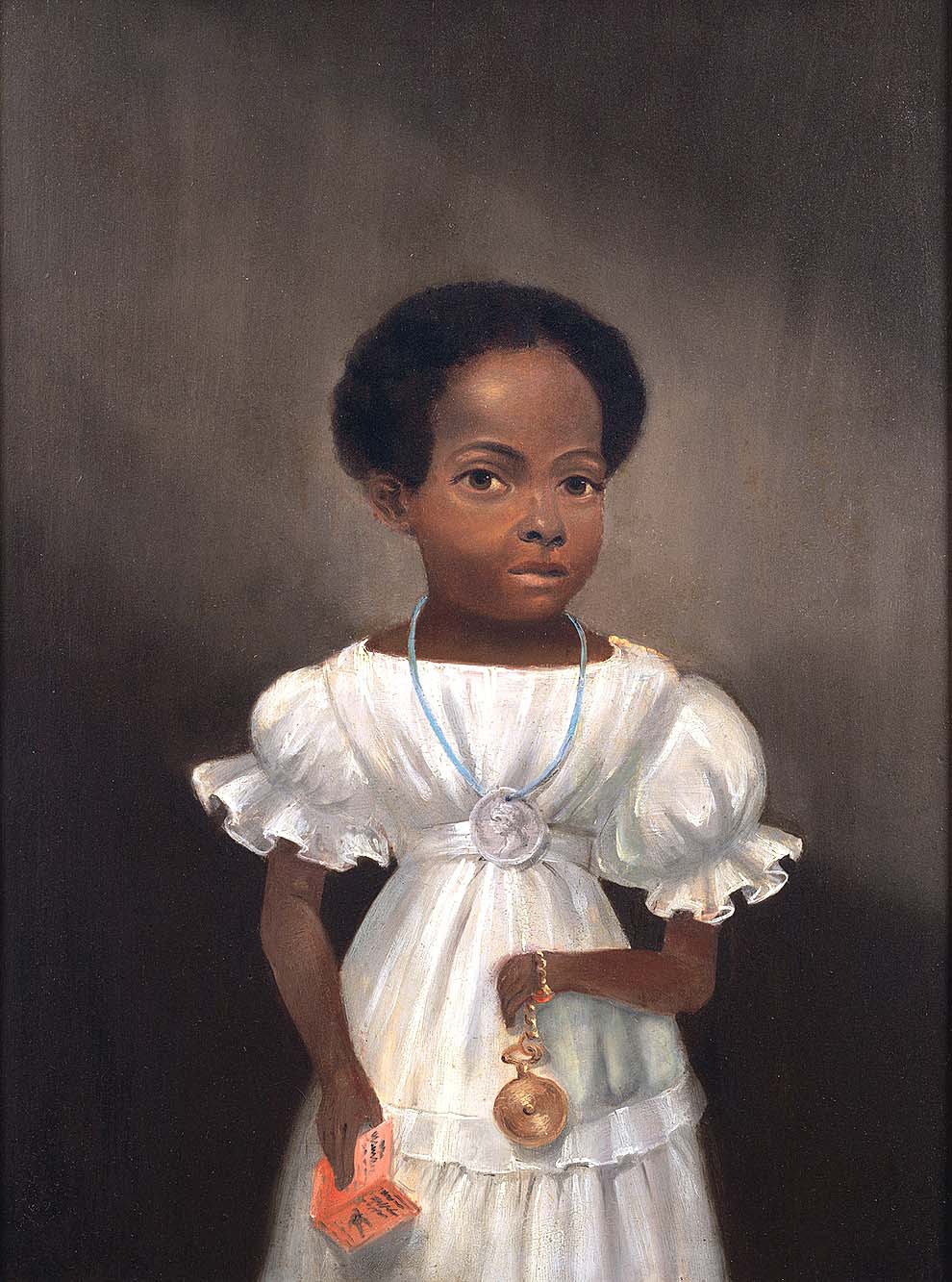
Of critical importance, “Locating Girlhood” tackles the subject of needlework by non-white girls and women. Formal educational opportunities for African American students were limited and only 45 surviving needlework samplers documented to Black girls are known, largely from communities with expanding free Black communities and activist movements. “Making Space: Black Girls and the Expansion of the Educational Sphere” conveys that African American girls and women “created needlework not simply for practical purposes but as part of a political movement to advance social progress and provide material proof of Black equality,” as the exhibition wall text suggests. Additionally, it notes “within an environment of ongoing racist restriction, the work of young Black needleworkers became a powerful manifestation of determination to lay claim to a place in American society.” Several Black girl-made needleworks are featured, as is a portrait of a young African American girl holding a book to show literacy as well as wearing a medal as proof of academic achievement.
Political imagery takes center stage towards the end of the exhibition, in “Visualizing the Political Landscape” and “Liberty: America Figured Feminine.” Using landscape as a vehicle within which to place an emblematic eagle or George Washington’s Mount Vernon as a model of American domesticity, girls reinforced connections between homelife and civic duty. Pictorial mourning needlework that abounded following George Washington’s death in 1799 were seen as both patriotic and expressions of personal grief. The ideal form of the new republic was seen in classical allegorical images of Liberty, Columbia and America, images that allowed girls to imagine themselves as central to nation building; an example of this can be seen in a “Towering Ladies of Lebanon” sampler worked at Mrs Hoff’s school in 1830, where Lady Liberty is shown alongside a brick house and pine tree while offering sustenance to the American eagle.
The American Folk Art Museum is at 2 Lincoln Square. For information, www.folkartmuseum.org.