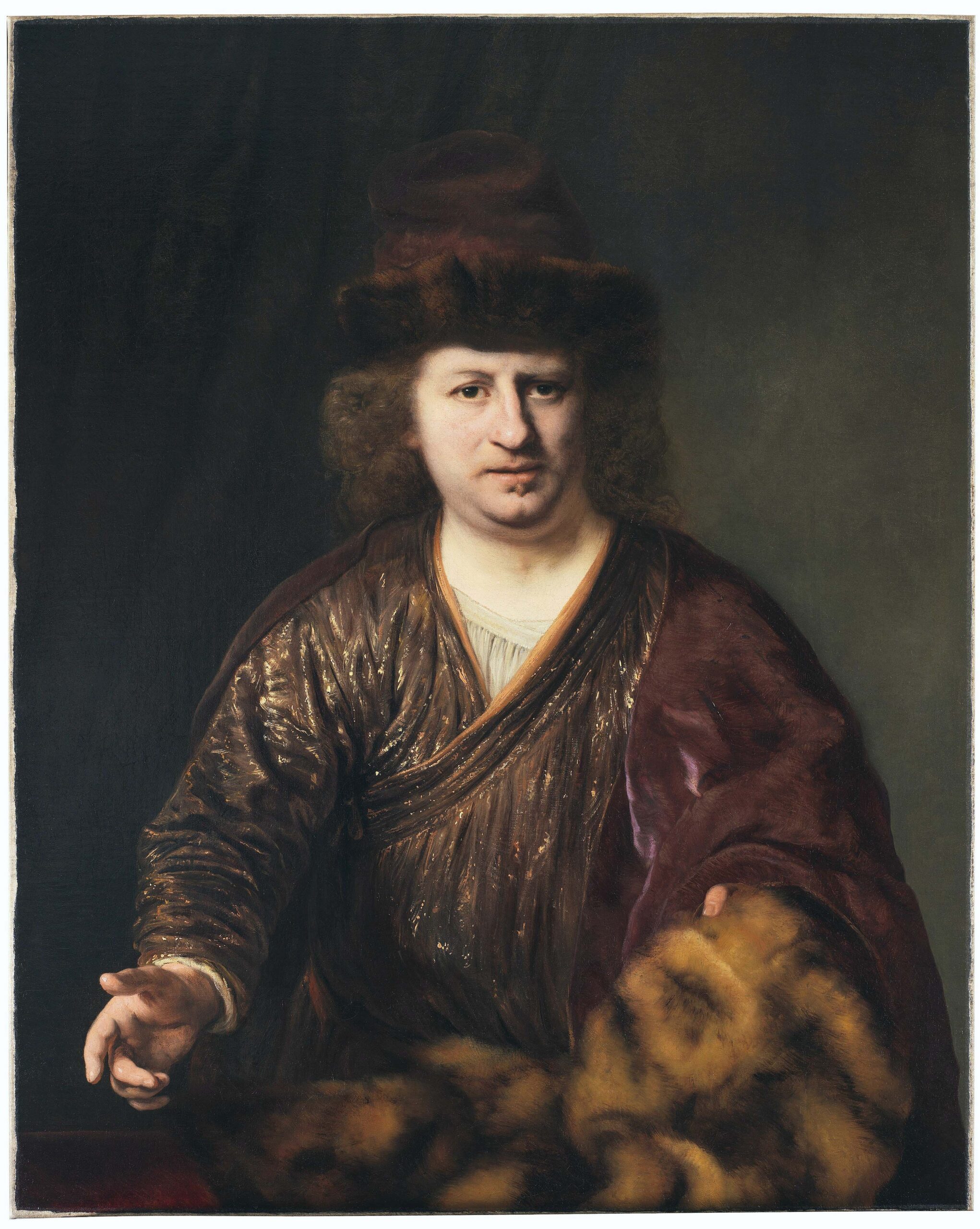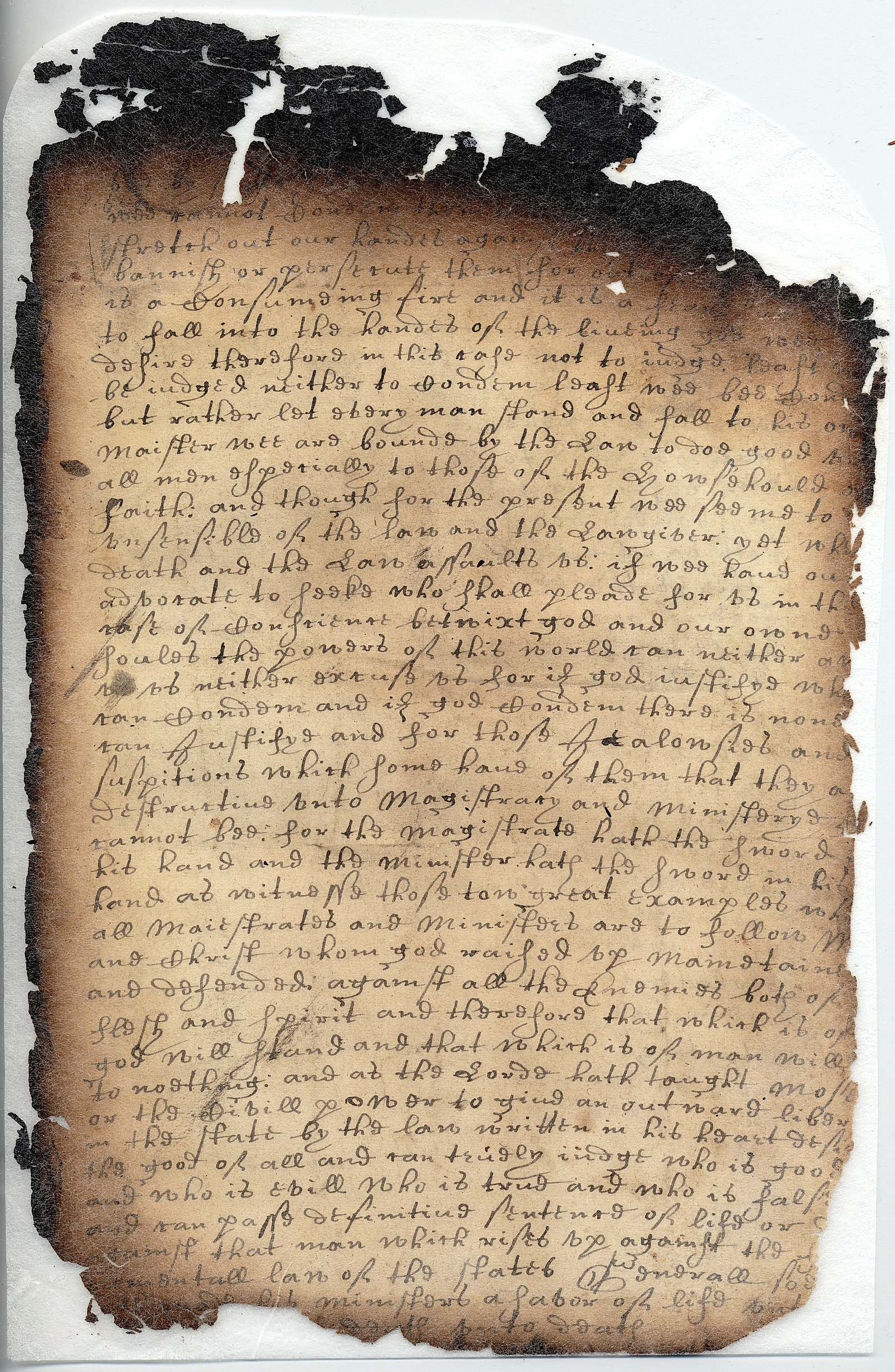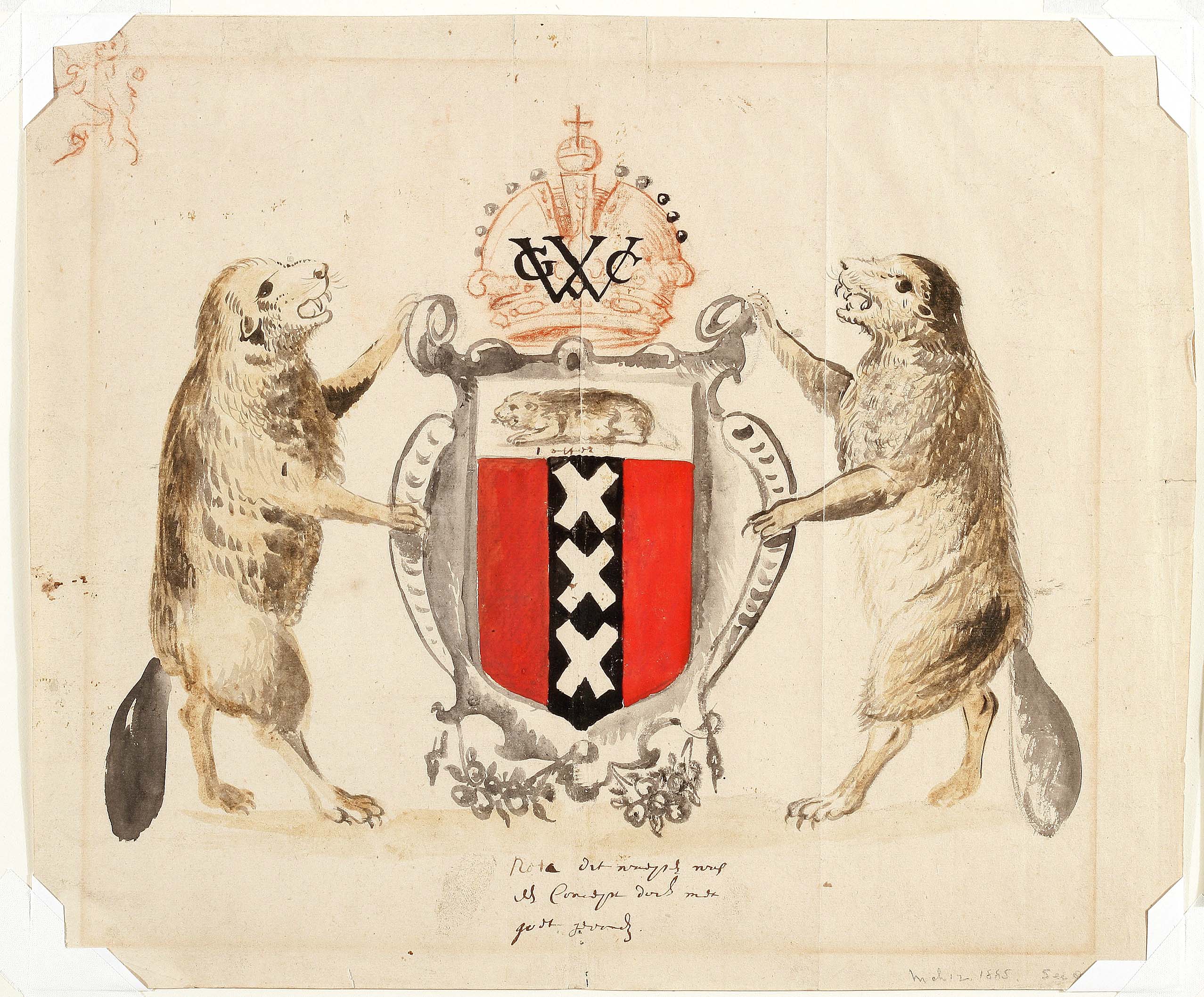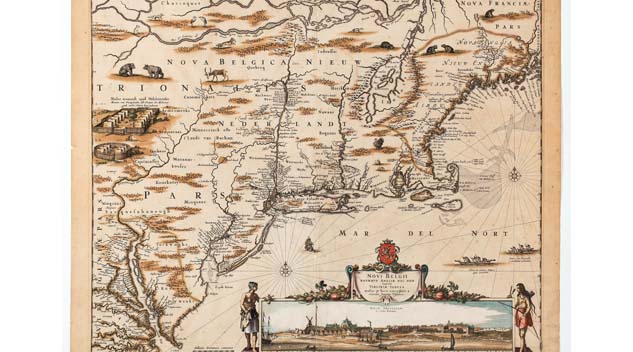
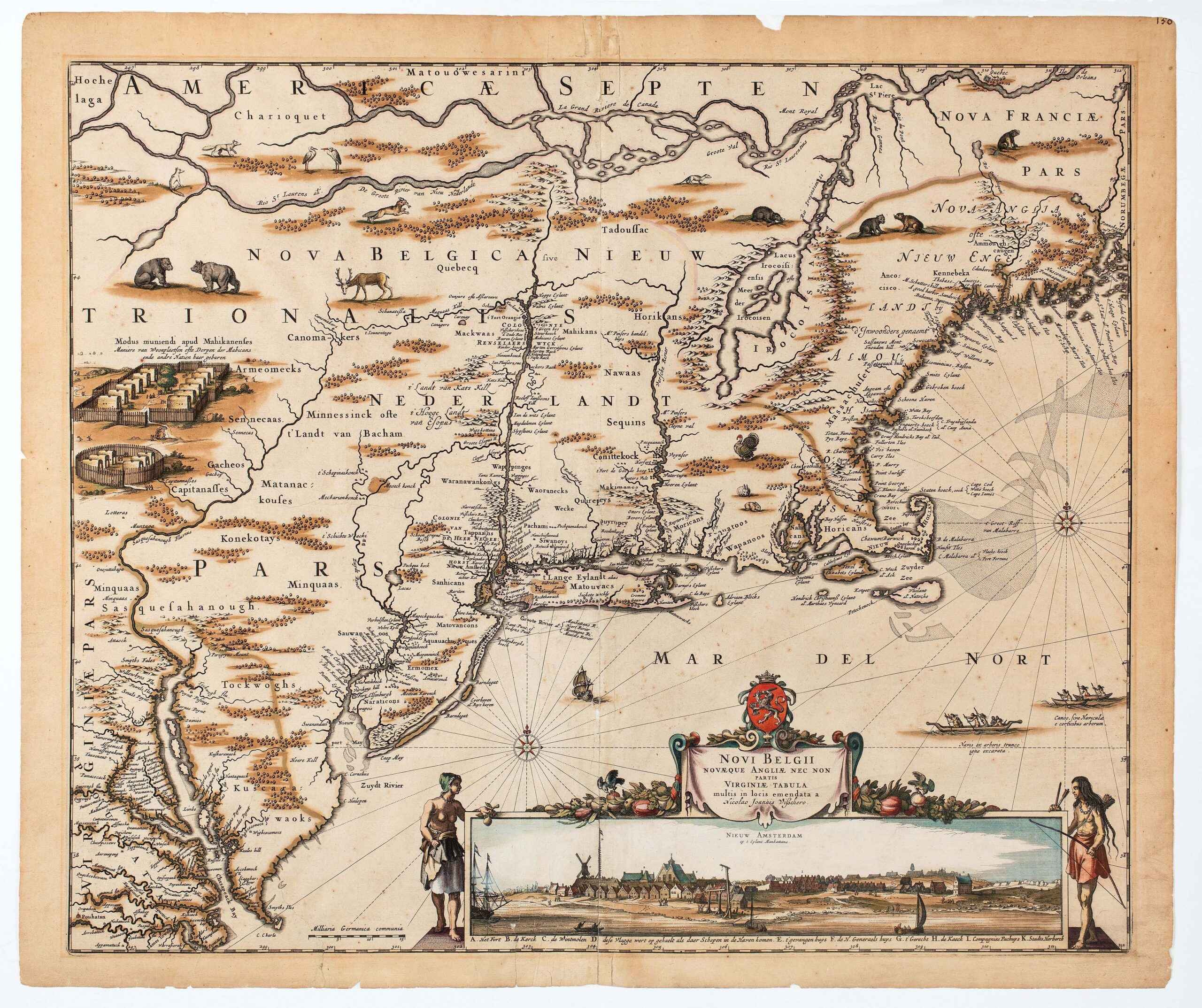
New Amsterdam was the capital of New Netherland Dutch colony from 1624 to 1664, spreading into parts of what would later be New York, New Jersey, Connecticut, Delaware and Pennsylvania. In 1655, cartographer Nicolaes Visscher (1649-1702) executed this highly detailed and accurate map, Novi Belgii Novaeque Angliae nec non Partis Virginiae, in black ink with color wash on paper. Patricia D. Klingenstein Library, The New York Historical.
By Linda Tuccio-Koonz
NEW YORK CITY — Today’s Manhattan is a teeming metropolis with hustle-bustle to spare. It’s depicted everywhere from novels such as The Great Gatsby to movies (think Spider-Man, Superman) as a gleaming, gritty, artsy and ambitious city.
But what was this island home like for the first Europeans who settled here — the Dutch who founded an outpost on the southern tip back in the 1600s? Daily life in this settlement that gave rise to New York is explored at The New York Historical in the exhibition, “Old Masters, New Amsterdam,” on view through August 30.
The exhibition features paintings by renowned Dutch artists such as Rembrandt van Rijn, Frans Hals and Jan Steen. New Amsterdam was a “humble but vibrant settlement,” and these works give insight into the world of Manhattan’s Seventeenth Century settlers, said co-curator Russell Shorto, director of the New Amsterdam Project at The New York Historical.
“There were no artists in New Amsterdam, so we don’t know what the place looked like,” Shorto said. “But at the same time that the Dutch were building the city, back home Dutch artists were focusing on the world around them, painting market scenes, taverns, homes and portraits of ordinary people. The idea … is to use these paintings, by Rembrandt and his contemporaries, to let us ‘see’ New Amsterdam for the first time.”
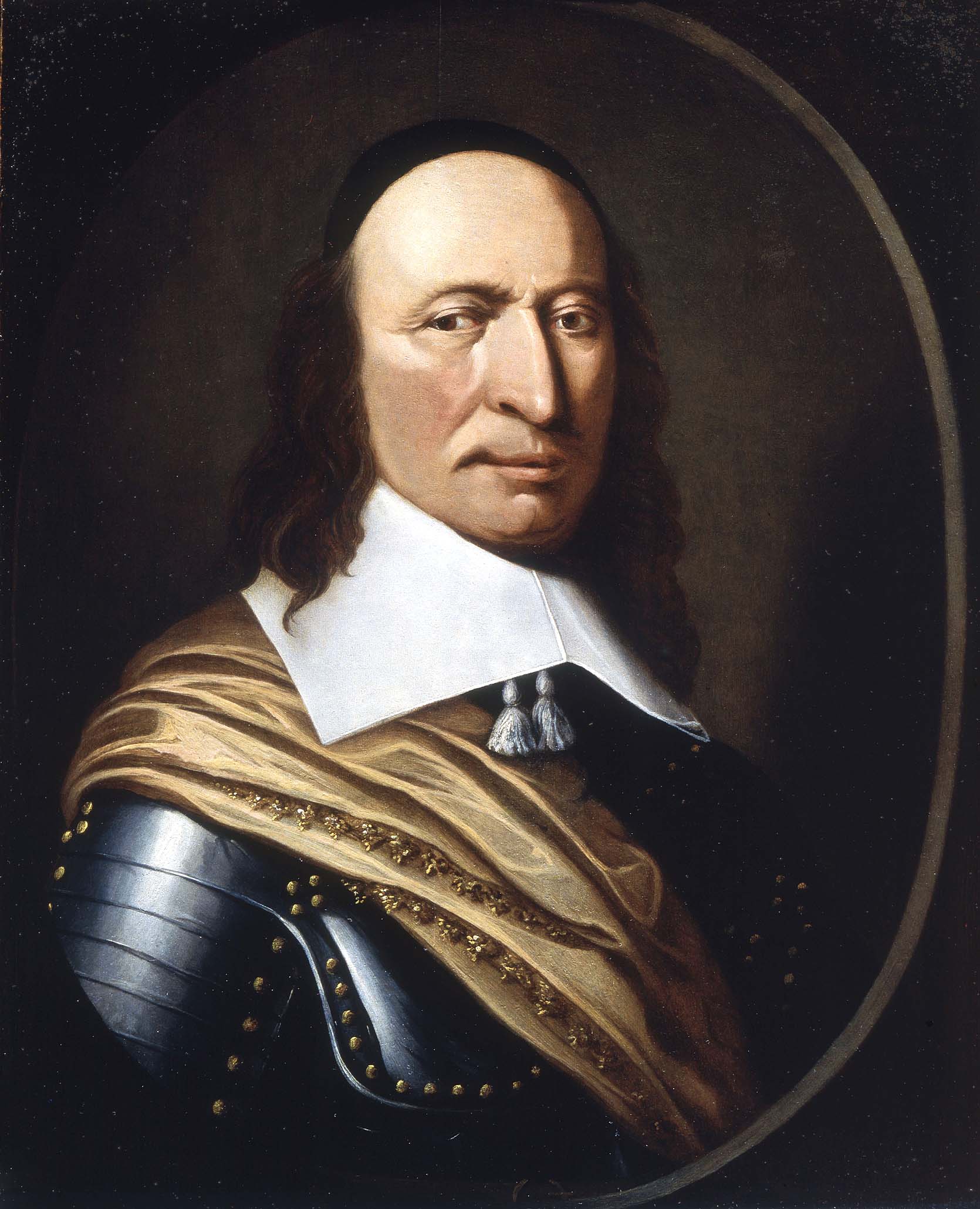
Portrait of Petrus “Peter” Stuyvesant, New York’s last Dutch Director-General, by Hendrick Couturier. Courtesy The New York Historical.
Many of these works have never before been shown in New York. And while these artists didn’t set foot in New Amsterdam, Shorto said their portraits, character studies and depictions of life in the Netherlands offer hints of what life was like here.
The exhibition really commemorates two anniversaries — the 400th of the founding of New Amsterdam and the 250th of the American Revolution, he said. The idea is to bring the past alive for visitors. Shorto said Dutch historian J. Huizinga had a great line: “He said that the wellspring of all historical inquiry is ‘our perpetual astonishment that the past was once a living reality.’”
If you walk through Lower Manhattan today, it’s easy to understand where New Amsterdam stood. New Amsterdam occupied what is today’s Financial District. The northern boundary of the Dutch city was where they built a wall, which became Wall Street, Shorto explained.
A map of New Amsterdam dating to about 1660 can still be used to walk around the city’s Financial District: the street pattern is essentially the same, he added. The main difference (besides the skyscrapers) is landfill, Battery Park and the blocks between Pearl Street and the East River that have been added.
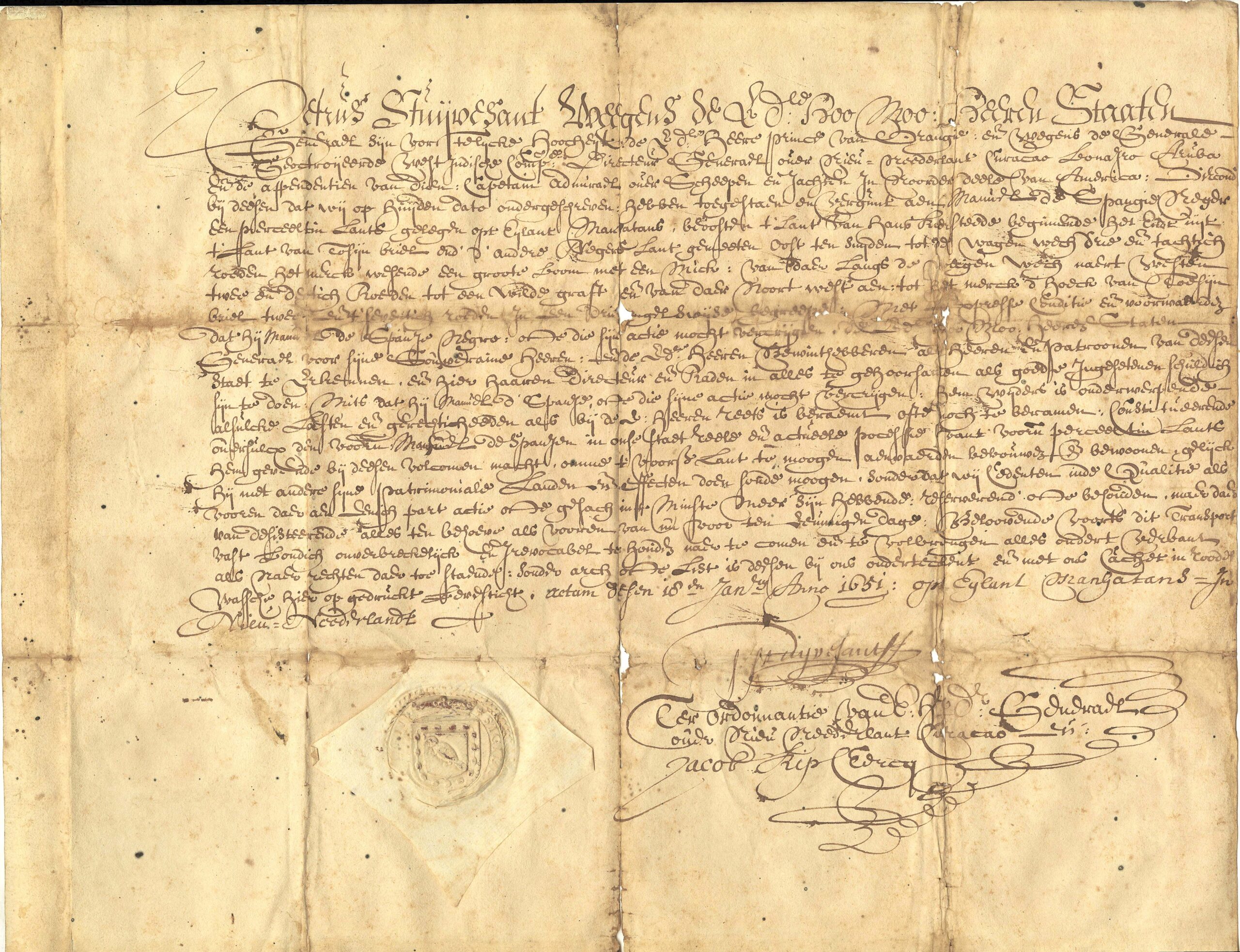
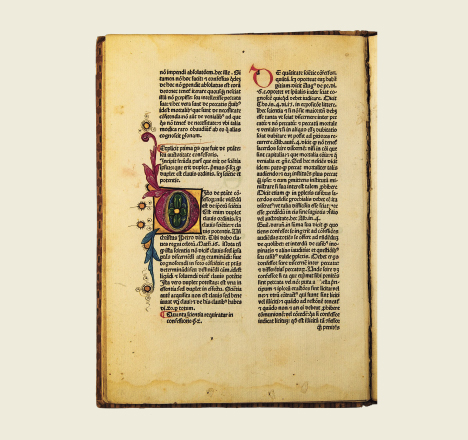
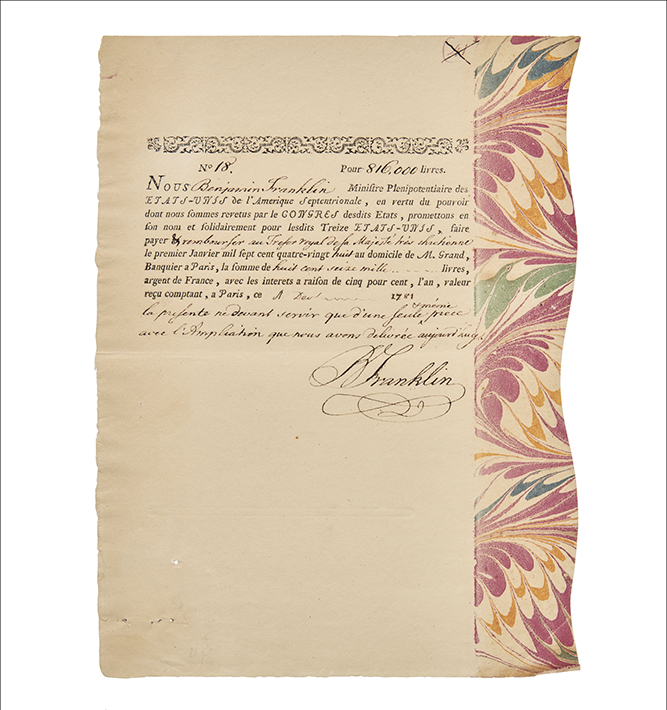
Property deed from Peter Stuyvesant (circa 1610-1672) to Manuel de Spangie, January 18, 1651. In this document, Stuyvesant grants de Spangie property north of New Amsterdam in an area then known as the Land of the Blacks. Patricia D. Klingenstein Library, The New York Historical.
The past was indeed “a living reality.” From 1626 to 1664 New Amsterdam was the capital of New Netherland, a colony established by the Dutch West India Company. It stretched across areas of five future states (New York, New Jersey, Connecticut, Delaware and Pennsylvania). The city’s position and diverse inhabitants made it a hub of global trade in the Atlantic network, according to the museum.
“Old Masters, New Amsterdam” features objects from The New York Historical’s collection and more than 60 Dutch paintings; they include works from the Leiden Collection — among the finest of Seventeenth Century Dutch art in private hands. There are also pieces from collectors and institutions such as the Museum of Fine Arts, Boston, National Gallery of Art, Virginia Museum of Fine Arts, the New York State Archives and Trinity Church.
Arthur Wheelock, senior advisor to the Leiden Collection, is co-curator of this exhibition and commented that Steen’s artworks are among his favorites. “Steen’s paintings, like those of Rembrandt, have a basic humanity that connects us to them in very real, personal ways,” he explained.
Among Steen’s works (and perhaps the liveliest here) is “Peasants Merrymaking Outside an Inn.” The Dutch enjoyed family festivities and this scene, created in Steen’s studio, shows the types of gatherings that must have occurred in New Amsterdam with the Dutch settlers who would have maintained traditions from home, Wheelock said.
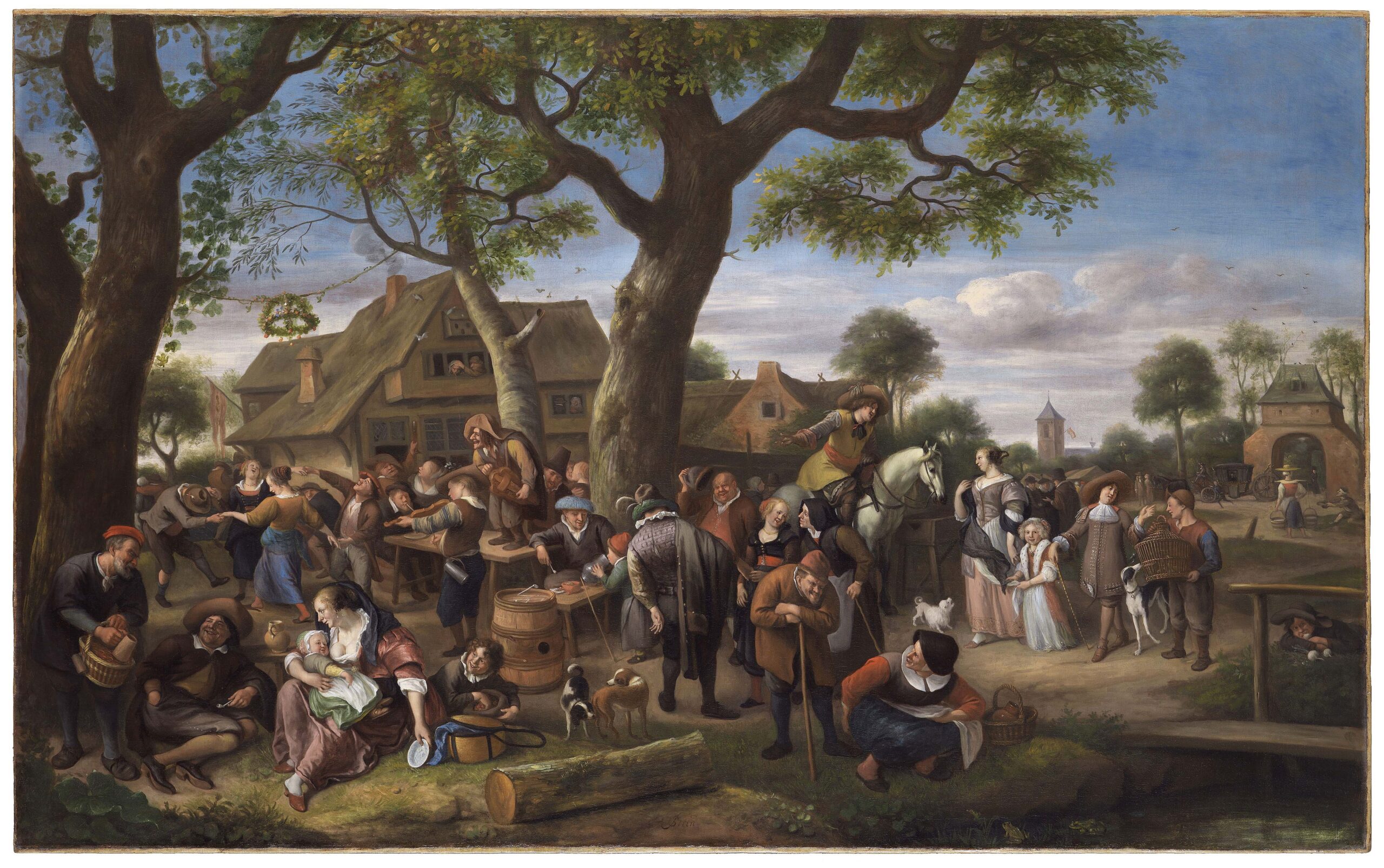
“Peasants Merrymaking Outside an Inn” by Jan Steen (1626-1679), circa 1676, oil on canvas. Image courtesy the Leiden Collection, New York City.
“Here you see young and old greeting each other, dancing, playing music, drinking, flirting and, right in the foreground, a mother nursing her child. Most of the participants are country folk, but a group of wealthier city-people have come to watch and enjoy the festivities,” he added. “The painting also has a very nice landscape and a Dutch flag blowing from the tower of a distant church.”
Steen loved capturing moments that showed loving care between individuals, particularly family but also friends and neighbors, Wheelock said. “He also had an amazing ability to enjoy life, and to find humor in individuals’ foibles, including his own. His humor seems timeless, and the expression a ‘Jan Steen family’ is one still current today in the Netherlands, which pretty much means a household where everything is a bit topsy-turvy and somewhat dysfunctional.”
Returning to his thoughts on Rembrandt, Wheelock noted he made so many self-portraits, as well as images of his family (including his parents, his wife Saskia and his companion in his later years, Hendrickje), that “we feel like we know him in a personal way.”
Rembrandt liked to explore different types of human expressions, Wheelock said. “He was always experimenting with differing painting styles and techniques, and so there is always a sense of discovery and excitement in seeing how he created new effects with impastos, glazes and light and shade.”
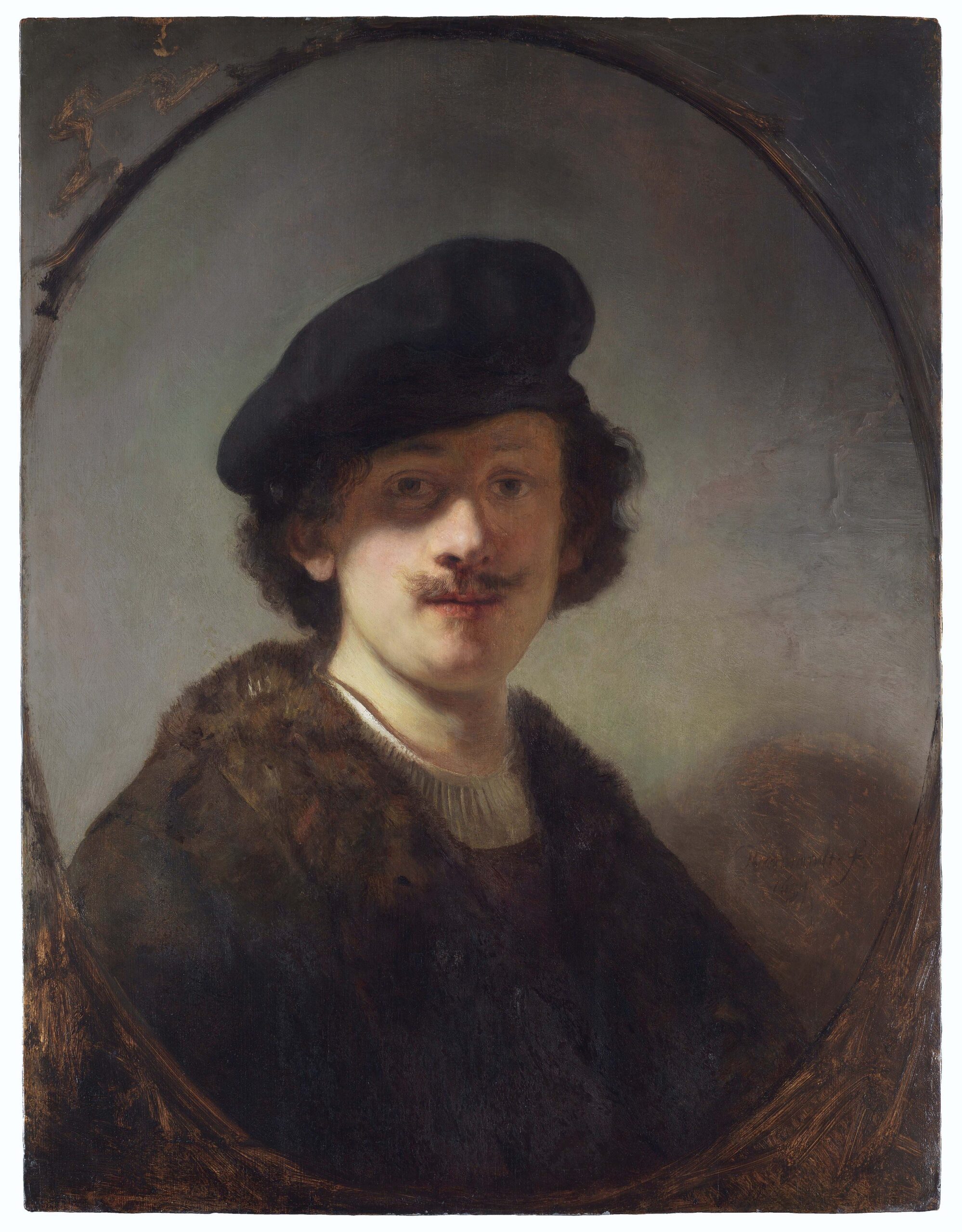
“Self-Portrait with Shaded Eyes” by Rembrandt van Rijn (1606-1669), 1634, oil on panel. Image courtesy the Leiden Collection, New York City.
He explored some of these effects in “Self-Portrait with Shaded Eyes” (1634), painted “the very year he married Saskia, which may help account for the friendly, approachable appearance… He painted this image in a very free manner, with thin layers of paint that capture the sense of his hand at work,” considered Wheelock.
“Rembrandt had an amazing ability to suggest a sense of inner life in his portraits, often by leaving the eyes, the window to the soul, a bit in shadow so that you find yourself completing the image in your own mind,” Wheelock added. “Once that happens, you become part of the experience and connected to him in a very real emotional and psychological sense.”
According to the museum, the Dutch policy of religious toleration spawned an unusually pluralistic society, in which at least 18 languages were spoken. Dr Louise Mirrer, the museum’s president and CEO, said New Amsterdam was “a place of commerce, creativity and conflict, which laid the foundations of the city and nation we know today.”
Among those conflicts: indigenous people (who had inhabited the region for thousands of years), were displaced and the first enslaved Africans probably arrived in 1627, a year after the city’s founding.
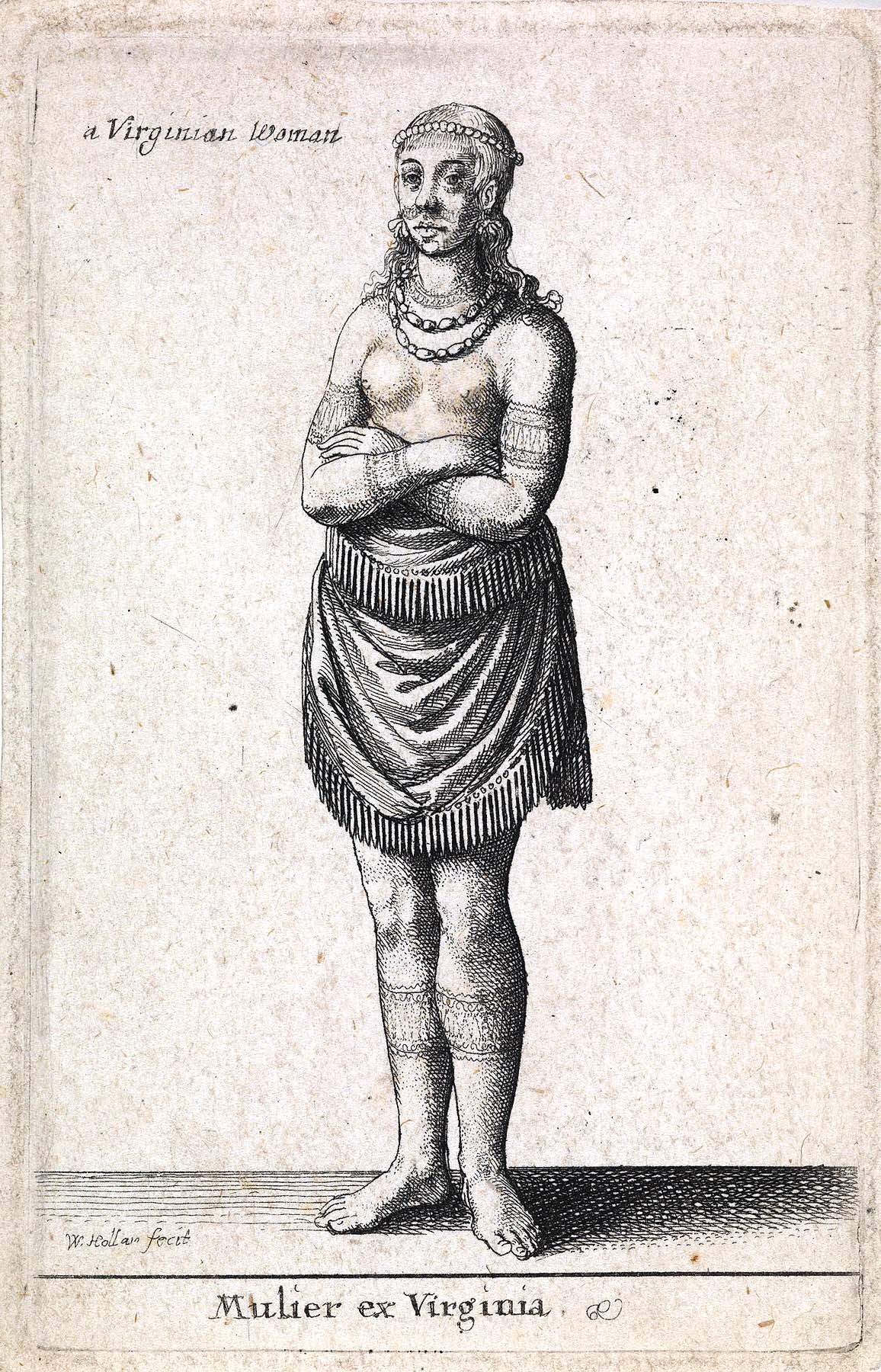
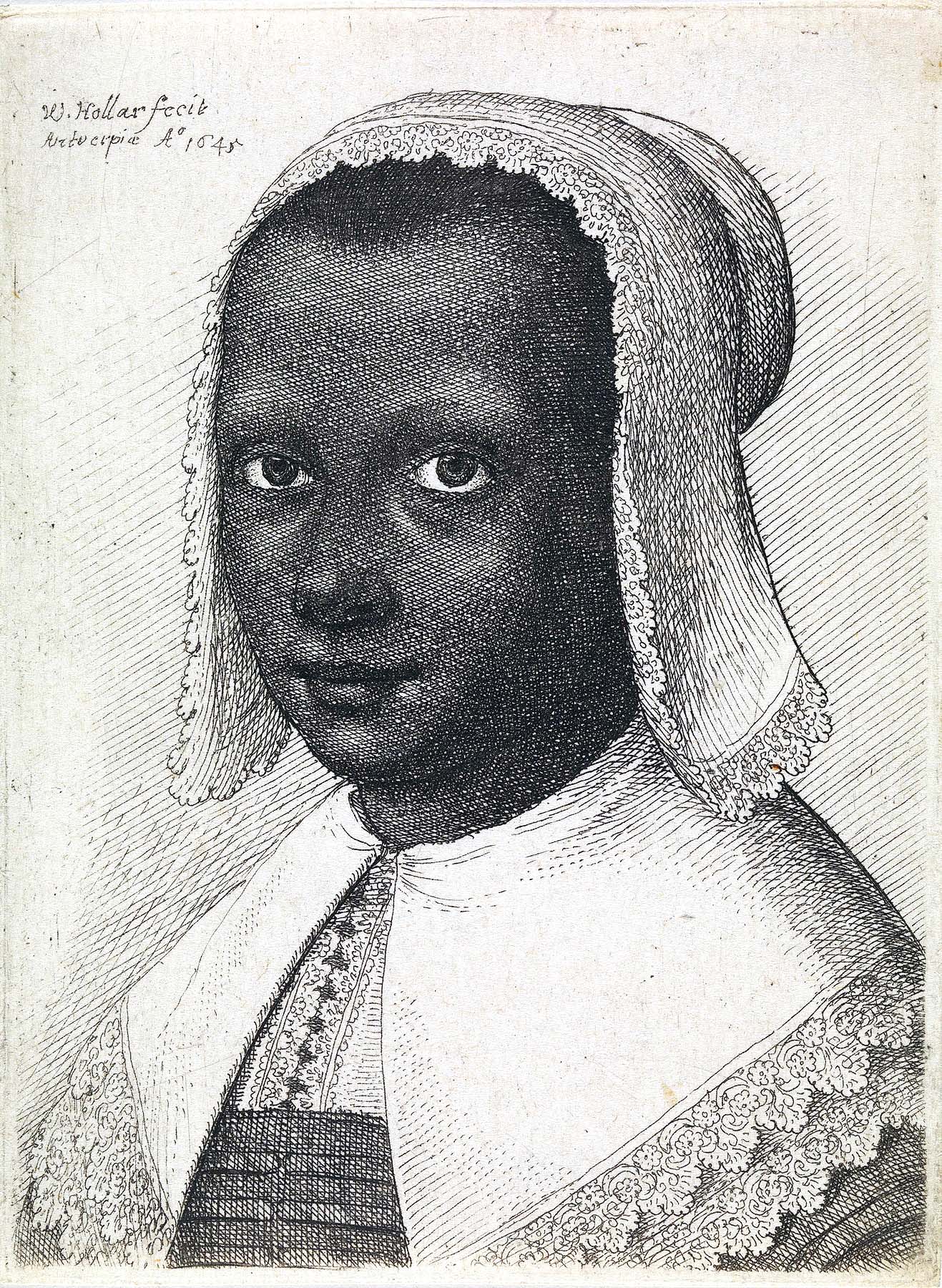
“Mulier ex Virginia (Woman of Virginia)” by Wenceslaus Hollar, 1644, eching printed in black ink on laid paper. Virginia Museum of Fine Arts, Richmond, gift of Frank Raysor, 2023.3830. Photo: David Stover © Virginia Museum of Fine Arts.
The Dutch and other Europeans were very curious about the people their nations had colonized, Shorto said. There are “instances in which soldiers based in New Amsterdam brought home Native Americans; in one case, they exhibited a man to the public for money. As to Africans, there was a vigorous Black community in Amsterdam. Some of the men who lived there were sailors. Other people came as slaves.”
Although slavery was technically illegal in Amsterdam, the line between “servant” and “slave” was blurry, according to the museum, which includes Wenceslaus Hollar’s haunting illustration, “Head of a Black Woman with a Lace Kerchief Hat.” The woman’s identity is unknown, but it’s likely she was a household servant, Shorto said.
The face of Peter Stuyvesant also graces the exhibition. “Stuyvesant was the director-general of New Netherland for 17 years,” stated Shorto, who believes this artwork was created sometime after 1664, when the English seized New Amsterdam and renamed it New York.
“After the English takeover, he had to return to the Netherlands to defend himself against the charge of relinquishing the colony,” Shorto added. “My presumption is that it was while he was there that he sat for his portrait. To me it shows a man in late middle age who is strong, proud, arrogant and perhaps wistful.”
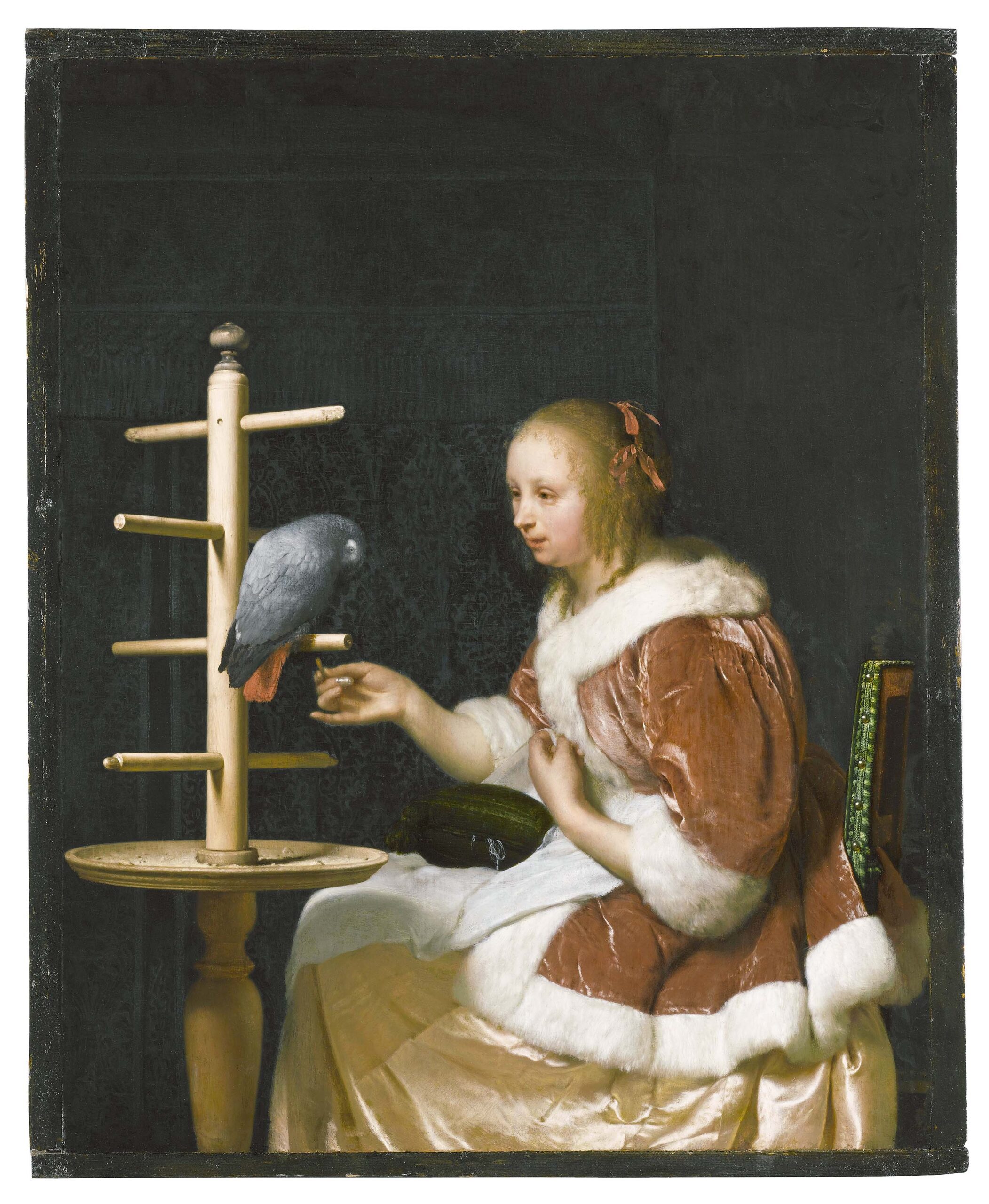
“Young Woman Feeding a Parrot” by Frans van Mieris (1635-1681), 1663, oil on panel. Image courtesy the Leiden Collection, New York City.
Speaking of Stuyvesant, the exhibit includes a deed from 1651 in which he grants land to Manuel de Spangie, an enslaved man who won his freedom in 1649. “Enslaved people were entitled to go to court in New Amsterdam. We know of some instances in which they petitioned for their freedom, arguing that they had served long enough,” Shorto noted.
A final Stuyvesant detail — Shorto said Stuyvesant and his wife “kept tropical birds on their farm in today’s East Village. They had parrots and parakeets shipped from Dutch possessions in the Caribbean.” Exotic birds from the Caribbean like parrots were kept as pets in the new world and this practice was a status symbol in Dutch culture. “Young Woman Feeding a Parrot,” painted by Frans van Mieris, is among the Leiden Collection treasures on view.
“Van Mieris is one of the so-called ‘Leiden fine painters’ who are renowned for their very detailed rendering of materials,” Shorto said, noting the elegant furs and satins of the young woman’s wardrobe, the delicate rendering of the parrot and firm structure of its perch. “The woman, modelled by Van Mieris’ wife, has interrupted her needlework to feed her pet gray parrot.” The painting suggests this through details such as the thimble on one of her fingers and her needle cushion on her lap.
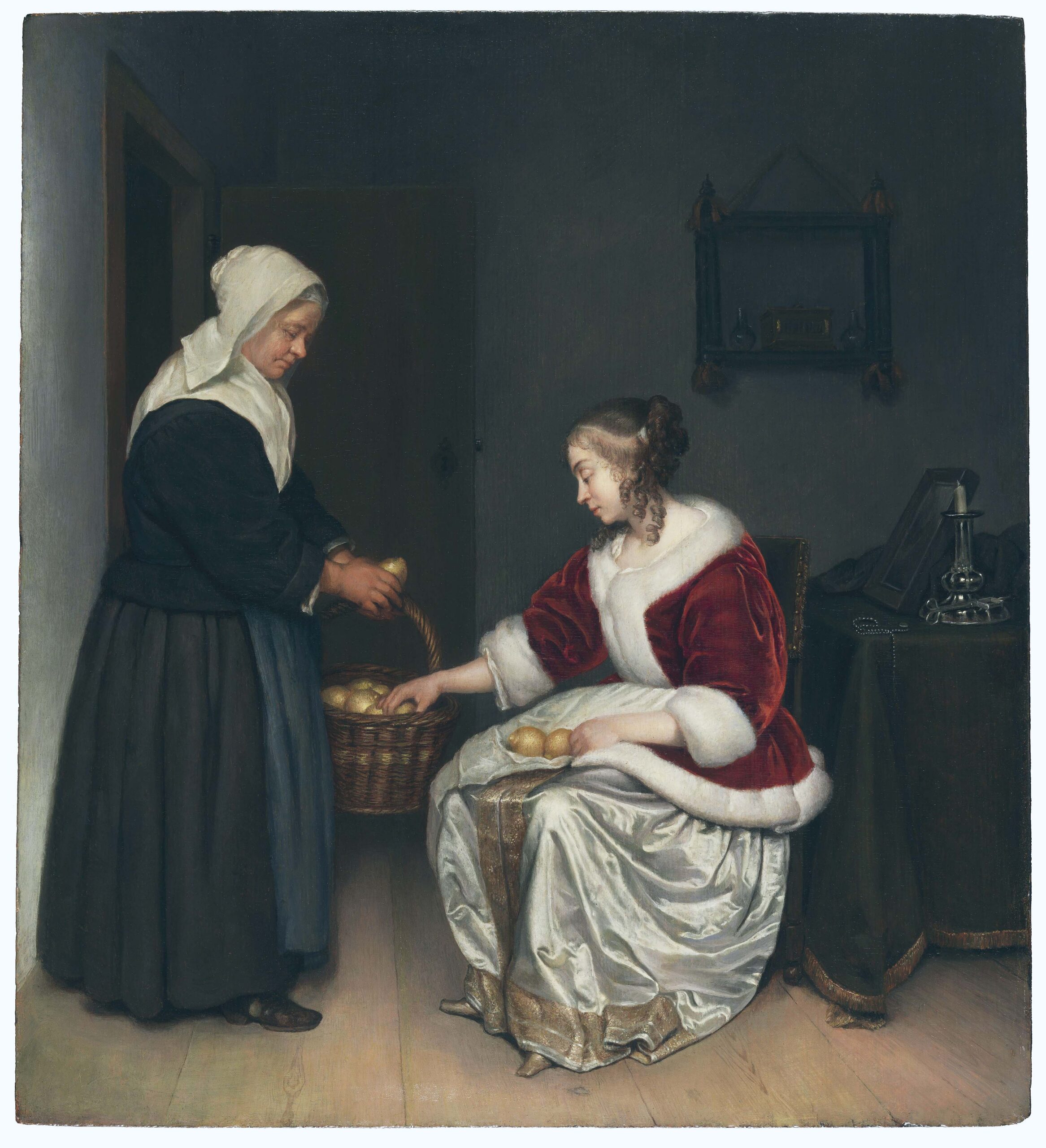
This slice-of-life image where a mistress of the house chooses fruit from a market woman’s basket — “Two Women in an Interior with a Basket of Lemons” by Caspar Netscher (1639-1684), circa 1664-65, oil on panel — exhibits how rising fortunes led to an influx of imported goods and refined tastes. Image courtesy the Leiden Collection, New York City.
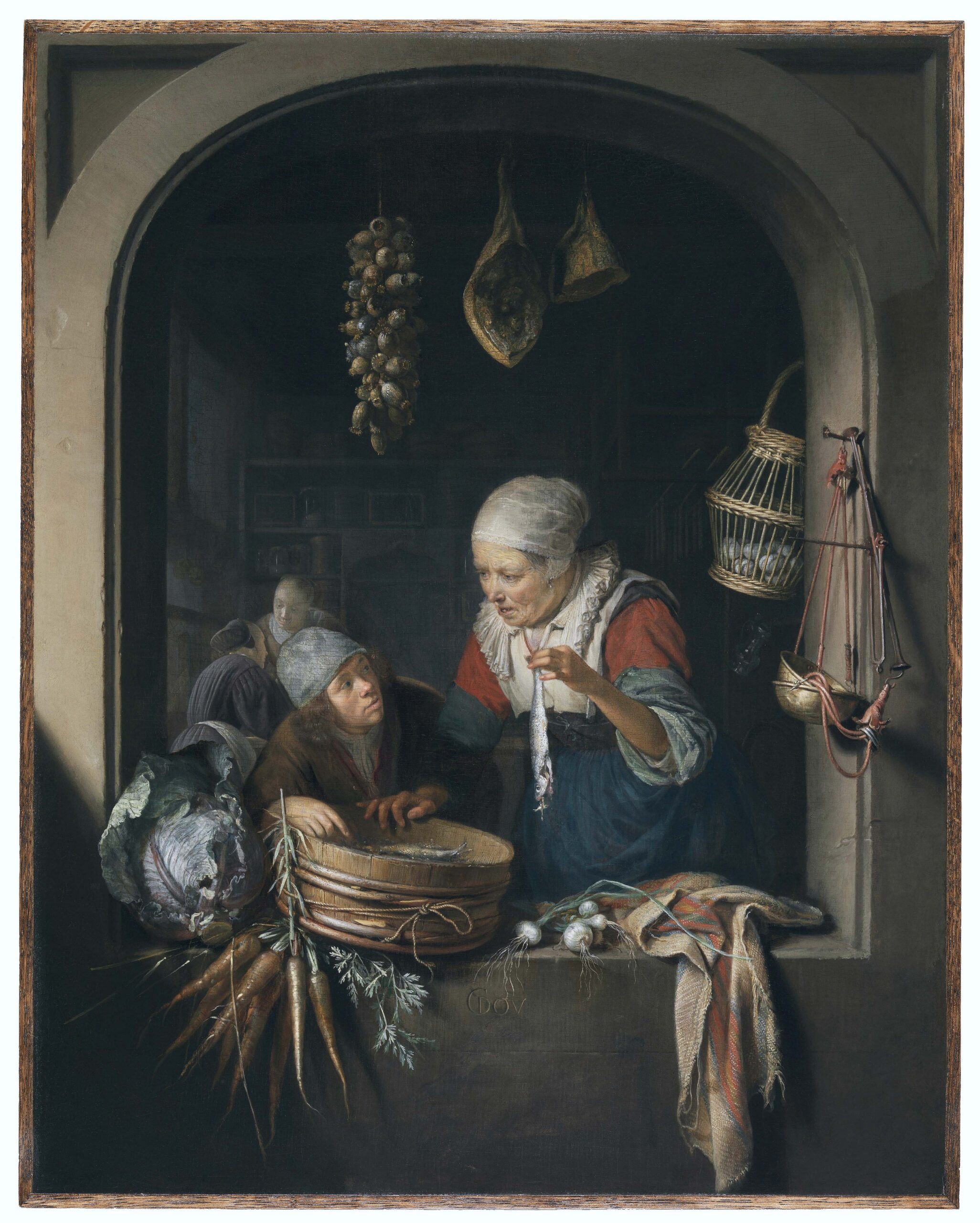
Wheelock said these exotic birds were often viewed symbolically as indications of virtue and willingness to learn because parrots could mimic speech. “The painting is important for the show because it shows the Dutch connection to the wider world, both in the Netherlands and in New Amsterdam…” That connection is also brought to life in Caspar Netscher’s “Two Women in an Interior with a Basket of Lemons” as lemons were not grown in either the Netherlands or in New Amsterdam. Meanwhile, Gerrit Dou’s “Herring Seller and Boy” shows an instance when judgment is being made about objects presented for sale. “Here instead of a woman selling lemons to the mistress of the house, a young fishmonger has brought a barrel of fish to a woman who will presumably sell them from the window of her market,” Wheelock commented. “She does not seem particularly pleased with the quality of what the boy has brought her!”
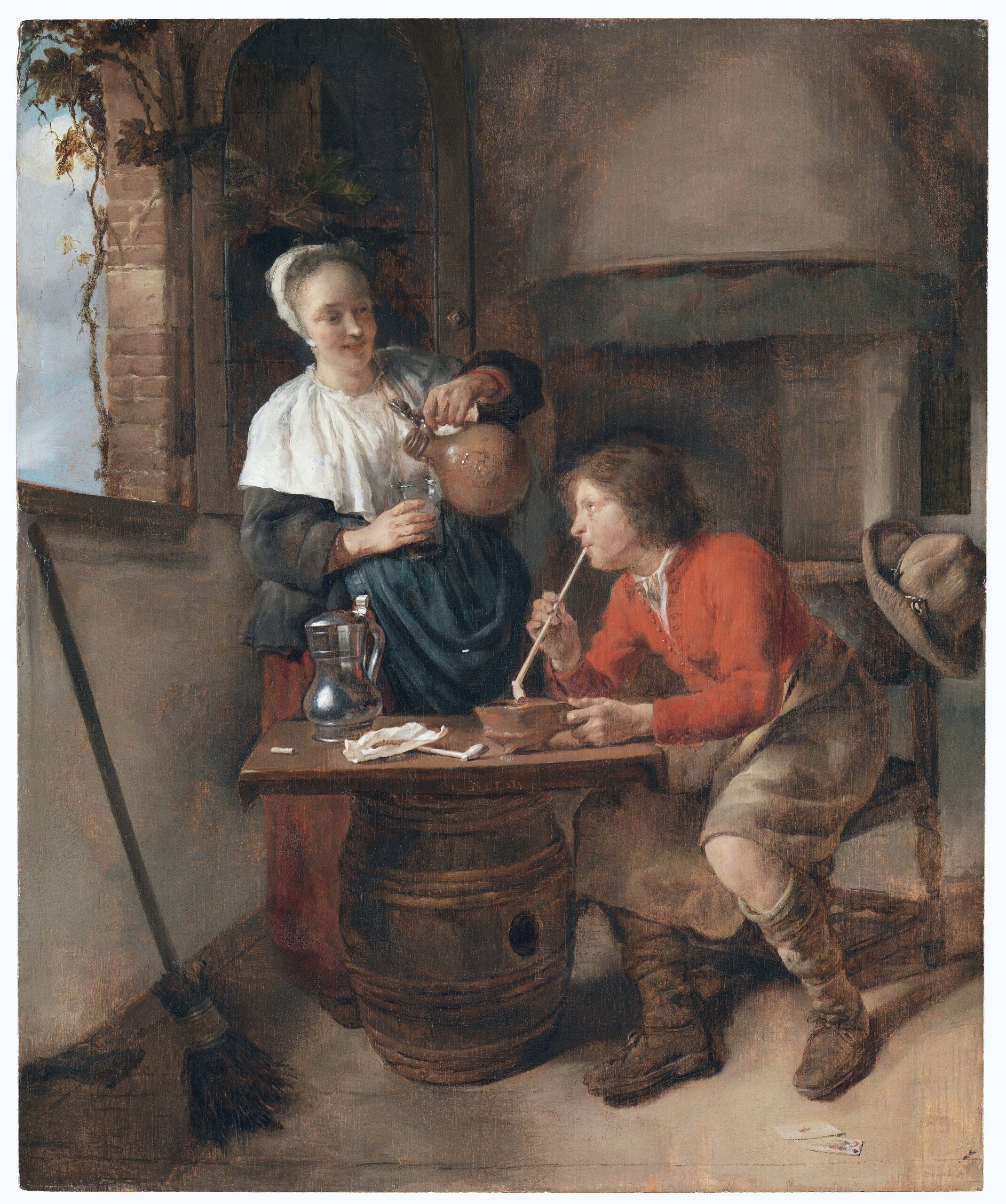
Another relatable glimpse of daily life is seen in Gabriel Metsu’s “Young Man Smoking and A Woman Pouring Beer.” “Like Steen, (Metsu) paints in a welcoming manner, and you immediately feel the gentle goodness of the figures in this scene,” said Wheelock. “The waitress smiles warmly toward the young man as she pours him a beer (a standard drink then because water was often polluted) and he lights the tobacco in his long clay pipe. Although the use of tobacco was often criticized in Dutch culture, there are no judgments here — just a moment of harmony. It is fun to see the red glow of the embers in the bowl of the young man’s pipe.”
Metsu enjoyed painting different textures of materials, such as the rough surface of the earthenware pitcher and the pewter tankard on the table. “The broom at the left indicates that the woman keeps a neat and tidy inn, and the hat on the back of the man’s chair indicates that he has just arrived,” Wheelock explained.
“We hope these fabulous paintings can bring to life a sense of the sights, sounds and smells that one would have encountered in the streets and homes of New Amsterdam,” he closed.
The New York Historical is at 170 Central Park West. For information, www.nyhistory.org or 212-873-3400.