By Kate Eagen Johnson
MANHATTAN, KAN. — “What! only $5 for a SIGNED ORIGINAL by Thomas Benton, the Great American Artist — Yes, Incredible, but True!” ran the snappy advertising headline. Long before eBay or Etsy, a company named Associated American Artists formed a virtual community of art collectors and design enthusiasts that stretched across the nation. In 1934, the retailing virtuoso Reeves Lewenthal launched AAA with the aim of selling limited-edition etchings and lithographs via mail order. Inclusive in corporate thought, word and deed, Lewenthal worked in partnership with artists, design companies, industries, government, media and consumers to fulfill AAA’s public arts mission.
Yet despite AAA’s longevity — the company closed its doors only in 2000 — and its considerable influence — “First American Publisher of David Hockney Prints” is one of its many claims to fame — neither its widespread impact nor even the basic facts of its business history and artistic output have been well documented until now. Much in the spirit of AAA itself, researchers, curators and scholars have teamed up to create a traveling exhibition, companion catalog and — “soon-to-be downloadable” — comprehensive product lists. They shine light on this significant but heretofore shadowy player in the realms of Twentieth Century prints, home decor and public and commercial art.
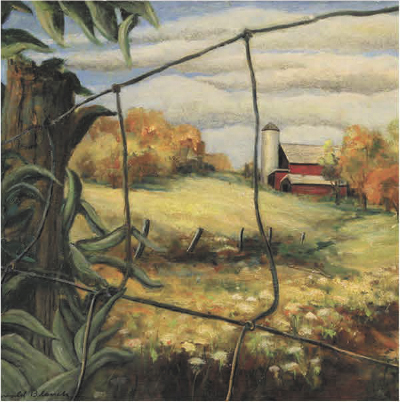
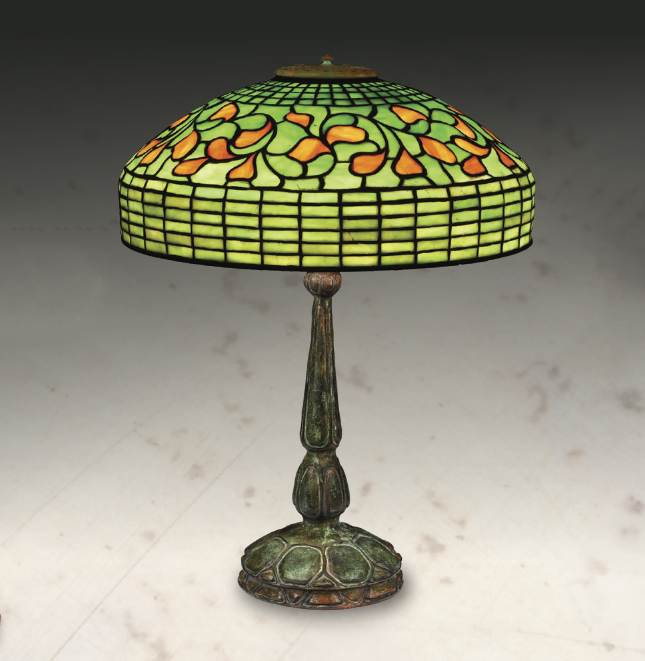
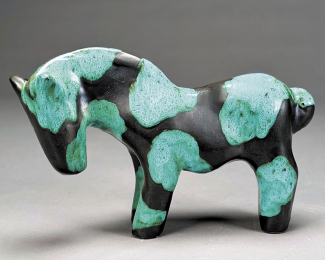
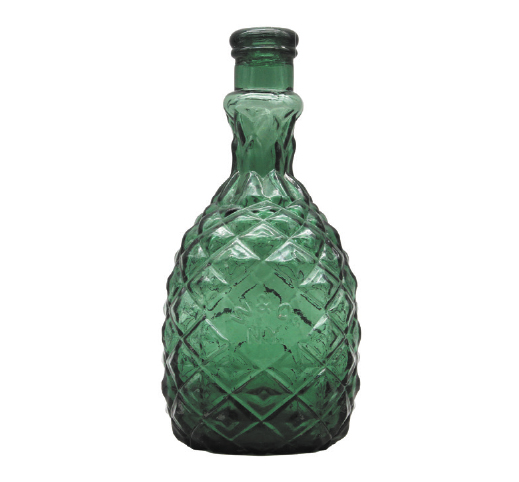
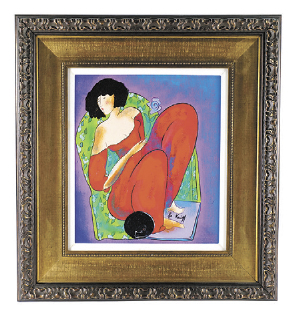
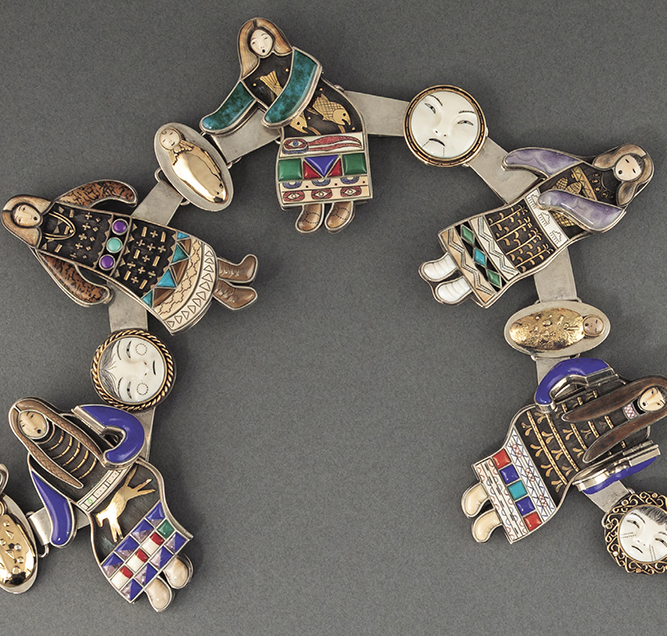
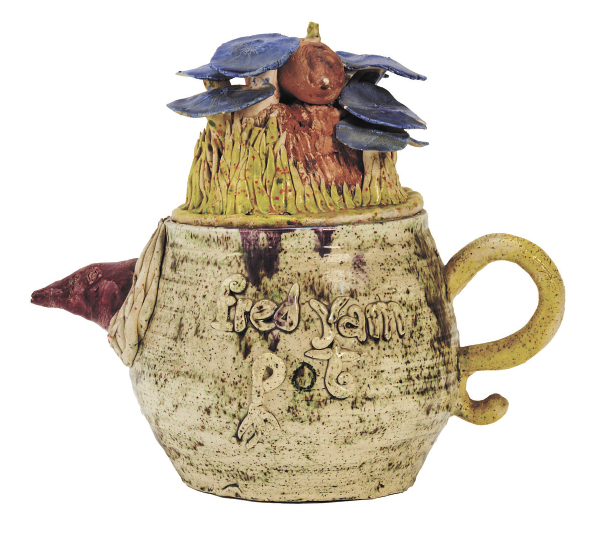
The groundbreaking traveling exhibition “Art for Every Home: Associated American Artists, 1934–2000” remains on view until January 31 at the Marianna Kistler Beach Museum at Kansas State University. Drawn from more than 25 private and public collections, the 136 AAA-related objects include prints, textiles, ceramics, glass, mail-order catalogs and other ephemera.
Beach Museum curator Elizabeth G. Seaton served as project director and co-curated the exhibition with Jane Myers, former senior curator of prints and drawings at the Amon Carter Museum of American Art. They worked closely with independent researcher and collector Gail Windisch, American Textile History Museum curator Karen J. Herbaugh and other specialists.
A short history of Associated American Artists is in order. In founding AAA during the Depression, the contrarian Lewenthal acted upon his conviction that, even during this economically challenging era, middle-class Americans were hungry to acquire high-quality art for their homes. He believed that one did not have to be a well-off expert living in or near an art capital to collect. His idea of offering a signed, limited-edition print by an artist like Grant Wood for a mere five dollars grabbed the public’s attention.
On the flip side, artists were anxious to find new sales avenues for their work during the Depression and appreciated the opportunities provided by AAA. Aside from Wood and Benton, artists who took part during the early years included John Steuart Curry, Peggy Bacon, Luigi Lucioni, Margery Ryerson, Adolph Dehn, Henry C. Pitz and Yasuo Kuniyoshi. Lewenthal went on to broaden the stable of artists beyond those living in the United States. For example, he established a Department of Latin American Art in 1946. In the later period, the likes of Francisco Mora, Alexander Archipenko, Will Barnet, Alexander Calder, Lyonel Feininger and Isabel Bishop participated. AAA issued 2,600 print titles created by more than 600 artists during the run of the program, which lasted from 1934 to 1990.
Responding to changes in American society and the country’s cultural and business climate, the energetic and imaginative Lewenthal built upon the company’s initial mail-order thrust by establishing a gallery in New York, showing and selling non-AAA prints, representing select artists, partnering with department stores and collaborating on arts merchandise as varied as stationery, maps, painted neckties, tableware, ashtrays, wallpaper and textiles for both clothing and home furnishings. He made and fostered connections among artists, business leaders, government officials, members of the Hollywood film industry and influential people in the retailing and advertising arenas. Lucrative corporate commissions grew from these relationships.
Lewenthal served as AAA’s head from 1934 until 1958. He was succeeded by Sylvan Cole Jr, who led the company from 1958 through 1983.
From an art historical perspective, two key factors contributed to AAA’s enigma status. The first was AAA’s less-than-stellar business records management. Not even a complete list of the limited-edition art prints existed, the program for which AAA was and is best known. The situation was compounded by the fact that AAA did not mark prints beyond the artist’s signature (which, at times, was hard to decipher.) When sold originally, an AAA print was accompanied by separate identification, but it was not always preserved. What an irony that this arts enterprise known for its promotional and advertising savvy fell into such obscurity.
But AAA’s fate was not oblivion. As luck would have it, collector Gail Windisch became fascinated by AAA about 15 years ago. She recalled that “back in 1999 or 2000 I bought a print on eBay. It was an AAA print and it came with the documentation. I decided to look into the organization. Through eBay I began to buy AAA mail-order catalogs. I thought this was a better focus for my time and money. I loved the imagery and the concepts in them.” Windisch also reached out to Sylvan Cole Jr and worked with him from 2003 until his death in 2005 to record the firm’s history and to compile a list of AAA prints.
Enter Beach Museum curator Liz Seaton, who says, “For many of my fellow American printmaking specialists, the Associated American Artists has been a familiar business but also a kind of mysterious one. Those of us who work in museums may have numerous AAA prints in our collections, but for years no one has really known how many prints AAA had published or had a full understanding of the business’s diverse activities.” Seaton learned about Windisch’s crusade about eight years ago at the Print Fair in New York, and she and a former colleague reached out to Windisch about publishing the list in conjunction with an exhibition.
According to Seaton, the exhibition was especially appropriate for the Beach Museum since it “holds a fair number of works by the Regionalist Triumvirate — Thomas Hart Benton, John Steuart Curry and Grant Wood — who were AAA’s heavy hitters,” as well some 250 AAA prints. Most of these prints were collected over a period of 25 years by an insurance salesman named Raymond Budge of St John, Kan., whose biography is not unusual for an AAA customer.
Seaton, Myers and Windisch edited the nearly 300-page catalog, Art for Every Home: Associated American Artists, 1934–2000. Collectively, they and the other contributors — Ellen Paul Denker, Karen Herbaugh, Lara Kuykendall, Bill North, Susan Teller, Tiffany Elena Washington and Kristina Wilson — have penned contextual essays, crafted timelines and compiled lists. The catalog begins with a chronology of AAA authored by Windisch, a fact underscoring the emphasis placed on delineating the AAA’s corporate history and product lines throughout the volume.
Examples of essays include “Cultural Democracy / Consumer Democracy: New Deal Printmaking and Associated American Artists, 1934–43;” “Modern Art for Modern Living: Associated American Artists and Decorative Home Accessories” and “Textile Art for the Masses.” Lists of prints, AAA’s Stonelain ceramics, textile designs, and companies and designers using AAA textile designs appear as appendices in the catalog.
Three of these appendices will be published as Art for Every Home: An Illustrated Index of Associated American Artists Prints, Ceramics and Textile Designs. This free, downloadable PDF will be available in January at http://hdl.handle.net/2097/19686.
Undeniably, the rediscovery of Associated American Artists is a boon to print dealers, curators and collectors. Those interested in decorative, public and commercial art and in the retailing of art and design will be fascinated, too. The firm and its activities represent the populist movement of self-betterment via informal education that flourished in mid-Twentieth Century America. Through AAA’s varied and ingenious initiatives, the benefits of owning art and fashioning artistic surroundings accrued to a broad swath of Americans, not solely to wealthy and urban connoisseurs.
After closing at the Beach Museum of Art, “Art for Every Home: Associated American Artists, 1934–2000” travels to the Grey Art Gallery, New York University, April 19 through July 9, 2016; the American Textile History Museum, Lowell, Mass., September 16, 2016, through January 2, 2017; and the Syracuse University Art Galleries, Syracuse, N.Y., January 26 through March 26, 2017.
The Mariana Kistler Beach Museum of Art is at 14th Street and Anderson Avenue. For information, 785-532-7718 or www.beach.k-state.edu.