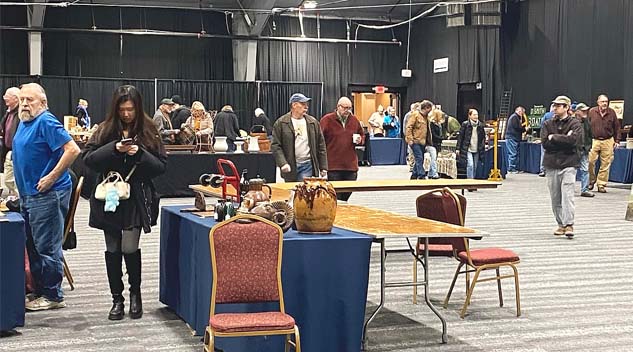
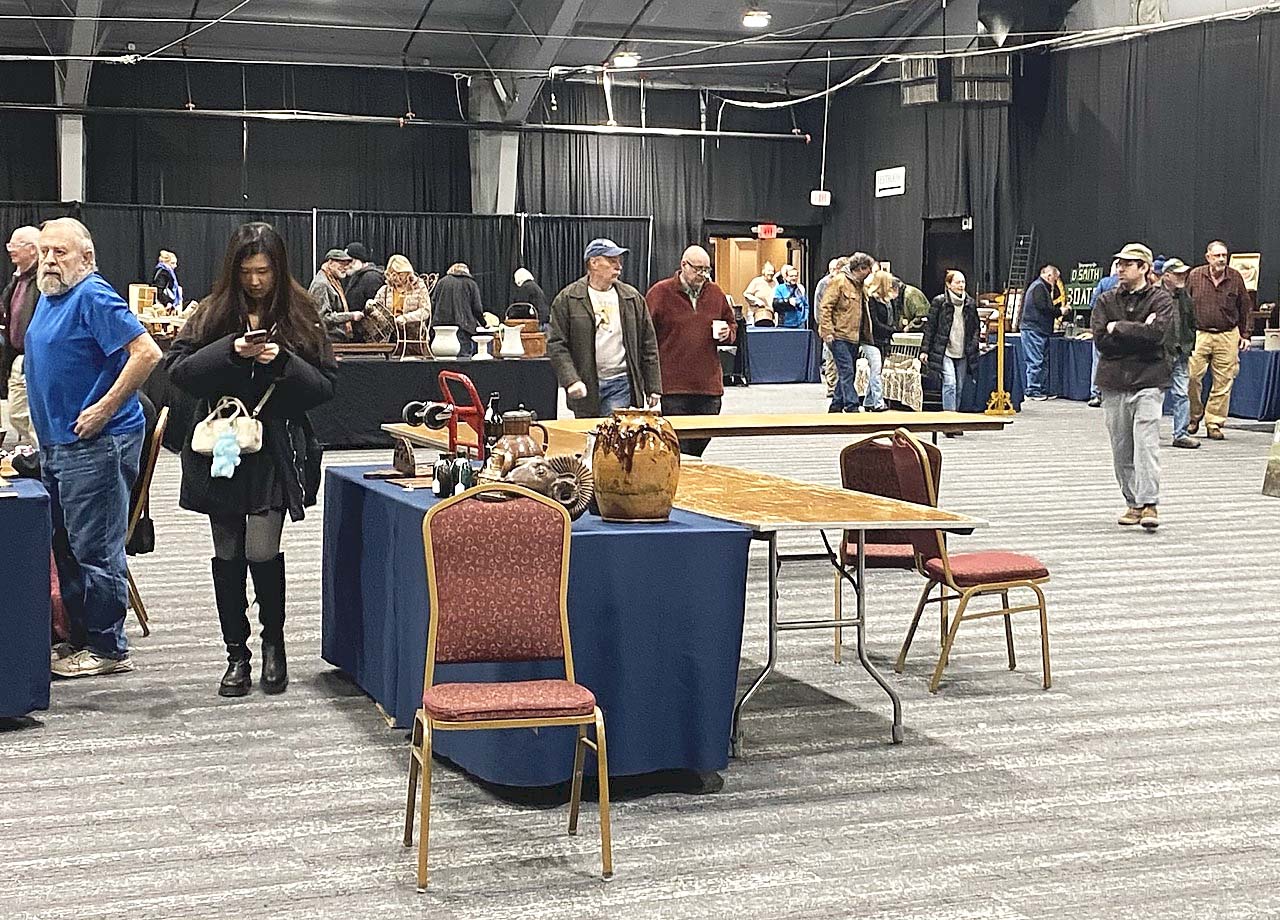
Buyers flooded the show floor after waiting in line for more than an hour before opening.
Review & Onsite Photos by Z.G. Burnett
BOXBOROUGH, MASS. — Amid threats of yet another snowstorm, the Gurley Antiques Show opened its second event of this year’s season at the Boxborough Regency Hotel on February 1. Eager customers braved what turned out to be a light dusting, lining up indoors over an hour before the show’s opening, empty totes in hand. They, and the majority of vendors, were rewarded for their bravery. “[It was a] good crowd and lots of sales,” said show manager Rachel Gurley the following week. “Happy dealers all around.”
There were a number of heart motifs on display in anticipation of Valentine’s Day. Thomas Thompson’s booth offered a set of iron markers with heart-shaped number plaques that looked straight out of Alice in Wonderland. Instead, they were early to Midcentury tee signs for a romantic round of golf. Another unusual heart motif was found on a small serpentine-front commode from Old Antiquarium Antiques, covering its keyholes. These escutcheons, along with the commode’s reverse-scrolled feet and the top surface’s marquetry pointed to either Italian or French origin, probably early to mid Eighteenth Century. Bordered by an alternating triangle pattern with starbursts at the corners, the inlaid wood showed a Maltese-style cross with two songbirds perched on either side. It is still available at the time of this report.
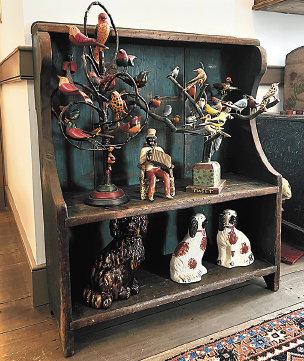
Feathered friends were abundant at the show. Michael and Lucinda Seward gave pride of place to a stuffed duck balanced on two delicate feet. Although faded with time, the little chap was in great condition. “It could be an early Steiff,” Michael supposed. “But it’s not in any [pricing guide], and I haven’t seen another like it.” Julia Hoik of Thor Hilmar Antiques had an equally anonymous and enticing papercut illustration showing what appeared to be blue starlings nestled in green-dotted leaves. Hoik estimated that it was from the turn of the Twentieth Century due to its condition and being crafted from blue-lined ruled paper, a machine for which was first patented by Englishman John Tetlow in 1770 but not widely used in the United States until the mid Nineteenth Century.
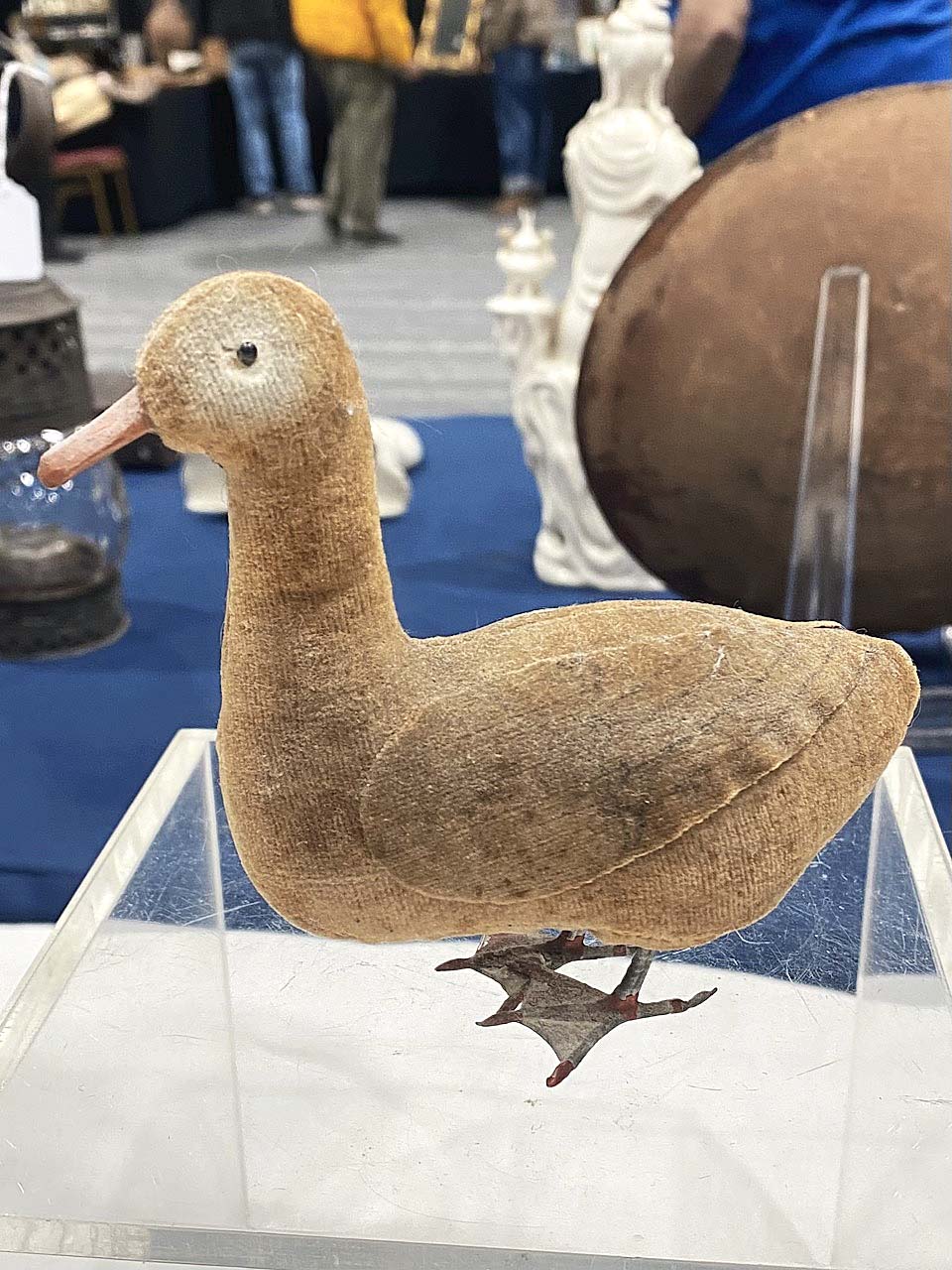
Whether this early stuffed duck was Steiff or not, it was certainly adorable. Michael & Lucinda Seward, Pittsford, Vt.
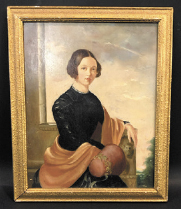
Another of the show’s most striking pieces of “naïve” art was found in the double booth of husband-and-wife team, Dennis Raleigh and Pumpkin Patch Antiques. Hung in what might have been its original frame was a Nineteenth Century watercolor portrait of a young woman that, despite the artist’s apparent inexperience (or disregard) in rendering the human form, was skillfully painted with a fine hand for color and detail. The sitter’s cheeks appear flushed, emphasizing her red bow lips, dark brown eyes and unusual but finely lined hairstyle. Tiny dots illustrate her multi-strand beaded necklace, and the dress is flecked with a distinct pattern. “She is definitely ‘Massachusetts,’” said Raleigh of the anonymous lady.
Two other mystery objects drew attention with their distinct forms but elusive purposes to the modern viewer. Garett Hughes of Antiques and Anvils presented a two-tiered, multichambered demilune shelving unit with both original and old paint. After receiving a few guesses, Hughes revealed that it was an axe bell that was made to store and display various sizes of the tool. The axes’ blades would slide into the chambers with their handles standing straight up, balanced on their “heads.” Hughes found the bell at C.F. Hays & Son General Store, Musella, Ga., one of the last and oldest of its kind in the state. Established circa 1900 by the prosperous peach farmer Robert “Mr Bob” L. Dickey, the store was managed and then bought by C.F. Hays, whose grandson Cary still runs the business today. As a local landmark, its original decorations and memorabilia are not for sale. “I tried so many times,” smiled Hughes. On one of these visits, he spotted the axe bell shoved in a corner, unused for decades and covered in dust. Hughes had recently noticed that the shop’s door was missing one of its original advertising handles, and he just so happened to have one of the same era and size. Cary accepted the trade, and now the axe bell has a story along with its direct provenance.
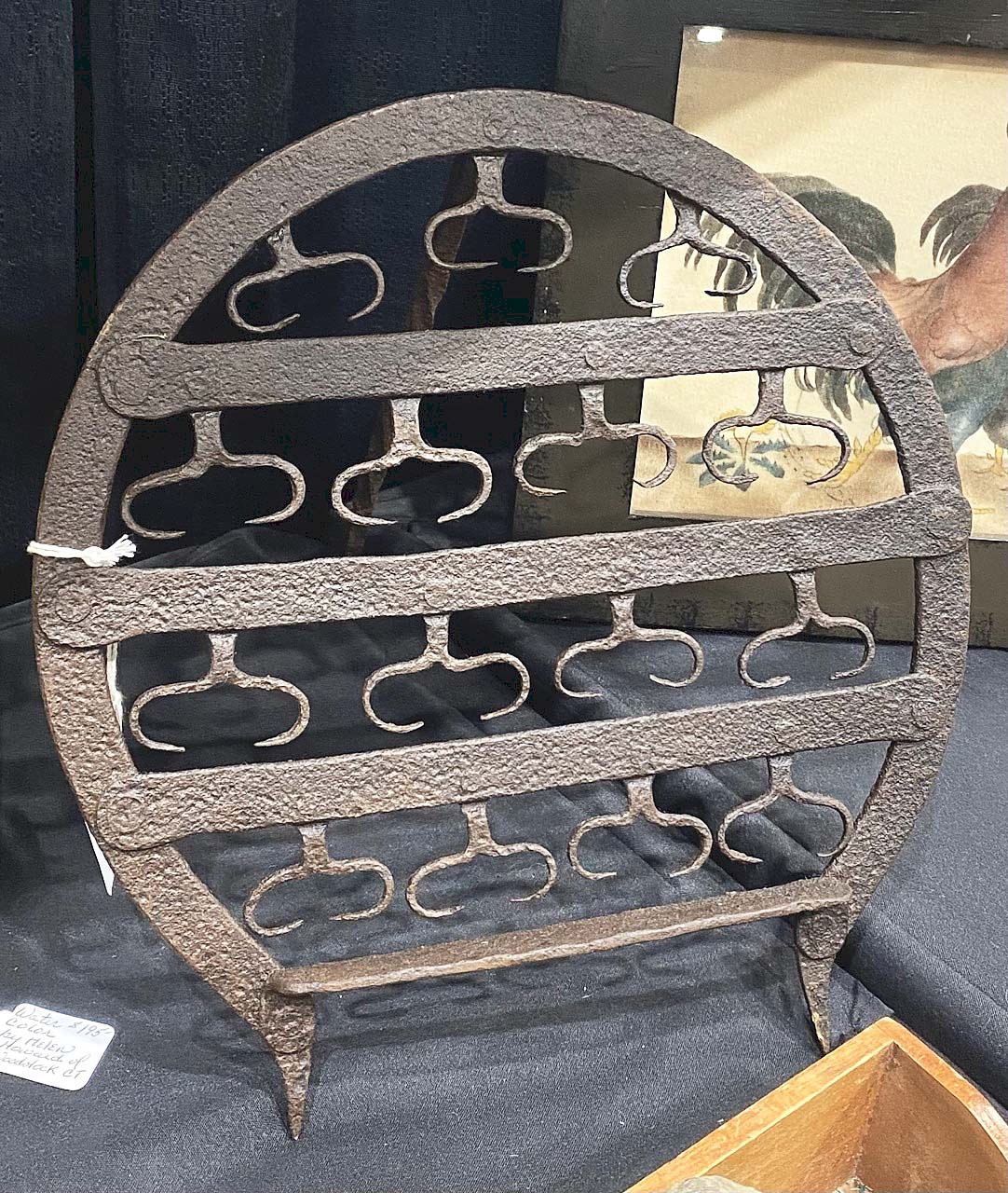
Can you guess what this contraption was used for? Read on to find out. Naomi Ayotte, Pomfret, Conn.
Another earlier “whatsit” in Naomi Ayotte’s booth was a somewhat fierce looking wrought-iron stand with rows of hooks across its horseshoe-shaped frame. Ayotte explained that it was a harnan, also known as an upright or Scotch broiler, used in the Eighteenth and Nineteenth Centuries to warm and cook food by an open hearth. The “ram’s horn” hooks formed a grate for different types of meat and bread, propping them up to cook against the flames. Ayotte’s example showed evidence of use but was otherwise in very good overall condition despite being over two centuries old. Though potential buyers with a fireplace could ostensibly make use of a harnan, its unique form also presents well as a striking piece of folk art. Such is the case with most antique objects removed from their original purpose and retired for perpetual admiration.
Gurley Antiques’ next show in Boxborough will be on March 1. For more shows and information, www.gurleyantiqueshows.com or 207-396-4255.