NEW YORK CITY — Our acquaintance began inauspiciously.
“You probably think I’m dead,” said the voice at the end of the line.
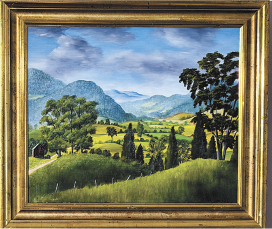
I hesitated. The name was certainly familiar, an auction house staple, in fact. But which Wiggins was this? He of the tranquil meadows and grazing livestock, or the urbane Wiggins, whose intimate Manhattan street scenes seem torn from the pages of The New Yorker.
The caller was in fact Guy A. Wiggins, bursting with vitality and inviting me to join him for lunch followed by a tour of New York’s Salmagundi Club, one of the nation’s oldest arts organizations. Of course, I said yes.
On the appointed day, I pounded on the massive front door of the West Village brownstone that Wiggins shares with his wife of 57 years, Dorothy. There presently appeared a spry, nattily attired man, now 95. He waved me through before returning to the phone conversation he was having with art dealer Jeffrey Cooley, an expert in Old Lyme colony painters, among them my host’s father and grandfather, Guy C. Wiggins (1883–1962) and J. Carleton Wiggins (1848–1932).
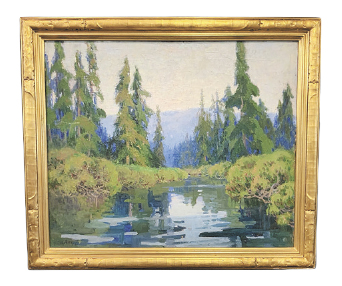
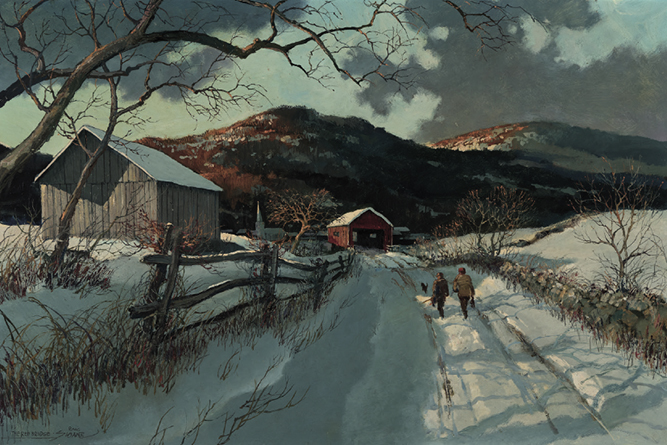
The Wiggins enterprise began in the 1860s. Carleton Wiggins trained with landscape painter George Inness, among others, and was exhibiting at the National Academy by the 1870s. In the 1880s, he traveled to France. Heavily influenced by the Barbizon style, he claimed a gold medal at the Paris Salon in 1894. He was elected to the Salmagundi Club in 1883, serving as its president between 1911 and 1913. He died in Old Lyme, Conn., in 1932.
Successful from a young age, Guy C. Wiggins perfected loosely brushed views of town and country. It is frequently snowing in Guy C.’s New York, perhaps because the artist was a seasonal resident or maybe because snow softened Manhattan’s angular geometry, making the obdurate metropolis more approachable. The public liked Wiggins’s traditional approach. Reviewing the painter’s solo show at the Morton Gallery in 1932, New York Times critic Edward Alden Jewell observed, “Mr Wiggins has done a good deal of experimenting without leaving in the lurch those of us who like their art pleasant and picturesque.”
“We’ve been in this house for 26 years. We bought it before the neighborhood was fashionable,” my host tells me. His accomplished floral still lifes, a genre for which the first two Wiggins were not known, decorate the hall and kitchen. “They’re here because they haven’t sold,” he says too modestly.
In an adjacent drawing room overlooking a private garden, a gilded screen above the fireplace is a souvenir from Japan, where Guy Arthur served as a civilian under General MacArthur during the American-led occupation. A long career in public service, with periodic overseas postings, followed. Having shown early artistic promise, Guy Arthur — who in 1930 took the Wanamaker Prize for best drawing by a child — did not paint professionally until he retired from government in 1975.
Guy Arthur works primarily in oil and, like his father, frequently paints New York buildings, streets, cafes and parks, from Wollman Rink to the Brooklyn Bridge. His urban scenes have gaiety and wit, much like Wiggins himself. Scattered throughout the house are European views — Sintra in Portugal, Taormina in Sicily, the hills above Antibes in France — testifying to summers abroad with his wife and children.
We are soon joined by a stylish blonde. Dorothy Palmer Wiggins, who studied acting with Stella Adler and once, not inaptly, told a reporter that she was endeared by her husband’s resemblance to Noel Coward and Leslie Howard, had returned from lunch with a friend.
“My mother had a house in Lyme and collected his father’s paintings. I knew his father, a dapper artist who wore yellow shirts, before I knew my husband,” Dorothy recalls. The couple married in 1959 and has two children, Noel Carleton and Guy Stuart. Not suited by temperament, as their father puts it, neither son paints professionally.
Guy Arthur was born in Lyme in 1920, near the height of father’s career. To make ends meet during the Depression, his parents started the Guy Wiggins Art School in Lyme. Young Guy sat in on weekly studio critiques and toted boxes of paint up a hill to a spot under a great oak tree where models posed for drawing sessions. He studied at what is now the Loomis Chaffee School in Windsor, Conn. After his parents divorced, he moved to Los Angeles with his English-born mother and siblings. By then a young adult, he worked briefly for Lockheed, took classes at UCLA, then enlisted in the Army in 1942. After the war, he pursued graduate studies at Harvard before joining the Economic Cooperation Administration, charged with administering the Marshall Plan. A Ford Foundation fellowship led to further study at the London School of Economics, followed by research in India.
“The biggest physical adventure of my life was driving overland to New Delhi through regions a good deal more dangerous now than they were then,” says Wiggins, a traveler in the best British tradition.
As recorded in his unpublished memoirs, Wiggins’s early memories of his father’s colleagues — Charles Vezin, Bruce Crane, Ernest Lawson, Ivan Olinsky and Robert Vonnoh and his wife, Bessie Potter, among them — remain vivid. Unable to sell his paintings during the Depression, John Sloan wrote to museums, with little success, offering his work. George Luks’ beautiful Cuban wife made a deep impression on the adolescent, as did the intemperate Luks, a charismatic teacher who died after a barroom brawl. The only man Guy Arthur recalls his father taking an extended painting trip with was the hearty, bearded Wilson Irvine.
The Wiggins school folded during World War II. Its impresario went to work in Ivoryton, Conn., in a former piano factory requisitioned by the US Army Air Force, which commissioned Guy C. to paint the gliders it was assembling there.
Wiggins grabs his hat and the three of us descend to the street. Even in the colorful enclave of the West Village, Guy and Dorothy are birds of rare plumage. Heads turn. A figure emerges from a doorway offering to hail us a cab for the short ride to the Salmagundi Club, since 1917 ensconced in the former Irad Hawley mansion at 47 Fifth Avenue, five blocks north of Washington Square.
New York is a city of clubs, just as it is one of neighborhoods. Both make the large and anonymous seem smaller and more manageable. Formed in 1871, six years after the Civil War ended, the Salmagundi Club then and now offers fellowship and support for working artists, along with instruction and friendly competition. The exact origin of its name — vaguely associated with the Salmagundi Papers, a series of satirical essays written by Washington Irving with William and James K. Paulding — remains in dispute. The club’s membership, which today numbers around 900 individuals nationwide, has over the years included everyone from Childe Hassam and William Merritt Chase to Louis Comfort Tiffany and Ogden Pleissner. Thomas Moran, Emil Carlsen and Bruce Crane each served as president. Lay members — Stanford White and John Phillip Sousa, among them — have long been welcome.
We are met by at the club by its chairman of the board, Tim Newton, accompanied by Ilene Skeen, chairman of the public relations committee. Newton, who has worked to advance the organization, is eager to show me its newly refurbished first floor galleries. We move past George Inness’s palette and brushes, displayed near the entrance, and through a parlor hung with selections from the Salmagundi’s 1,500-work permanent collection.
“It’s an honor to serve such a prestigious institution,” says Newton. When he was first introduced to the club in 2002, the galleries’ lighting and heating systems were decades old. Air-conditioning was an afterthought. Walls and floors were worn. Familiar with the juried invitational exhibit organized by the National Museum of Wildlife Art in Jackson Hole, Wyo., Newton, originally from the West, proposed the Salmagundi Club do something similar, reaching out beyond its membership to artists nationally.
The result is the club’s annual “American Masters” show and sale, on view October 5 to 23. A gala evening is planned for Friday, October 16, preceded, on October 14, by “Seeing in the Dark,” a panel discussion for collectors moderated by Fine Art Connoisseur editor Peter Trippi and underwritten by the Newington-Cropsey Cultural Studies Center. This year’s theme is inspired by “Night Visions: Nocturnes in American Art, 1860–1960,” at Bowdoin College Museum of Art through October 18. Loosely coinciding with “American Masters,” on October 9, 18 and 23 are three benefit auctions of more than 200 works by members.
The Salmagundi Club presented its first “American Masters” show in 2008. About $200,000 in proceeds from the show were applied to gallery renovations. Individual and foundation gifts accounted for the balance of the roughly $1.5 million cost. The club unveiled its new galleries in April 2014, a little more than a year after construction began.
“Our first ‘American Masters’ in the new space was a particular joy for me,” recalls Newton, who is especially proud of the sophisticated lighting system. “We can flood the walls for large, group shows or spotlight individual sculptures in the round.” Having enhanced its galleries, the club rents them out. The Oil Painters of America, Audubon Artists and American Watercolor Society are three groups of the ten or so planning shows here in coming months.
Contrary to its aura of privilege, the Salmagundi welcomes the public, organizing a busy schedule of exhibitions and events open to all who are interested. One of its oldest and best known productions is its annual “Black and White” exhibition dating to 1878. Sargent, Whistler, Eakins and Homer all submitted work to the juried show limited in palette but not media.
The first Salmagundians enjoyed boxing matches and sausages. While tastes have changed, the club’s tavern, grill and billiard rooms are still convivial places. A parallel taste for competition is on view in the dining room, where the club displays selections from its collection of prize-winning “Thumb Box” paintings. An annual tradition, the selling exhibition of paintings no bigger than an artist’s paint box this year runs from November 23 to January 1.
“I look at this building of about 1854, the last standing mansion south of 124th Street on Fifth Avenue. The last one. Were it not for the foresight of our founders, it would be completely out of reach for artists and art lovers today,” muses Newton. Challenges remain. The club’s chairman would like to see the third floor remodeled as additional galleries. The fourth floor would remain offices and storage space.
We visit the library, whose most distinctive feature is a collection of pottery mugs decorated by J. Francis Murphy, Luis Mora, Chauncey F. Ryder and other Salmagundians. The tradition, begun in 1897 and encouraged by Charles Volkmar (1841–1914), who worked in clay as well as paint and supplied members with blanks, no doubt stemmed from the late Nineteenth Century fetish for china painting. It is hard to imagine Jeff Koons, Cindy Sherman and today’s top artists getting together for a tipple and creative playtime.
The tour complete, we head for the door. Guy Wiggins promises to be in touch. He is a cherished fixture of the Salmagundi Club, a living link to the talents and traditions of its past. This subtle, nimble, entertaining man is what used to be called clubbable. He reminds us of the richness of community and of our growing estrangement from it, a peril hastened by living too much in the virtual world. The remedy, it turns out, may be more places like the Salmagundi Club. The Guy Wigginses, alas, will remain in short supply.
The Salmagundi Club is at 47 Fifth Avenue. For information, www.salmagundi.org. or 212-255-7740.