By Stephen May
LOS ANGELES, CALIF — Americans know shamefully little about the art of Canada. Yet over the years our neighbor to the north has produced a number of gifted artists who deserve to be better known. Case in point: Lawren Harris (1885–1970), a skilled painter of the frozen, wintry northland, a founding member of the Canadian Group of Seven and, eventually, a pioneering abstractionist.
The first major US exhibition of works by Harris, “The Idea of North: The Paintings of Lawren Harris,” is on view at the Hammer Museum at UCLA through January 24, and will tour thereafter. Co-organized by the Hammer and the Art Gallery of Ontario (AGO) in Toronto, the show is curated by actor and entertainer Steve Martin in collaboration with Cynthia Burlingham, deputy director of curatorial affairs at the Hammer, and Andrew Hunter, curator of Canadian art at AGO. The exhibition comprises more than 30 of Harris’s most important northern landscapes from the 1920s and 1930s.
Martin is an avid collector and promoter of Harris’s work. He has no doubts about the artist’s importance: “Harris is truly worthy and Americans need to know more about him.” He added, “Harris is the only artist I could conceive of getting involved with as a curator, and this is a time when my celebrity face might actually do the world some good.”
Hammer Museum director Ann Philbin observed that when Martin introduced her to Harris’s paintings she was “struck by their astonishing beauty and surprised by how little awareness I had of the work and its importance to the history of Twentieth Century Modernism.”
Welcoming the show, AGO director and chief executive officer Matthew Teitelbaum observed that the display includes Harris’s “most majestic works … that are truly alive. This alone will serve to build a platform for Canadian art on the world stage in a manner reflecting our great desire to celebrate the land that binds us.”
Harris was born into a well-to-do family in Brantford, Ontario. He grew up in a progressive but pious household. At the age of 19, Harris traveled to Berlin, where he studied for three years with academic painters and first encountered transcendental philosophy.
Returning to Canada in 1908, he continued to paint landscapes and urban views, seeking to develop a socially conscious, internationally relevant but distinctly Canadian manner. For several years, he concentrated on renderings of streetscapes in older and poorer sections of Toronto and small Ontario towns. He was an active supporter and patron of the arts throughout his career. In 1910, Harris married Beatrice “Trixie” Phillips, who became the mother of their three children.
The genesis of the celebrated Group of Seven is unclear. Many credit Harris with providing the stimulus for the Group, dating to 1912 when he traveled to Buffalo to see an exhibition of contemporary Scandinavian painting. He was struck by the artists’ use of simple areas of flat, bright colors to create vivid depictions of Northern landscapes. Harris recognized that the subjects of the paintings could have easily been Canada’s wintry north. It was the melding of Northern subjects with this new treatment that created the distinctive images that became the hallmark of the Group of Seven.
The Group evolved out of a support group in Toronto that met to critique each other’s paintings. In addition to Harris, the Seven comprised Franklin Carmichael, A.Y. Jackson, Franz Johnson, Arthur Lismer, J.E.H. MacDonald and F.H. Varley. Another member of the small circle, Tom Thomson, was an influential outdoorsman who encouraged members to paint the wilderness. He died before the group formally organized. It was in the Northern forests that the Group of Seven found the imagery that imprinted itself on the Canadian consciousness — depictions of the rugged, wind-swept forest panoramas that would eventually be equated with a romanticized concept of Canadian strength and independence.
Greeted with negative reviews, members of the Group fought back with clever, passionate responses that underlined the importance of their work as a product of nationalistic expression. Group members were outstanding teachers, writers and speakers who worked with major Canadian museums to mount touring exhibitions that showcased their work — in the United States, London and Paris. It helped that the bright colors and bold patterning favored by Group members was ideal for reproductions and mass distribution.
Starting in 1920, the Group of Seven sought to broaden the appeal of Canadian art beyond national borders. Critics who were dismissive at first eventually came around. By the peak of their fame in the mid-fifties, reproductions of Group of Seven paintings hung on classroom walls in every school in Canada.
The Group’s paintings of the Northern wilderness became a popular imagery for Canadians. In time, the influence of these artists waned, but by that time the Group had convinced many that art could serve as a visual expression of Canadian nationalism. In sum, the Group of Seven introduced the idea that Canadian art could be important and should be seen on the international stage. It energized the national art community and eventually stimulated the development of museums and government units that would clear the way for artists who followed.
Around the time the Group of Seven was getting off the ground, Harris altered the course of his career, putting his urban subjects behind him in favor of exploring and painting the mountains, lakes and icebergs of Canada — Lake Superior, the Arctic and the Rocky Mountains. His views of these frigid, isolated areas became increasingly somber, his brushwork more crisp and expressive, and his manner more stylized.
Martin says Harris’s works “achieved — then surpassed — his dream of a national art of Canada. His format more than tripled in size, his impasto flattened and light often became tangible, entering as rays of sun from outside the frame or lying in snaking curves on lake water.” A good example of what Martin had in mind is “Lake Superior,” circa 1923, a spectacular image in which shafts of light illuminate smooth rock forms in blue and white water.
Several of the most intriguing works of this period depict dead tree branches shooting skyward among huge boulders, as in “Lake Superior,” 1924. As Martin observes, Harris’s “trees, formerly dappled with sunlight and Impressionist leaves, became dead sentinels poking into thin air at the tree line.”
They serve as silent guardians of a world of quiet and tranquility. In “North Shore, Lake Superior” a single dead tree is muted, while light and color suggest interplay between the spiritual and the material.
Some Harris works, like “Lake Harbor, South Shore, Baffin Islands, Morning” and “Mount Thule, Bylot Island,” convey a mystical feeling, not unusual among these vast expanses of peopleless water, rock and snow.
In particular, Harris’ depictions of “Isolation Peak, Rocky Mountains” and “Mt Lefroy” capture a palpable sense of cold and remoteness, just as the artist intended.
The smooth expanses of snow in Harris’s images of the frigid North bear interesting comparisons to the work of Rockwell Kent, who spent extended periods in Alaska, Greenland and Newfoundland and filled numerous canvases with equally smooth depictions of snow. The imagery also puts one in mind of Dale Nichols, whose wintry Midwestern farm scenes are engulfed in all-encompassing, smooth mounds of the white stuff.
Contemporary critics described Harris works as “epics of solitude, chaos and snow.” A measure of his eminence and importance, in 1930 Harris’s search for new forms of landscapes took him to the Arctic as a guest of the Canadian government.
These travels came at a time of changes in Harris’s life and work. The final Group of Seven exhibition took place in 1931. A couple of years later, Harris became the founding president of the more esthetically diversified Canadian Group of Painters. He began to explore the artistic potential of abstraction.
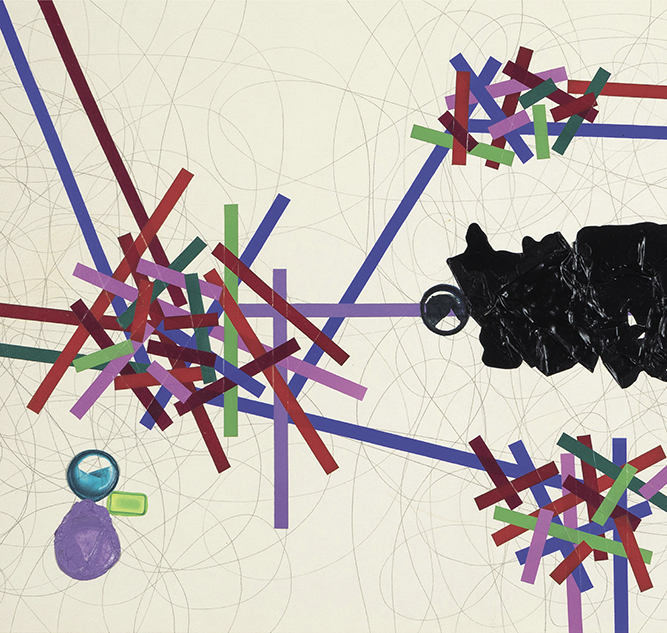
In 1934, Harris left Canada for New England, where he focused on abstract paintings. In 1938, he traveled to New Mexico, where he became an important figure in the Transcendental Painting Group, turning out a fascinating array of abstract images.
Returning to his homeland in the mid-1940s, Harris was welcomed as an elder statesman of Canadian art. He became the first artist to serve on the board of the National Gallery in Ottawa and was the first Canadian to mount a retrospective at what is now the AGO.
Harris never stopped sketching and continued to make treks in the Rockies for years. Toward the end, even while he was slowed by heart problems, he continued to create abstract paintings as his health permitted. He died in 1970, at the age of 85, bequeathing to a potentially worldwide audience his breathtakingly beautiful and moving images of the frozen North. They are a unique contribution of memorable imagery of lasting importance.
The exhibition organizers observe that museum visitors who view major Harris paintings find that they continually “challenge, reveal and surprise.” Little wonder that important Harris canvases have sold for large amounts in recent years, including several for well over $2 million. A record for the artist in 2009 was $3.51 million for an oil sketch, “The Old Stump.” That was the second highest amount ever paid at an art auction in Canada and the most ever fetched for a work by a member of the Group of Seven. Lawren Harris will endure as an icon of Canadian art. With this exhibition, one can hope he will gain the respectful recognition he deserves around the world.
After closing in Los Angeles, “The Idea of North” travels to the Museum of Fine Arts, Boston (March 12–June 12) and the AGO in Toronto (July 2–September 11). This exposure to American viewers should enhance Harris’s and Canadian art’s presence beyond Canada’s borders.
The fully illustrated, 160-page exhibition catalog contains valuable essays offering important insights into Harris’s work. Published by Prestel, it sells for $49.95 hardcover.
The Hammer Museum is at 10899 Wilshire Boulevard. For information, 310-443-7000 or www.hammer.ucla.edu.