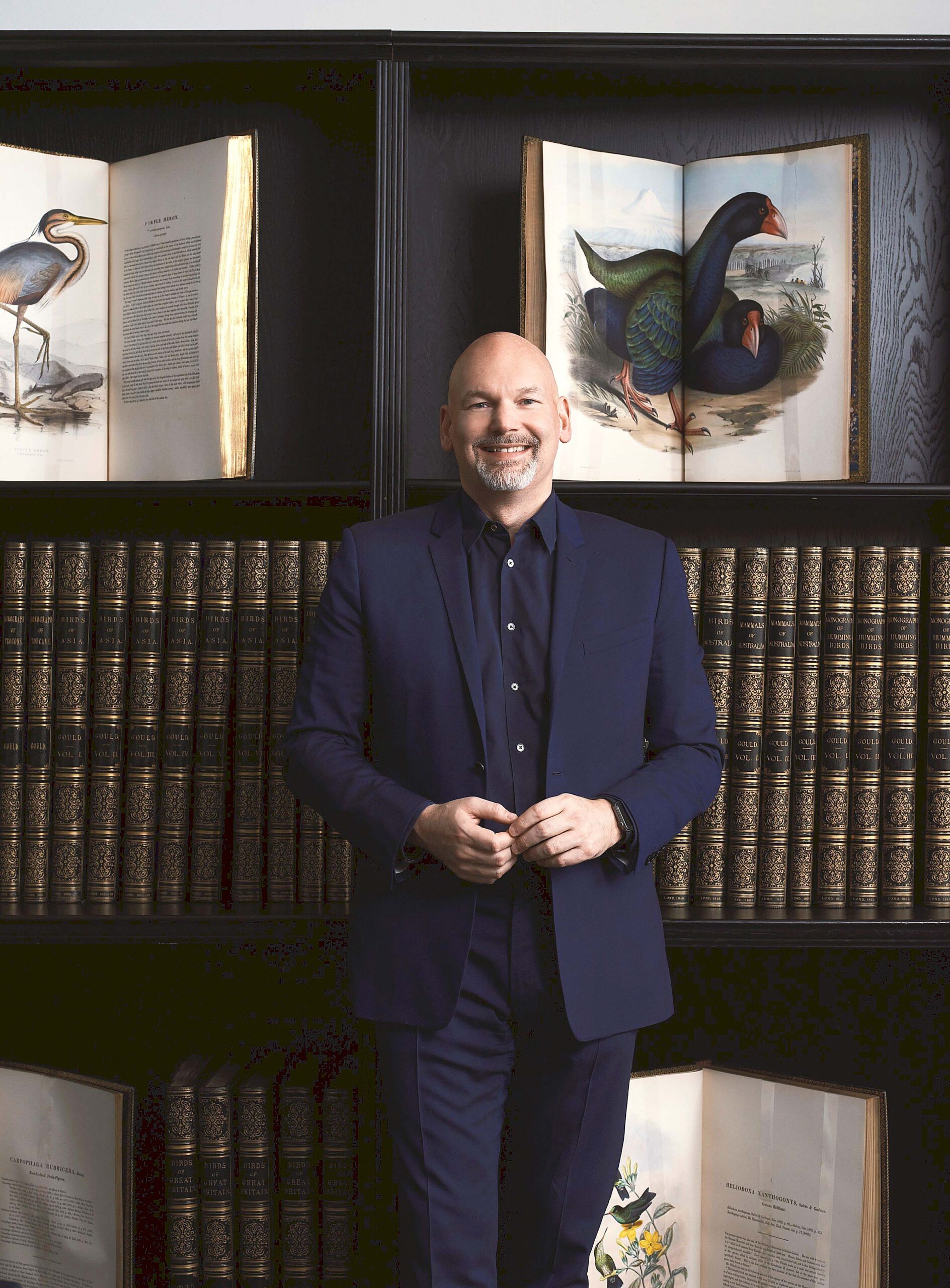
Readers of Antiques and The Arts Weekly may be familiar with Peter Harrington Rare Books, a recurring character in our coverage of antiquarian book fairs. At this year’s AABA New York International Antiquarian Book Fair, we were able to learn more about the London-based firm’s freshly minted New York City location and caught up with owner Pom Harrington to get the scoop on how the US location has been doing and what’s currently on offer.
You celebrated the opening of your “American home” on 35 East 67th Street in New York City on September 17. How has the gallery been in its first eight months?
We’ve had a warm response from both clients and the rare book trade since arriving in Manhattan. Our American clients really seem to understand what we’ve set out to achieve with the New York gallery, which has been hugely encouraging.
This year’s New York International Antiquarian Book Fair also reinforced the value of having a home base in the US, as we could clearly see how it has helped us scale up our operations and presence there. Looking ahead, we’re focused on building on the momentum of the past eight months and are currently looking to grow our US team, which is very exciting.
What, if anything, differs at this location compared to its counterpart in London, and why did you choose New York City as a landing place?
America has always been central to our business, with clients here representing a major part of what we do. New York has always excited me, ever since my first book fair visit with my father many years ago. While London remains our home, we wanted New York to mirror what we do in Mayfair — bringing the very best we have directly to our American clients in a space where they can truly spend time with the books.
Our New York gallery differs from Dover Street, which is a street-front store in prime central London, in that in New York we occupy an entire floor of a historic Upper East Side Beaux Arts townhouse, giving it the feel of a private library. But we definitely have made a nod to our Dover Street gallery. We even had the same English furniture makers custom-build the American cherry-wood shelves, so clients feel at home wherever they visit us.
New York also attracts a different mix of visitors than London, making the gallery an excellent place to meet clients from around the world who travel regularly to the US, complementing the reach we already enjoy in London.
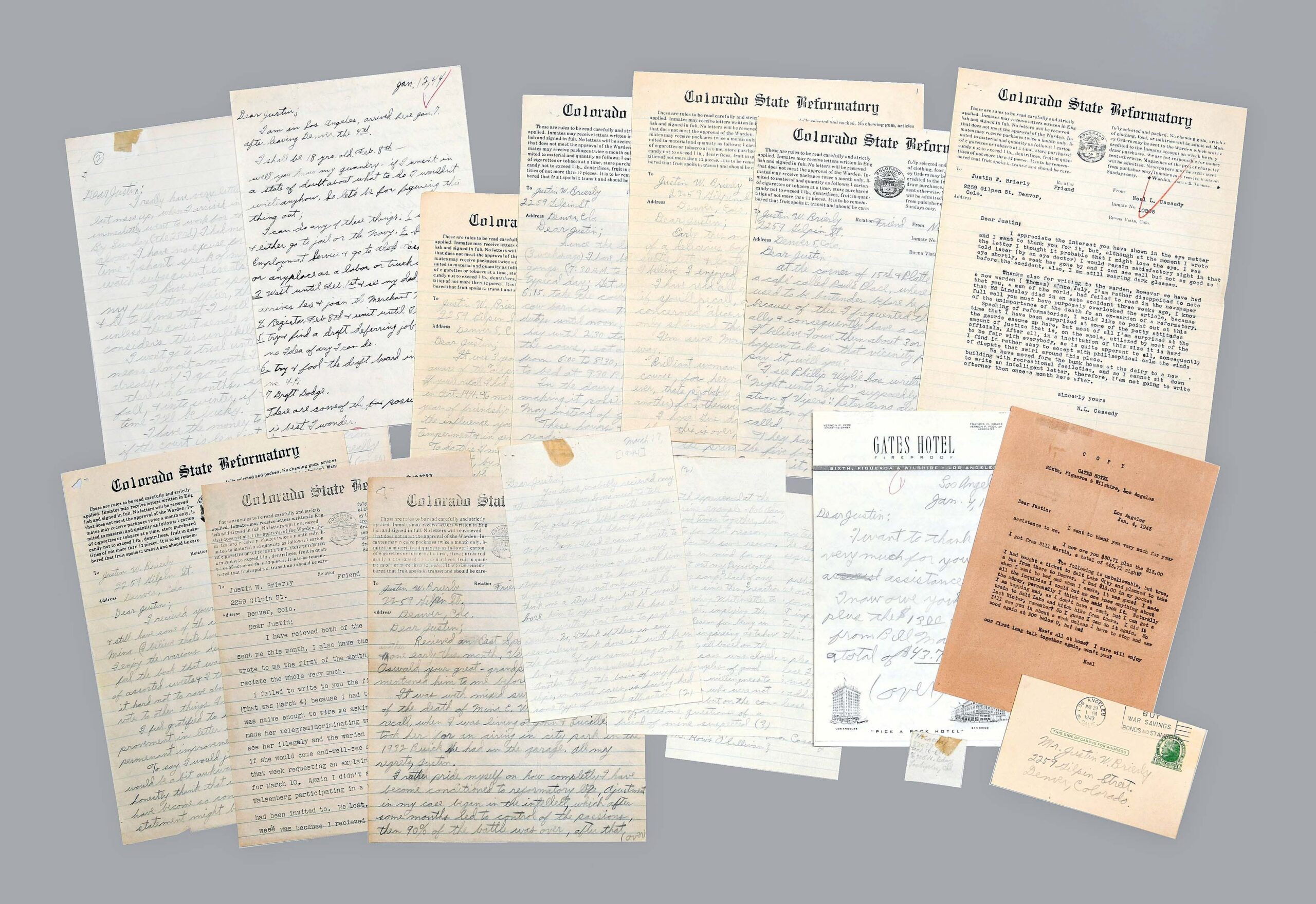
Neal Cassady, collection of letters, signed, to Justin Brierly, January 4, 1943-March 26, 1945. Photo courtesy Peter Harrington Rare Books.
What are some unique or standout offerings at your New York City location that visiting bibliophiles would be excited to see?
We have a number of unique items currently on display at E67, including:
A collection of letters from Neal Cassady, signed, to Justin Brierly (January 4, 1943-March 26, 1945). This is a substantial archive of autograph and typescript letters from a teenage Neal Cassady, later a central figure of the Beat generation and the model for Dean Moriarty in On the Road. All are addressed to Cassady’s friend and mentor, Justin Brierly, with a significant proportion written during Cassady’s incarceration at the Colorado State Reformatory. These are the earliest surviving letters by Cassady currently known; five remain unpublished, and the group likely represents the largest collection of Cassady correspondence in private hands.
Next, a first obtainable official printing on paper of the Declaration of Independence, the founding document of the United States, preceded only by the printing on vellum for private distribution. The original Declaration of Independence is now almost illegible; its ink badly degraded in part because of the very effort to preserve it. In 1820, Secretary of State John Quincy Adams commissioned William J. Stone to create an exact facsimile, using a wet-ink transfer method that lifted ink from the parchment to make the engraving plate. The process damaged the original declaration, but it ensured the text survived: Stone’s facsimile became the version distributed on vellum to leaders, later reprinted on fine rice paper as here for historian Peter Force’s American Archives, and it is what has ultimately become the image of the Declaration recognized worldwide today.
Additionally, a first edition, first printing of Guys and Dolls inscribed by Damon Runyon five days before publication: “To Fred Kelly, who makes good kellys, from Damon Runyon, August 15, 1931.” Fred Kelly was a well-known haberdasher near Times Square. According to their shop boy Martin Rackin, Runyon bought a new hat there every Saturday.
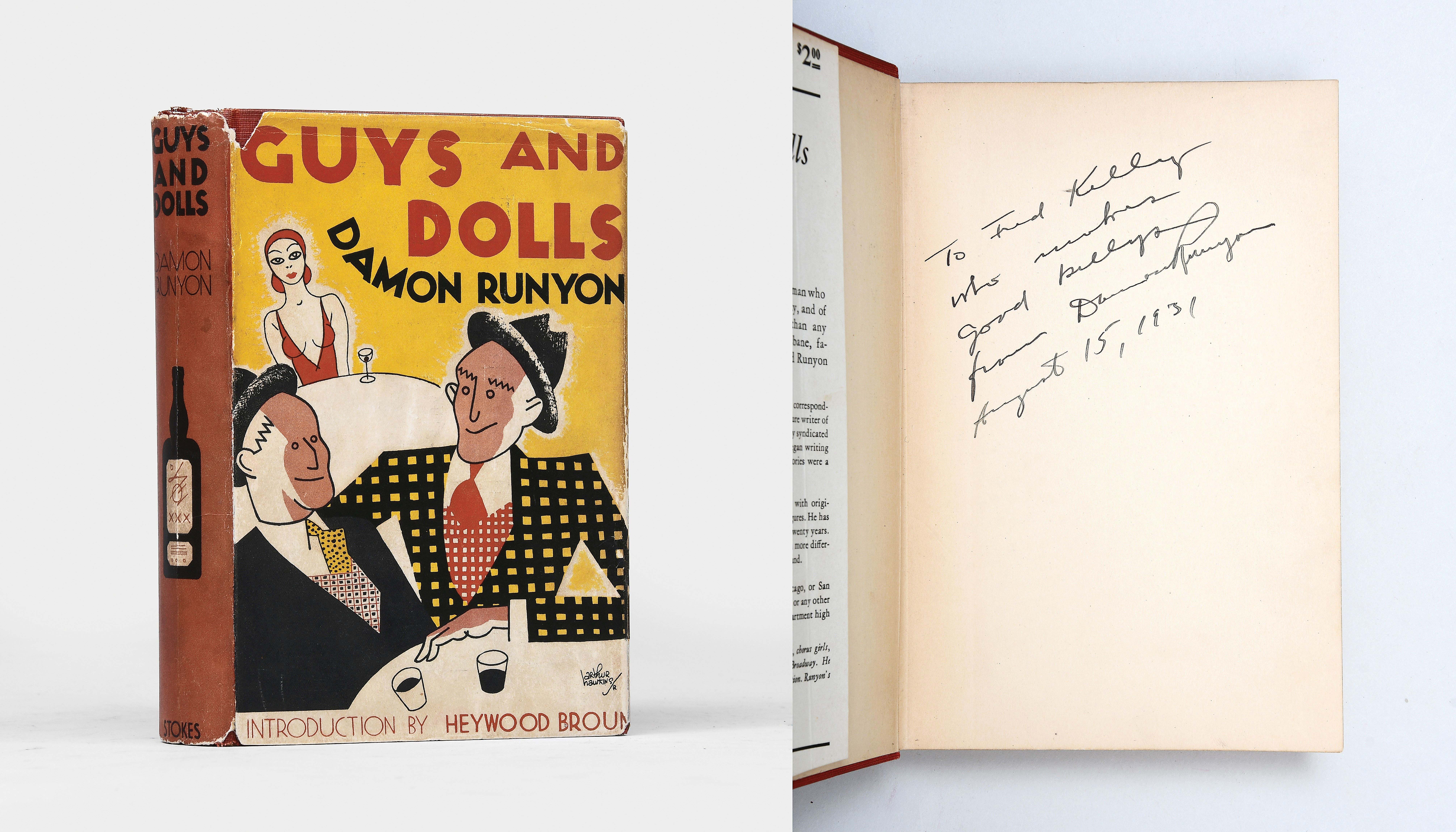
Guys and Dolls by Damon Runyon (New York: Frederick A. Stokes Company, 1931), first edition, with an introduction by Heywood Broun. Inscribed by Runyon to his favorite hatmaker, Fred Kelly. Photo courtesy Peter Harrington Rare Books.
You recently launched “An Englishman in New York,” a sampling from the library of consummate bookman Stephen C. Massey at your New York location. What is your relationship to Massey, and what are some highlights from his collection that you are proud to offer?
Stephen Massey belongs to that rare category of “bookman”: someone whose knowledge was formed in the saleroom and shaped by the traditions of the book trade. During his decades at Christie’s, he played a central role in establishing the firm’s books and manuscripts department in New York, handling some of the most celebrated artefacts of the written word, including copies of the Gutenberg Bible, Shakespeare’s First Folio, Audubon’s Birds of America and Leonardo da Vinci’s Codex Leicester.
I first came to know Stephen in the late 1990s, soon after joining my father in the business. By then he was working independently, and my father and I quickly came to rely on his extraordinary expertise and deep understanding of the American market, and he has consulted for us over many years. This selection from his library reflects a lifetime of sales, friendships and memories, and his personal collector’s instinct. We are proud and privileged to offer them for sale.
Highlights include:
The auctioneer’s copy of Leonardo da Vinci’s Codex Hammer ($6,000): an in-depth study by Carlo Pedretti of the Codex Hammer, best known today as Codex Leicester. Massey is the antiquarian books specialist and auctioneer at Christie’s who sought out, secured for auction, cataloged and sold the original manuscript to Bill Gates for $30,802,500 in 1994.
Also, a limited edition of The Book of Jonah, bound by “the grande dame of British fine bookbinding,” Elizabeth Greenhill ($10,000). It is a fine example of Massey’s fondness for beautiful modern bindings. It was first sold to Lord Wardington, a long-time friend of Massey, and was sold with his monumental library by Sotheby’s London in 2006.
Finally, the Houghton Shahnameh, a first edition of a fine facsimile and study of the Shahnameh of Shah Tahmasp, gifted to Massey by Arthur A. Houghton, Jr, the founder of the Harvard library that bears his name, and president of both the Metropolitan Museum of Art and the Grolier Club ($3,500). This facsimile edition might be considered a small token of recompense for Houghton’s infamous decision to break up the Rothschild manuscript of the Shahnameh, which Massey has described as “the ultimate act of vandalism.” Until the time came to examine it for this catalog, Massey had left it unopened in the shipping carton in which it was sent to him.
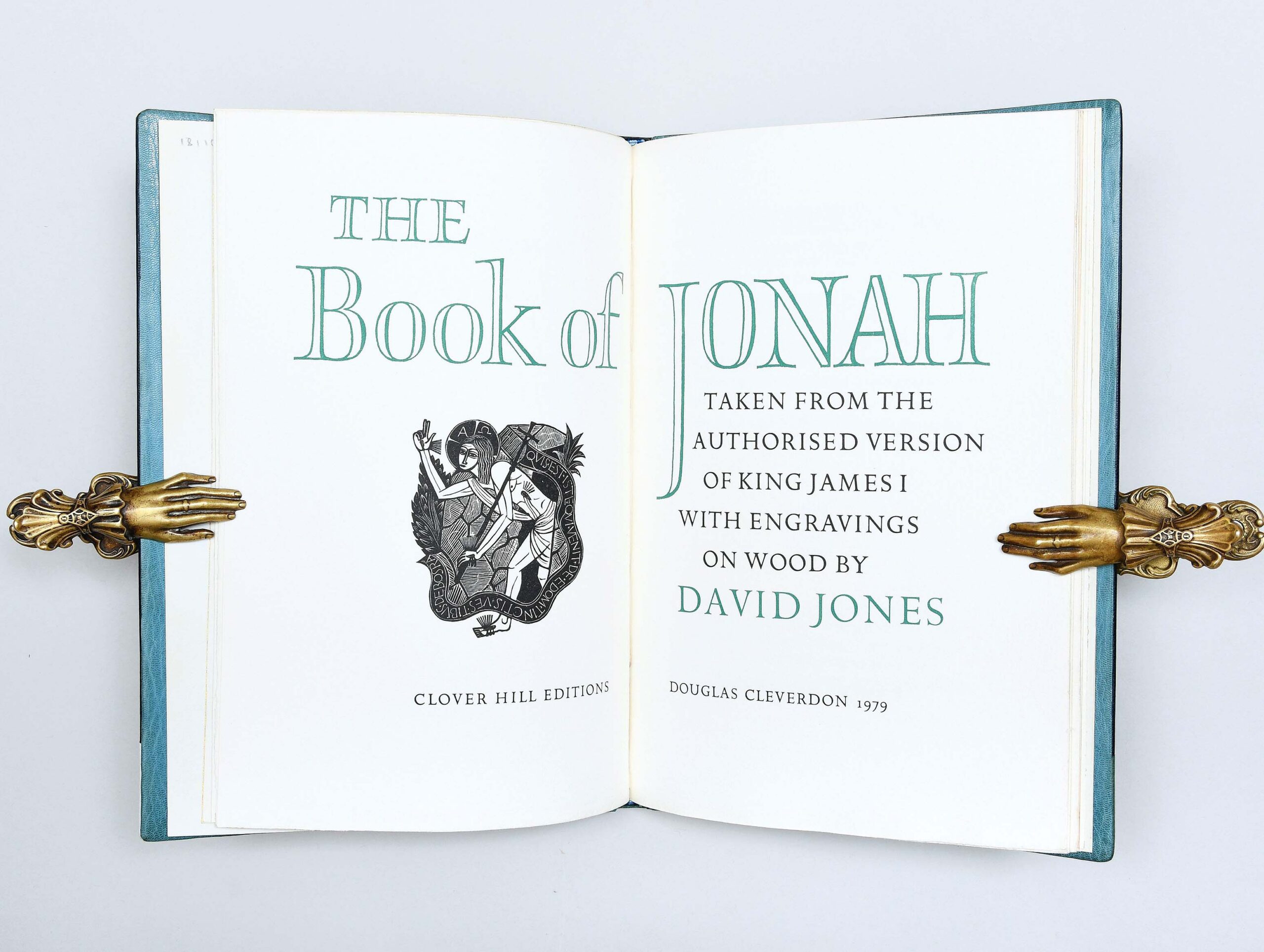
The Book of Jonah taken from the Authorized Version of King James I, Elizabeth Greenhill (binder), David Jones (illustrator), London: Douglas Cleverdon, 1979. Photo courtesy Peter Harrington Rare Books.
Do you have plans to expand further into the US market, or any other parts of the world?
A permanent base in New York gives us the reach and resource to better serve the entire US market on a much larger scale, and we expect it to only grow as an important hub for the business. Beyond the books, we’re planning a busy program of book launches, collaborations and events with institutions and book clubs, creating a space where collectors and curious visitors alike can engage meaningfully with rare books.
At the same time, in London, much of our team is moving into a new purpose-built hub near our Chelsea headquarters. The 7,200-square-foot facility brings together the entire rare book business under one roof, including 1.2 kilometers [three-quarters of a mile] of shelving, a reference library and our in-house fine binding workshop, the Chelsea Bindery.
Together, these developments mark an exciting new chapter for the business as we continue to serve private and institutional clients in the markets where we sell and exhibit — from the UK, the US and Europe, Abu Dhabi and Melbourne to Canada, Hong Kong and beyond.
—Kiersten Busch