Bringing $31,720, the sale’s highest price, was this paint-decorated wood Native American warrior tobacconist trade figure, probably New England, late Nineteenth Century to early Twentieth Century, which measured 83 inches tall on its wooden base ($15/30,000).
Review by Carly Timpson
WINDSOR, CONN. — Nadeau’s Auction Gallery’s 614-lot April 25 auction focused on Americana and Chinese items, but the day’s final 200 or so lots were all from the estate of Mr and Mrs John D. Rockefeller III, as well as additional property from the collection of their eldest daughter, Sandra Ferry Rockefeller (1935-2024).
Nadeau’s staffer Josh Lynch said, “As a whole, we performed over our estimate — the total estimate was $465,000-$856,000, and the sale hammered at just about $910,000. Especially for an antique sale, it was kind of an eclectic mix and it was good to see antiques doing well in today’s world. There were some good surprises, and overall we are happy with the results.”
Fourteen tobacconist figures were offered in the auction, and all of the sale’s top five prices were won by these carved wooden figures. “The tobacco figures did what we expected them to, all selling in and around the estimates,” Lynch told us. Sharing the sale’s highest price of $31,720 were two examples: a warrior example and a “Rising Star.” The former figure, made in the late Nineteenth Century to early Twentieth Century, was a polychrome painted wood Native American warrior depicted holding a package of tobacco in his outstretched right hand and tobacco leaves in the left. It retained its old paint and was mounted on a beveled wooden base with iron wheels. The latter, “Rising Star,” was a rare paint-decorated cast zinc figure by William Demuth. Made circa 1874, she was dressed in “theatrical attire, wearing a short, patriotically themed costume with high button boots, rather than traditional dress, suggesting a stage performer,” as described in the catalog.

This “Rising Star” cast zinc tobacconist trade figure by William Demuth (German/American 1835-1911), New York, circa 1874, 79 inches tall on base, achieved the sale’s highest price of $31,720 ($15/30,000).
The next three highest prices in the sale were earned by a circa 1880 princess ($28,060), a circa 1850-70 warrior attributed to John L. Cromwell ($28,060) and a carved yellow pine hobo ($25,620). Each of the figures came from the collection of the General Cigar Company, acquired by the Cullman family when purchased in the 1960s by Edgar and Louise Cullman, and Lynch noted that they all sold to US-based buyers.
An unexpected result to crack into the top results was a drypoint etching of “La Morgue” in Paris. The 1854 print had provenance to Kennedy Galleries Rare Prints in New York City, and other examples of the print are in the collections of The Metropolitan Museum of Art as well as the Minneapolis Institute of Art. The one at Nadeau’s rose well beyond its $4,000 high estimate to achieve $24,400, a figure motivated by its early printing date, according to Lynch.
As to be expected, Chinese offerings were highlighted by early porcelains, including blue-and-white, celadon, famille rose and wucai examples, among others. Lynch shared, “There were some good surprises with the Chinese porcelains,” noting that the firm has an expert in the area to appraise the items, but many of the strong examples still overperformed their estimates. “About half of the Chinese pieces went back to China,” he added.

This blue-and-white porcelain bitong or brush pot, likely late Ming, Seventeenth Century or later, 8½ inches tall by 8 inches in diameter, led Chinese offerings at $20,740 ($500/800).
The top Chinese lot, at $20,740, was a blue-and-white bitong or brush pot, likely made during the late Ming dynasty. Of cylindrical form, the vessel was decorated in blue underglaze with a continuous figural landscape scene depicting scholars and attendants approaching fishermen at the shore. Another blue-and-white piece, this example an 18½-inch-tall sleeve vase, rose to $14,640. In the Qing style with a tapering cylindrical body and wide waisted flared neck, the vase was decorated with a figural story scene that depicted several warriors, including some on horseback.
Selling together for $12,200 were two celadon vases. The taller of the two was in the Republic Meiping style with five-clawed dragons and, in iron red underglaze, allover crashing waves. The other, having crackle glaze and of bottle form with a bulbous lower body, was covered in pale celadon glaze and raised on a short foot with a Qianlong Qing mark and paper label to the underside.
A 14-inch-tall Meiping celadon vase with raised five-clawed dragon motifs among clouds and waves realized $9,150 ($300/500). This example was later wired and mounted as a lamp.
Possibly from the Joseon dynasty, Korea, Fifteenth to Sixteenth Century, this 13½-inch-tall Buncheong bottle was mounted as vase and earned $14,640 ($200/400).
Other Asian antiques included a Korean buncheong bottle, also mounted as a vase. Decorated with incised lines inlaid with white slip and applied with a green-tinged clear glaze, the bottle had jumping fish and waves motifs and was possibly from the Joseon dynasty, Korea, Fifteenth to Sixteenth Century. This example was from the Rockefeller estate and finished well beyond its $400 high estimate, making $14,640.
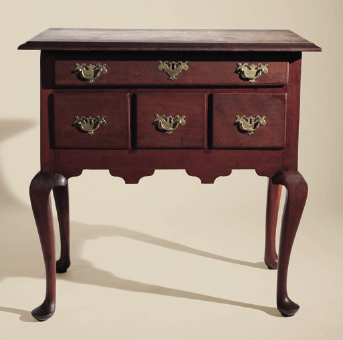
“With the Rockefeller collection, we put in some things that wouldn’t typically have been in this sale, but it all did well,” Lynch explained. Other items from the estate that departed from the Americana and Chinese theme included a George III side table. Made of walnut wood and having rectangular marble top above a plain apron, the Eighteenth Century table was in fair to good condition overall, and it brought $19,520 against a high estimate of $2,000. “We thought it was likely English or Irish, and it did end up going to a buyer in the UK,” he said of the table.
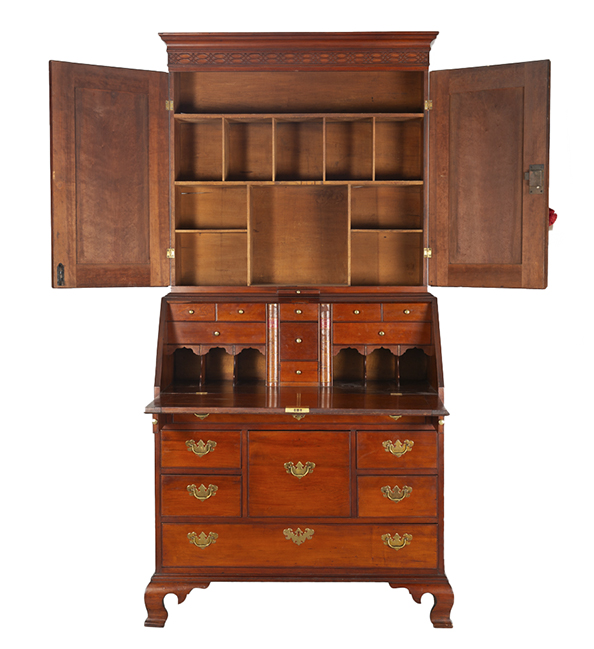
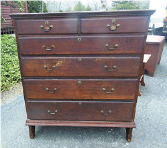
Another antique piece of furniture to do well was a Chippendale chest-on-chest. The two-part bonnet-top chest was probably made in Colchester, Conn., circa 1780-1800, and it brought $20,740. As Lynch said, “It was good to see that sale in today’s world. It’s good to see good pieces sell with a good return.” Its provenance — which included exhibitions such as the 1933 Connecticut Tercentenary and the several at the Wadsworth Atheneum (Hartford, Conn.), where it was on loan from the estate of L. Edmund Zacher, president of Travelers Insurance — likely aided in its success. Notably, it was also featured in Connecticut Valley Furniture.
Made of cherry wood circa 1780-1800, this Chippendale chest-on-chest, probably Colchester, Conn., in the Calvin Willey group, stood 81⅝ inches tall in total and finished for $20,740 ($10/20,000).
In the paintings category, several works from The Cooley Gallery in Old Lyme, Conn., were on offer. Topping the selection was William Smith Robinson’s 1925 landscape depicting that town. The oil on board, which earned $7,930, was signed to the lower right. Lynch identified this result as “a good surprise — a cool one.” The same estate also produced Charles Henry Ebert’s oil on canvas board “The Breaker Monhegan” ($5,490) and the oil on board “Tulip Trees in Autumn” by Frank Alfred Bicknell (American 1866-1943), which rose past its $1,200 high estimate to earn $5,185.
Prices quoted include the buyer’s premium as reported by the auction house. For information, www.nadeausauction.com or 860-246-2444.