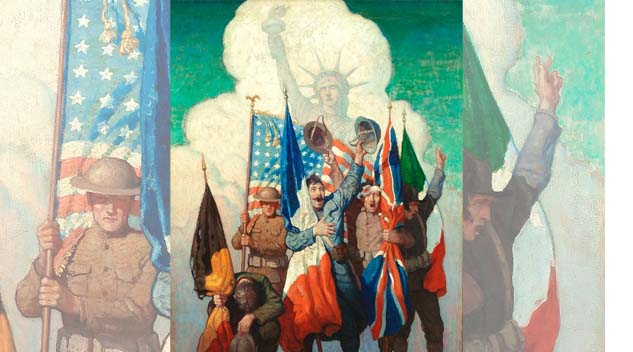
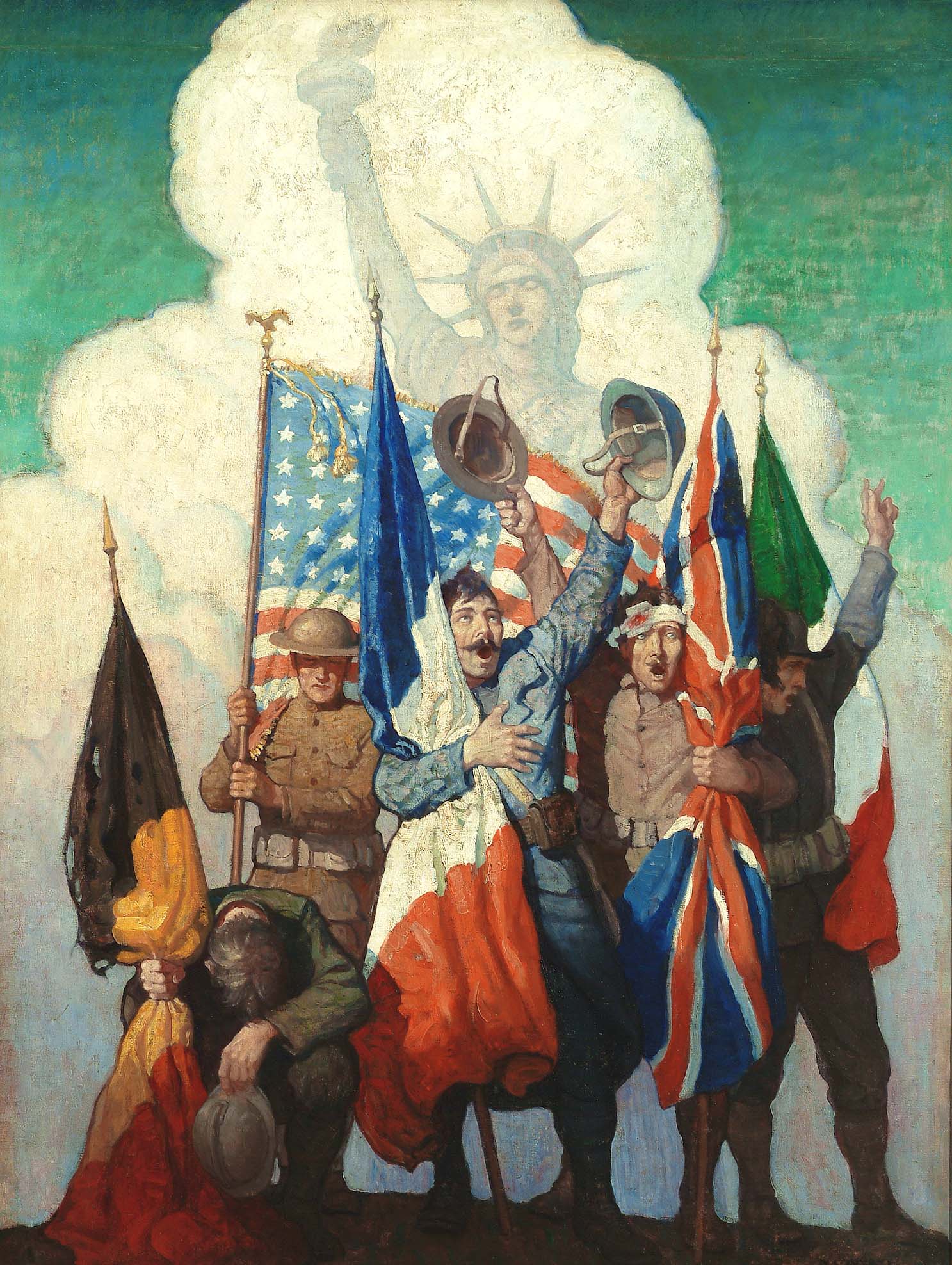
“The Victorious Allies” by N. C. Wyeth (1882-1945), 1918, oil on canvas, 45¼ by 34¼ inches. Delaware Art Museum, Gift of the Bank of Delaware, 1989.
By Andrea Valluzzo
FAIRFIELD, CONN. — The American flag has been an enduring symbol of the United States since the Declaration of Independence was signed 250 years ago, symbolizing freedom, patriotism and valor. Today, it’s also a controversial symbol, sometimes associated with nationalism or perverted for political purposes. Some marginalized peoples see the flag as a symbol of how they have been excluded from its promise of justice and unity for all.
Many artists have explored the American flag as subject matter, particularly those who create what is called protest art. An impressive collection of 75 artworks depicting the flag can be seen in “For Which It Stands…,” on view through July 25 at the Fairfield University Art Museum.
“The exhibition really does present a history of the United States from World War I to the present day and I think because so much of it is protest, it will cause people to pause and think about some more contemporary moments,” said Carey Mack Weber, exhibition curator and executive director.
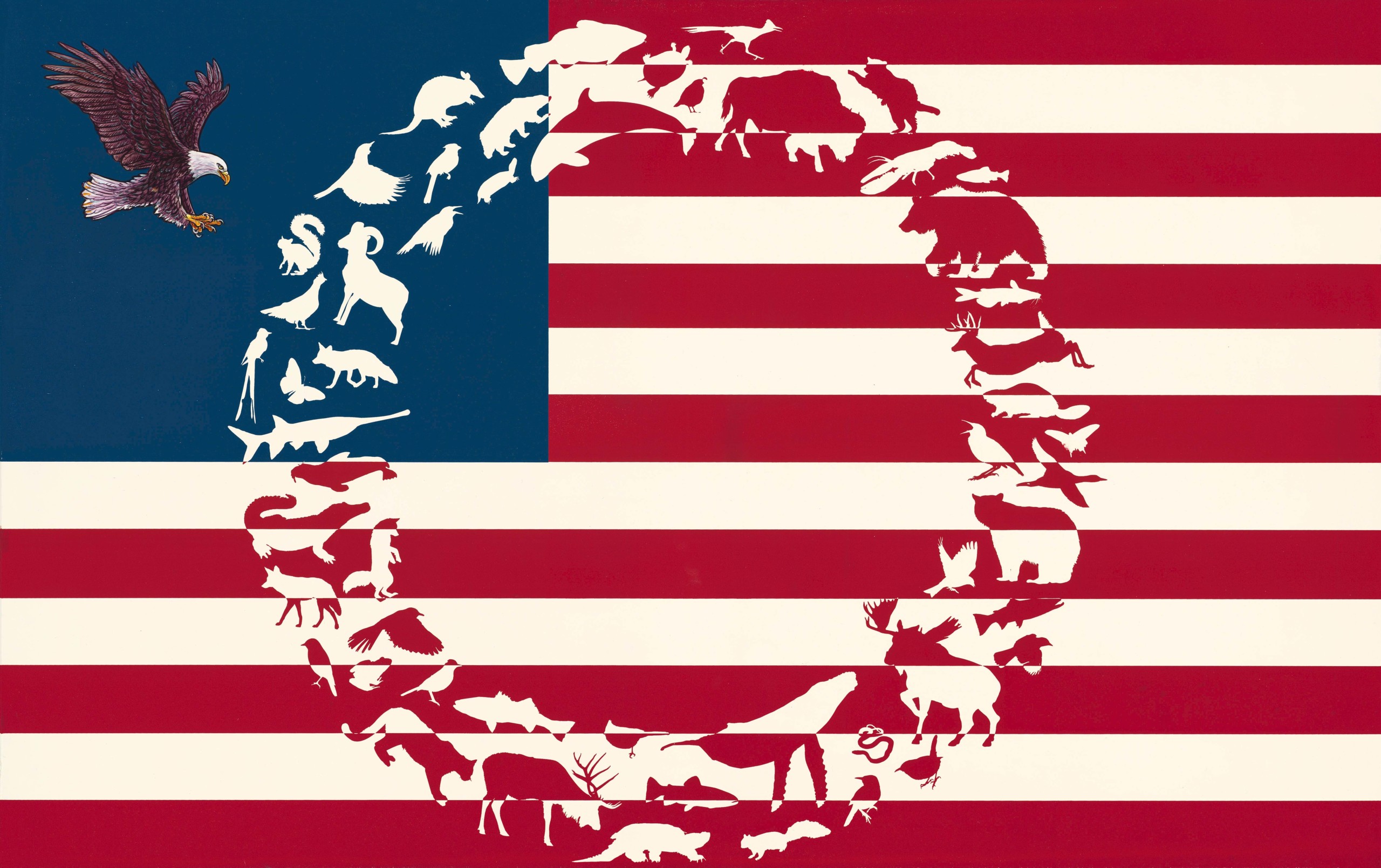
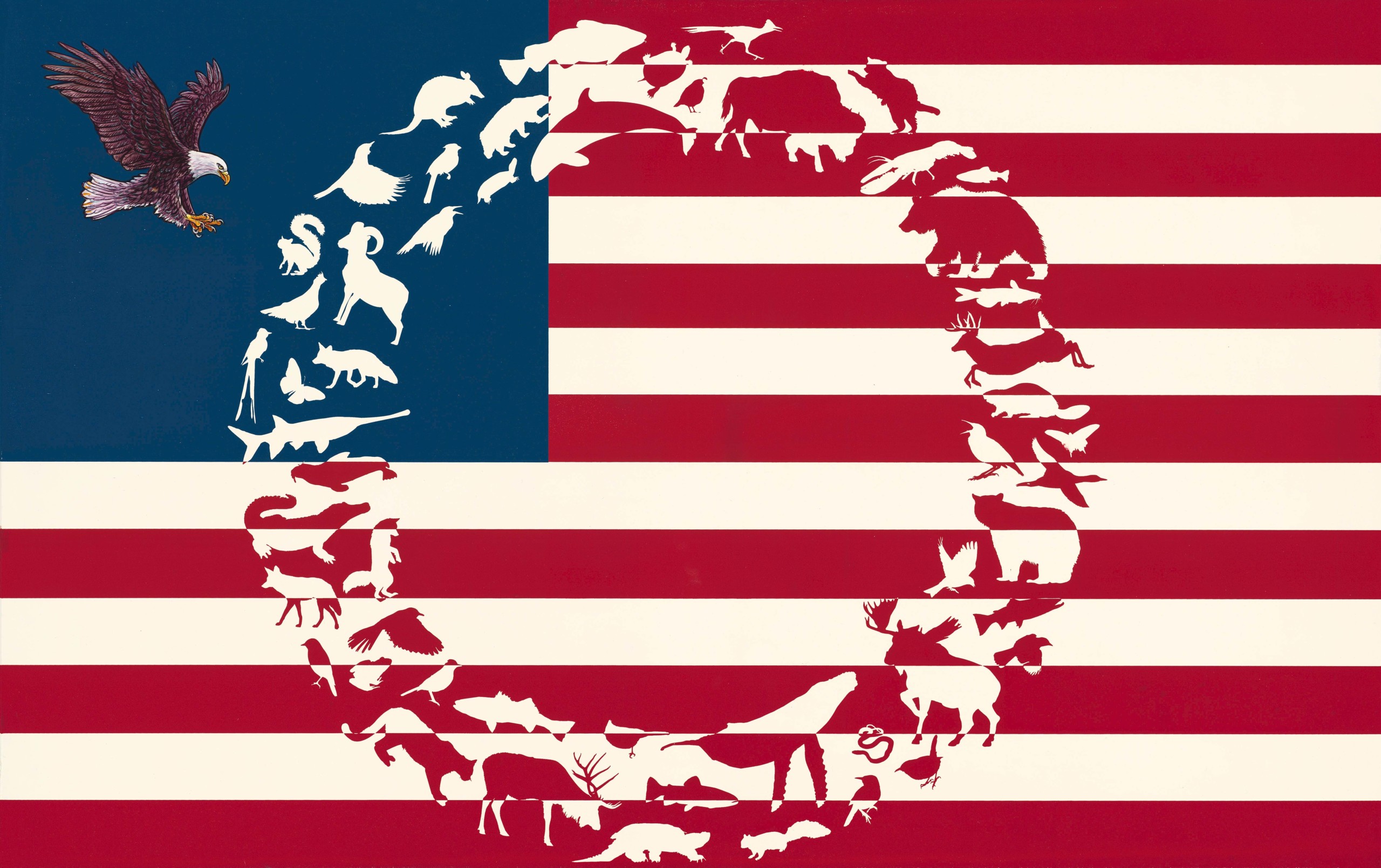
“Invisible Boundaries” by James Prosek, 2021, acrylic on panel. Courtesy of the artist and Waqas Wajahat, New York. © James Prosek.
There are many narratives running through the exhibition that likely will cause viewers to reflect on key moments in the country’s history as well as the meanings the flag holds today. The latter note is reflected in the exhibition’s title, referencing the Pledge of Allegiance, dating to 1892, which compels one to “pledge allegiance to my Flag and the Republic for which it stands, one nation, indivisible, with liberty and justice for all.”
In the country’s early decades, American flags varied greatly, but since its appearance was standardized in 1912, the flag has been a frequent motif in art, depicted in most every medium and from representational styles to highly abstracted. Artists have sought to include the flag to extoll their national pride but also to use it to call questionable practices into question. In a 1955 essay, civil rights activist and author James Baldwin proclaimed: “I love America more than any other country in the world and, exactly for this reason, I insist on the right to criticize her perpetually.”
The exhibition is loosely organized chronologically, opening up with such sweeping and sentimental expressions of patriotism in the World War I era as N.C. Wyeth’s oil on canvas painting “The Victorious Allies.” The painting was created during an American Red Cross push for artworks to show its mission and tap into the swell of patriotism sweeping the country. Wyeth’s image of an American soldier returning home after the war’s conclusion, unhurt and determinedly carrying the American flag, is an apt symbol for victory.
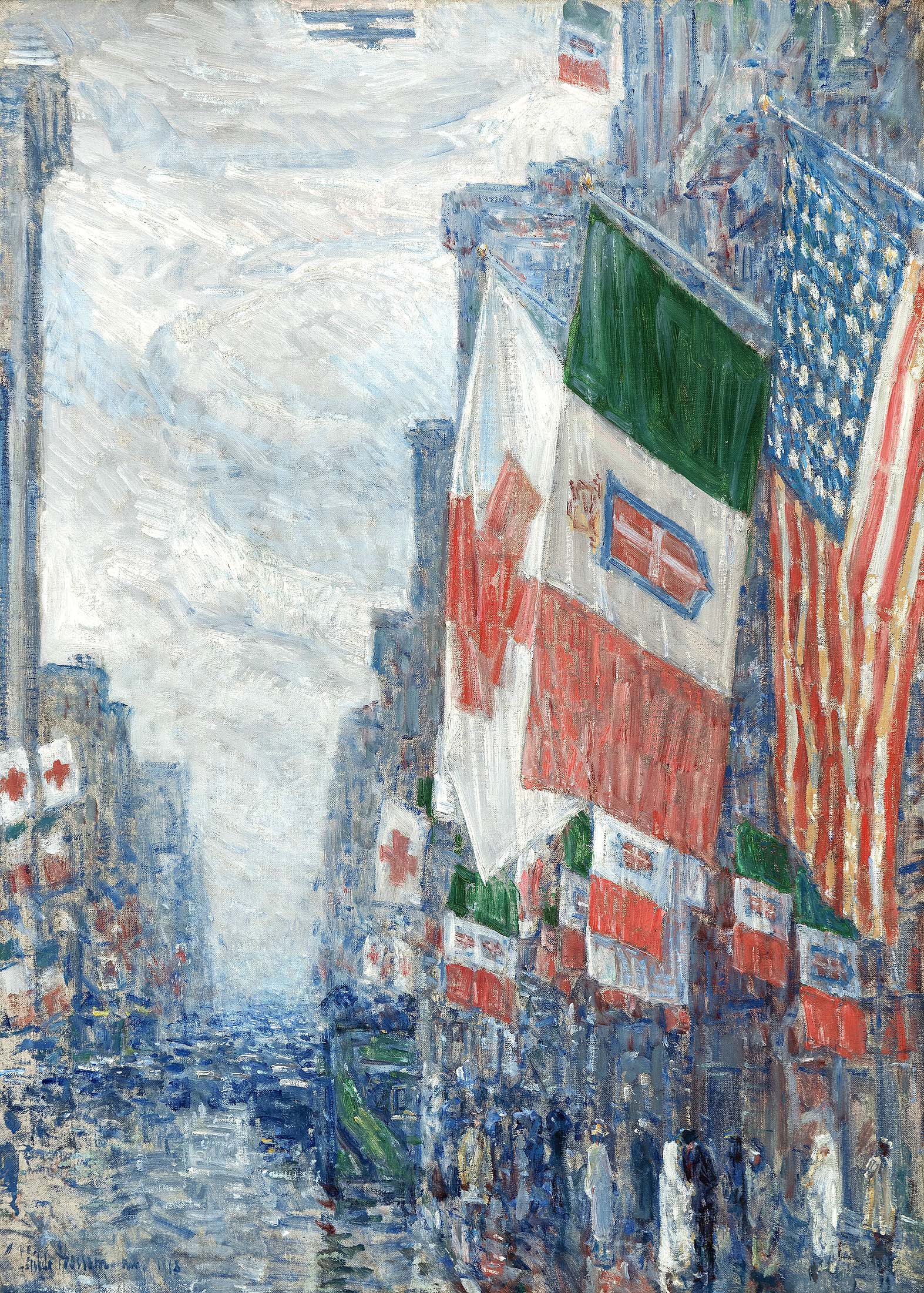
“Italian Day, May 1918” by Childe Hassam (1859-1935), 1918, oil on canvas, 36 by 26 inches. Art Bridges.
The genesis for this exhibition came more than five years ago when Weber was curating an exhibition on birds and came across a flag painting by Connecticut painter Childe Hassam, “Italian Day, May 1918.” It was part of a series of more than 30 paintings the artist did of New York City’s famed Fifth Avenue draped in American flags. The city often held parades to stir patriotism during WWI, and from his studio on West 57th Street, Hassam was afforded great views. Weber saw the painting and had already been thinking about the upcoming Semiquincentennial; she immediately knew flags would be the focus. “The show was literally born at that moment,” she explained. “The hardest part about curating the exhibition was what not to include. There is just such a wealth of material; it’s a subject that many, many artists have been drawn to over the years.”
Looking back on history, the exhibition moves on from WWI up through the present day. From the WWII era, there is a photograph of a Nazi flag hung up at San Francisco’s city hall being cut down, and then we see Black photographer Gordon Parks’ images commenting on social inequities in Washington, DC. Protest art starts to really gear up during the Vietnam war era, and in 1970 artist Faith Ringgold was arrested for flag desecration after she challenged the country’s flag laws by helping mount the New York City exhibition “The People’s Flag Show” to criticize artists deprived of their free speech rights to use the flag as an artistic motif. “There was a lot of flag law happening at that time and then Jasper Johns blows everything up and really lets artists know they can abstract the flag, which no one had really done in the way that he did it,” Weber said. “Once artists felt they had that freedom to protest through their artistic medium, they used it and that doesn’t mean they don’t love their country, it just means they want their country to do better.”
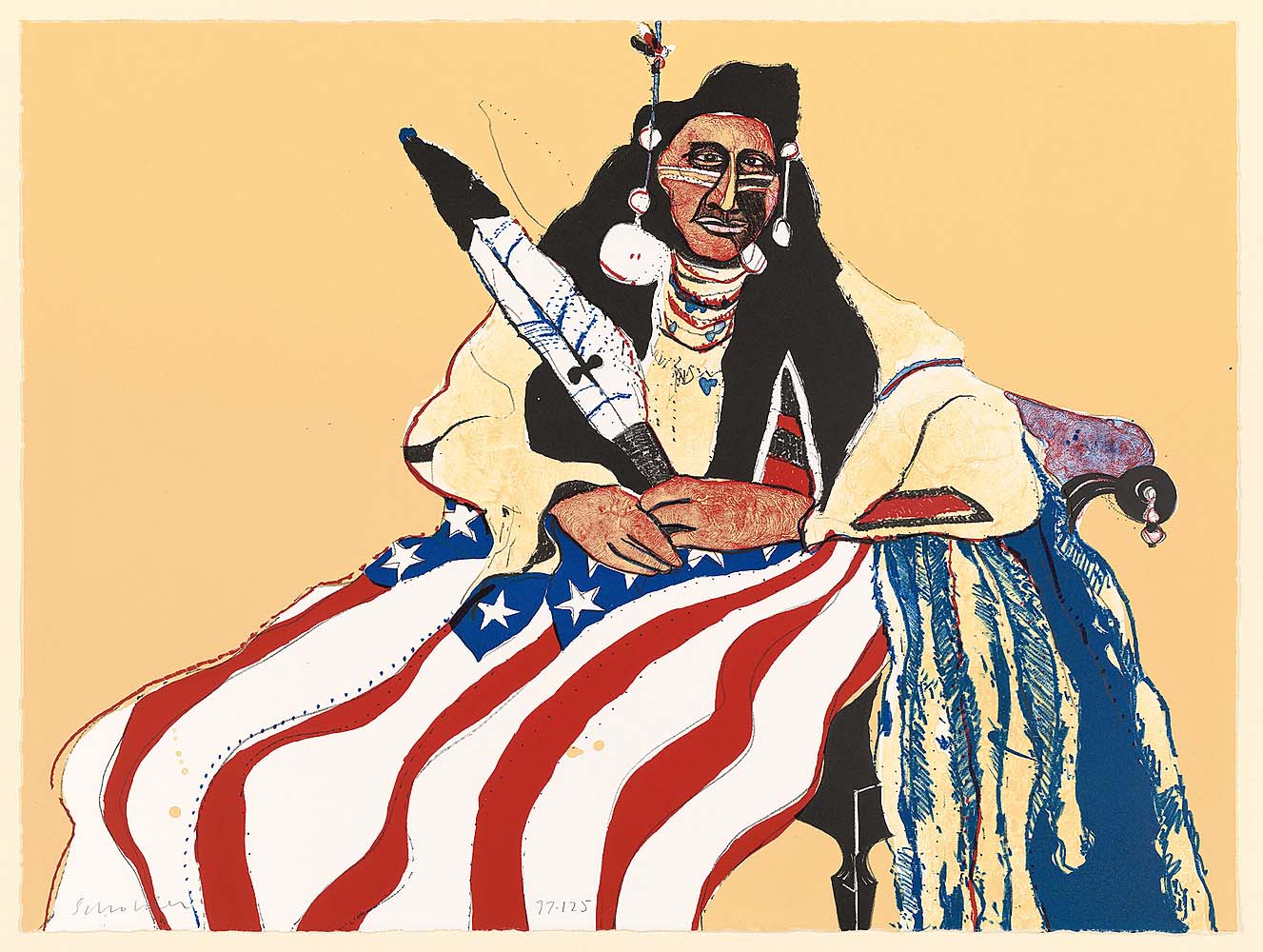
“Bicentennial Indian” from the Kent Bicentennial Portfolio: Spirit of Independence by Fritz Scholder, 1974, color lithograph. © Fritz Scholder. Courtesy the estate of the artist and Garth Greenan Gallery, New York City. Yale University Art Gallery. Gift of the Lorillard Company.
Touching on various narratives such as racism, integration, social justice, war, slavery and civil religion, the exhibition includes several striking protest type images. A standout is Native American artist Fritz Scholder’s “Bicentennial Indian” lithograph from the Kent Bicentennial Portfolio: Spirit of Independence, 1974. A proud warrior is depicted wearing typical Plains men attire as he held aloft a fan of eagle feather; he simultaneously is draped in an American flag.
Among the most provocative images are a Dred Scott photograph showing a man burning the flag and a Sarah Raybar mixed media work showing a flag nearly entirely covered with various pieces of military equipment. Mark Thomas Gibson’s ink on canvas “The Wringer” is equally powerful and surveys the despair many feel in today’s overly politicized climes. Two hands are seen wringing out the American flag with liquid (tears? sweat?) pouring down the middle of the scene. “It’s like we as a country are being put through the wringer,” Weber commented.
Another perhaps controversial yet somewhat whimsical image is a package display for the Old Glory Condom Corporation, a “business” created by conceptual artist Jay Critchley in 1989. The 1990 cardboard box with patriotic condom packages was marketed in conjunction with a World AIDS conference.
A textile sculpture was commissioned for this show from artist Maria de Los Angeles (b Mexico). Her work speaks to citizenship, belonging, migration and community, as she was an undocumented resident in the United States for many years.
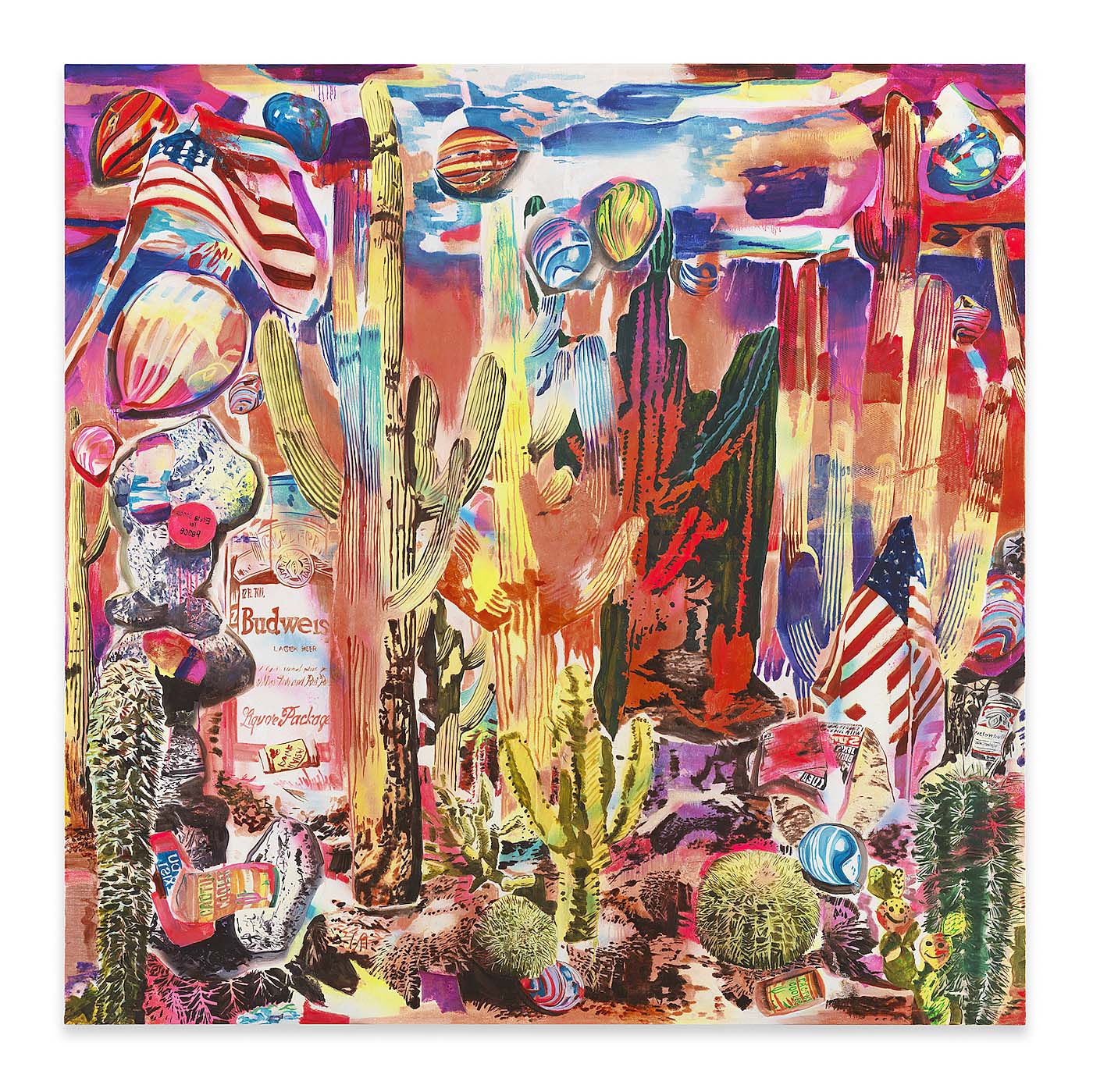
“Fragility (Pax Americana)” by Rosson Crow, 2023, acrylic, spray paint, photo transfer and oil on canvas. Courtesy of the artist and Miles McEnery Gallery, New York City.
The Bicentennial was an event that dramatically shaped Weber’s outlook, and she realizes this exhibition would not have looked the same had it been mounted in 1976 as it likely would not have had artists of color or included few women artists.
“The world we live in today is a much more inclusive place but that is because a lot of people have worked really hard to make it that way and we need to keep doing that work to continue telling the stories of everyone who helped create this country,” she added. “The American flag is an incredibly versatile symbol — over the last century, artists have used it to explore what seems like every possible position from praise to critique to outright destruction. That artists absolutely have the right and freedom to engage in these explorations (even to destroy the flag, according to the Supreme Court decision of 1989!) is something we owe to the First Amendment, one of the most powerful expressions of American exceptionalism and one we must continue to advocate for.”
The Fairfield University Art Museum is at 200 Barlow Road. For more information, www.fairfield.edu/museum or 203-254-4046.