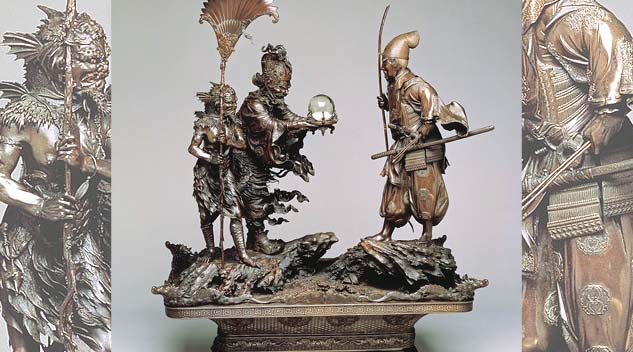
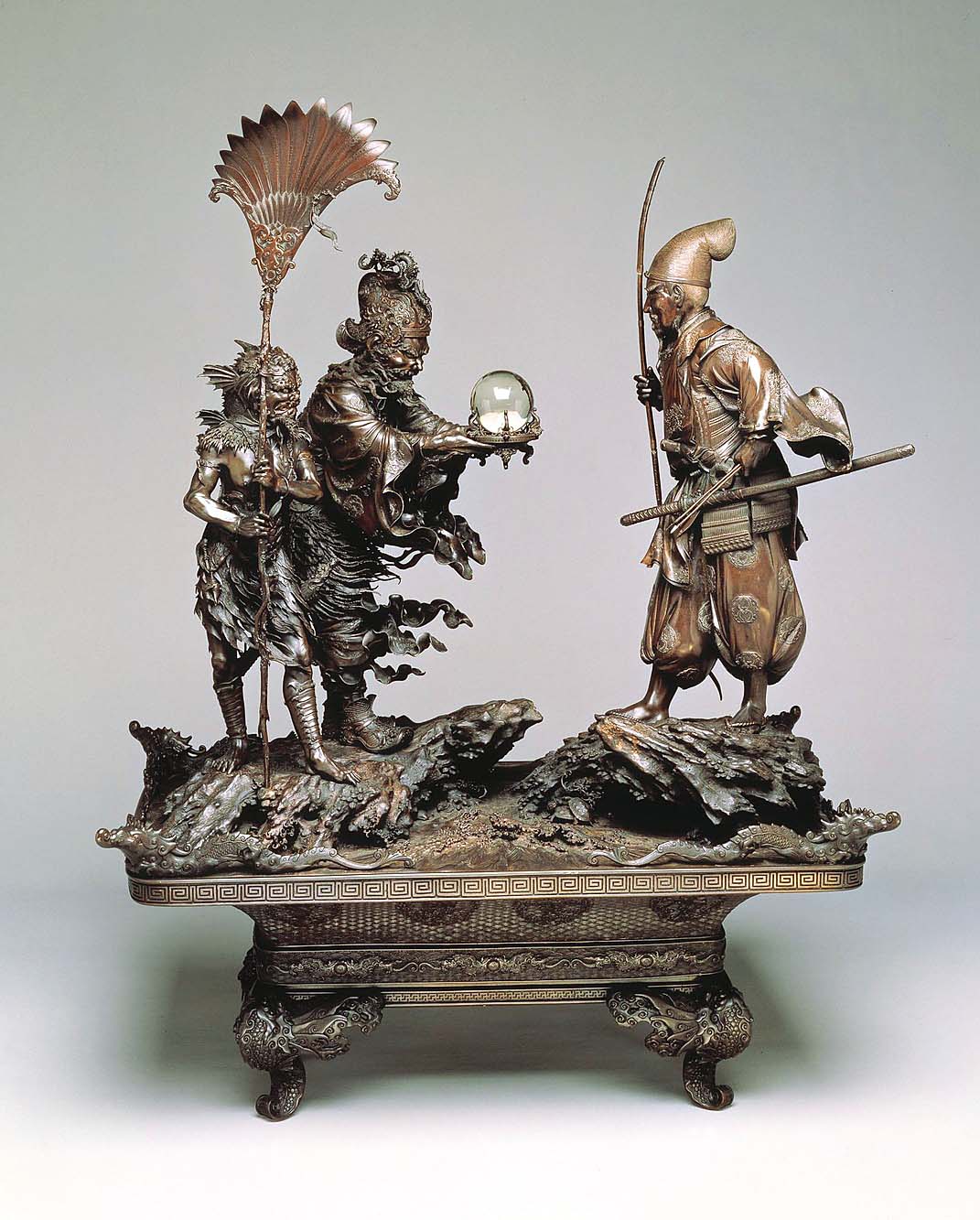
“Dragon King Presenting a Jewel to Fujiwara no Hidesato,” 1879-81, Japan, bronze and rock crystal. Dallas Museum of Art, Foundation for the Arts Collection, The John R. Young Collection, gift of M. Frances and John R. Young, 1993.86.11.FA.
By Z.G. Burnett
DALLAS — The Dallas Museum of Art (DMA) premieres “Samurai to the Imperial Court: Japanese Metalwork,” exhibiting five centuries of metallurgic artistry and invention. Through more than 90 art objects, the show celebrates technical mastery and aesthetic brilliance from the late Muromachi period (1336-1573) through the transformative Meiji period (1868-1912). While mostly drawn from the DMA’s significant collection of Japanese art, many featured works have been loaned from important private collections to expand the exhibition’s comprehensive scope while complementing and deepening their stories. Presented in five thematic sections, “Samurai to the Imperial Court” presents objects such as arms and armor, royal commissions, luminous enameled vessels and sculptures of fantastical animals and figures made with a variety of metallurgic techniques. The dazzling array of treasures shaped by centuries of imagination and craftsmanship remains on view through September 6.
“While metal craftsmanship has a very long tradition and has played a significant role throughout Japan’s history, less is known about the artists behind these works and their many technical innovations,” said Dr Jacqueline Chao, the Cecil and Ida Green curator of Asian art. “The magnificent works of art in ‘Samurai to the Imperial Court’ offers a deeper view into the profound ingenuity, aesthetic diversity and cultural significance of these artists and their art forms.”
“The original impetus for this exhibition came when I first joined [DMA] and began closely studying the Asian art collection,” Chao explained. “The selection process was focused on shaping a compelling narrative that could highlight the technical brilliance of these artists while also bringing attention to figures who are still relatively lesser known to American audiences. Ultimately, objects were chosen based on their ability to support and enrich the exhibition’s thematic framework, and their status as outstanding representative works by particular artists that showcased their high level of craftsmanship.”
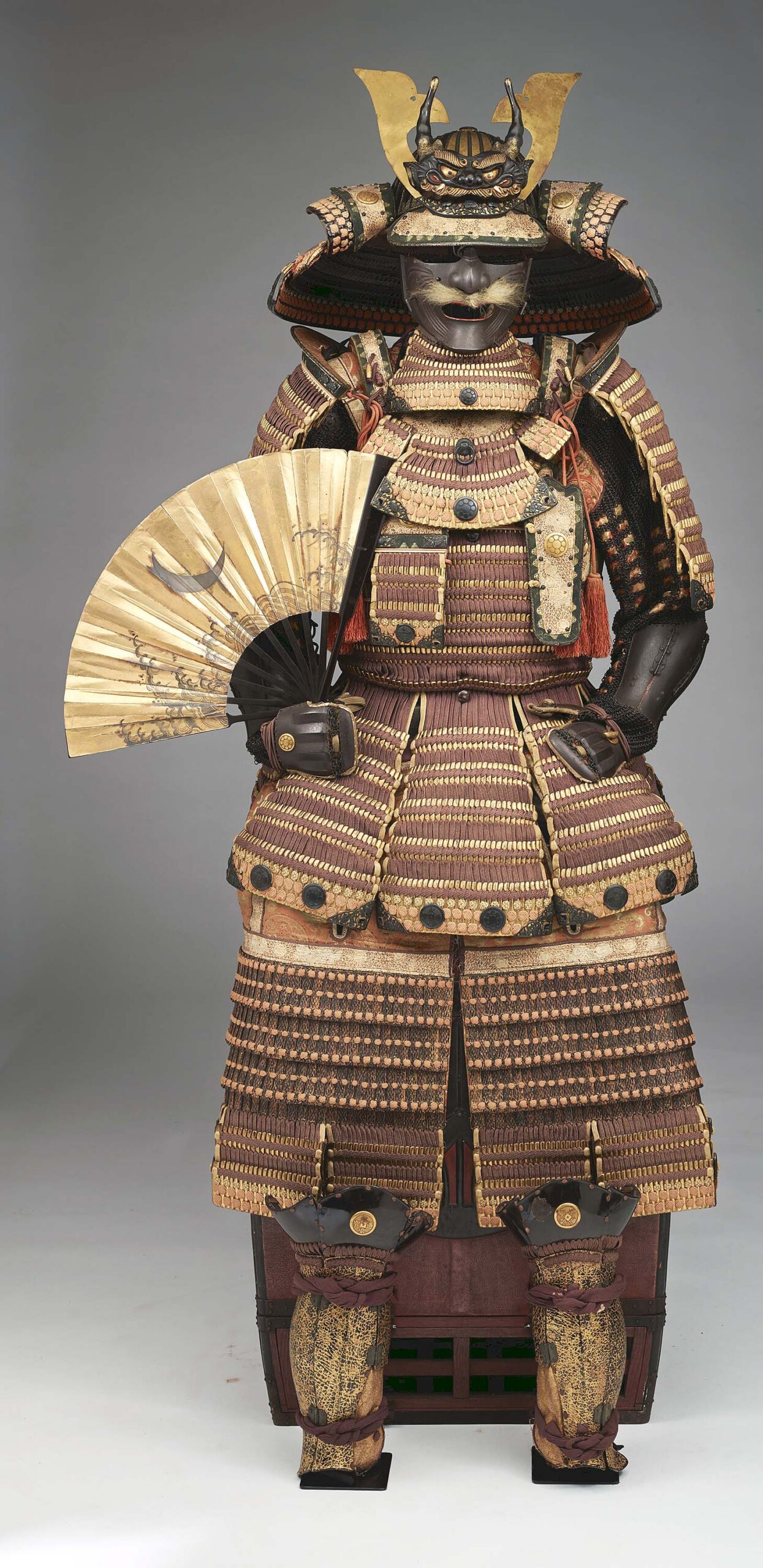
Armor (haramaki husoku) with war fan (gunsen), helmet by Masanobu, Eighteenth Century, iron, gold, lacquer, lacing, shakudō, leather, boar hair, silver, washi (paper) and wood. The Ann & Gabriel Barbier-Mueller Museum: The Samurai Collection, Dallas. Photo by Brad Flowers.
“Samurai to the Imperial Court” begins with an introductory overview of different metals, casting and decorative methods that date back to the Third Century BCE when Chinese techniques were transmitted to Korea and Japan. Steel weapons are durable, bronze sculptures enlivened dim temple halls, bells produced lucid sounds, and iron tea kettles quickly conducted heat to boil water. Craftsmen changed the proportions of the base materials to create different colors, textures and acoustic properties, and combined them to make alloys.
The Muromachi era heads the next section, when power resided not with the emperor but with the shogun (supreme military commander). Beginning in the late 1100s, the samurai class ruled Japan for over seven centuries. The shogunate and daimyo (provincial lords) all belonged to the samurai class, and the term came to denote skilled, educated and refined warriors. Samurai lived by a code that valued honor, loyalty and bravery and they mastered both martial and artistic skills. Wealthy warriors employed their own craftspeople who developed unique metallurgic techniques for making sword fittings. Daimyo patronized local artisans in their areas of rule, fostering regional styles in lacquer, metalwork, ceramics, textiles and more.
After centuries of experimentation and refining their skills, smiths rose to artist status during the Edo period (1615-1868). This next section of the exhibition explores the evolving culture of the warrior class during a time of peace from the Eighteenth Century and onwards, featuring important examples of samurai arms and armor and exquisite decorative objects. Several artists collaborated often on individual pieces of armor, all signing their work, and passed distinctive styles and skills down through generations. Included is a rare sake fountain by Okamura Sugaji, decorated with an idealized image of Mount Horai, the legendary isle of the immortals, and a jizai okimono, or fully articulated model, of a spiny lobster, created with the hammering and riveting techniques used to produce samurai helmets and body armor.
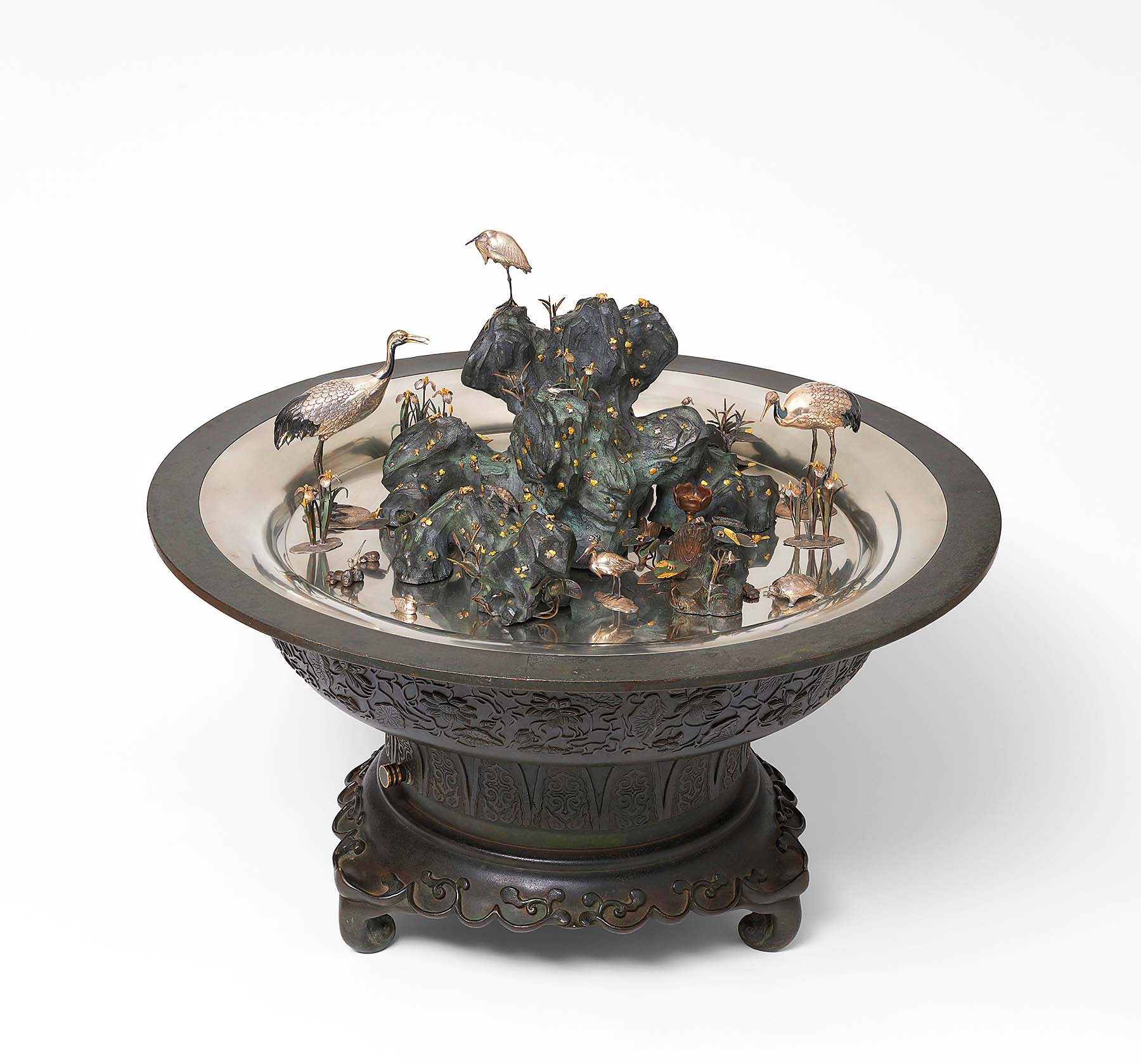
Sake fountain by Okamura Sugaji, circa 1825-50, bronze, tin, gold, silver, shibuichi and shakudō. Private collection. Photo courtesy of Julia Featheringill.
The Dallas Museum of Art’s collection is notably strong in objects from the Meiji period, which dominates the exhibition’s final section. External threats and internal unrest led to the Meiji Restoration in 1868, restoring power to the emperor and ending centuries of shogunate rule. This event marked Japan’s rapid modernization from a feudal, isolationist society to an industrialized nation modeled after Western powers. The warrior class was dissolved and the 1876 Haitōrei decree banned samurai from wearing swords in public, depriving artisans of a key market. Many adapted by creating intricate export art that blended traditional techniques with new styles.
Government initiatives during this era such as the founding of the Tokyo School of Fine Arts in 1889 and the Imperial Court Artist System in 1890 helped preserve and promote excellence in traditional metalworking and art forms. Japanese participation in international exhibitions, notably the 1873 Vienna World’s Fair, elevated its artistry’s global reputation. An incense burner shaped like a falcon perched on an anchor by Sano Takachika that once belonged to the emperor himself is shown, as well as a selection of works by artist craftsmen of the imperial household appointed as Teishitsu-gigeiin, the highest official title given in recognition of exceptional mastery.
“There were several rewarding discoveries during the planning process,” said Chao. “Through close research, I was able to reattribute and identify artists for some of our pieces that had not been firmly attributed… In addition, collaboration with conservators provided invaluable opportunities to examine the works in detail,” she added, noting this often revealed new insights into both technique and intended viewing experience. While preparing a large, ornate incense burner created by a group of artists led by Suzuki Gensuke, the curatorial team discovered small, previously unnoticed holes in the lid. This suggests that when in use, incense smoke rose through the lid and the sculpted mountain form to create a swirling, atmospheric effect around the central phoenix. “It’s a subtle but remarkable feature that speaks to the artists’ attention to multisensory experience,” Chao continued. “Moments like these not only enriched the exhibition planning process but also underscore how much more there still is to learn about these works.”
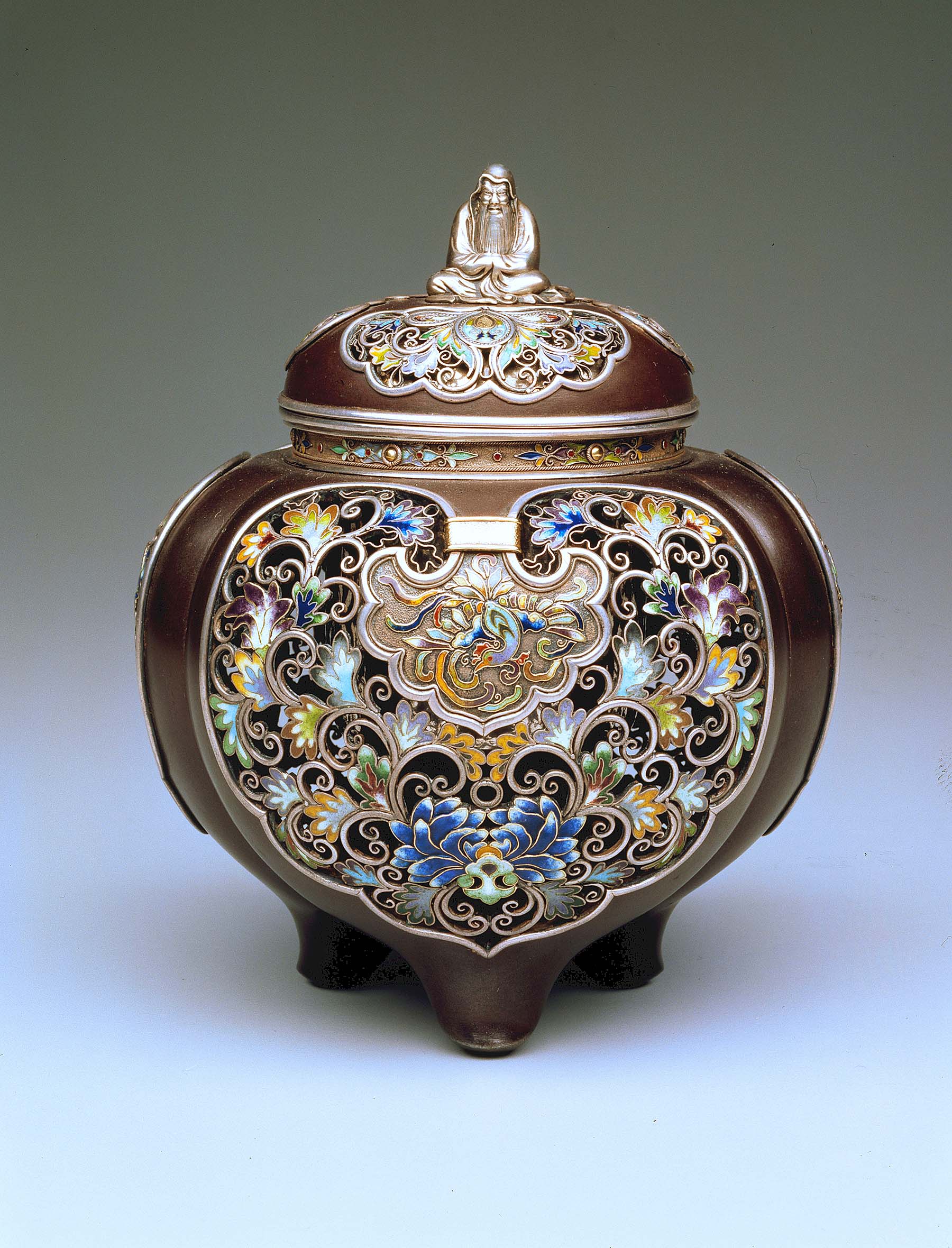
Incense burner (kōro) by Hiratsuka Mohei, circa 1890, iron, silver, gold and enamel. Dallas Museum of Art, Foundation for the Arts Collection, The John R. Young Collection, gift of M. Frances and John R. Young, 1993.86.9.A-B.FA.
This section also includes brilliantly colored Japanese cloisonné enameling from each of the five artist companies that executed imperial commissions during the Meiji period when its production flourished. Originated in China, cloisonné uses fine wires of silver, brass or gold to outline designs on a metal base, usually copper. These are fused to the surface and then enamel or colored glass paste is applied inside the wire shapes. The object is then kiln-fired and polished and both processes are repeated many times to create a perfectly smooth finish. The Japanese term for enamels, shippo, refers to the “Seven Treasures” mentioned in Buddhist texts — gold, silver, emerald, coral, agate, lapis lazuli and pearl — and their gem-like colors. New cloisonné techniques were developed, manipulating wires and enamel layers to achieve different textures and finishes.
“Samurai to the Imperial Court” culminates with the magnificent bronze-cast sculpture titled “Dragon King Presenting a Jewel to Fujiwara no Hidesato.” It depicts the legendary Tenth Century warrior and patriarch of a powerful samurai lineage being thanked by the Dragon King of the Sea after Hidesato vanquished a giant centipede that was terrorizing his palace. He was given many gifts for this brave deed such as an inexhaustible bag of rice, an unending supply of the gold and copper alloy shakudō, a large bronze bell and finally, the Dragon King’s tide-controlling jewel, represented in the sculpture by a crystal ball. The sculpture was first exhibited in the Second Domestic Industrial Exposition in 1881, and today it is recognized as the most significant Meiji period bronze sculpture in North America.
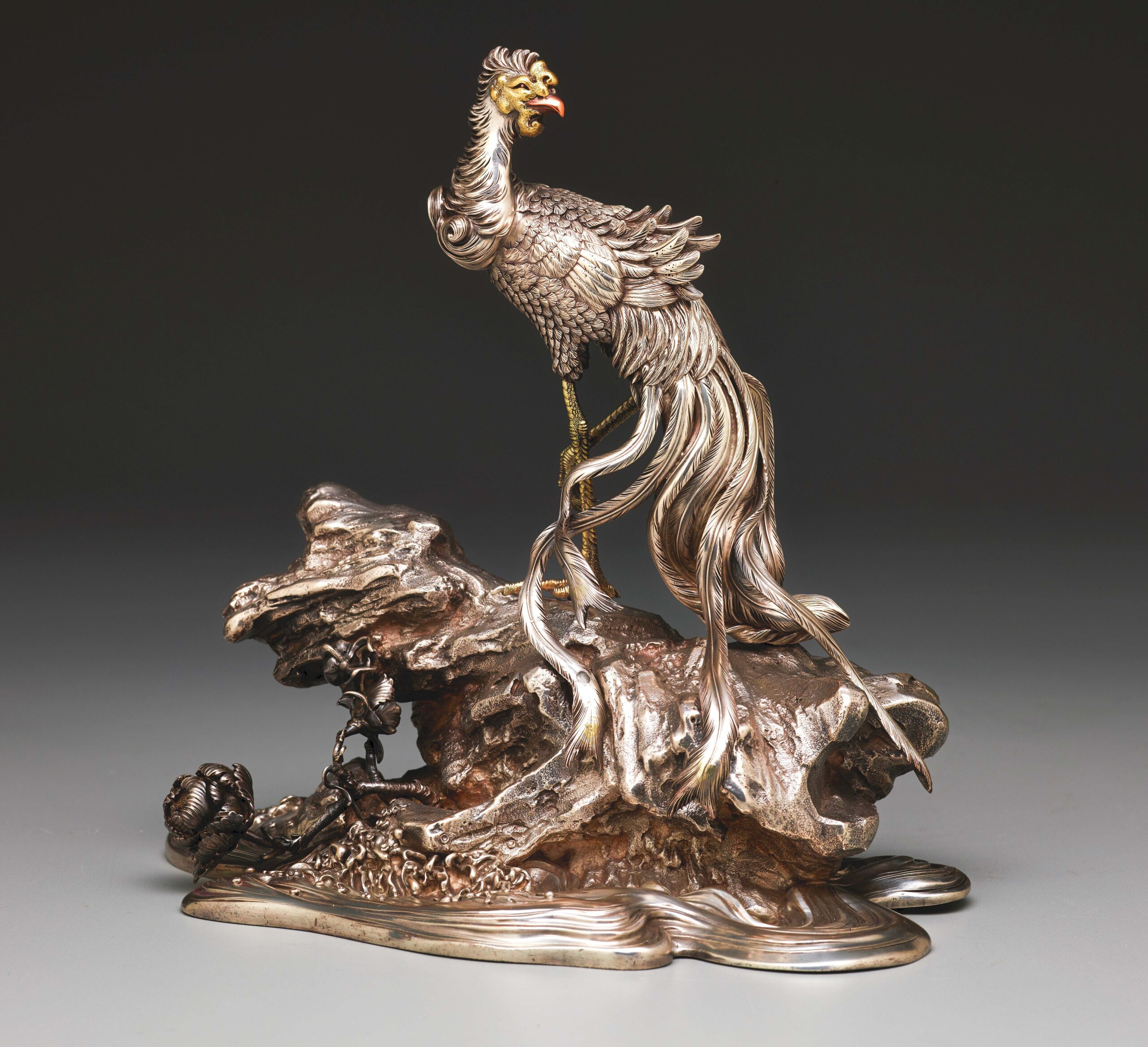
Phoenix by Hirayama Kantei, circa 1900, silver, gold, copper and shakudō. Dallas Museum of Art, Foundation for the Arts Collection, The John R. Young Collection, gift of M. Frances and John R. Young, 1993.86.13.FA.
“What makes this work especially remarkable is the extraordinary level of collaboration behind it,” Chao said. “It brought together several of the most accomplished artists of the period: the celebrated painter Kawanabe Kyōsai, who created the original design; the master woodcarver Takamura Kōun, who produced the model; and the distinguished bronze caster Ōshima Joun, whose company [Sanseisha] cast the final sculpture. It’s also an incredibly ambitious work [that required] two years of intensive labor and exemplifies the technical virtuosity and artistic inventiveness of Meiji period metalwork at its highest level.”
Chao’s hope is that visitors come away from the exhibition with a deeper appreciation not only for Japanese metalworking as an artistic and cultural practice but for the extraordinary artisans behind these works. “Ultimately, I invite visitors to slow down and really look, to marvel at the precision and innovation, to delight in the intricate designs and to experience the artistry on both an intellectual and sensory level,” she concluded. “If they leave with a deeper appreciation for Japanese art and culture, and perhaps even on craftsmanship more broadly, then I think the exhibition has succeeded.”
The Dallas Museum of Art is at 1717 North Harwood Street. For information, www.dma.org or 214-922-1200.